Order Management System Ecommerce: How to Assess Fit
The most repeated advice about choosing an order management system is to count integrations. Shortlist the platforms with the most connectors, the reasoning goes, and order data will find its way everywhere it needs to go. That advice produces the failure it promises to prevent: a console that shows order status while the record behind it is wrong, and nobody able to say which system owns the truth.
Most order management system ecommerce advice treats the job as routing. Orders arrive, orders get pushed to a warehouse, a tracking number comes back. That's the visible third of the work. The other two thirds are coordination after the sale: capturing payment against a shipment that may never leave, holding and releasing stock, and deciding what a returned item tells you about the product page that sold it.
The better test is narrower and harder. Judge an order management system by the transaction record it keeps and the diagnostic data it retains. Everything else, the dashboards, the connector counts, the feature grids, is downstream of those two things.
Table of Contents
- The Order Lifecycle an OMS Must Cover
- Deciding Whether Your Business Needs a Dedicated OMS
- Inventory Accuracy Benchmarks Your OMS Must Hit
- Integrations an OMS Needs and Where They Break
- Run the Return Loop Without Losing the Data
- Scorecard for Judging OMS Fit
- Migrating Orders Without Losing History
- Governing Automation Inside Your OMS
- Take Your OMS Shortlist to a WebinOne Conversation
The Order Lifecycle an OMS Must Cover
An order moves through more states than a storefront shows. Placed, shipped and delivered are the customer-facing labels; behind them sit authorization, reservation, allocation, capture and disposition, and each transition is a place where the record can go wrong. The order management layer sits between the storefront, the warehouse, the payment provider and the carriers, and its job is to keep one order record true from the moment a basket is submitted to the moment a returned item is graded and put back on the shelf.
On WebinOne, the commerce core of that record lives on one platform: catalog, orders and payments run in the same system as the CMS and CRM, with no plugins required. Whatever platform you run, judge it against the full stage list below. A vendor that covers only the first three rows is selling you a checkout with better reporting.
| Stage | What the System Controls | What Breaks Without It |
|---|---|---|
| Order capture | Validates items, prices, customer and payment intent across every storefront | Duplicate or mispriced orders |
| Payment authorization and capture | Authorizes, captures and splits payment against each order | Charged orders that never ship and reconciliation gaps |
| Inventory reservation | Reserves stock against available-to-promise quantity before the order is accepted | Overselling and cancellations |
| Routing and allocation | Assigns the fulfillment node by stock, distance and carrier cutoff | Split shipments and late delivery |
| Shipment and tracking | Creates shipments, labels and tracking events | Customers chasing order status |
| Changes and cancellations | Edits or cancels before picking and reverses reservations | Stock held for orders that no longer exist |
| Returns and refunds | Authorizes returns, records the reason, triggers refund or exchange | Refunds issued outside the order record |
| Restock and disposition | Routes returned items to resale, repair or write-off and updates stock | Phantom inventory |
Where Post-Sale Failures Start
For all the attention checkout gets, the problems that reach a support queue cluster after the sale. Three failures cover most of what teams bring to a rebuild.
- A payment captured for an order that never ships. The gateway says paid, the warehouse says nothing, and the order parks in a state no one owns.
- Stock held for a cancelled order. The cancellation lands in the storefront, the reservation never reverses, and the unit stays locked until someone counts the shelf.
- A refund issued outside the order record. Money leaves through the payment provider and the order ledger never learns about it, so margin reporting drifts a little further every quarter.
Each one is a stage failure, and each one names its owner. The first belongs to whoever owns the payment-to-fulfillment state transition. The second belongs to the reservation layer. The third belongs to the accounting integration. When a vendor demos any of these stages, ask to see the state field that changes and the event log that records it. A system that shows you the outcome without the history is storing results, not evidence.
Practical rule: if you can't name the system that owns each row of that table, you don't have an order management system. You have a storefront with an order list.
The reverse leg alone justifies the discipline. U.S. consumers returned between $113 billion and $132 billion of ecommerce purchases in 2017, and ecommerce return rates ran roughly three times higher than rates for traditional physical retail, according to a U.S. Postal Service Office of Inspector General analysis. The years have moved on, the shape hasn't. The reason code captured at return authorization is the part worth protecting: lose it and the product page keeps selling the item that keeps coming back.
Run a test this week. Pull the last ten problem orders, write down the stage where each one failed, and rank the stages by failure count. Do that before you compare a single vendor, because it tells you which three demo questions matter most. When you map the handoffs between those stages, these deterministic O2C architecture patterns from Loopfour are a useful reference for assigning an owner to each transition.
Deciding Whether Your Business Needs a Dedicated OMS
A dedicated order management layer pays off when orders span several nodes, channels or marketplaces, and no checkout add-on can keep one order record accurate across them. WebinOne is built for that shape of business, with the catalog, the customer record and the order sitting on one platform instead of three exports stitched together each morning.
Four triggers tell you which side of the line you're on. More than one warehouse or store selling the same stock. Marketplace orders arriving alongside web orders with different service levels. Returns that need a reason attached to a specific product. Order volume high enough that manual reconciliation has become a standing weekly task.
The test takes ten minutes. Count how many systems hold a copy of an order today, then count how many people reconcile those copies each week. If the answer is more than one system and more than zero people, the manual work is a line item you're already paying for. When order state has to fan out to several services, the consistency model matters more than the feature list, and microservices architecture for ecommerce covers where eventual consistency is safe and where it isn't.
Fit is also a cost question, and the monthly fee is the worst number to compare. Ask for total cost per order: payment processing, platform transaction fees, integration build, and the reconciliation hours the system removes. On a WebinOne ecommerce build there are zero transaction fees and plans start at $10 per month per site, so the comparison that matters is cost per order against the cost of the manual work it replaces.
A single-location store with one stock pool, one carrier and low return volume may need less than a full layer, and buying one anyway just moves the work into configuration. Name the trigger you have before you read the scorecard.
Inventory Accuracy Benchmarks Your OMS Must Hit
A warehouse can count every unit perfectly and the storefront can still oversell. The number a shopper buys against is the one stored in the order system, and it fails in two distinct ways: it can count wrong, or it can count right and arrive late. Set a floor for each before you talk to a vendor.
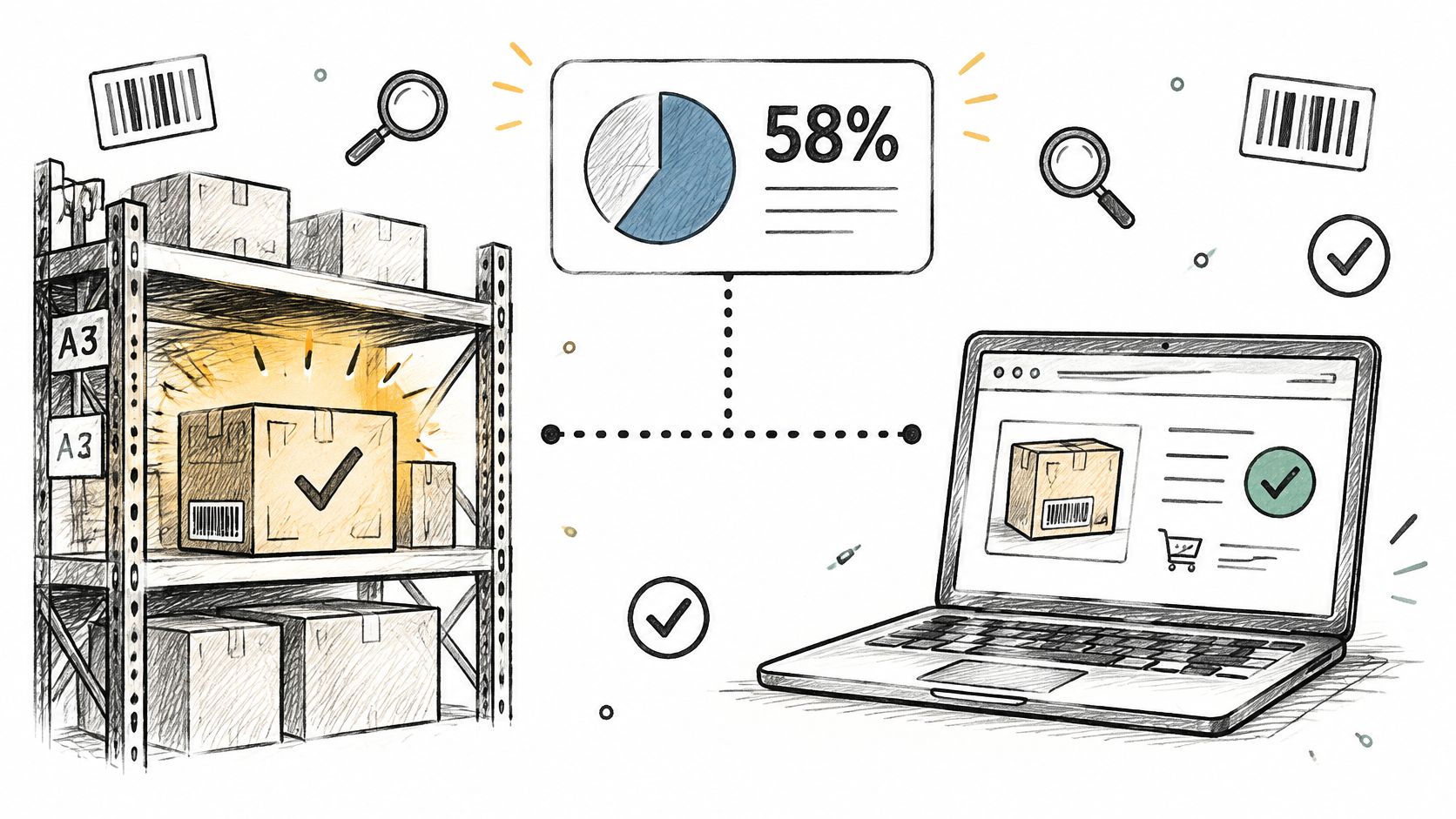
For accuracy, hold the line at 95% sellable accuracy or better, measured per channel and per node. Every point below that floor gets paid out in cancellations, substitutions and refunds. For freshness, demand inventory pushes in single-digit minutes: five minutes or less between syncs as the target, thirty minutes as the hard ceiling. A count older than an hour on a live product page is decoration, and it produces cancelled orders. For cancellations themselves, keep accepted-then-cancelled orders under one percent of volume. Above that, the storefront is selling stock it does not have, and no picking process repairs the defect upstream.
Turn Each Benchmark Into a Question
- Accuracy: what exactly is being measured, on-hand versus sellable, and who owns the number when a channel disputes it?
- Freshness: how old is the count a shopper sees when they load a product page right now?
- Cancellations: how many orders do you accept and then cancel before they ship?
The mechanics behind those numbers are unglamorous. Stock has to sync across ERP, point-of-sale, warehouse, store and storefront channels, and the system has to reserve or promise stock before it accepts an order. When catalog, orders and storefront run on a single platform, as they do on WebinOne, one sync hop disappears because the page reads the same system that takes the order. A storefront that sells inventory already allocated elsewhere produces cancellations, refunds and support tickets that all trace back to one stale field. Events also have to be replay-safe: a duplicate or delayed webhook creates phantom stock that looks real to every channel reading it.
The money argument is broader than a fulfillment metric. Overselling is the visible failure; the quieter cost is the buffer stock teams buy to compensate for counts they do not trust, plus the support hours spent explaining cancellations to customers who already paid. An OMS worth buying exposes its own diagnostics: accuracy per node, sync lag per channel, and a cancellation reason attached to every killed order. If the system cannot report its own lag, it cannot show you the failure before your customers do.
Track four measures this month, each broken out by channel and fulfillment node: inventory accuracy, oversell rate, cancellation rate and promise-failure rate. A blended number hides the node that is failing.
Integrations an OMS Needs and Where They Break
Eight connections surround nearly every ecommerce order flow, and each one either keeps the order record intact or splits it into two versions that disagree. The map below is the same one you'll draw for almost any stack.
| Integration | Data Exchanged | Direction | Failure to Plan For |
|---|---|---|---|
| ERP and accounting | Orders, invoices, tax and cost of goods | Two-way | Ledger mismatch after refunds |
| Payment gateway | Authorizations, captures, refunds and chargebacks | Two-way | Money captured for cancelled orders |
| Warehouse or WMS | Picks, packs, stock counts and receipts | Two-way | Stock drift between systems |
| Point-of-sale and stores | Store stock, store orders and pickup status | Two-way | Web and store selling the same unit |
| Carriers | Labels, rates and tracking events | Two-way | Missed cutoffs and untracked parcels |
| Marketplaces | Orders, listings and stock levels | Two-way | Duplicate orders and overselling |
| CRM and customer records | Order history, contacts and return history | Two-way | Support agents without order context |
| Tax engine | Rates by jurisdiction for each order | Outbound | Wrong tax on exchanges and partial refunds |
Three Patterns and the Questions They Force
Every connection on that map runs one of three patterns. Synchronous API calls handle order and payment actions that need an answer in the moment, like an authorization before checkout completes. Webhooks carry status events as they happen, and they'll occasionally arrive twice, late or out of sequence. Scheduled batch jobs exist for reconciliation, because some data only becomes trustworthy an hour later. Judge each pattern by the diagnostic data it preserves: a synchronous call that fails leaves a gap with no event to replay, while a dropped webhook leaves a record that looks complete but isn't.
Three questions decide whether each connection holds. Which system is the source of truth for stock, for price and for order status, answered per data type and written down. What happens when a carrier API times out after a label has already printed, and does the retry print a second label? When a marketplace order arrives twice, do you create one shipment or two? Ask these before signing, because the vendor's answer to the second and third tells you how the integration behaves on its worst day.
WebinOne consolidates CMS, ecommerce, CRM, forms and hosting into a single platform with no plugins required, and its 300+ APIs and webhooks connect the order record to storefronts, CRM and payment providers without rebuilding it in each one. Our ecommerce integration services work covers how those connections get built, retried and monitored.
Marketplace and carrier connections need their own reconciliation schedule, since their events arrive late and out of order. For the freight side of that problem, Peak Transport's writeup on closing visibility gaps in regional freight explains why a shipment's status lags the order status it belongs to.
Draw the integration map on one page, mark the source of truth for each data type, and circle every arrow with no retry and no alert. That circle is your next three months of support tickets.
Run the Return Loop Without Losing the Data
Returns are diagnostic data, and teams that process them as isolated refunds throw the diagnosis away. A return record carrying a structured reason code tells you which product, which supplier and which product page needs fixing. One carrying free text tells you very little. Judge an order management system by what it keeps here, because the return loop is where order data either becomes intelligence or evaporates.

The diagnostic view has backing. An eBook on turning ecommerce returns into revenue recommends integrating return data with customer, product and operational data so merchants can find root causes instead of treating each return as a standalone transaction. The same eBook reports that 51% of surveyed online shoppers named order status or delivery tracking as a high-priority account feature, a reminder that the post-purchase experience is part of the product.
Per-shopper behaviour is modest, which is why the aggregate surprises operators. In a June 2019 survey of 1,188 online shoppers cited in this Digital Commerce 360 and Bizrate Insights returns report, 79% of consumers said they had returned 5% or less of the products they ordered online. Small individual habits multiplied across high order volume become a real workload.
A jacket returned forty times in one month for running small is a size chart problem. Without the reason code, the operations team sees forty returns and hires packing staff.
The Return Loop in Six Steps
- Authorize against the original order. Check the return window and eligibility rules on the order record, not on a spreadsheet somebody maintains on Fridays.
- Capture a structured reason at the moment of request. Free text is a comment. A dropdown with eight codes is data you can aggregate.
- Decide refund, exchange or credit by policy. Make it a rule rather than an agent's judgement on the day, so outcomes stay consistent across channels.
- Route the item for inspection, resale or write-off. Decide before the parcel arrives, so receiving has a destination and a queue.
- Update available-to-promise once the item is graded. Restock only what passed inspection, or the same damaged unit sells twice.
- Send the reason and outcome to product content and merchandising. Teams skip this step more than any other, and it is the only one that cuts future returns.
This loop assumes the order record, the customer record and the product record sit within reach of each other. WebinOne runs catalog, orders and payments alongside a built-in CRM on a single platform, so a coded return has a customer and a product to attach to. On a split stack, the reason code dies in the gap between the storefront and the order system.
Fast, transparent returns can hold a customer who would otherwise leave. The real cost sits in the returns that carry no reason at all.
Define your reason codes before launch: wrong size, not as described, damaged on arrival, arrived late, changed mind, wrong item sent, quality below expectation, better price found. Add a free-text field and a photo upload for damage claims, and make a code mandatory on every request.
Scorecard for Judging OMS Fit
A scorecard earns its keep when it makes a vendor answer in writing before anyone books a demo. Treat the OMS as the layer that coordinates transactions and preserves returns intelligence; if a criterion produces only a confident verbal answer, mark it as a fail.
| Criterion | Question to Ask the Vendor | Pass Signal |
|---|---|---|
| Inventory freshness | How often does stock sync per node, and what happens when a sync fails? | Sync interval stated in minutes, with a failure alert and retry state |
| Promise and allocation | Does the promise check live stock, carrier cutoff and transfer rules before showing a date? | Promise computed from node-level available-to-promise |
| Idempotency and replay | Are order and inventory events safe to replay after a timeout or duplicate webhook? | Duplicate events create no duplicate stock change |
| Returns data | Can return reason codes flow into product and customer records? | Reason codes exportable by SKU and reusable in reporting |
| Peak throughput | Has throughput been tested under high load? | Benchmarks for p95 and p99 order latency, not averages |
| Availability and recovery | What uptime is committed in writing? | Published SLA with a stated percentage |
| Audit and rollback | Can every automated change be logged and reversed? | Activity logs and one-click rollback |
| Hosting and data residency | Where do order and customer records live? | Named regions and a documented dedicated-hosting option |
| Migration path | What validation and rollback exist for cutover? | Written cutover plan with delta sync |
What the Throughput Numbers Do and Don't Say
Distributed architecture is worth the complexity when volume and geography create contention. A 2025 study comparing a distributed order management framework against a traditional centralized design reported 2.5 times higher throughput under high-load conditions, a 30% reduction in order-fulfillment time and 15% faster handling of expedited orders, published in the IJISAE distributed order management study. The gains come from distributing allocation, inventory evaluation and fulfillment coordination across nodes.
Read the caveat in the same breath. Those results depend on order volume, geographic spread and fulfillment complexity, and a single-warehouse operation may never hit the bottleneck that makes them matter. Strong consistency is generally required for payment capture and inventory reservation, while event-driven eventual consistency is acceptable for notifications, analytics and customer status updates.
Promise logic is where the honest numbers show up. A promise date only improves when live inventory, carrier cutoff and transfer rules feed the same decision; with stale inputs, a faster OMS makes wrong promises faster. Demand p95 and p99 latency figures rather than averages, because averages hide the tail where customers abandon.
The infrastructure answers you can verify: WebinOne publishes a 99.95% availability commitment in its SLA and has run at 99.99% uptime over the last 12 months, hosted on AWS across six AWS regions, as an AWS Partner that has passed the AWS Foundational Technical Review.
Any vendor that cannot produce these artifacts is asking you to fund the discovery phase after go-live.
Migrating Orders Without Losing History
Migration failures rarely announce themselves as missing orders. The damage hides in orders that kept their totals but lost the diagnostic layer: refund reasons, status-change timestamps, fulfillment references, the history that tells you why an order went wrong. Totals are easy to move. Meaning is not.
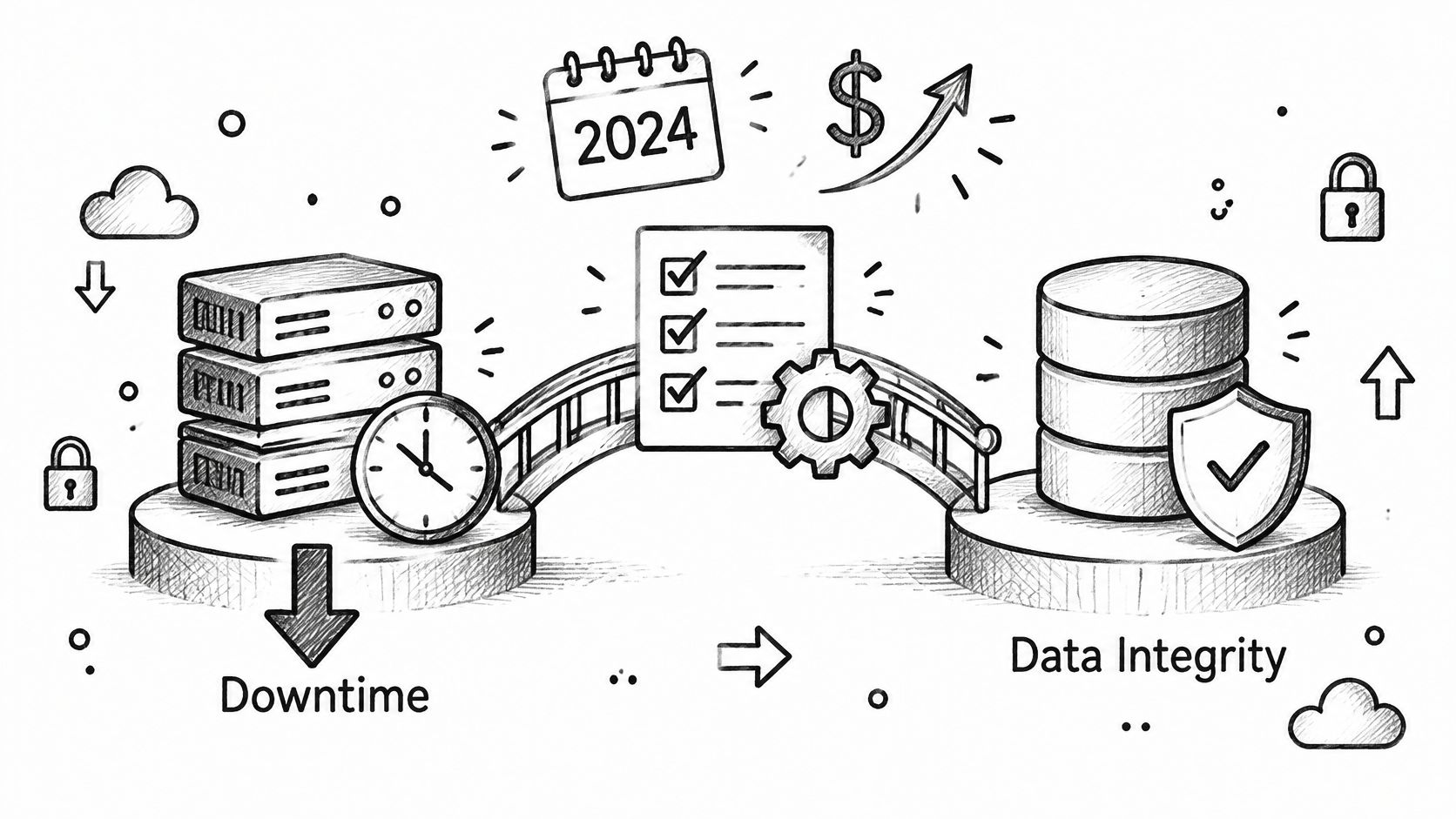
Cutover planning earns its own budget because downtime is priced by the hour. ITIC's 2024 Hourly Cost of Downtime Survey reports that the large majority of midsize and large enterprises face hourly downtime costs in the hundreds of thousands of dollars, with a substantial share reporting losses in the millions. A cutover that slips a few hours can cost more than the migration itself.
The Migration Sequence
| Step | What it proves |
|---|---|
| Map the data before moving it | Every order state, payment and refund record, customer identity, fulfillment reference and tax field has a destination field |
| Reconcile a sample by hand | Fifty orders across states and totals reconcile on paper before the job runs at volume |
| Migrate history in batches | A failed batch stays small, and you can stop without losing the day |
| Validate counts and totals per batch | Line-item sums and refund totals match, not just order counts |
| Run the full order flow in staging | Place, capture, fulfil, cancel, return and refund all work against migrated data |
| Apply a controlled delta sync | Anything created during testing lands before cutover instead of disappearing |
| Cut over with the rollback path open | A named person can call a rollback inside a fixed window |
The risk concentrates in stacks where order data is spread across plugins, custom tables, warehouses and payment systems. Every one of them is a place a refund can hide from the reconciliation, and every join is a join the mapping can miss. WebinOne consolidates CMS, ecommerce, CRM, forms and hosting into a single platform with no plugins required, which shrinks that surface, and its Ecommerce Site migration package covering products and payments is priced at $3,000. If you're planning the move, our guidance on ecommerce platform migration services sets out how the staging and validation work is run.
Governing Automation Inside Your OMS
Adding AI to an order management system is easy. Governing it across inventory, refunds and customer messages is the hard part, and the gap between the two shows up in the data. Research in Adobe's retail AI and digital trends report found that 45% of retailers were already using generative AI for customer-experience management, while 85% of large-retail executives had developed AI capabilities and 60% were expanding them. The same analysis notes that only 31% of chains operate real-time customer-data platforms, leaving inventory, pricing, promotions and customer context disconnected. Automation inherits whatever those disconnected records get wrong.
The control mechanism is a permission map, and it gets written before any workflow switches on. Every automated action falls into one of three tiers.
| Tier | What it covers | Production effect |
|---|---|---|
| Suggest only | Content or routing recommendations an operator reviews | None until a person accepts |
| Approval required | Refunds, stock reallocation, customer eligibility decisions | Each action waits for a named sign-off |
| Logged and reversible | Everything else that can run unattended | Recorded in full and undoable |
Four questions decide where each action lands: which decisions may act without approval, how inventory, refunds, substitutions, fraud checks and customer messages are constrained, who approves exceptions, and whether every change can be audited and reversed. That last question is where the platform underneath matters. WebinOne runs automated actions inside logged, reversible bounds, so a tier is an enforceable boundary rather than a policy document.
Automation acting on stale inventory and stale customer context repeats the underlying problem at machine speed.
Write the permission map first. One column for the action, one for the tier, one for who approves it, and keep it somewhere the auditor can find it.
Take Your OMS Shortlist to a WebinOne Conversation
A shortlist call that opens with a feature deck ends as a feature checklist, and checklists never reveal whether a platform keeps the diagnostic data your order flow runs on. Open with evidence instead. Four artifacts turn the conversation into a test:
- The ten problem orders, with the lifecycle stage where each one failed. Ask the vendor to trace one through their system: which status it carried, which component owned it at each handoff, and what record survives.
- The source-of-truth decision for stock, price and order status, written per data type. "It depends" without a written rule is still an answer.
- The return reason codes you've defined, plus where each one routes. Codes stored as free text can't be reported on, and the returns diagnosis is gone.
- The permission map for automation, tier by tier. A platform that can't enforce your tiers can't host the automation safely.
For systems integrators, AWS partners and enterprise teams, put deployment on the same agenda. WebinOne is an AWS Partner that has passed the AWS Foundational Technical Review and holds the AWS Qualified Software designation; qualifying integrators can run a licensed version in their own or their client's AWS account, including AWS GovCloud for government projects, with dedicated server options and selectable data residency. The platform consolidates CMS, ecommerce, CRM, forms and hosting into one system with no plugins required, and ecommerce plans carry zero transaction fees at any catalog size or sales volume.
Score the call on the worst order you brought. The platform that traces it cleanly and keeps your reason codes queryable is the one that stays on the list.