Microservices Architecture for Ecommerce: Where to Split It

Splitting every ecommerce capability into a service isn't a scaling strategy. It can turn a manageable store into a network of dependencies that still have to deploy together, now with more places to fail. The service boundary, not the service count, decides whether microservices help.
For agencies moving into larger commerce projects and systems integrators replacing maintenance-heavy platforms, the useful question isn't how much code can be separated. It's which capability needs independent deployment, scaling and ownership badly enough to justify the operating cost.
Table of Contents
- Deciding Between Microservices and a Modular Monolith
- Which Ecommerce Capabilities Deserve Their Own Service
- Performance Gains Appear Only Under Concurrent Load
- Keeping Orders, Stock and Customer Records Consistent
- Gateways, Service Discovery and Service-to-Service Security
- Operational Work and Ownership to Plan For
- Plan Your Service Boundaries with the WebinOne Team
Deciding Between Microservices and a Modular Monolith
WebinOne's recommendation is a modular monolith by default until traffic, ownership or release pace justifies separate deployments. More services don't automatically mean more scale, especially when those services still share records and release dependencies.
A systematic review of scalability approaches identifies orchestration and monitoring complexity as service counts grow and notes limited comparative evidence across architectural patterns. The defensible decision therefore rests on the store's own constraints, not a general promise of scalability.
Microservices or modular monolith by decision criterion
| Criterion | Points toward microservices | Points toward a modular monolith |
|---|---|---|
| Traffic variability | One capability takes far more load than the rest, such as checkout during flash sales | Load is steady and similar across domains |
| Team autonomy | Three or more teams own domains and ship on separate schedules | One or two teams share the codebase |
| Release frequency | Parts of the store deploy several times a week without coordination | Releases are coordinated and happen on a fixed cycle |
| Failure isolation | A payment or search outage must not stop browsing | A shared outage is acceptable for the business |
| Operational maturity | Tracing, per-service deploys and on-call rotations already exist | Observability and automated deploys are still being built |
| Data ownership | Each domain has a clear source of truth with few cross-domain writes | Several capabilities write to the same records constantly |
The team and release examples are planning heuristics, not architectural thresholds. A large delivery organization can still need a shared deployable, while a small specialist team can justify an isolated integration.
Make every proposed split earn its cost
Account for the proposed boundary explicitly. List the network calls added to each customer request, the dependencies that need cross-service tracing, the releases that require coordination and the incident handoffs that cross ownership boundaries.
Don't accept a smaller codebase as sufficient justification. If pricing and cart must change together for every promotion, separating their runtimes may add coordination without creating meaningful independence.
A strangler migration offers a safer route. Keep catalog, content and checkout inside a clearly modular deployable initially, then extract the capability that demonstrably struggles, perhaps search or checkout. Route its traffic through a stable interface, compare the result against the baseline and retain a rollback path before considering another extraction.
Boundary test: Name the owning team, its on-call rotation and the dashboard that will judge the new service. If any is missing, the boundary is premature.
Agencies and integrators seeking a second opinion can bring a proposed boundary map to the WebinOne enterprise team before implementation. The objective is the smallest useful boundary, with shared governance, observability standards and explicit API ownership, not centrally coordinated releases disguised as independent services.
Which Ecommerce Capabilities Deserve Their Own Service
A marketplace selling the same stock through three channels faces a different boundary question than a single storefront with one warehouse. The first needs an inventory authority that no channel can bypass. The second gains nothing from isolating it. Whether a capability deserves its own service depends on its load pattern, change rate and ownership, which is why the split map below does the important work.
The term microservices was selected in 2012, and Martin Fowler and James Lewis published their defining description in 2014: independently deployable services organized around business capabilities.
Ecommerce capability split verdicts
| Capability | Split out when | Keep together when |
|---|---|---|
| Product catalog | Many channels or markets read it at high volume and it changes apart from pricing | Catalog is small and edited by the same team as the storefront |
| Search | Query load and index rebuilds need their own scaling | Traffic is low and one search service covers the store |
| Pricing and promotions | Rules change weekly and several channels must share one price engine | One storefront with a fixed price list |
| Cart | Campaign spikes and abandoned-cart volume justify isolation | Cart is tied to the checkout UI and one team owns both |
| Checkout and payments | Provider integrations change often and need separate compliance scope | One payment provider and simple tax rules |
| Inventory | Several warehouses or marketplaces sell the same stock | One warehouse and one sales channel |
| Orders and fulfillment | Multiple fulfillment partners or a returns workflow | Orders stay with checkout until shipment |
| Customer accounts and CRM | Shared identity across brands or sites | One brand and one store |
| Content and marketing | Several brands or sites publish on their own schedules | One site with one editorial team |
Separate business authority from read-heavy projections
Catalog and search sit at different boundaries. The catalog owns product information; search owns a query-optimized projection built from it. Extracting search relieves query pressure without forcing product editing into a separate system, which is why search is often the first boundary a growing store needs.
Pricing earns independence when multiple channels need the same authoritative calculation. A weekly promotion schedule alone rarely justifies a split. The stronger trigger combines independent rule ownership with several consumers that must receive consistent prices: a price engine serving web, app and marketplace channels qualifies, while a single storefront discount code does not.
Cart isolation can protect campaign traffic, but it introduces handoff questions. Decide whether the cart stores a quoted price or merely a product reference, and require checkout to validate the final amount rather than trusting stale browser state.
Keep tightly coordinated decisions close
Checkout and payment orchestration can evolve independently of storefront presentation. That independence applies to provider integrations, where release cycles and compliance scope differ, rather than to every checkout operation. Splitting each step of the purchase workflow into its own service creates round trips the customer cannot afford.
Inventory earns a boundary when channels compete for shared stock. Orders and fulfillment earn theirs when shipment, cancellation and return lifecycles extend beyond checkout ownership. Shared identity across brands can justify an account boundary, and independent publishing schedules can justify separating content delivery. Neither turns every customer field or campaign object into a service.
The pattern across the table is consistent: a boundary earns its place when the capability behind it carries a different scaling profile, release cycle or owning team than its neighbors.
WebinOne keeps CMS, ecommerce, CRM and a headless API in one managed system. A delivery team can hold related capabilities together, expose interfaces to external systems through the API and postpone data-model separation until a trigger in the table becomes real.
Performance Gains Appear Only Under Concurrent Load
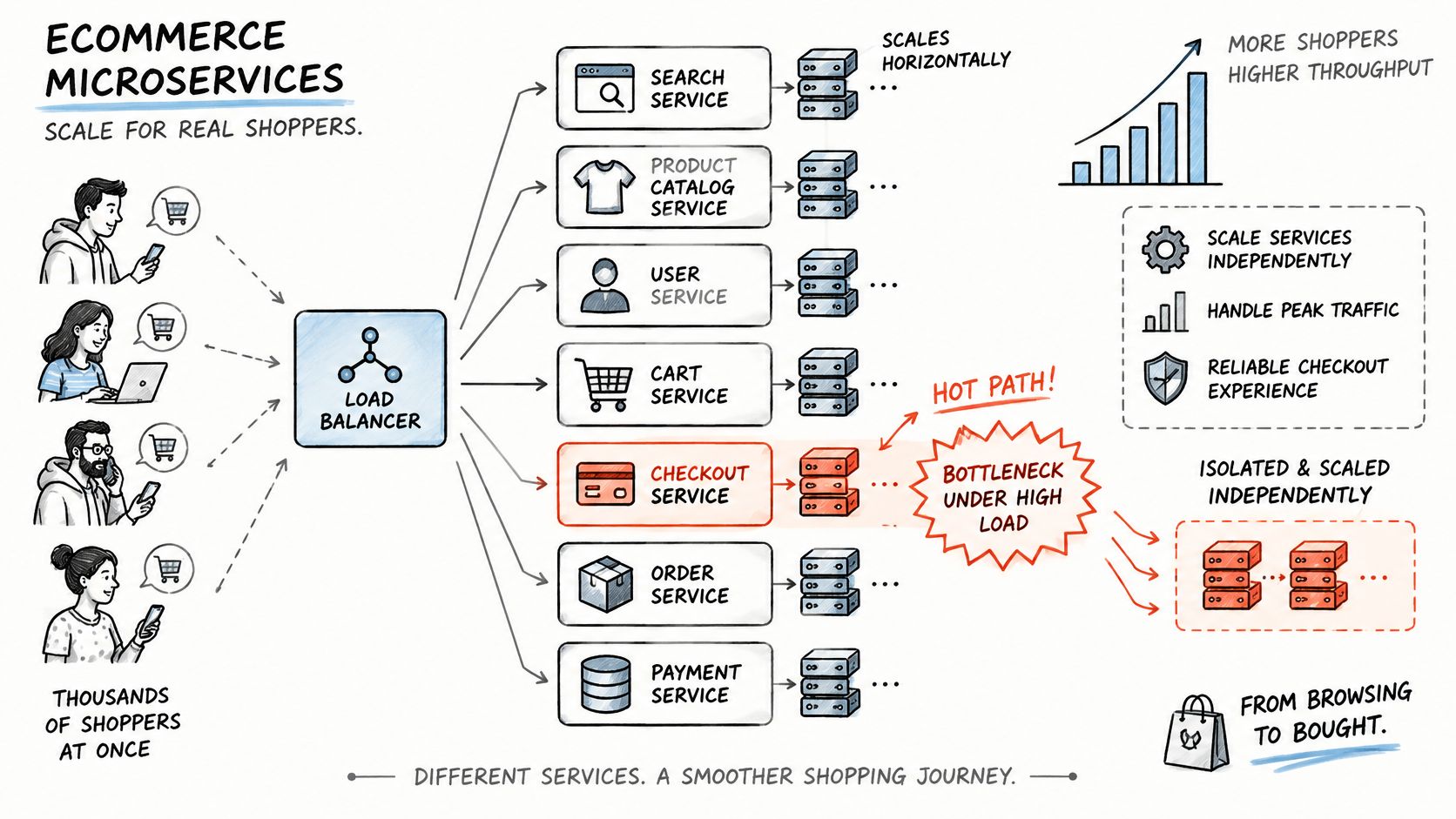
At 50 virtual users, the two architectures performed about the same. At 100 virtual users, they diverged: an empirical comparison of equivalent ecommerce applications using a shared PostgreSQL database measured 5.4% higher throughput, 25% lower mean latency and 39% lower p95 latency for microservices, with a median error rate of 0.00% versus 0.69% for the monolith. The shared database is a material limitation: the result doesn't establish how independently owned data stores would behave.
A split earns its place when it removes measured contention on a busy request path. Measure first, then draw the boundary where concurrency concentrates.
The following diagram illustrates where independent scaling can target a constrained capability.
Network hops can consume the gain
A study of network overhead in containerized microservices found that inter-service network processing could account for more than 30% of tail latency, even at low load. Treat that figure as a warning about hop count in containerized workloads, and measure your own call chain before assuming it applies to your store.
Consider a product page that synchronously calls catalog, pricing, inventory, promotions, recommendations and reviews. Each dependency introduces serialization, queueing, network and timeout costs; executing the calls sequentially makes the shopper wait through the chain.
Use a precomputed product-view model for browsing. Cache appropriate fields, update search and recommendations through events, and keep authoritative price and availability validation in the purchase workflow. Isolate optional dependencies behind bulkheads so unavailable reviews don't block product details. Deadlines and circuit breakers are service-to-service concerns, handled alongside the gateway and security defaults.
Arch's guide helps teams compare system scaling patterns and trade-offs before choosing whether to add capacity, cache reads or introduce a service boundary.
Test the dependency chain end to end
A credible load-test plan includes:
- Production-like inputs. Match catalog size, cache behavior, payment-provider latency and database topology; an empty test store proves little.
- Tail objectives. Record p95 and p99 latency, timeout rate, retry amplification and recovery time alongside throughput.
- Flash-sale behavior. Exercise bursts, depleted stock, queue buildup and exhausted downstream connections.
- A controlled comparison. Keep infrastructure and workload assumptions comparable so extra capacity isn't mistaken for an architectural gain.
A faster average response isn't a successful migration if slow checkout requests become more frequent.
Keep the split only when it improves the customer-facing objective under representative load without creating an unacceptable recovery burden.
Keeping Orders, Stock and Customer Records Consistent
Payment succeeds, then inventory reservation fails. The customer has a charge, the store has no stock to ship, and someone has to decide what happens next. That partial-failure scenario, not the happy path, is what consistency design in an ecommerce split must solve. Shipment updates arrive after orders close. Account changes reach the identity record but never the CRM. A distributed-ecommerce implementation study identifies authentication and data consistency as significant implementation challenges, so these recovery paths are architectural requirements rather than edge-case cleanup.
The way through is to give every customer-journey step an explicit source of truth, consistency model and compensation rule. A blanket demand for real-time synchronization across services resolves nothing; per-step rules do.
Consistency rules for each customer journey step
| Journey step | Source of truth | Consistency model | Failure handling |
|---|---|---|---|
| Add to cart | Cart service | Session-level, last write wins | Rebuild the cart from the session on retry |
| Stock reservation at checkout | Inventory service | Strong, reserved before payment capture | Release the reservation when it times out |
| Payment authorization | Payment service | Strong, one idempotency key per order | Retry with the same key and never re-charge |
| Order creation | Order service | Strong workflow state | Compensate by voiding payment and releasing stock |
| Shipment update | Fulfillment partner feed | Eventual | Replay late events by order ID |
| Customer profile change | Accounts service | Eventual to CRM and marketing | Reconcile on a schedule and log conflicts |
| Return and refund | Order service | Strong for refund amount | Write a compensating refund record with an audit entry |
Protect the purchase before propagating the event
For cart updates, a retry must restore the intended session state, not add the same quantity again. Last-write-wins behavior should use a defined version or ordering rule so a delayed request doesn't overwrite a newer cart.
For stock reservation, checking availability and reserving stock must be an authoritative inventory operation. A reservation needs an expiry and an identifier that checkout can reference; otherwise abandoned purchases can leave stock unavailable indefinitely.
For payment authorization, a timeout means the result may be unknown, not that authorization failed. Retry with the original idempotency key or query the existing operation before creating another attempt. Deliberate reauthorization needs a separately controlled lifecycle.
For order creation, store durable workflow state before acknowledging success. If inventory fails after authorization, use saga-style compensation: void the authorization, record the reason and release partial reservations. If funds were already captured, recovery requires a refund, not an authorization void.
A distributed two-phase commit held open across inventory and an external payment provider adds blocking without adding safety. The provider commits on its own schedule, so waiting on it locks stock records that other checkouts need. Compensating actions fit these business-state transitions better.
Accept delay where it doesn't compromise the purchase
For shipment updates, preserve event identifiers and ordering information. A late dispatch event shouldn't reopen a delivered or closed order without an explicit transition rule. Supply Automate's guide to software for managing ecommerce orders provides useful context for evaluating the operational workflows around those transitions.
For profile changes, accounts should publish authoritative updates while downstream CRM and marketing consumers apply them asynchronously. Reconciliation should identify rejected updates and conflicting field ownership rather than repeatedly overwriting both systems.
For returns and refunds, validate the refundable balance atomically and record the compensating transaction. Duplicate return notifications must resolve to the existing refund operation.
The handoff rule that follows: strong guarantees stay local to the step that owns the state, and everything downstream subscribes to durable events. Recommendations, analytics and marketing segments tolerate delayed updates comfortably. Defining which systems sit on each side of those handoffs is the work covered by WebinOne's ecommerce integration services.
Idempotent writes, time-limited reservations and reconciliation prevent duplicate charges, overselling and contradictory records. Retain the initiating request, resulting transition, retry history and recovery decision so regulated and government-facing deployments can explain what happened without reconstructing it from scattered logs.
Gateways, Service Discovery and Service-to-Service Security
A payment provider timing out during a sale is the failure that exposes weak gateway design. The shopper sees a stalled checkout, the order service waits on a reservation, and retries can turn one slow dependency into duplicate payment attempts. Discovery, routing, throttling and identity controls decide whether that incident stays contained.
NIST's microservices security guidance identifies authentication and access management, service discovery, secure communication protocols, security monitoring, load balancing, throttling, service-integrity controls and session persistence as core capabilities. Gateways and service meshes give teams a consistent place to apply those controls across customer-facing traffic and internal calls.
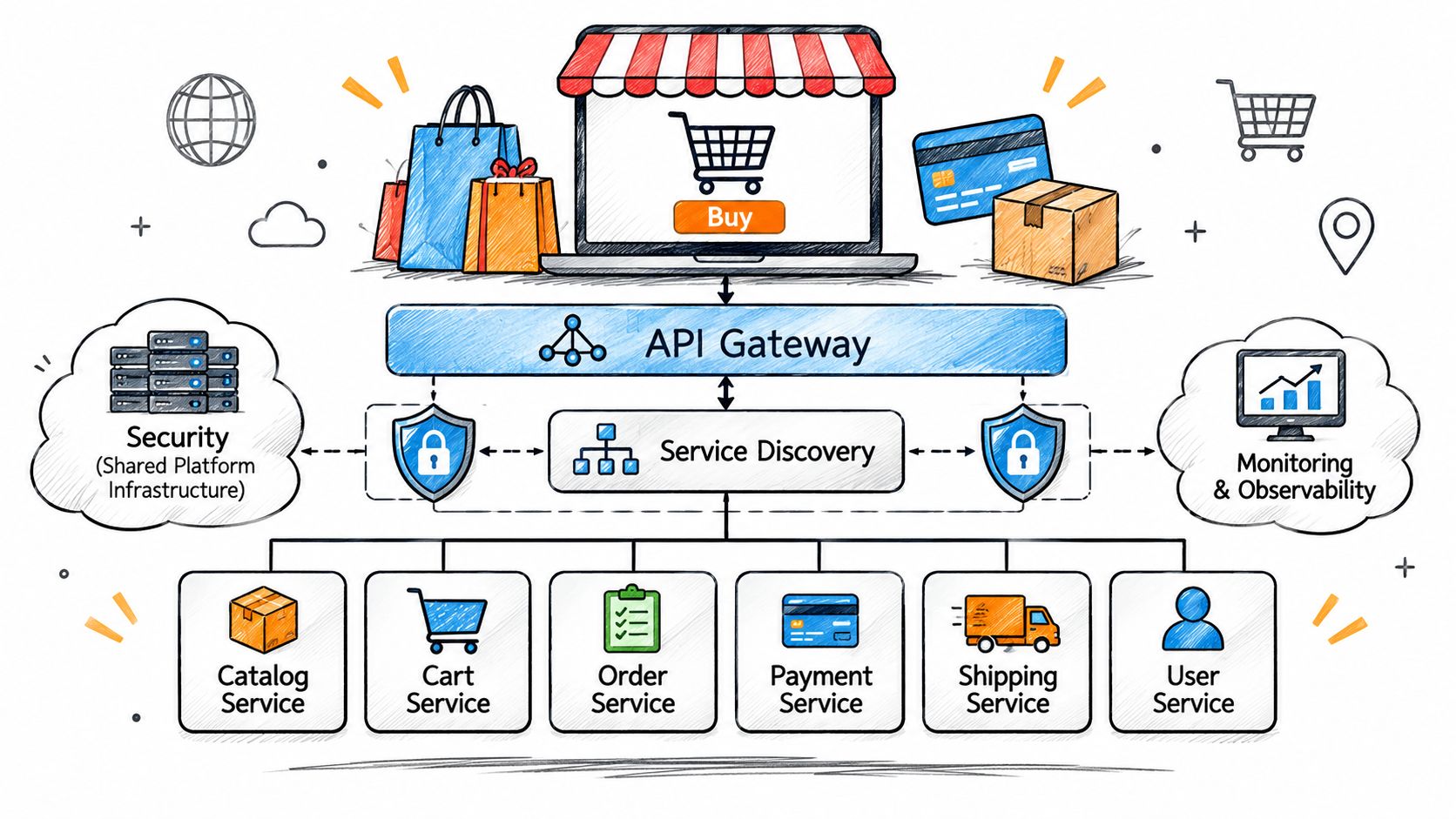
Apply controls to the checkout path
Service discovery lets checkout find healthy payment instances without hard-coded hosts. Load balancing distributes requests, throttling protects inventory from overload during a sale, and health checks keep a failed instance from receiving fresh traffic. A bounded checkout queue is safer than letting every stalled call wait until the shopper refreshes and submits again.
Session persistence keeps the shopper's cart context intact across requests. Prefer explicit session handling and shared durable state where appropriate rather than assuming requests always reach the same process. Service-integrity controls help prevent an untrusted deployment from joining the request path.
API keys alone leave sensitive operations exposed. NIST SP 800-204 calls for digitally signed authentication tokens or tokens verified against an authoritative source for sensitive microservice APIs. Apply that requirement to checkout, accounts, payment orchestration, order administration and inventory.
Internal traffic needs authorization too. A compromised catalog component must not inherit refund privileges because it runs behind the gateway. Use service-specific identities, audience checks, key management, encryption in transit and continuous monitoring.
Establish the gateway contract before deployment
The Software Modernization Intelligence API modernization analysis offers a useful starting point for reviewing legacy API boundaries. WebinOne's headless ecommerce API guidance adds context for separating storefront access from privileged backend operations.
Before a service ships, establish:
- Token scope per service. Restrict operations and audiences, including internal calls.
- Rate limits per route. Protect costly writes separately from cached reads.
- Rejection logging fields. Capture identity, route, decision and reason without credentials or payment payloads.
- Central key rotation. Assign a controlled location and owner for credential changes.
Record rejected authentication, authorization failures and unusual request patterns without logging credentials or sensitive payment payloads. A gateway rule is useful only if the delivery team can verify that it works.
Operational Work and Ownership to Plan For
Start the service register before the first deployment, not after the first incident. For every service, record the owning team, data store, dependencies, deployment pipeline and escalation route. Ownership covers migrations, schema changes, recovery procedures and eventual retirement, not only feature development.
A distributed rewrite adds a runtime, a deployment path and an on-call duty for each service. Managed operations can take on hosting and platform upkeep, but they do not decide who owns a custom service or its business failures. Agencies already handling upgrades, security incidents and scaling work across client sites can trade one maintenance burden for another if that assignment stays vague.
Build the operating checklist around failures
- Distributed tracing prevents blind handoffs. Propagate a correlation ID through synchronous calls and asynchronous events so support can follow a purchase across boundaries. Preserve separate event and request identifiers where replay is possible.
- Per-service dashboards expose hidden degradation. Track p95 and p99 latency, error rate, saturation and dependency health. Include business outcomes such as reservation rejection and unresolved payment state so a technically healthy endpoint does not mask a broken purchase.
- Versioned contracts prevent consumer breakage. Run consumer tests before publishing API changes. A pricing response change must not invalidate the cart's calculation or currency handling.
- Deployment-order rules prevent incompatible releases. Introduce backward-compatible fields before consumers require them, and remove old behavior only after consumers stop using it. Document which changes require coordinated rollout.
- Runbooks shorten recovery. Write specific procedures for payment-provider timeouts, inventory lag and search-index backlogs. Each procedure needs a safe customer response, an escalation owner and a way to verify recovery.
- Failure drills expose fragile assumptions. Stop a dependency during a load test and verify that checkout fails safely, optional features degrade cleanly and recovery does not trigger uncontrolled retries.
WebinOne's system stability guidance provides additional context for turning availability expectations into operating practices. The deliverable is a team that can diagnose and recover each defined failure, shown in a drill.
Assign ownership beyond launch
Set a retirement rule for services that lose their owner or stop receiving legitimate traffic. Confirm scheduled jobs, event consumers and external clients before shutdown, then revoke credentials and remove routing deliberately. A quiet retirement prevents the orphaned endpoints that surface later as security findings.
Account for the work that continues after launch as well: additional environments, monitoring retention, cross-service traffic and the engineering time spent coordinating releases. An agency that skips this inventory discovers it during the first coordinated outage, when someone has to answer who staffs the on-call rota.
Before the initial split goes live, the owner, automated deploy path, contract tests, dashboard, runbook and rollback procedure must exist. If the team cannot staff those pieces and keep them current, keep the capability as a module inside one runtime until it can.
Plan Your Service Boundaries with the WebinOne Team
A boundary review produces better answers when the agency arrives with evidence instead of opinions. Before scoping a decomposition, assemble the inputs the review will test:
- Traffic profile. Concurrent users, peak order rate and the events that drive them, such as campaigns and seasonal spikes.
- Data owners. Who owns each data store today and who can approve a schema change.
- On-call roster. Named engineers per proposed service, plus the escalation route when coverage is thin.
- Delivery budget. What the client can fund for environments, monitoring and release coordination after launch.
Then check what the platform underneath already does. WebinOne consolidates CMS, ecommerce, CRM, forms and hosting in one system with no plugins, so capabilities that would need separate services elsewhere can stay as modules inside the managed platform. Its Open API exposes 300+ APIs with webhooks for anything that needs an external runtime, and ecommerce plans carry zero transaction fees on top of the selected content plan. Sites run on AWS across six global regions with 99.99% uptime over the last 12 months, dedicated server options and selectable data residency. WebinOne is an AWS Partner, has passed the AWS Foundational Technical Review and holds AWS Qualified Software status; qualifying SIs can license a deployment in their own or their client's AWS account, including AWS GovCloud for government projects.
Where a boundary needs custom work, TeamOne covers Liquid templating, custom modules, API and marketplace integrations, and the server setup behind them. Site pricing starts at $10/month per site, so the choice between "module now, service later" and "service now" is usually a staffing decision, not a licensing one. Test each proposed split against the checklist and the operating budget before committing.