Headless Ecommerce API: Architecture and Best Practices
The usual advice on headless commerce starts with storefront freedom. That's the wrong starting point for a client engagement. A headless ecommerce API earns its place when an agency can name the system that owns every price, stock adjustment, customer record, and order, then explain who fixes the integration when those systems disagree. Without that operating model, decoupling creates more interfaces to maintain, not a better business.
Table of Contents
- What a Headless Ecommerce API Actually Separates
- REST Versus GraphQL for Commerce Workloads
- The Endpoints an Ecommerce API Has to Expose
- The Operating Model Most Headless Guides Skip
- API Security as an Authorization and Business-Flow Problem
- Integrating a DXP Like WebinOne as the API Layer
- When Headless Pays Off and What to Do Next
What a Headless Ecommerce API Actually Separates
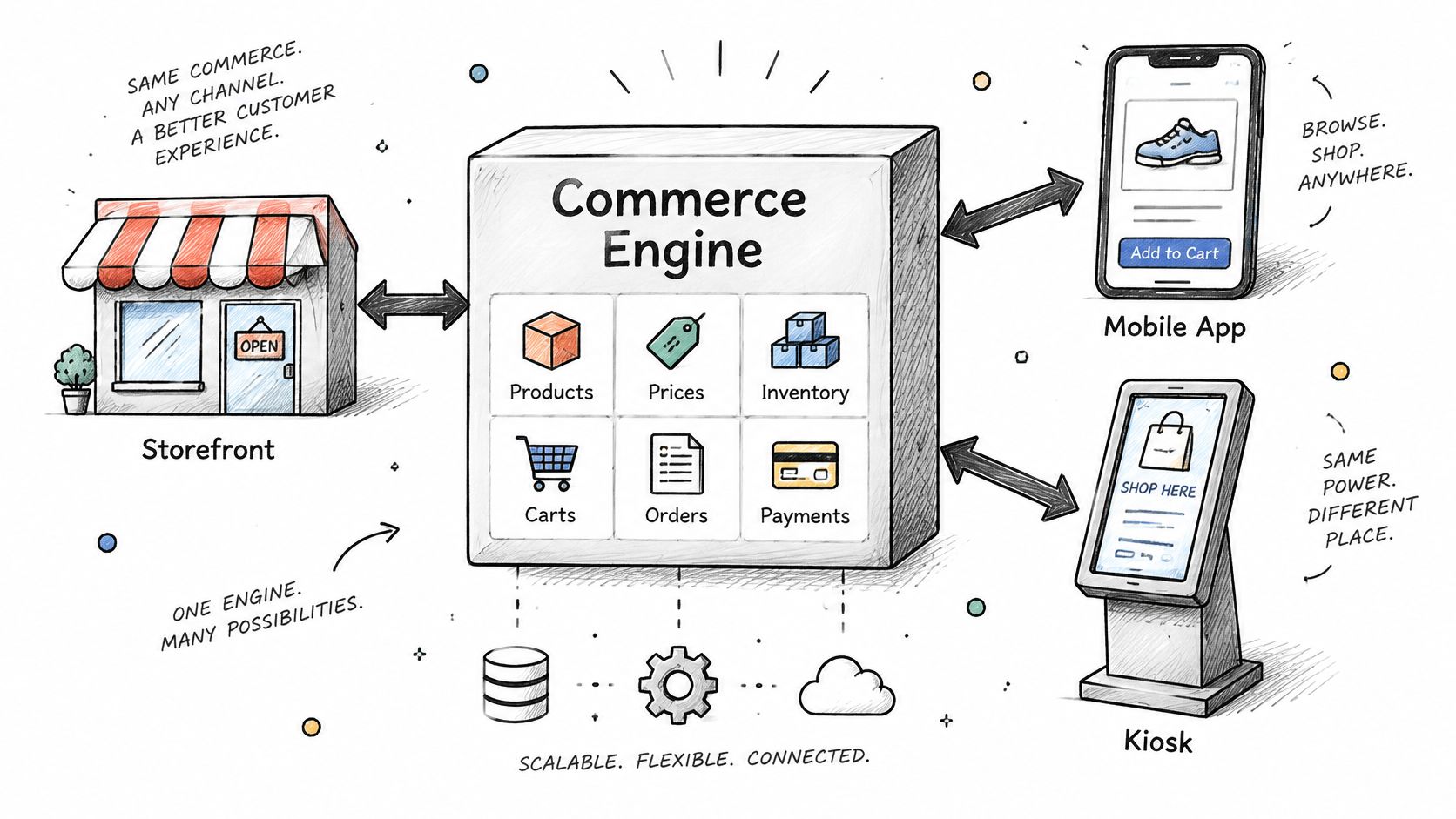
WebinOne treats headless commerce as a separation between commerce operations and presentation, not permission to scatter business rules across channels. The commerce engine manages products, prices, inventory, carts, orders, and payments; independently developed front ends consume those capabilities through an API.
A storefront, mobile app, kiosk, marketplace, or in-store screen becomes a client of that commerce engine. The interface moves out. The transaction rules stay behind the API, rather than being reimplemented separately for each device. That distinction makes the API an integration boundary, not a feed of product descriptions, as outlined in the API usage and architecture overview.
Keep transaction decisions behind the interface
Consider a customer buying through a kiosk and later checking an order through a mobile app. Both channels should receive the same commercial interpretation of that transaction. Neither should invent its own promotion rules, stock deductions, or order status meanings.
The architecture should assign responsibilities explicitly:
- Commerce engine: Calculate authoritative totals, validate purchases, and maintain transaction state.
- Front end: Render the experience, collect input, and explain API responses to the customer.
- Integration services: Translate and synchronize data between the commerce engine and operational systems without becoming competing sources of truth.
The historical move from server-rendered storefronts toward API-mediated delivery followed channels that couldn't depend on a single website. Apps, social selling, and in-store interfaces needed access to commerce functions without inheriting the website's presentation.
For agencies mapping that separation during discovery, Tagada's headless commerce solutions guide provides a useful companion resource for discussing the architectural choice with clients.
Buy release independence, not another maintenance obligation
The business benefit is the ability to replace or redesign a channel without rebuilding the catalog and transaction system. That benefit depends on consistent authentication, pricing, inventory, cart, order, webhook, and error-handling contracts.
A replaceable storefront is useful. A storefront that must reconstruct missing commerce rules is an integration liability.
An agency evaluating headless should therefore scope ownership, failure handling, and ongoing support alongside interface development. A polished product page doesn't prove that the architecture can process a purchase correctly across channels.
REST Versus GraphQL for Commerce Workloads
WebinOne's recommendation is to choose API styles by request shape and traffic profile, not developer preference. Favor cache-friendly REST reads for predictable resources, and consider GraphQL when a screen benefits from assembling nested data in a single request.
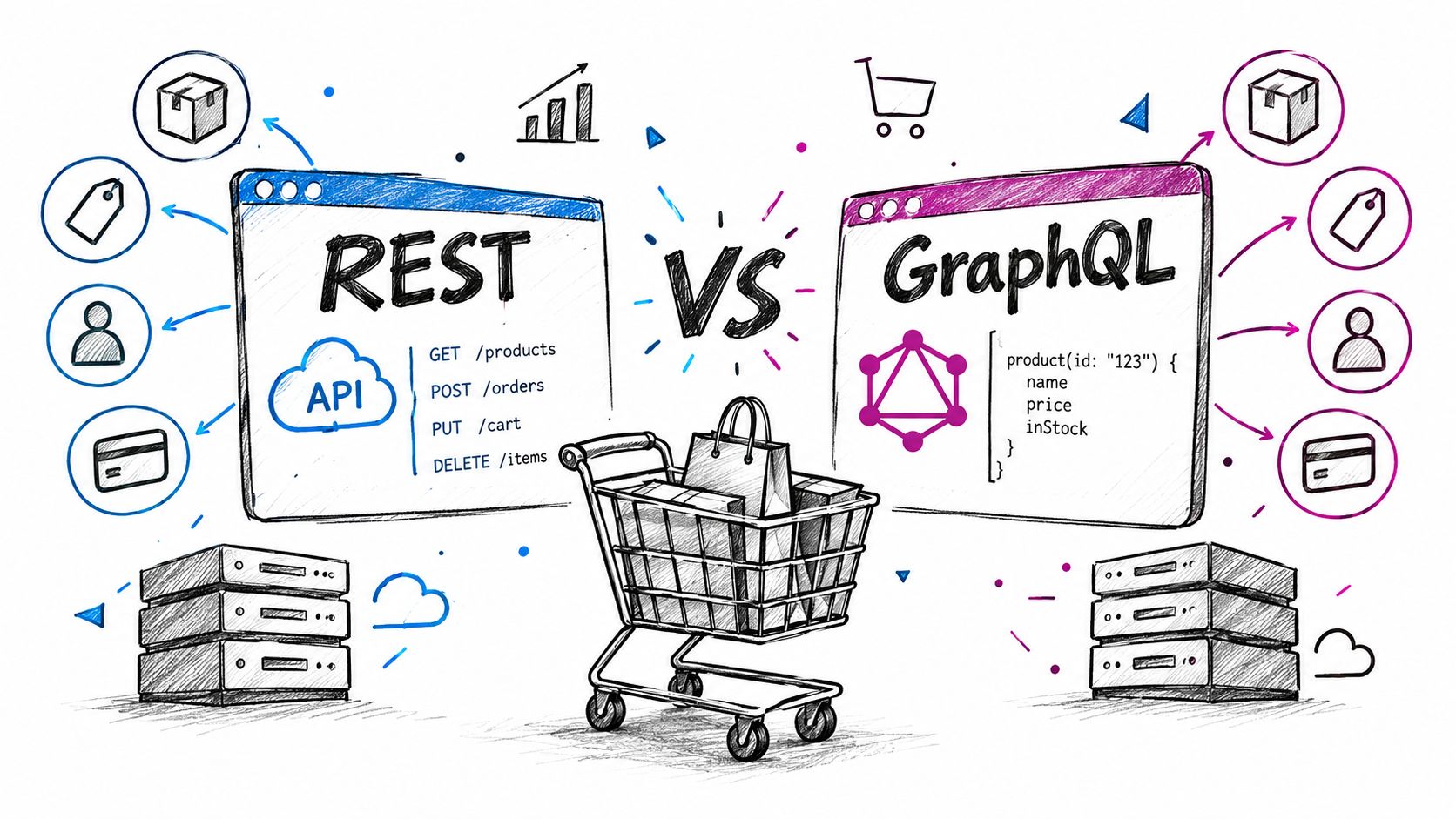
REST gives product and inventory resources stable URLs that fit standard HTTP caching. GraphQL lets a client select the fields needed for a particular screen, reducing over-fetching and client-side request orchestration. Neither property guarantees better production performance across every workload.
The supplied comparative results illustrate that trade-off: REST achieved up to 50.50% lower response time and 37.16% higher throughput, while GraphQL reduced measured CPU load by 37.26% and memory utilization by 39.74%; the accompanying load-test figures recorded 10,541 requests per second for REST against 6,688 for full GraphQL, discussed alongside the REST and GraphQL performance research. These are workload-specific results, not contractual promises for a client build.
Match the interface to the screen
For a category listing, a predictable catalog resource is straightforward to cache and inspect. A product-detail screen combining variants, inventory, recommendations, and merchandising metadata presents a different request shape.
| Workload | Recommended approach | Engineering consideration |
|---|---|---|
| Public catalog and media reads | Cache-friendly REST | Stable resource identity and invalidation |
| Contextual price and availability | Carefully partitioned REST reads | Currency, customer context, and freshness |
| Deeply nested product screen | Selective GraphQL | Resolver cost and field permissions |
| Personalized account views | Explicitly authorized operations | Private responses and restricted fields |
Adopting GraphQL means budgeting for depth limits, persisted queries, field-level controls, and per-operation latency budgets. A compact client request can still trigger expensive resolver work behind the gateway.
Put caching into capacity planning
Caching reduces repeated origin work because a nearby cache can answer without contacting the origin, as explained in HTTP caching guidance. Product descriptions, images, and public merchandising are different caching candidates from carts, orders, customer details, and contextual pricing.
The delivery team should define cache keys and purge behavior before load testing. Personalized data must not enter a shared cache merely because the endpoint uses a read method.
Benchmark simple and nested requests at expected concurrency, including cold-cache behavior and invalidation. Track tail latency, origin traffic, cache hits, and stale-data incidents separately. An attractive average response time can conceal an unacceptable checkout delay or incorrect availability response.
The Endpoints an Ecommerce API Has to Expose
WebinOne evaluates an ecommerce API by whether it supports complete business operations, not whether its documentation contains a product endpoint. The route names below are illustrative contracts, not claims about particular WebinOne endpoint paths.
Ecommerce API endpoints agencies actually wire
| Endpoint group | Typical methods | Most common integration mistake |
|---|---|---|
| Catalog | GET /products, GET /categories |
Omitting variant relationships and merchandising fields |
| Price and availability | GET /prices, GET /availability |
Ignoring customer context or stock location |
| Cart and checkout | POST /carts, PATCH /carts/{id}, POST /checkout |
Trusting totals calculated by the front end |
| Customer and account | GET /customers/me, PATCH /customers/me |
Returning excessive personal information |
| Order lifecycle | POST /orders, GET /orders/{id}, POST /refunds |
Treating placement as the end of the integration |
| Webhook delivery | Signed event delivery and acknowledgement | Assuming events arrive once and in order |
Catalog reads should return stable identifiers, variants, category relationships, media, and merchandising metadata. A response containing only a title, description, and image leaves the storefront guessing how selectable options map to purchasable items.
Price and availability responses need explicit context: currency, customer group, stock location, and the meaning of availability. Treating a warehouse quantity as an unconditional promise to sell creates a mismatch between the product page and checkout.
Integrate the transaction, not just the product page
The cart contract should expose line items, applied promotions, taxes, shipping options, and authoritative totals. Customer-group rules belong in the calculation, not in a storefront discount script. Payment inputs should use the agreed tokenization boundary rather than move raw payment details through general-purpose integration code.
Customer endpoints should return the profile, addresses, and permitted order history required for the task. Saved payment methods require explicit PCI-scope review: the integration contract should distinguish processor references and display metadata from sensitive card data. A saved-payment feature isn't permission to return payment credentials.
Order endpoints must support the lifecycle after placement, including status, fulfillment, returns, and refunds. Define permitted transitions and explain whether an accepted request means the operation completed or was queued.
Webhook contracts should specify events such as order.created, order.fulfilled, inventory.updated, and customer.updated, together with signing, retries, acknowledgement, and replay handling. Consumers need a documented way to recover when delivery fails.
The REST API endpoints guide is a practical starting point for reviewing the integration surface. Discovery should turn that review into acceptance tests: required fields, authorization, error semantics, and recovery behavior.
These contracts determine whether headless delivery pays off. Missing commercial semantics don't disappear when the storefront is decoupled; the agency ends up rebuilding them elsewhere.
The Operating Model Most Headless Guides Skip
Decoupling moves the integration boundary. It does not simplify operations on its own. WebinOne's position, and mine after watching agencies ship these builds, is that the engagement needs a data-ownership and change-management model before anyone writes a line of front-end code.
Skip that step and you get the usual outcome: a beautiful storefront wired to systems nobody agreed on, reconciled by hand.
Legacy integration remains a material constraint in the headless commerce market analysis. Older operational systems often lack API readiness, and undocumented workflows, inconsistent records, and version conflicts surface mid-implementation rather than in discovery. Investigate those conditions before committing to a cutover date, because the remediation cost lands on the agency, not the platform.
Assign authority by business domain
The commerce platform needn't originate every record. An inventory system might own stock, an ERP might own negotiated prices, and the commerce engine might own carts and submitted orders. What matters is that each domain has one documented authority and one conflict-resolution rule. Two systems that both "own" price will eventually disagree, and the disagreement will surface in a customer-facing number.
| Domain | Decision required before implementation |
|---|---|
| Product | Which system owns identifiers, attributes, and publication state? |
| Price | Who approves changes, and which system calculates the selling price? |
| Inventory | Who owns reservations, adjustments, and reconciliation? |
| Customer | Which record survives a merge or conflicting update? |
| Order | Which system owns commercial status and fulfillment status? |
Map workflows before designing endpoints. A cancellation can involve payment, warehouse activity, customer communication, and stock release. An endpoint that updates an order label without coordinating those consequences is incomplete.
Delivery rule: Every synchronization path needs an owner, a failure queue, and a reconciliation procedure.
Govern changes across the portfolio
Maintain contract tests against actual consumer expectations. A field can remain syntactically valid while its business meaning changes, so test totals, state transitions, and permissions as well as response schemas. A response that passes schema validation and returns the wrong price is worse than a hard failure, because nothing alerts on it.
Publish a deprecation policy that names affected consumers, migration responsibilities, rollback procedures, and the conditions for retiring a route. Track webhook subscriptions with the same discipline: owner, destination, event version, credentials, and failure handling. Across a portfolio of a dozen decoupled sites, the webhook registry is where undocumented drift accumulates fastest.
For agencies whose current workload includes plugin upkeep, patching, scaling work, or recovery from security incidents, a headless migration shouldn't reproduce that burden as undocumented integration maintenance. If the operating model just relocates the same maintenance to a new layer, you have changed the architecture and kept the problem.
Adjacent authenticated experiences need similar planning. Continuum Solutions' resource on serverless hosting for membership sites is relevant when a commerce engagement also includes member-only access or client portals.
A managed, centralized commerce and API foundation reduces the number of platform boundaries an agency governs. The partner still owns integration quality. It just doesn't have to assemble a separate service for every underlying capability, which is where most of the governance overhead comes from in the first place.
API Security as an Authorization and Business-Flow Problem
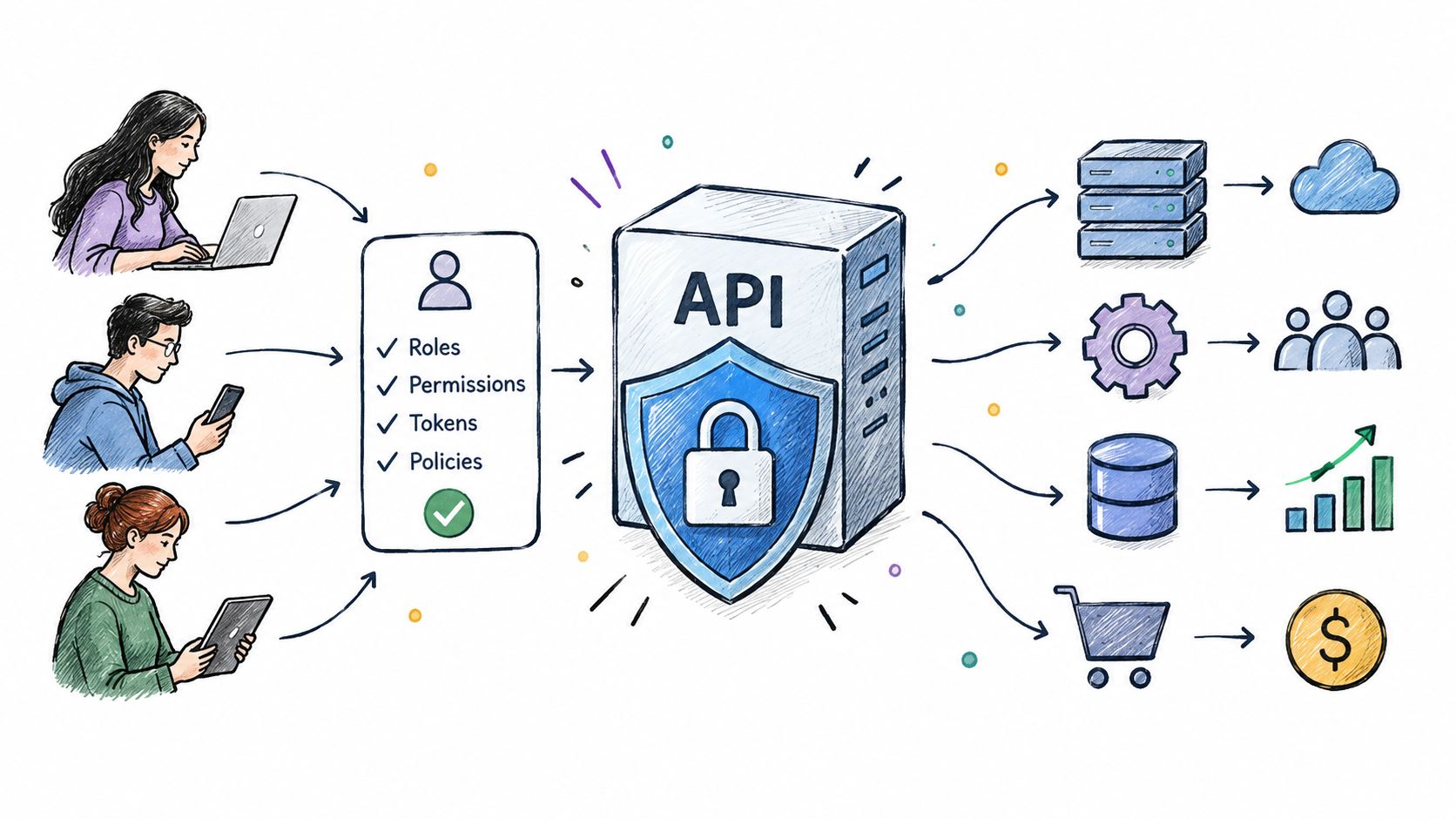
WebinOne treats commerce API security as control over who may perform which action on which record. A valid token establishes identity; it doesn't establish permission to read an order, alter inventory, issue a refund, or inspect a customer's negotiated price.
OWASP's 2023 API Security Top 10 ranks Broken Object Level Authorization at API1, Broken Authentication at API2, Broken Object Property Level Authorization at API3, and Broken Function Level Authorization at API5. Consequently, three of the five highest-ranked risks involve access control, according to the OWASP API Security Top 10.
Authorize the object, field, and operation
An order lookup must verify that the caller can access that specific order. Customer access should not imply permission to inspect internal margin fields, and an integration allowed to update fulfillment shouldn't automatically gain refund privileges.
Enforce those checks server-side. Hiding an administrative button doesn't protect its endpoint.
Separate anonymous, authenticated customer, staff, agency, and integration identities. Give machine credentials permissions for their actual workflows rather than copying a broad administrator scope into every connector.
Security review should include:
- Object access: Attempt cross-customer access to carts, orders, and addresses.
- Field access: Check whether public responses expose restricted pricing or personal data.
- Function access: Verify separate permissions for refunds, bulk exports, and inventory changes.
- Lifecycle coverage: Inventory exposed routes, old versions, and deprecated interfaces.
Protect legitimate workflows from automated abuse
An authorized operation can still be abused. OWASP's Unrestricted Access to Sensitive Business Flows category addresses excessive automated use of sensitive actions, including patterns relevant to stock reservation, checkout, coupon redemption, account creation, returns, and bulk purchasing.
Apply rate limits to the business operation, not only the network address. Add velocity rules, fraud monitoring, queueing for scarce inventory, and explicit bulk-action limits. Payment and order requests also need idempotency handling so a client retry doesn't unintentionally repeat the commercial action.
The payment processing integration guide provides context for reviewing that transaction boundary. The acceptance criteria should include ambiguous outcomes, such as a payment request that times out before the storefront receives confirmation.
Security testing should ask whether a caller can misuse a valid workflow, not only whether an invalid caller can log in.
Make sensitive access observable
Retail API reporting states that 68% of retail and ecommerce organizations experienced API security incidents in 2025, while only 29% had full visibility into APIs returning sensitive data, according to the retail API security incident analysis.
That visibility gap makes endpoint inventory and auditability operational requirements. Record sensitive access without copying secrets into logs. Authenticate webhooks, reject replays, rotate credentials, and review permissions when a partner or integration changes responsibility.
Integrating a DXP Like WebinOne as the API Layer
Headless projects fail at the data boundary more often than at the rendering layer. A managed platform earns its place when it absorbs the system-of-record work: canonical product records, price ownership, order state. WebinOne combines CMS, ecommerce, CRM, email, multi-site management, and headless delivery in one managed DXP, so the platform sits beneath the agency's customer experience rather than dictating a detached storefront on every project.
The digital experience platform overview describes that consolidated model. On a real engagement, integration runs through staged data validation, transactional testing, and controlled channel cutover, in that order.
Establish the data before connecting the storefront
Map product identifiers, variants, price ownership, and order references into the platform APIs first. Validate representative records against the source systems, then run complete purchases and downstream reconciliation before any customer traffic moves. Skipping reconciliation testing is how agencies inherit a month of finance-team tickets after launch.
Connect the storefront or app to the commerce and content capabilities the experience requires. Where native templates and API delivery coexist, verify identical commercial results through both paths; assume nothing about implementation symmetry.
WebinOne supports Liquid templates, custom modules, and headless delivery. An agency keeps its chosen front-end stack while sourcing content, customer, and commerce data from the managed platform.
Preview deserves an explicit delivery design:
- Draft access: Keep unpublished content behind authorized preview requests.
- Rendering: Render the preview with the target channel's own behavior.
- Publishing: Tie publication to cache invalidation and release checks.
- Recovery: Document the route back to the last accepted experience.
Connect webhook flows such as order.created, inventory.updated, and customer.updated only after confirming payload and delivery contracts. For surrounding systems, teams can browse SellerAI's connectors during integration discovery, then validate compatibility, permissions, and ownership independently.
Separate platform operations from delivery responsibility
WebinOne runs on AWS across six global regions, with 99.99% uptime over the last 12 months and a 99.95% availability commitment in its published SLA. It is an AWS Partner, has passed the AWS Foundational Technical Review, holds the AWS Qualified Software designation, participates in the AWS Software and Services Paths, and is listed on AWS Marketplace for enterprise and AWS delivery engagements.
Standard managed deployments run in WebinOne's AWS account. Qualifying systems integrators can discuss licensed deployments in their own or a customer's AWS account by agreement, including AWS GovCloud projects.
The white-label model keeps the client-facing platform under the partner's brand. Reseller pricing starts from $10 per month per site, with zero platform transaction fees on ecommerce; custom development, integration support, and payment-provider costs still belong in the commercial model.
After launch, ownership splits cleanly: the partner owns the client relationship and front-end delivery, WebinOne owns platform operations, and TeamOne handles migration or managed delivery as scoped projects. That split is the argument for a managed DXP. It turns the platform question into an operating-model decision rather than a hosting one.
When Headless Pays Off and What to Do Next
Headless pays off when three conditions hold at once: more than one front end consumes the same catalog, channels ship on independent release cycles, and a named team owns canonical product, price, and order data after go-live. When a template-driven storefront does the job, or nobody accepts that ownership, the decoupled architecture adds cost without adding capability. Adoption surveys will not settle this for you; definitions vary too widely. Build the business case on your channel count, release cadence, and integration load instead.
Agencies weighing white-label delivery should walk into the WebinOne reseller program discussion with one real client workflow in hand, not a hypothetical portfolio. Systems integrators and enterprise teams should bring the system-of-record map, channel requirements, and current integration constraints when they open a partnership or migration conversation with the WebinOne team, as noted earlier. The decision that matters is who runs the operating model, not which diagram wins.