What Is a Digital Experience Platform and Why It Matters
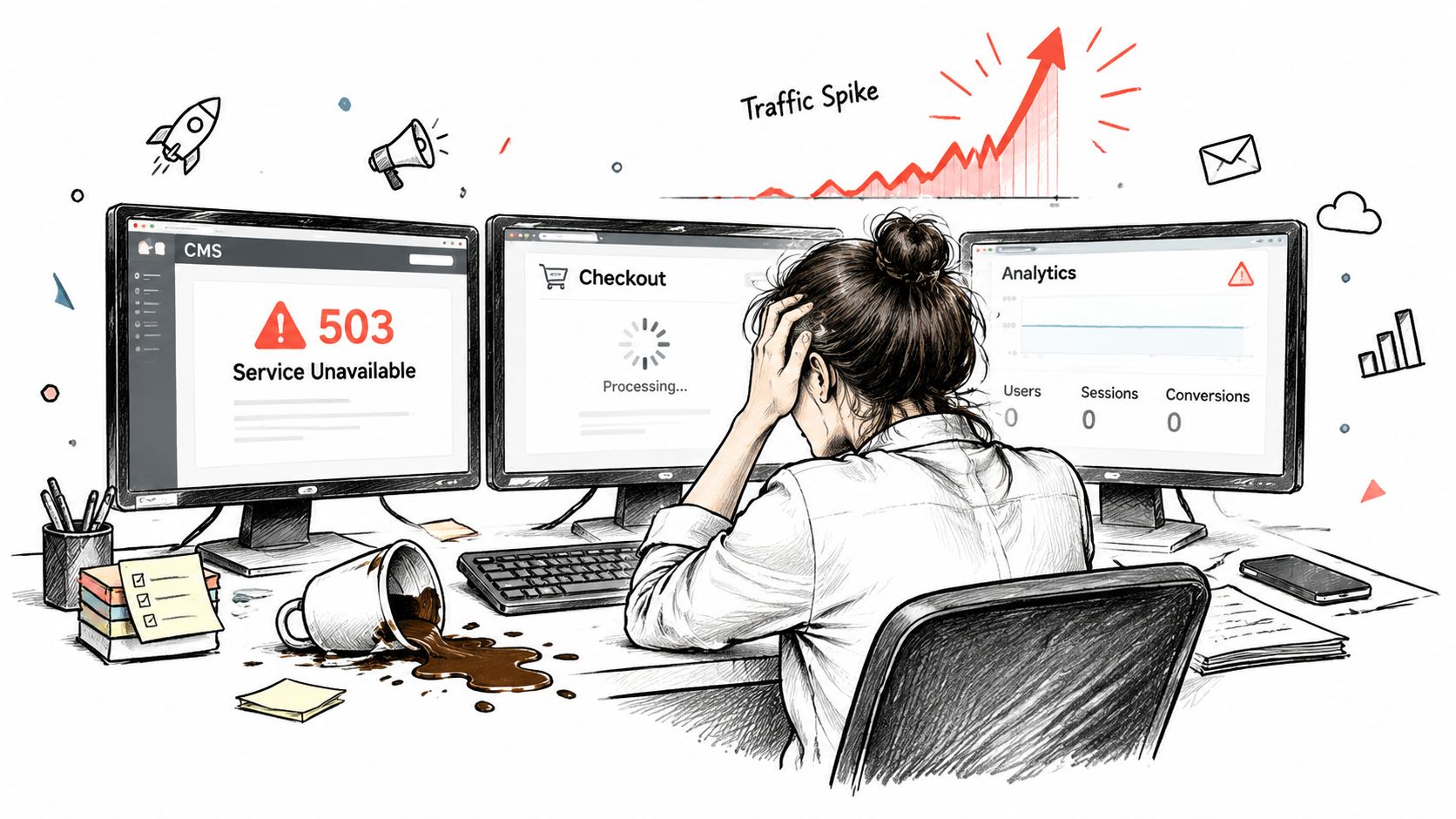
A campaign goes live, traffic surges, and the stack fails in sequence. The CMS returns errors, checkout loses sessions, and marketing automation sends the wrong audience the wrong message. Nobody owns the whole incident because the website, commerce layer, customer data, hosting, and integrations all belong to different systems and teams.
That's the moment operators stop asking whether they need a better CMS. The question becomes what is a digital experience platform, and whether it can replace the fragmented operating model that created the failure. A DXP isn't valuable because it has more features than WordPress. It's valuable when it gives one team control over content, data, delivery, governance, and the changes connecting them.
Table of Contents
- The Day a Fragmented Stack Stops Working
- Defining a Digital Experience Platform on Real Terms
- The Five Capabilities That Make a DXP
- Site Builders, CMSs, Composable Stacks, and DXPs Compared
- Why Operators Move to a DXP and What It Returns
- Replace the CMS, Sit on Top, or Assemble Composable
- What a Managed DXP Migration Looks Like in Practice
The Day a Fragmented Stack Stops Working
The stack usually looked reasonable when each piece was approved. WordPress handled content. WooCommerce handled transactions. A customer platform stored profiles. An email tool managed campaigns. Plugins connected the gaps. An agency maintained the front end, while an internal developer knew which custom integration could never be touched.
Then the campaign arrived.
A traffic spike exposed an infrastructure weakness. A plugin update collided with a custom checkout change. The marketing team discovered that audience data had stopped synchronizing. The business didn't have one failure. It had several failures with no shared owner and no reliable way to establish which system caused the first one.
The visible incident is expensive, but the hidden failure lasts longer. Institutional knowledge often lives in the head of one developer or one agency contact. When that person leaves, the roadmap stalls while the replacement reconstructs undocumented dependencies, credentials, data mappings, and deployment rules. The business hasn't just lost a person. It has lost the operating model.
Operator's rule: If nobody can describe the full customer journey, nobody owns the digital experience.
Fragmentation doesn't look dangerous while every integration works and every specialist remains available. It becomes dangerous when a release touches two systems, a vendor changes an API, or a key person resigns. That's why a DXP buying case often appears suddenly. The need was building, but the organization only recognized it when separate tools failed as one customer experience.
A real DXP responds to that operational problem. It creates a common platform for content, customer data, personalization, commerce, analytics, workflows, and delivery across touchpoints. The purpose isn't to collect more software under one logo. The purpose is to replace the manual assembly job that developers, marketers, agencies, and system integrators have been performing between disconnected tools.
Defining a Digital Experience Platform on Real Terms
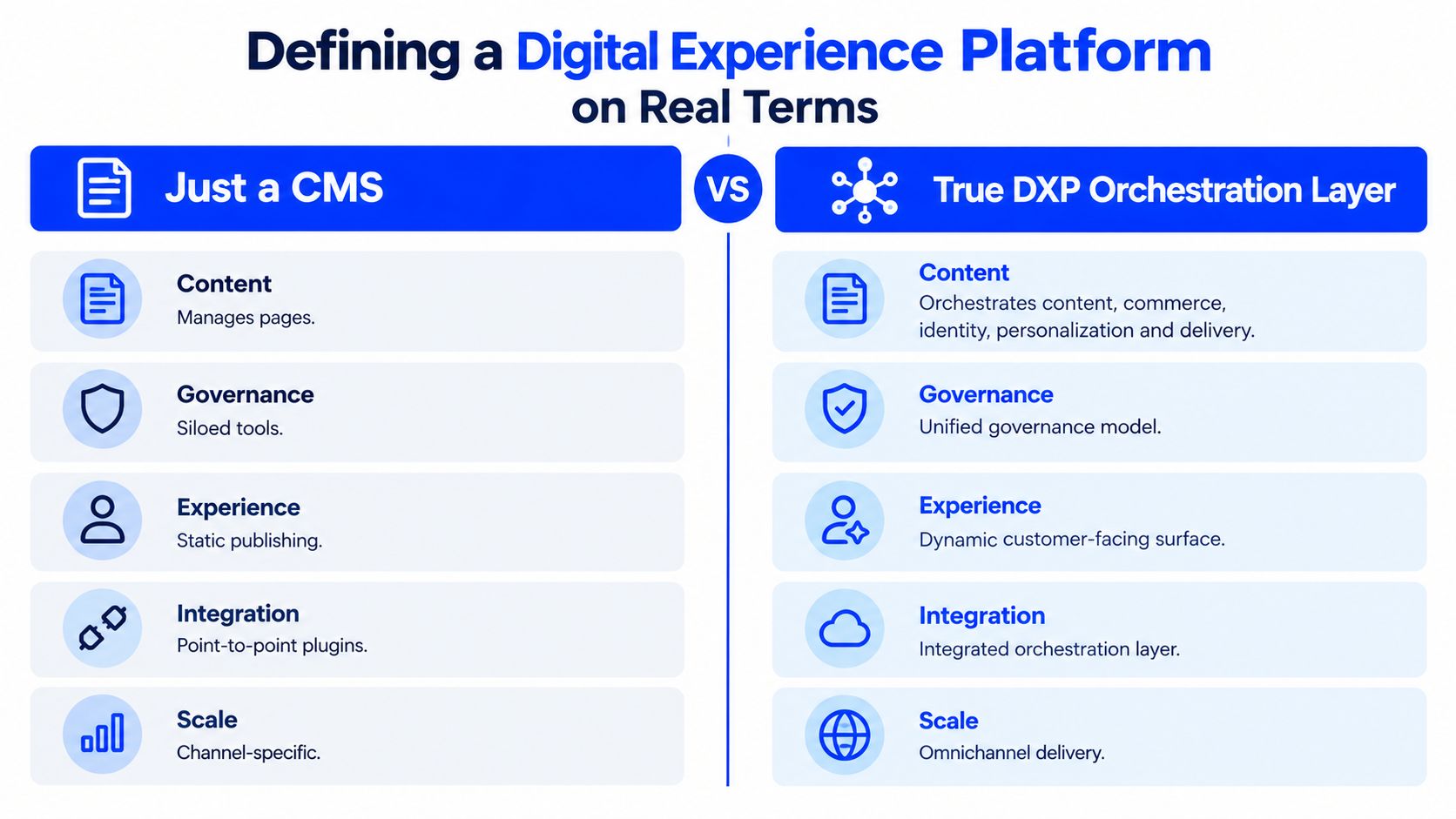
A digital experience platform is an integrated software framework that centralizes content management, customer data, personalization, analytics, and workflow orchestration so an organization can deliver consistent experiences across websites, apps, commerce, and other touchpoints. That definition aligns with the broader market explanation from Progress's guide to digital experience platforms, which distinguishes a DXP from a CMS by the breadth of connected capabilities.
A CMS publishes and manages content. A DXP coordinates the systems that decide what a customer sees, how that experience is delivered, what data informs it, and how the team governs the change. The platform must also account for roles, permissions, devices, audiences, and business context. Otherwise, it's still a collection of tools with a marketing label.
Consider a retailer running WordPress for editorial content, WooCommerce for checkout, a separate customer data platform for audience segments, and several integrations intended to keep products, profiles, orders, and campaigns synchronized. Each tool may work well in isolation. The retailer still has to maintain mappings, permissions, release processes, error handling, and monitoring across the full chain.
On a DXP, the same workload can use shared content models, product data, audience profiles, permissions, and release controls. The point of “integrated” isn't that the tools appear in one dashboard. It means they share data, governance, and observability. A team can trace a campaign from content creation through audience selection, delivery, transaction, and measurement without asking five vendors which system owns the truth.
For a deeper non-promotional overview of the category, digital experience platform explained offers useful background on the way DXPs connect content, data, personalization, and channels. Technical teams evaluating delivery patterns should also understand headless architecture, particularly when a DXP needs to serve websites, applications, commerce experiences, and other front ends.
Market data confirms that DXPs have moved beyond the CMS add-on category. Allied Market Research estimates the global DXP market at $11.2 billion in 2023, projecting $41.7 billion by 2032 at a 16.1% CAGR from 2024 to 2032. The same category has also been estimated at $17.82 billion in 2026, rising to $30.11 billion by 2031, as documented in the DXP market analysis from Allied Market Research. The estimates differ, but the direction is clear. Organizations are buying orchestration, not merely page publishing.
The Five Capabilities That Make a DXP
A platform deserves the DXP label only when it reduces the number of systems and handoffs required to operate a digital experience. Five capability areas matter most.
| Capability | What It Does | What It Replaces |
|---|---|---|
| CMS | Structures, versions, localizes, previews, and delivers content through hybrid or headless models | Standalone WordPress or Drupal installations |
| Ecommerce | Manages catalogs, storefront experiences, carts, checkout, orders, and payments | Shopify, Magento, WooCommerce, and commerce plugins |
| CRM | Holds customer profiles, segmentation, cases, activity, and journey logic | Bolted-on HubSpot or Salesforce Marketing Cloud workflows |
| APIs | Exposes documented REST and GraphQL services, webhooks, and reusable integrations | Point-to-point middleware, Zapier flows, and fragile custom connectors |
| Multi-site | Governs brands, domains, locales, teams, and permissions from one platform | Duplicated regional and brand stacks |
CMS becomes the content foundation
The CMS remains important, but its role changes. It should support structured content, reusable modules, localization, version history, previews, redirects, metadata, and controlled publishing. A headless or hybrid model lets the same content serve a website, application, portal, or commerce front end without forcing teams to recreate it for every channel.
That replaces the standalone CMS and the custom work required to make it behave like a platform. Teams still need editorial freedom, but developers shouldn't have to rebuild the same content model for every brand or region.
Ecommerce stops being a plugin dependency
Commerce inside a DXP doesn't necessarily mean every business must abandon a specialized commerce engine. It means product information, customer context, content, checkout, and analytics must participate in one governed experience. For simpler operations, native catalog, cart, order, and payment capabilities eliminate another contract and another integration surface.
For complex commerce, the DXP should expose APIs and events cleanly enough to coordinate with an existing engine. The deciding test is operational ownership. If a checkout change requires three vendors and a custom deployment sequence, the architecture is creating work rather than removing it.
CRM puts context beside content
A DXP's customer capability should connect profiles, cases, custom fields, activity, segments, and permissions to the experience layer. That allows a team to govern what a member, prospect, partner, or service user sees without copying profile logic into separate marketing and website systems.
The platform doesn't need to replace every enterprise CRM. It does need to prevent customer context from becoming an isolated database that content teams can't use.
APIs replace integration folklore
REST, GraphQL, webhooks, authentication, and documented events provide the escape hatch for systems that should remain specialized. They also stop integrations from depending on one developer's memory. A documented API is an operational asset because another team can inspect, test, monitor, and replace the connection.
Teams building a broader unified data platform should treat API ownership as part of governance, not as an afterthought delegated to a contractor.
Multi-site turns scale into administration
Multi-site governance is where many CMS deployments fail. A DXP should let central teams control templates, permissions, SEO rules, security, domains, and shared components while local teams manage approved content and brand-specific needs. One console and one release model remove duplicated administration without forcing every site to look identical.
The value of each capability is the same: one fewer vendor, one fewer contract, and one fewer integration to maintain. A feature list matters less than the operational work the platform removes.
Site Builders, CMSs, Composable Stacks, and DXPs Compared
Buyers often compare products that solve different problems. Wix and Squarespace optimize for quick site creation. WordPress and Drupal provide extensible content management. A composable stack combines specialist services. Adobe, Liferay, Sitecore, and Optimizely offer broad enterprise platforms. A white-label DXP serves agencies and multi-brand teams that need centralized delivery without buying a heavyweight suite.
The right comparison uses three dimensions: governance, three-year total cost of ownership, and the ceiling before the buyer outgrows the platform. Licensing alone is a poor measure. Integration, migration, training, customization, support, and the opportunity cost of slow releases all belong in the calculation.
| Category | Governance | 3-Year TCO | Ceiling | Best Fit |
|---|---|---|---|---|
| Hosted site builders, such as Wix and Squarespace | Simple permissions, limited enterprise and multi-brand control | Low entry cost, but migrations and workarounds can become expensive | Low to moderate | Small teams and straightforward sites |
| Monolith CMSs, such as WordPress and Drupal | Flexible, but governance depends heavily on configuration, plugins, and administrators | Familiar licensing profile, with integration, maintenance, security, and agency costs accumulating | Moderate to high, depending on engineering quality | Teams with strong CMS expertise and controlled scope |
| Composable MACH stacks, such as Contentful, commercetools, and Segment | Potentially precise, but governance spans vendors, contracts, identities, and release systems | Component flexibility, with substantial integration and platform-operations overhead | High | Organizations with dedicated platform engineering |
| Enterprise DXPs, such as Adobe, Liferay, Sitecore, and Optimizely | Broad governance and deep enterprise controls | High licensing, implementation, customization, and lock-in exposure | Very high | Large enterprises with the budget and operating model to support a suite |
| White-label DXPs, such as WebinOne | Centralized multi-site, agency, role, branding, and operational governance | Bundled platform and managed operations can reduce vendor coordination | High for agency and multi-brand operations | Agencies, system integrators, and enterprises consolidating estates |
Hosted builders win when speed matters more than control. They fail when a business needs complex permissions, reusable content models, regional governance, custom integrations, or a migration path that doesn't depend on the original builder.
Monoliths win on familiarity. WordPress has a large ecosystem, but plugin sprawl creates a governance problem rather than solving one. WordPress Multisite provides site-level isolation through per-site settings, table prefixes, and roles, while Network Admin manages the network. It isn't true tenant isolation because themes and plugins remain network-level, user accounts are shared, and a compromise in the shared codebase can affect every site, as explained in the WordPress DXP scorecard.
Composable stacks win on choice. They also transfer orchestration responsibility to the buyer. Market analysis increasingly treats composability, API-first integration, cloud deployment, and multi-experience delivery as core DXP requirements, but flexibility doesn't remove the need for ownership. It makes ownership more technical.
Enterprise suites buy breadth and governance at a significant price. Independent AEM comparison material places typical annual licensing at $100K to $500K or more, implementation at $500K to $2M or more, and three-year total cost of ownership at roughly $750K to $2M or more. Those figures appear in Clear Digital's AEM and WordPress comparison. A white-label DXP fits the buyer that needs centralized control but refuses to carry the full integration and licensing burden of a major enterprise suite.
Why Operators Move to a DXP and What It Returns
The strongest DXP business case is operational. The software purchase matters, but the larger decision concerns who maintains integrations, who handles incidents, who approves releases, and who answers when a campaign fails outside office hours.
DXP programs are frequently dominated by integration work rather than licensing. One industry source citing Gartner data attributes 85% of total DXP effort and cost to integrations, migration, training, and customization, as reported in this analysis of composable DXP and monolithic CMS costs. That is why a cheaper license can still produce an expensive platform if the buyer must fund the operational glue separately.
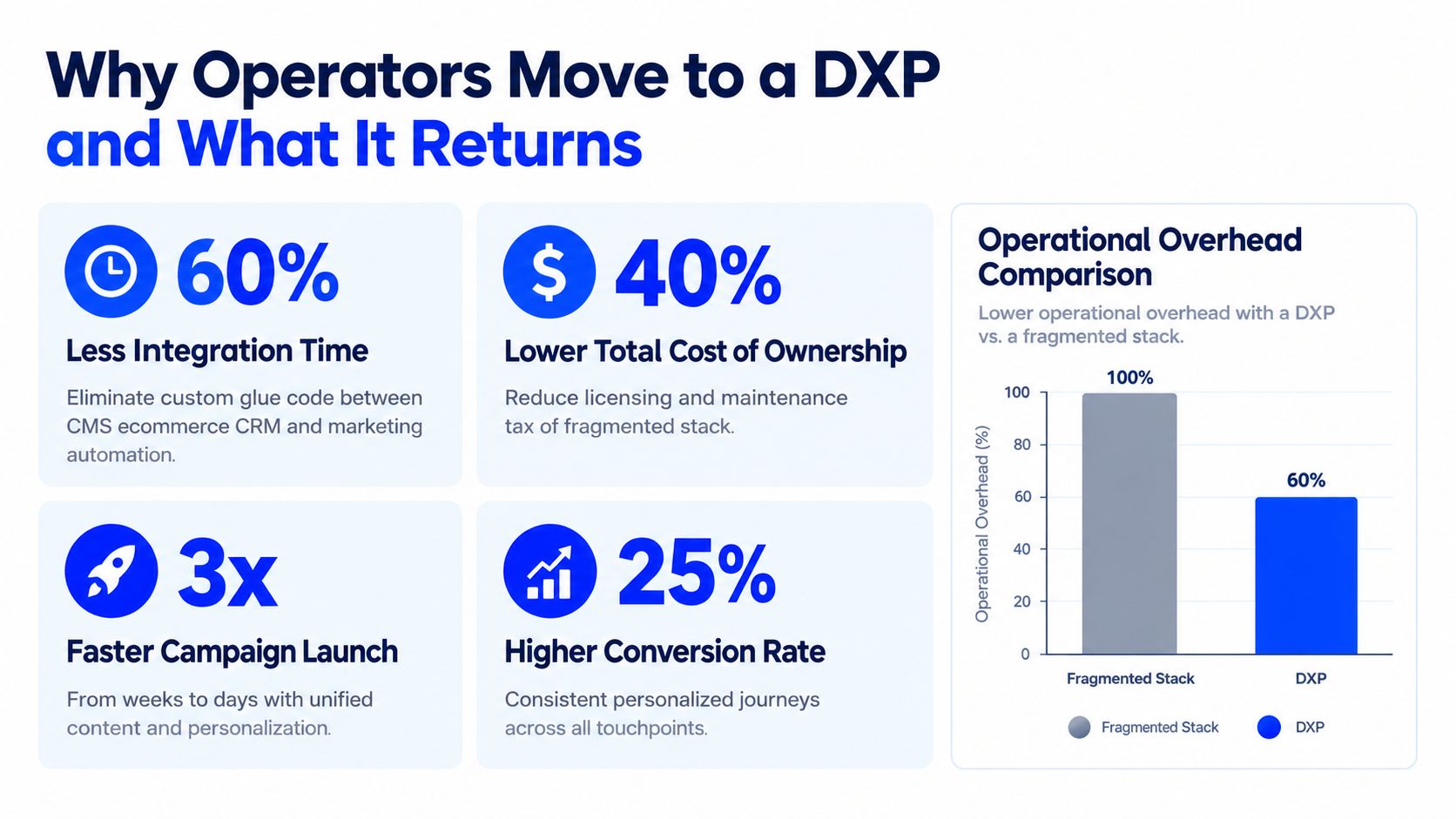
A DXP changes the cost model by consolidating shared services. Agencies can manage multiple brands from a governed foundation instead of repeating hosting, security, deployment, support, and integration decisions for every client. Enterprise teams can standardize permissions, content models, release controls, and reporting across a portfolio.
The shift also improves margin. An agency that repeatedly resolves plugin conflicts or maintains undocumented custom code isn't charging for strategy. It's absorbing an integration tax. A managed platform creates a clearer boundary between billable delivery work and platform operations.
The proof has to survive procurement
WebinOne has 3,000+ sites migrated, including complex live-site migrations during the Adobe Business Catalyst end-of-life period. It records 99.99% uptime over the last 12 months, runs on AWS across 6 global data centers, and has supported US and Australian government clients. It is an AWS Partner, is live on AWS Marketplace, has an approved AWS Foundational Technical Review, and has completed an AWS Well-Architected Review, according to the platform's verified business and infrastructure information.
Those proof points don't eliminate the need for due diligence. They do give agencies and enterprise teams concrete questions to ask about migration controls, hosting, resilience, support ownership, and platform governance. Buyers should demand the same specificity from every DXP vendor.
Cost belongs to the operating model
The key comparison isn't “one license versus many licenses.” It's one accountable owner versus a federation of vendors, agencies, plugins, and internal specialists. WebinOne provides white-label control, full-code access, managed infrastructure, native extensions, and zero transaction fees on ecommerce. Pricing starts from $10/month, as stated in the platform's published positioning, but serious buyers should still model migration, support, customization, training, and governance.
AgentOne extends that operating model with managed vibe coding. It builds and operates sites inside the managed platform, uses scoped permissions and audit logs, and makes changes visible, reviewable, and reversible before production. That's materially different from an AI tool that generates a site and abandons the team with the maintenance burden.
Replace the CMS, Sit on Top, or Assemble Composable
The decision isn't “suite or composable” in the abstract. It's a decision about where the organization wants to carry complexity.
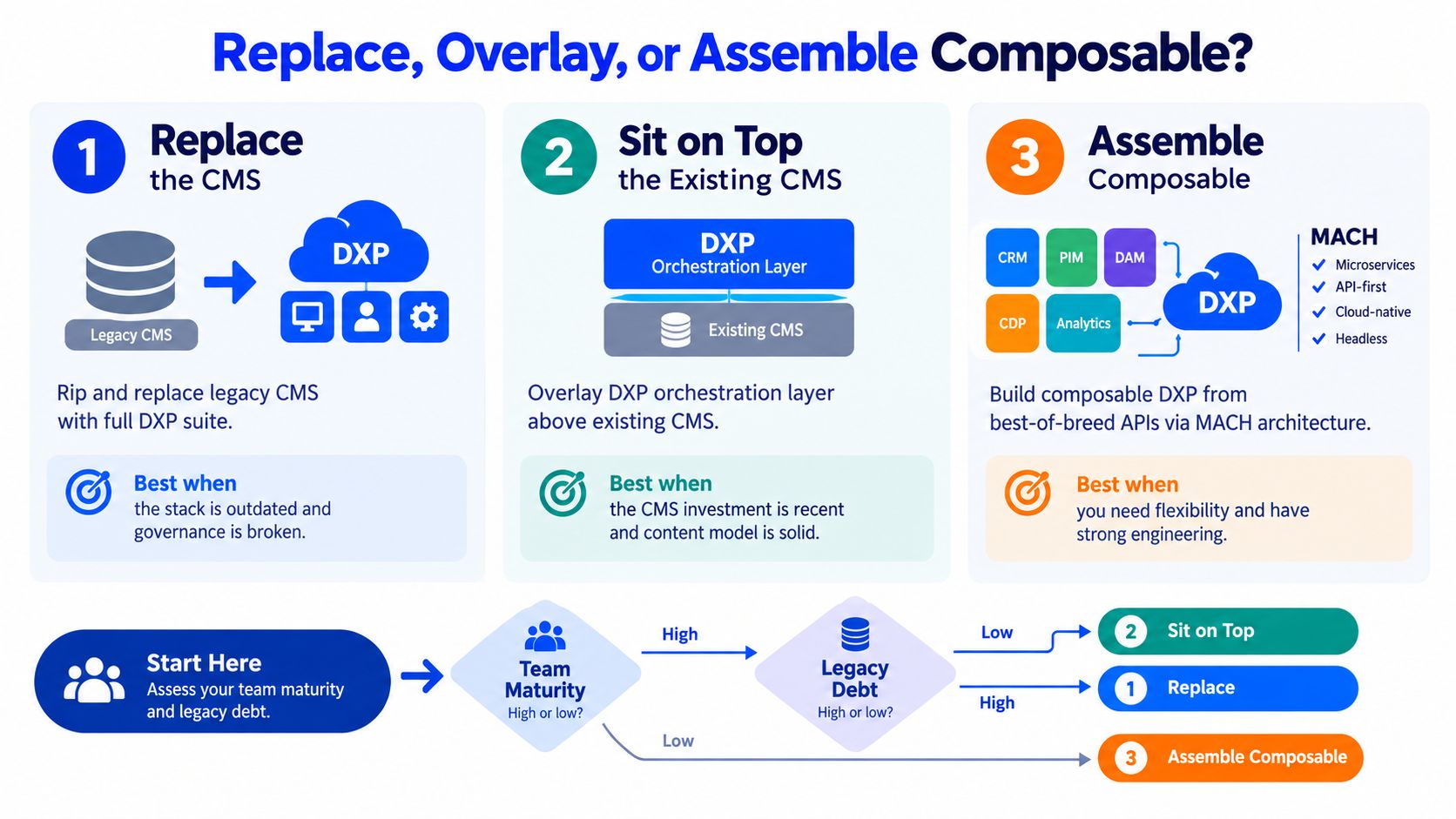
Replace the CMS when the foundation is the constraint
Replace the CMS when integrations outnumber meaningful features, publishing depends on one specialist, security maintenance consumes the team, or governance has broken down across brands and regions. This path gives a smaller team one migration to absorb instead of years of incremental repairs.
The failure mode is a migration that never ends. Protect against it with content inventories, URL mapping, staged delivery, acceptance criteria, and a rollback plan. A DXP replacement should reduce operational surfaces, not recreate every legacy exception inside a new system.
Sit on top when existing content has value
Layer a DXP over the existing CMS when the content model is sound, the site has valuable search authority, and editorial workflows are worth preserving. In that model, the DXP acts as the orchestration, integration, identity, personalization, or delivery layer while the existing CMS remains the authoring system.
The risk is permanent duplication. Teams often promise a transitional overlay and then keep both systems indefinitely. The buyer should define which system owns content, permissions, URLs, analytics, and release approval, then set a retirement condition for the legacy layer.
Assemble composably only with platform ownership
A composable DXP makes sense when the organization needs specialist services, has a dedicated platform team, and can fund the integration work. Gartner coverage summarized by Syzygy projects that 70% of organizations will need a composable-first DXP approach by 2026, up from 50% in 2023, as detailed in its composable DXP report summary. That projection supports composability as a serious architectural direction, not as a reason for every team to assemble its own stack.
The failure mode is an elegant architecture diagram attached to a delayed launch. The operational test is simple:
Who owns the integration when it breaks at 11 p.m.?
Small agencies and multi-brand teams usually benefit from replacement or a managed overlay. Enterprises with mature platform engineering can justify composability. Teams without a named owner, incident process, and integration budget should choose a governed platform instead of purchasing architectural freedom they can't operate.
What a Managed DXP Migration Looks Like in Practice
A managed migration starts with discovery, not design. The team inventories domains, templates, content types, assets, users, permissions, redirects, integrations, commerce flows, analytics, and search requirements. The output is a sitemap and data map that identify what moves, what gets transformed, and what should be retired.
The next stage builds the destination in a non-production environment. Developers migrate representative content, configure templates and modules, connect required services, establish roles, and test the release process. The staging build should be hardened before stakeholders review it, not used as a substitute for an implementation plan.
A parallel run then compares the new experience with the legacy stack. The sign-off checklist should cover content parity, URLs, redirects, forms, commerce, integrations, permissions, metadata, accessibility, performance, and analytics. Teams should test real workflows, not just inspect a handful of pages.
The final stage is cutover with monitored traffic and a documented rollback path. Reversibility matters because it turns a high-risk launch into a controlled operational change. The cross-platform migration guide provides useful context for planning the work across legacy platforms, content models, and delivery environments.
For implementation planning, timelines should match scope. A single-market site with moderate content complexity typically takes 4 to 6 months, while a multi-market migration across 10 or more countries, multiple languages, and complex integrations typically takes 9 to 18 months, according to this DXP implementation guide. Those ranges reinforce the practical lesson: migration belongs on a roadmap measured in quarters, not optimistic launch-week promises.
WebinOne provides a managed DXP for agencies, system integrators, and enterprise teams consolidating CMS, ecommerce, CRM, email marketing, multi-site governance, and headless delivery. Visit WebinOne to map the existing stack to a staged migration plan, review the platform, or discuss an operating model with the team.