Ecommerce Integration Services That Actually Scale
Most advice on ecommerce integration services starts in the wrong place. It starts with connector catalogs, app marketplaces, and a demo of how fast one tool can talk to another. That's how teams buy a pile of moving parts instead of an operating model.
The hard truth is simple. Connector choice is downstream of architecture. If the system map is wrong, the integration fails with perfect connectors. If the system map is right, the connector list becomes procurement detail.
That matters more now because the category is already substantial and still growing. One market study estimated the global e-commerce integration market at USD 5.0 billion to USD 15.0 billion by 2025, with overall growth projected at roughly 10% to 20% CAGR through 2030, while services alone were projected to grow at 9% to 18% CAGR (Research and Markets market outlook). That isn't a niche implementation task. It's a long-term services layer around modern commerce stacks.
Table of Contents
- Why Most Ecommerce Integration Projects Quietly Fail
- Mapping the System Before You Write a Single Connector
- Designing Payment, Order, and Refund Flows That Survive Scale
- Catalog Sync as Event-Driven Data Modeling
- Headless APIs vs Monolithic Storefronts for Integration
- How a Unified DXP Collapses the Integration Bill of Materials
- Testing, Security, and the Pre-Launch Checklist
Why Most Ecommerce Integration Projects Quietly Fail
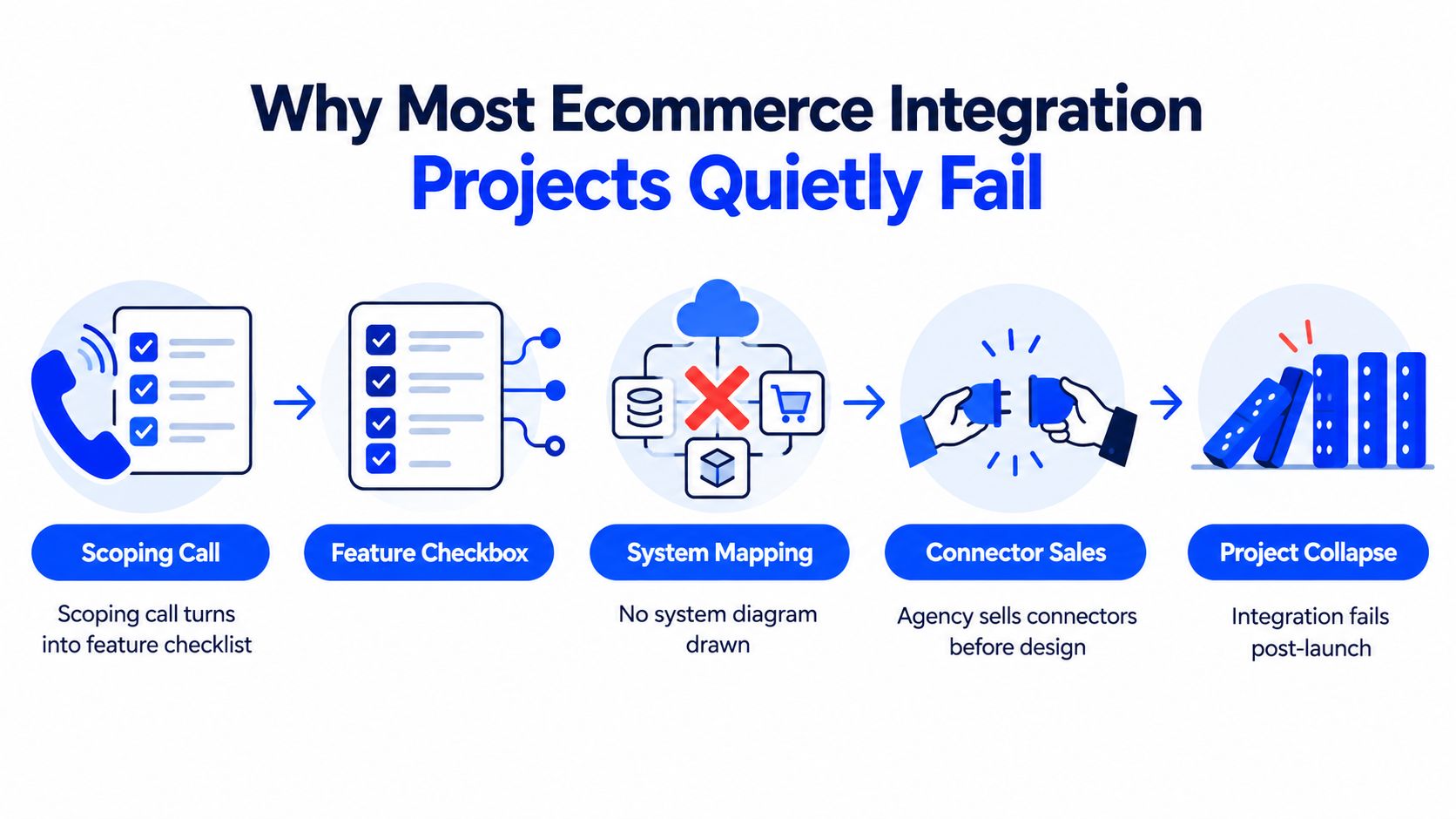
Agencies sell connectors before they define systems of record. That decision creates rework before delivery even starts.
The failure pattern is boringly consistent. A kickoff that should settle ownership turns into a shopping list of apps, APIs, tax tools, search adapters, and middleware shortcuts. Then the team hits launch with no hard answer to three questions: who owns product truth, who owns order state, and who decides a refund is complete.
That is where projects start leaking money. Orders duplicate. Prices drift across channels. Payment status arrives late. Inventory lags behind reality. Finance cleans up the mess in spreadsheets, and support inherits customer complaints.
Connectors don't solve ownership
A connector moves data. It does not decide authority.
It will not settle whether ERP or storefront owns stock, whether CRM can overwrite checkout identity, or whether a marketplace refund should update finance before warehouse disposition. Teams that skip those decisions end up buying more integration work every time they add a channel, brand, market, or payment method. The connector catalog grows. The operating model stays broken.
Practical rule: If your solution diagram has more arrows than ownership decisions, the architecture is still unfinished.
A lot of agencies scope this work as implementation because implementation is easier to price. The client usually needs operating design first. Econsultancy reported that email database and CRM connections were the top integration areas on both the company and agency side, and that implementer use rose sharply with ecommerce complexity, especially among higher-spend organizations (Econsultancy integration survey findings). That tracks with what fails in practice. Complexity does not punish teams for lacking connectors. It punishes them for lacking ownership rules, failure handling, and change control.
What competent teams do instead
Strong teams treat ecommerce integration services as architecture work tied to operations, not as connector procurement.
A serious discovery phase should produce:
- A system-of-record map for catalog, inventory, customer, order, payment, refund, tax, and content
- A flow map that labels each exchange as event-driven, synchronous, or batch
- A failure-state model for retries, duplicates, partial refunds, and reconciliation
- A governance decision about where new channels plug in and who approves changes
This is also why unified platforms beat stitched stacks more often than agencies admit. If your DXP, content layer, commerce engine, and brand sites run in one operating environment, the integration bill of materials shrinks fast. Zero transaction fees help too, because every new storefront or brand launch stops triggering another round of commercial and technical sprawl.
Growth teams often learn this late. A specialist partner such as an ecommerce SEO agency Oslo can drive acquisition, but traffic only reaches the systems you built. If the architecture is confused, growth increases failure volume.
Mapping the System Before You Write a Single Connector
A real integration project starts with a whiteboard, not middleware. The first job is to decide which platform owns which truth, then force every downstream consumer to respect that decision.
Start with systems of record
The storefront is almost never the right place to own everything. It presents and transacts. That's different from governing the source of business truth.
Use this map:
| Domain | System of Record | Primary Consumers | Flow Type |
|---|---|---|---|
| Product catalog | PIM or catalog service | Commerce engine, storefront, search | Event-driven |
| Inventory | ERP or OMS | Commerce engine, storefront, marketplaces | Event-driven |
| Orders | Commerce platform | OMS, ERP, customer service tools | Event-driven |
| Payments | Payment gateway plus commerce order state | ERP, finance, customer service | Event-driven |
| Customer profile | CRM or CDP | Marketing automation, support, personalization | Event-driven or scheduled sync |
| Content | CMS or DXP | Storefront, apps, localized sites | API-driven |
| Analytics | Warehouse or BI layer | Reporting teams, operators, leadership | Batch acceptable |
That map changes by business model, but the principle doesn't. Ownership must be explicit.
A lot of teams also underestimate store operations that span physical and digital channels. If payments must reconcile between online checkout and retail counters, the integration plan should account for the operational realities of a point-of-sale payments solution instead of pretending all payment events originate in one channel.
Label the direction of every flow
Most broken implementations fail because arrows are implied instead of named. Write the verbs directly on the diagram.
- Publishes: PIM publishes product updates
- Subscribes: search subscribes to searchable catalog changes
- Reconciles: ERP reconciles settled payment and order totals
- Mirrors: CRM mirrors approved customer profile changes
- Rejects: gateway rejects duplicate payment events
- Enriches: tax service enriches cart totals before authorization
Teams that skip flow verbs end up arguing about expected behavior in production instead of defining it in design.
This is also where the event-versus-batch decision gets made. Revenue-critical flows should be event-driven. Analytics exports can wait.
For technical teams debating integration mechanics, webhooks vs APIs is the useful line to draw. APIs are for asking. Webhooks are for being told. Mature commerce stacks need both, but they should be assigned deliberately by use case, not mixed together because one vendor happened to ship an SDK first.
Prioritize by operational importance
The smartest sequencing model is boring. Integrate CRM and email first, because that's where ecommerce teams most commonly start and where dependency chains surface quickly. Then move into orders, inventory, and fulfillment. That ordering reduces noise and exposes bad identity assumptions before money starts moving through the stack.
Designing Payment, Order, and Refund Flows That Survive Scale
Connector catalogs do not save these flows. Architecture does.
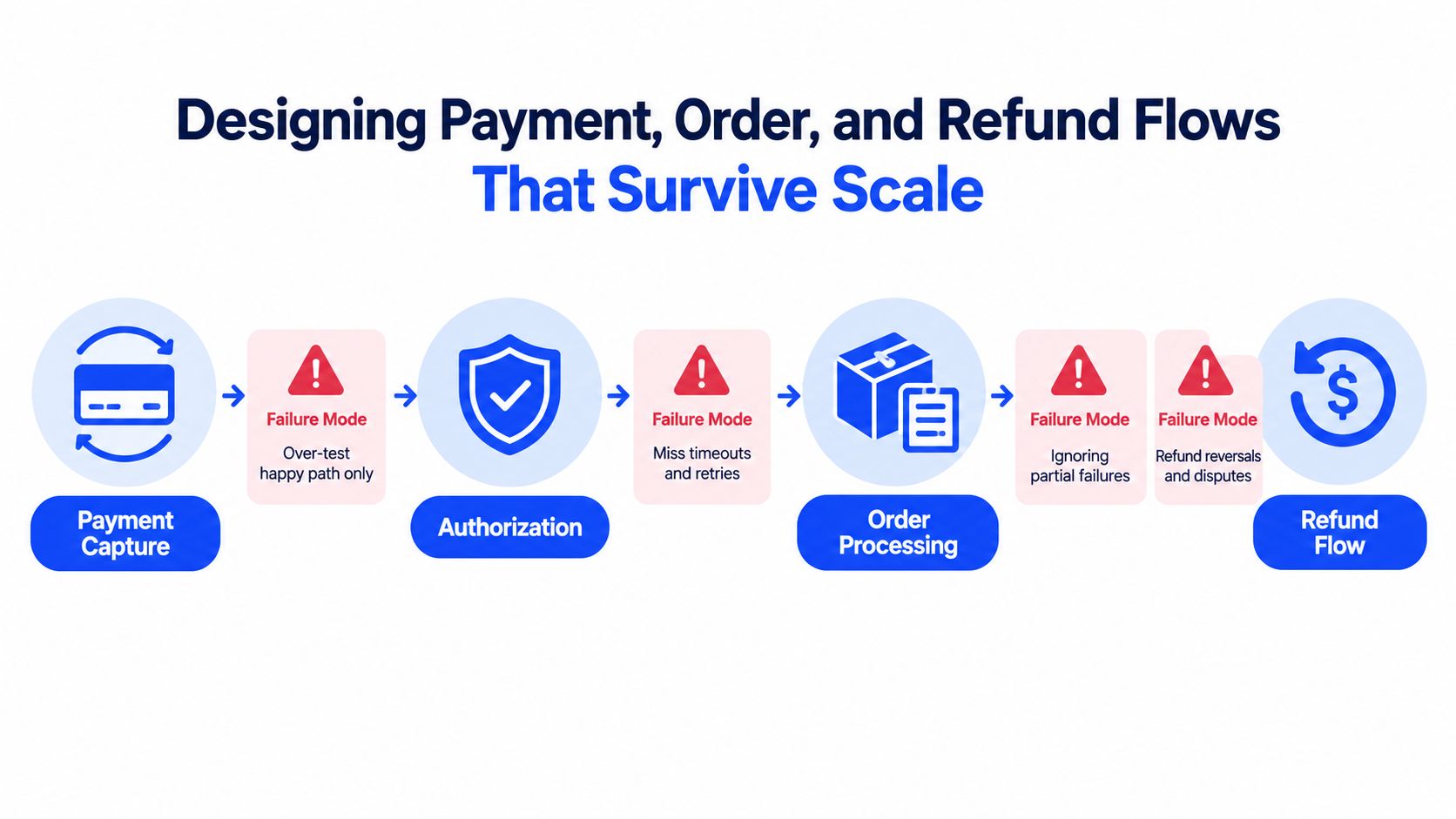
A team can buy a polished gateway connector, a polished OMS connector, and a polished ERP connector, then still spend every Friday reconciling duplicate captures and refund mismatches by hand. Payment, order, and refund flows fail because state changes are split across systems that disagree on sequence, ownership, and source of truth. Agencies and multi-brand operators feel this first because every extra store, market, or payment method multiplies the cleanup work.
Treat payment events as separate states
Authorization, capture, settlement, reversal, and refund are different records with different timing and different failure modes. If your platform collapses them into one payment status, finance gets bad reports, support gets bad answers, and operations gets surprise exceptions.
Use rules that survive production pressure:
- Keep authorization separate from capture. Fraud review, inventory holds, and split fulfillment can interrupt the flow after auth.
- Resolve tax and currency before order creation. Backfilling them later creates refund disputes and ledger mismatches.
- Enforce idempotency on inbound events. A retried webhook should update state once.
- Store gateway references on the order and on each payment event. Refunds, disputes, and settlement reconciliation depend on them.
- Assign one system to route orders. Do not scatter routing rules across middleware, ERP scripts, and connector settings.
That last point gets ignored too often. One order router should decide where an order goes, whether it can split, and what happens when a downstream system rejects it. If three tools can make that decision, none of them owns the outcome.
Build refunds like a first-class workflow
Refunds leak cash faster than checkout bugs because they stay hidden longer. A bad checkout usually breaks loudly. A bad refund design creates small accounting errors across weeks, channels, and brands until someone in finance has to stop month-end close and sort it out manually.
Use a refund state model such as:
- Requested
- Approved
- Gateway pending
- Partially completed
- Completed
- Failed
That lifecycle matters because customer approval, warehouse receipt, gateway action, store credit issuance, and finance posting rarely complete at the same time.
Refunds should be modeled as first-class records. If the platform treats them like comments on an order, the finance team will end up doing the integration work in spreadsheets.
Partial refunds need line-level references. Split tenders need allocation logic. Cross-border orders need FX handling that preserves what the customer saw, what the gateway settled, and what finance books. If your stack cannot express those cases cleanly, adding another connector will not fix it. It will spread the problem.
Technical teams planning this layer should review payment architecture directly instead of burying it inside checkout delivery. The mechanics in payment processing integration architecture matter because every downstream refund, dispute, settlement file, and reconciliation report depends on them.
This is also where unified architecture changes the economics. In a fragmented stack, every payment state has to be translated, forwarded, stored, and reconciled across multiple tools. In a unified DXP with zero transaction fees, more of that flow can live under one operating model with fewer translation points, fewer failure states, and fewer connectors to maintain. That is how you reduce the integration bill of materials. Not by collecting more apps.
Catalog Sync as Event-Driven Data Modeling
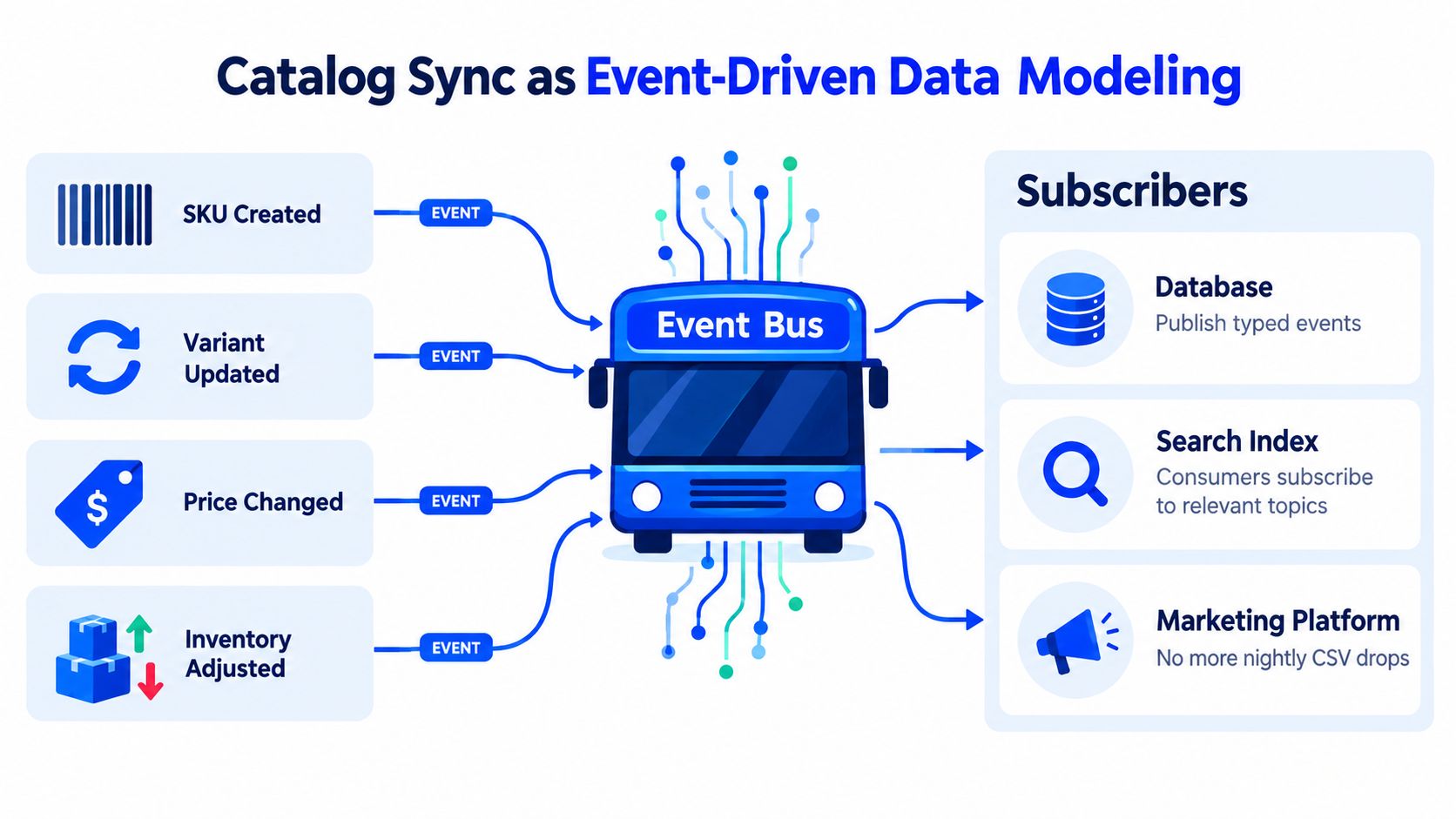
Teams still defend nightly CSV drops because everyone understands a file. That comfort is expensive. Catalog sync decides whether search, merchandising, pricing, inventory, and channel feeds agree on what you sell. Treat it like file movement and you get fast exports feeding slow confusion.
Start with the model. Connector choice comes later.
A usable commerce catalog needs canonical entities with stable IDs, clear ownership, and rules that survive every downstream system touching them. In practice, that means defining at least:
- Product for the marketable parent concept
- Variant for each sellable SKU and its option combination
- PriceList for market, channel, or customer-group pricing
- StockNode for location-level availability
- Category for navigation and merchandising structure
- AttributeSet for shared field definitions and validation rules
Once those entities are explicit, sync becomes event handling instead of bulk export. Product created. Variant discontinued. Price changed. Inventory adjusted. Category reassigned. Those events need versioning, ordering rules, and replay support, because catalog state changes constantly and every subscriber will miss something eventually.
The common failure is not “bad sync.” It is bad modeling exposed at scale. ERP calls color an attribute. PIM treats it as a variant dimension. Marketplace feed wants a normalized value. Search index stores free text because nobody enforced a controlled list. Then one team wonders why “navy,” “blue,” and “midnight” fragment filtering, reporting, and campaign logic across channels.
Fix the schema before you add another app.
Good catalog governance is unglamorous and mandatory:
- Option values stay canonical. If the business standard is “navy,” every system publishes and consumes “navy.”
- Localized content follows structure. Locale, fallback, and channel rules belong in the model, not in random rich-text fields.
- Partial updates are validated. A price event that breaks tax, market, or effective-date rules should be rejected.
- Retirement is modeled. Deleting records outright creates broken references, ghost variants, and stale channel listings.
- Media and attributes have ownership. Teams need to know which system is allowed to overwrite titles, images, specs, and merchandising data.
Connectors do not clean catalogs. They distribute catalog mistakes faster.
This is why connector catalogs are the wrong center of gravity for ecommerce integration services. Agencies and multi-brand operators do not need twenty ways to push the same bad SKU data around. They need one operating model for product, price, and inventory that every storefront, feed, and region can share. A unified DXP cuts this mess down further because more of the catalog contract can live in one platform instead of being translated between separate PIM, middleware, storefront, search, and feed tools. Zero transaction fees help, but the bigger win is fewer translation points and fewer places for the model to drift.
Operate the sync like production infrastructure. Track propagation lag, replay counts, dead-letter queues, schema validation failures, and subscriber error rates by event type. If the team cannot answer which catalog events are delayed, dropped, or out of order right now, the sync is not under control.
Headless APIs vs Monolithic Storefronts for Integration
This argument gets framed badly. Headless versus monolith isn't really about frontend freedom. It's about where complexity lives and how often a team wants to pay for it.
For ecommerce integration services, headless wins for agencies building bespoke storefronts and for enterprise or multi-brand estates running several localized properties. Monoliths still make sense for a single-brand store with a small integration surface and limited internal technical ownership.
Compare them on integration reality
| Criterion | Headless API | Monolithic Storefront |
|---|---|---|
| Connector count over time | Lower if the API layer is reused across brands and channels | Often grows as each storefront feature pulls its own app or extension |
| Ownership of business logic | Can be centralized in orchestration and service layer | Often split between theme, plugins, platform settings, and apps |
| New sales channel onboarding | Faster once canonical APIs and events are in place | Often requires channel-specific rework or another extension |
| Frontend change blast radius | Lower if contracts are stable | Higher when storefront changes are tightly coupled to platform behavior |
| Multi-site governance | Strong for shared services across brands | Usually weaker once each site drifts |
| Three-year cost pattern | Higher up front, lower when reused properly | Lower at first, higher once customization and maintenance stack up |
| Main failure mode | Fragmented logic across services | Plugin and extension sprawl |
The adjacent ERP integration market tells the same story about where architecture is going. One 2026 industry report estimated the ecommerce ERP integration market at USD 14.21 billion in 2025, USD 15.21 billion in 2026, and USD 21.31 billion by 2031, implying a 6.98% CAGR from 2026 to 2031. The report also found cloud-based solutions held 54.23% of market share in 2025, API integration accounted for 46.49% of revenue, and iPaaS was the fastest-growing approach at 7.78% CAGR to 2031 (AppsTech ERP integration market summary). That's the market moving away from brittle point-to-point integration and toward reusable API-led systems.
Where monoliths still earn a place
A monolith is still rational when:
- The team is small
- The catalog is simple
- The sales model is single-channel or close to it
- The business won't maintain an orchestration layer
That's not a knock on monoliths. It's just a scope match.
Teams weighing this choice from a platform angle should look at what a headless commerce platform actually changes. The benefit isn't trend compliance. It's cleaner integration ownership when the estate grows beyond one storefront and one market.
How a Unified DXP Collapses the Integration Bill of Materials
Most mid-market commerce stacks are overbought and under-governed. They have a CMS, storefront, CRM, email platform, search product, loyalty app, form builder, plugin bundle, middleware layer, and custom scripts gluing the gaps together. Procurement calls that flexibility. Operators call it a warranty burden.
Count contracts, not logos
A typical bill of materials often includes:
- CMS
- Commerce engine
- Search
- CRM
- Email automation
- PIM or product management layer
- Payment gateway
- Tax service
- OMS or ERP connector
- Custom middleware
- Agency-maintained patches
Every extra product adds another SLA, another admin surface, another migration risk, and another point where one resignation can strand the business.
That's why unified architecture matters more than connector depth. A managed DXP that combines content, commerce, CRM, email, and multisite governance removes a lot of integration surface before implementation even begins. WebinOne is one such option. It combines CMS, ecommerce, CRM, email marketing, multi-site management, a headless API layer, and zero transaction fees on ecommerce, with pricing from $10/month, AWS hosting across 6 global data centers, 99.99% uptime over the last 12 months, and availability through AWS Marketplace as an AWS Partner with AWS Foundational Technical Review approved and AWS Well-Architected Review completed. It has also migrated 3,000+ sites and supports US and Australian government clients.
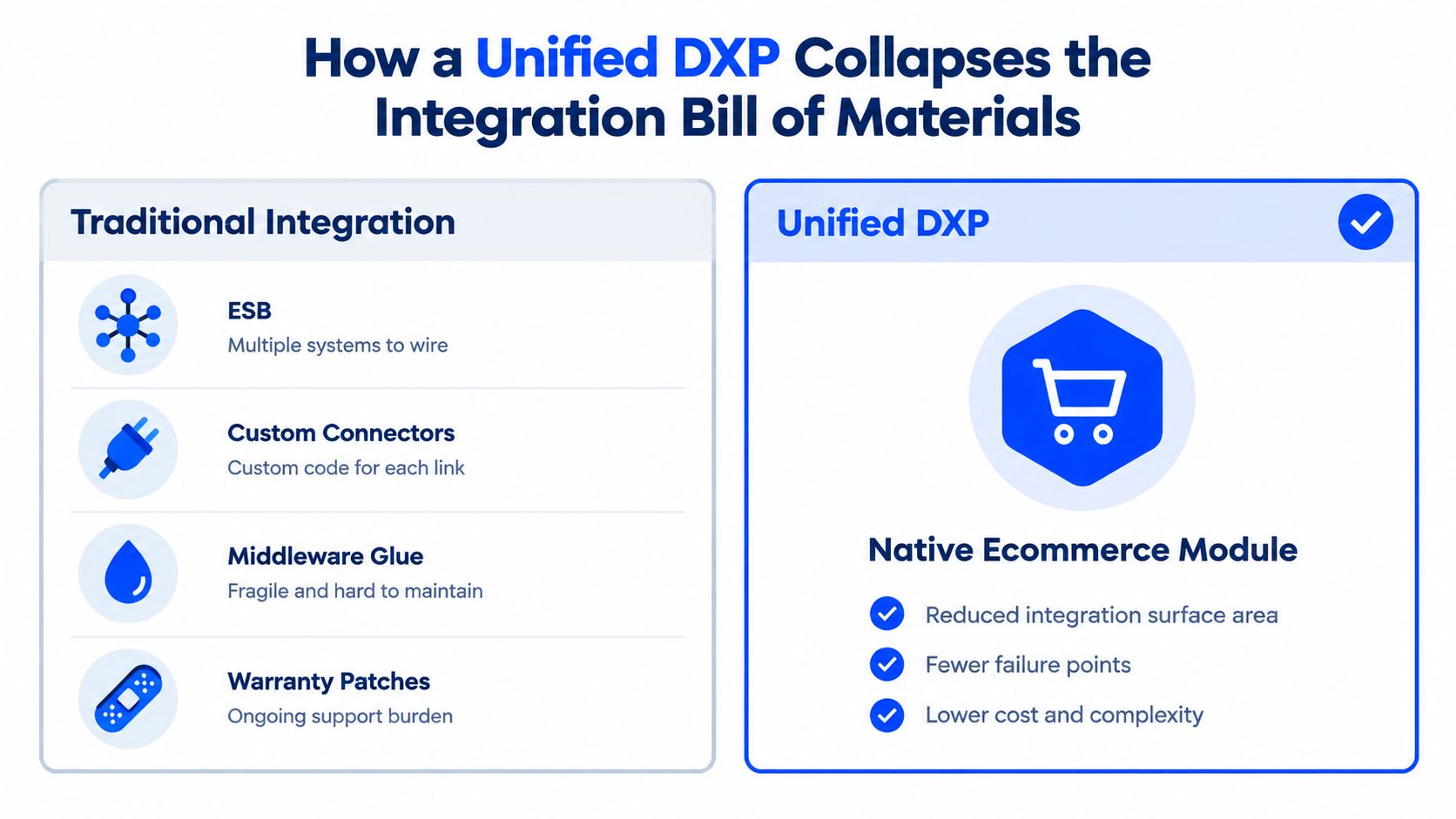
What a unified stack actually replaces
A unified DXP can reasonably replace or collapse:
| Replaced or Reduced | Why it often disappears |
|---|---|
| Separate CMS | Content is native |
| Extra CRM for basic contact and case flows | Customer records live inside the platform |
| Standalone email tool for core lifecycle campaigns | Email capabilities are built in |
| Multi-site management add-ons | Governance is native |
| Several glue connectors | Fewer systems need translation layers |
| Plugin bundles | Native extensions reduce dependency spread |
It usually does not replace:
- ERP
- Specialist tax engines in complex jurisdictions
- Payment gateways
- Warehouse and logistics systems
- Enterprise-grade PIM in very large catalog environments
That distinction matters. Serious operators shouldn't believe “all-in-one” claims that pretend ERP and logistics no longer exist. They do. The win is reducing the number of systems that need to be wired, monitored, patched, and defended.
There's also a security argument here, especially for teams escaping WordPress estates. Patchstack's 2026 report says 11,334 new vulnerabilities were disclosed across the WordPress ecosystem in 2025, and 91% were in plugins rather than core (Patchstack WordPress security report). Plugin sprawl isn't an abstract architecture concern. It's attack surface.
Migration is where this pays off
Replatforming exposes stack fragility better than any architecture diagram. Adobe Business Catalyst's end-of-life forced thousands of sites to move under deadline pressure, which remains a useful precedent for why agencies and multi-site teams need repeatable rescue processes instead of person-dependent stacks (Business Catalyst migration precedent). Integration design that only works when one senior developer is available isn't a platform strategy. It's operational debt.
AgentOne matters here too. Managed Vibe Coding only works if the AI builds and operates inside a governed platform with auditable permissions, not in a generate-and-abandon toolchain. If AI is going to touch automations, content, and commerce operations, the platform has to own the runtime discipline.
Testing, Security, and the Pre-Launch Checklist
A single QA pass before launch is amateur hour. Ecommerce integration services need staged validation. Contract testing, operational testing, and rollback planning all need separate sign-off.
Pre-launch checks that actually matter
Use a must-pass checklist:
- Contract tests on every API boundary: Validate payload shape, required fields, enum values, and error handling before production traffic touches the endpoint.
- Idempotency checks on payment and order webhooks: Replay events and confirm no duplicate order, capture, or refund side effects occur.
- Load tests against real catalog and cart behavior: Test with realistic product structures, promotion logic, and concurrency patterns.
- Negative-path drills: Simulate failed captures, partial shipments, missing inventory acknowledgments, and split refunds.
- Permission review: Limit API credentials to the smallest practical scope by system and event type.
- Secrets handling: Store credentials in a managed vault with rotation policy and documented ownership.
- PCI boundary review: Keep tokenized payment processing in place so card data never touches application servers, then document that scope boundary in language finance and compliance teams can understand.
Post-launch discipline separates solid teams from cleanup crews
The launch window isn't the finish line. It's the first live validation period.
A credible cutover plan includes:
- Feature flags for risky mapping changes, especially catalog and pricing rules
- Rollback paths per integration, not one giant all-or-nothing reversal
- Blue-green or equivalent release control for storefront changes
- A monitored stabilization period focused on order errors, webhook latency, and inventory drift
- Daily reconciliation review between commerce, payments, and ERP until the flow proves stable
Launch decisions should be based on objective pass criteria. If a team can't define what blocks go-live, it will rationalize defects under deadline pressure.
The checklist should also be attached to the statement of work. That keeps launch governance out of opinion battles and inside delivery terms.
The buyer question that exposes weak vendors
Ask any provider of ecommerce integration services one question: what is the rollback plan for partial failure across payment, order, and inventory state?
If the answer turns into a product tour, keep looking. Competent teams answer with states, ownership, event handling, and operational playbooks. Everyone else is still selling connectors.
WebinOne offers a managed platform for agencies and enterprise teams that want fewer moving parts, native commerce with zero transaction fees, and a cleaner foundation for migration, multisite governance, and API-led delivery. Teams escaping plugin sprawl, legacy replatforms, or brittle connector stacks can see how it fits this architecture approach at WebinOne.