Ecommerce Platform Migration Services: A 2026 Guide
Most advice on ecommerce platform migration services is wrong at the starting line. It treats data, SEO, payments, tax, and integrations as separate workstreams that can be handed to separate vendors, then stitched together during launch week. That's how teams create a fire drill.
A replatform succeeds when one operator owns the commercial cutover. Not the theme rebuild. Not the connector backlog. The commercial cutover. That means products, customers, pricing, redirects, payment flows, and operational ownership all move as one controlled system. When they don't, the new platform may be technically live and commercially broken.
That distinction matters because migrations can create real upside when they're run properly. A vendor-neutral 2024 report found that 90% of recent migrators reported sales and revenue improvements, 30% said gains were 30% or more, and 92% were satisfied or very satisfied with the outcome, according to the 2024 ecommerce replatforming report from commercetools. The opportunity is real. The execution failure pattern is real too.
Table of Contents
- Why Most Replatforms Fail Before the Code Is Written
- Discovery and the Commercial Audit You Cannot Skip
- Data Mapping That Protects Products, Customers, and Pricing
- Preserving SEO Through the Cutover
- Payments, Tax, and Integration Cutover Without Downtime
- Staged Testing and the Zero-Downtime Playbook
- Operational Handover and Your Next Move
Why Most Replatforms Fail Before the Code Is Written
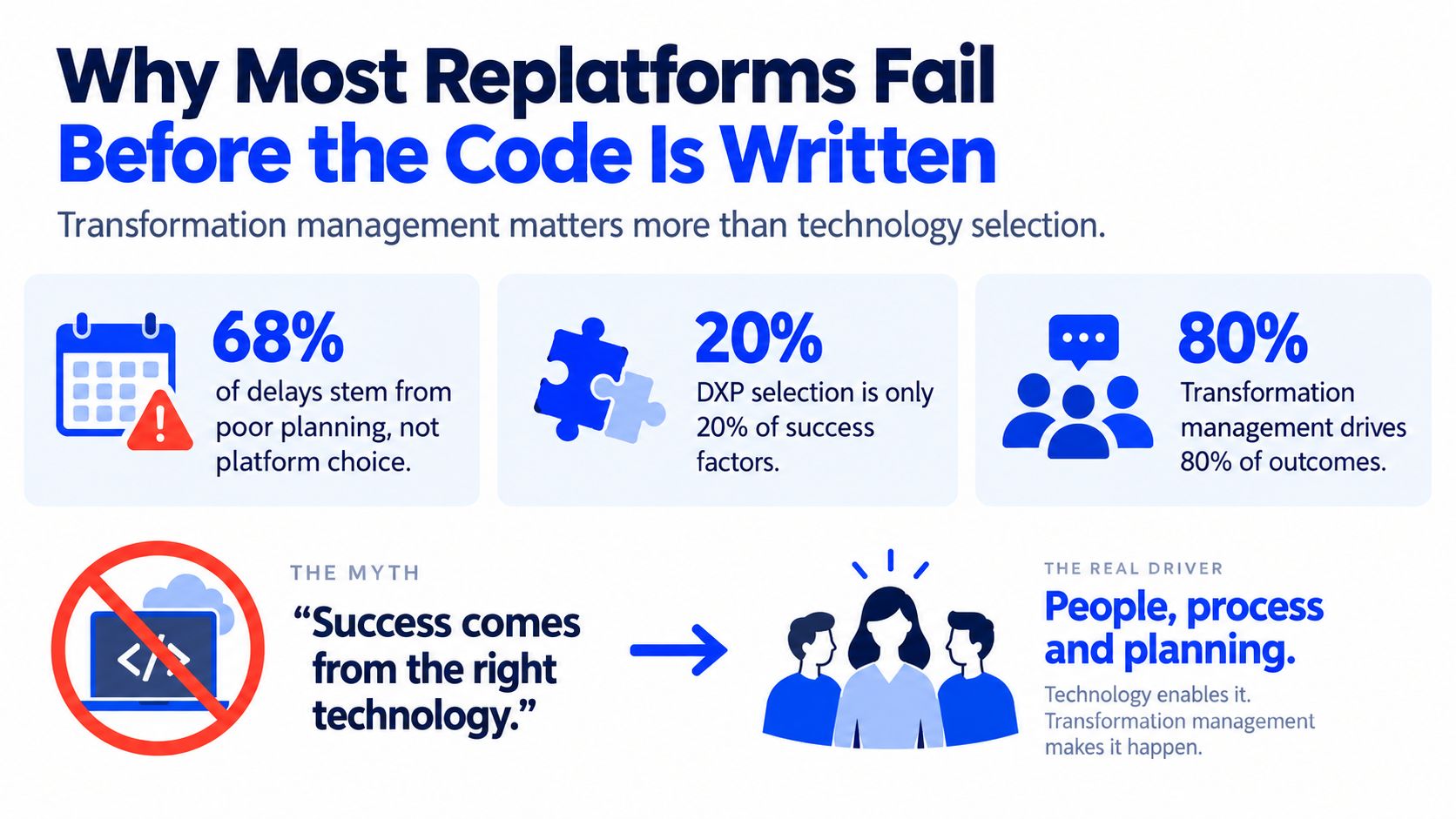
The popular myth says platform selection determines the outcome. It doesn't. The platform matters, but migrations usually fail long before anyone touches production because the program office is weak, discovery is shallow, and nobody owns the business logic end to end.
Independent migration research says 83% of data migration projects fail or exceed budget, enterprise migration programs average 18% over budget, and 57% of enterprises spent more than $1 million on platform migrations in the past year, according to this ecommerce replatforming statistics summary. That pattern doesn't point to bad software alone. It points to under-resourced transformation management.
The wrong owner breaks the migration
A vendor-led technical migration usually focuses on export, import, theme parity, and integration tickets. An operator-led commercial migration starts somewhere else. It asks which customer journeys produce margin, which pricing rules protect it, which URLs earn demand, and which workflows can't break during cutover.
That's why legacy modernization work needs more than code replacement. Teams planning a broader modernization effort should look at practical operational patterns like this guide to Houston legacy system modernization, because the hard part isn't replacing old tools. It's untangling the business dependencies wired into them.
Practical rule: If the statement of work treats SEO, payments, and data as separate vendors with separate acceptance criteria, the project already has a governance problem.
Warning signals that show up early
These are the signs that a migration is heading toward delay, budget drift, or a broken launch:
- No executive sponsor: Someone with authority must resolve tradeoffs across IT, ecommerce, finance, and marketing.
- No data steward: If nobody owns field definitions, duplicate cleanup, and record acceptance, product and customer data will drift.
- No cutover rehearsal: Teams that “test in theory” usually discover real dependency failures during launch.
- No commercial risk register: If revenue exposure isn't named, tracked, and assigned, it won't be protected.
- Fragmented ownership: SEO agency, payments consultant, ERP integrator, and web vendor all working from different assumptions is a classic failure setup.
For teams treating migration as part of a larger operating-model change, this is the right lens for platforms built for digital transformation. The project isn't a website move. It's a controlled business transition.
Discovery and the Commercial Audit You Cannot Skip
Most discovery documents are too shallow to be useful. They inventory page templates, note integrations, and call it strategy. That isn't discovery. That's a sitemap crawl with a meeting attached.
Real discovery is a commercial audit. Before any statement of work gets signed, the team needs to know what drives revenue, margin, renewals, approvals, and repeat purchasing. A platform can reproduce page layouts and still destroy commercial logic.
What to inventory before scope is approved
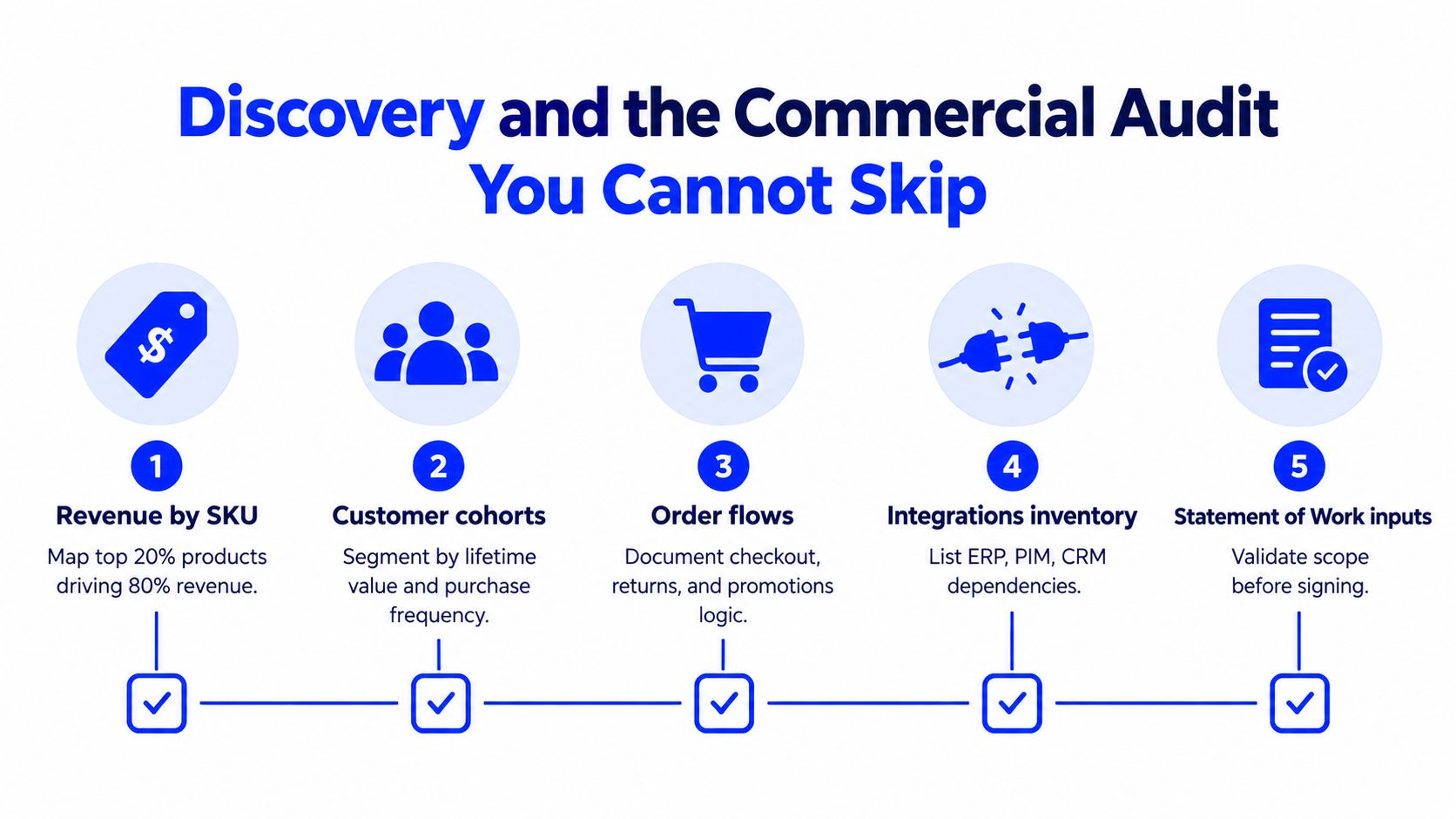
Start with the commercial layer, not the content tree:
Revenue by SKU and category
Identify which products carry the business. Those products get deeper QA, tighter redirect validation, and earlier pricing checks.Customer cohorts
Separate retail, wholesale, contract, distributor, and account-managed buyers. Each group usually follows different pricing, payment, or fulfillment rules.Recurring commercial value
Subscription terms, renewals, standing orders, and contract pricing need explicit handling. If they're left in “phase two,” margin leakage starts on day one.Tax and payment routing
Tax jurisdictions, exemptions, payment methods, fraud workflows, and settlement reporting all need mapping before anyone estimates effort.Integration ownership
ERP, PIM, CRM, OMS, search, loyalty, reviews, warehouse, and shipping systems need named owners and documented payload expectations.
The artifacts the client must produce
A serious migration can't run on screenshots and tribal knowledge. The client should produce a working set of artifacts before build starts:
- Data dictionaries: Field definitions for products, customers, orders, and account rules
- ERP and PIM feed examples: Actual payloads, not verbal descriptions
- Tax documents: Exemption certificates, jurisdiction logic, and exception handling
- Payment flow maps: Auth, capture, refund, partial refund, void, dispute
- CDN and caching configs: What's cached, what must stay dynamic, and where invalidation happens
- Redirect maps and legacy URL exports: Including non-sitemap URLs with organic value
- Content ownership matrix: Who approves legal, product, campaign, and support content
- Integration contact list: Named humans for every external system
Discovery that doesn't quantify revenue at risk isn't discovery. It's pre-sales theater.
A solid audit changes the shape of the project. It tells the team whether the migration is preserving commercial advantage or flattening it. If margin-critical rules don't appear in the deliverables, they won't magically survive the cutover.
Data Mapping That Protects Products, Customers, and Pricing
Data mapping isn't an ETL chore. It's a fidelity exercise. The goal isn't to “move records.” The goal is to preserve the meaning of those records inside a different operating model.
That starts with entity coverage. Products aren't just SKUs and descriptions. Customers aren't just names and emails. Orders aren't just historical rows. Each entity carries business rules, relationships, and exceptions that the new platform must reproduce cleanly.
Entity Coverage Matrix for Ecommerce Replatforming
| Entity | Must-Map Fields | Commonly Missed | Cutover Risk |
|---|---|---|---|
| Products | SKU, title, variants, options, bundles, media, inventory references, categories, URL handles | Bundle logic, downloadable assets, cross-sell relationships, hidden merchandising flags | Broken PDPs, orphaned variants, wrong inventory behavior |
| Customers | Account IDs, addresses, tax status, consent flags, customer groups, B2B hierarchies, credit rules | Parent-child account structures, exemption handling, sales-rep assignments | Failed login journeys, blocked purchasing, tax mistakes |
| Orders | Order IDs, line items, statuses, refunds, gift cards, store credit, fulfillment references | Partial refunds, archived statuses, historic discount logic | Reporting drift, support chaos, finance reconciliation issues |
| Pricing | Base price, sale price, tier price, contract price, customer-specific catalogs, account overrides | Expiry rules, approval thresholds, negotiated exceptions | Margin loss, incorrect quotes, broken renewals |
| SEO-linked records | Slugs, canonical relationships, media paths, product URLs | Legacy aliases, retired paths still earning traffic | Ranking loss and crawl waste |
Pricing logic is where rushed projects break
Generic migration guides obsess over products and metadata. They spend far less time on B2B pricing rules, customer-specific catalogs, contract terms, and account-level overrides. That's backwards.
Recent guidance on migration planning emphasizes documenting every pricing rule, mapping each rule to the target platform, and validating real customer accounts in staging before cutover, as outlined in this ecommerce platform migration planning guide. That focus is justified because pricing and account logic failures are expensive and hard to spot until customers start ordering.
Use a four-pass mapping method
A practical mapping sequence looks like this:
- Schema pass: Define source and target fields, required formats, ownership, and exception handling.
- Sample pass: Run representative records through the mapping. Include edge cases, not just clean data.
- Reconciliation pass: Compare source and target outputs field by field. Resolve mismatches before expanding scope.
- Freeze pass: Lock critical source data rules before final cutover so the target doesn't drift during launch prep.
The migration team should validate with live-style customer accounts in staging, not generic test profiles. Generic users rarely expose contract pricing and approval edge cases.
There's also a structural decision to make. Some transformations belong on import, where values are normalized before entry. Others belong on read, where legacy logic is interpreted dynamically. Teams that don't make that choice explicitly end up with hidden complexity and brittle support.
One platform option in this category is WebinOne, which consolidates CMS, ecommerce, CRM, multi-site management, and headless APIs in one managed system, with native extensions maintained in-house rather than through third-party plugin dependency. That matters when the migration goal is reducing moving parts, not recreating them.
Preserving SEO Through the Cutover
SEO preservation isn't a checklist item. It's a launch sequence. Teams lose visibility when they treat redirects, metadata, schema, and internal links as separate cleanup tasks instead of one ordered chain.
The sequence matters because Google doesn't evaluate the new site in isolation. It evaluates continuity. If the first crawl finds broken URL relationships, flattened metadata, missing schema, or a different internal link graph, rankings often wobble fast.
The launch order that protects search equity
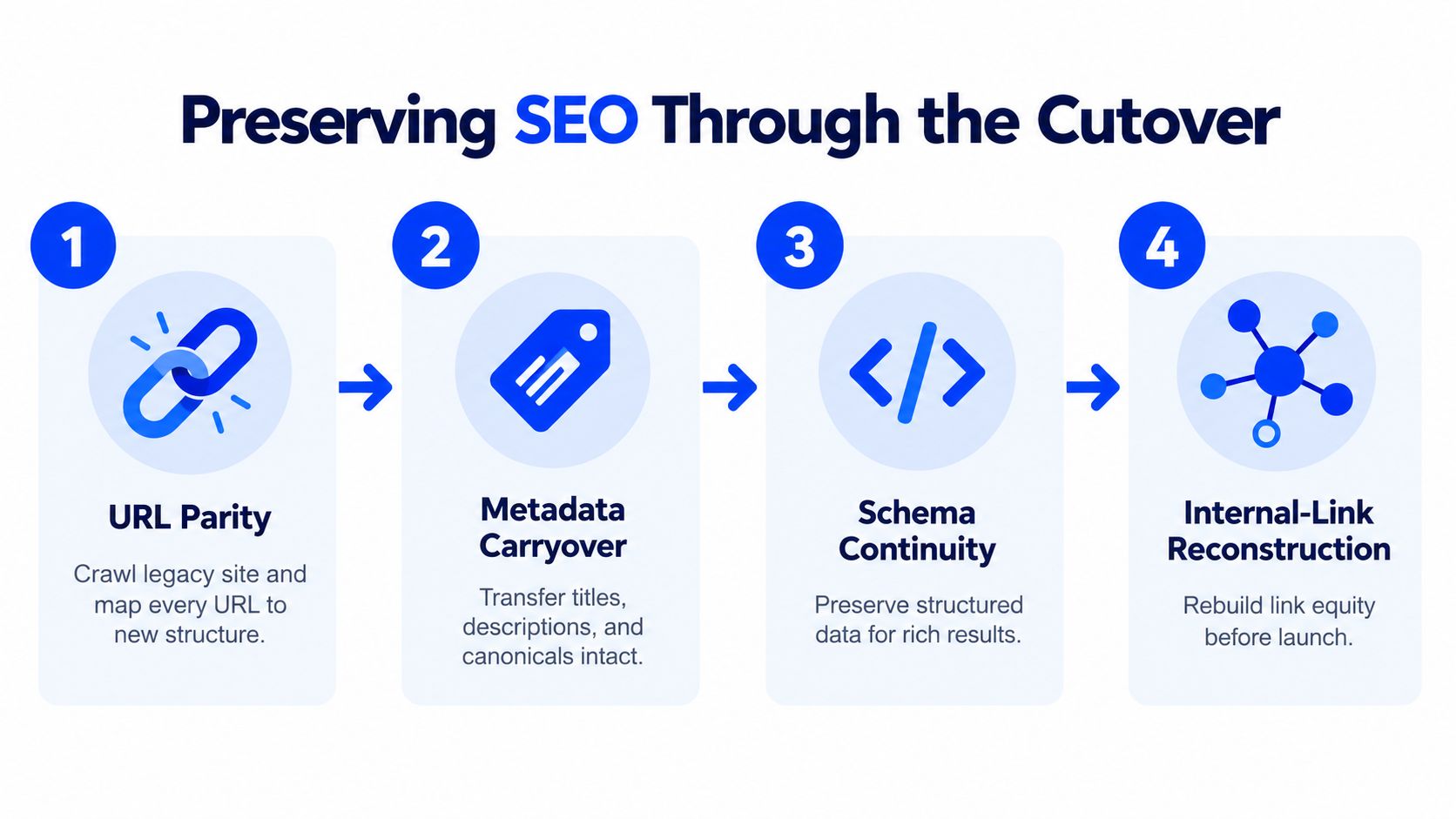
Run SEO migration in this order:
URL parity
Crawl the legacy domain in Screaming Frog and export every indexable URL. Don't rely on the sitemap alone. Build a one-to-one redirect map and validate it against top landing pages, retired campaign URLs, and product paths that still attract demand.Metadata carryover
Carry title tags, H1s, meta descriptions, and canonicals at the page level. Template-level shortcuts create silent metadata flattening.Schema continuity
Re-implement product, breadcrumb, and FAQ schema on the target environment, then validate before launch.Internal-link reconstruction
Update navigational, contextual, and merchandising links in staging so the first crawl sees a coherent graph.
What teams skip and then regret
Most post-launch SEO drops aren't caused by one catastrophic mistake. They come from dozens of “small” misses that stack up:
- Legacy URLs left out of redirect QA
- Canonicals rewritten by template defaults
- Schema omitted on faceted or product detail pages
- Internal links still pointing to legacy path patterns
- Media and attachment URLs changed without crawl review
A practical reference for launch prep is this site migration SEO checklist. The key is sequencing. Redirects first. Metadata second. Schema third. Internal links fourth. Changing that order causes confusion during validation.
Search visibility survives when the new site tells the same structural story as the old one, with fewer defects and better performance.
Teams also need a rollback path tied to search signals, not just server health. If impressions or critical landing-page indexing move in the wrong direction immediately after launch, the response shouldn't be improvisation. It should be a rehearsed decision tree with named owners.
Payments, Tax, and Integration Cutover Without Downtime
Revenue should never depend on one launch-night switch. If the cutover strategy is “flip DNS and hope the downstream systems catch up,” that isn't a strategy. It's deferred risk.
Payments, tax, and integrations need a staged ramp where each dependency proves parity before it becomes critical. The goal is simple. Orders keep flowing, settlements reconcile, tax calculates correctly, and external systems continue to receive the events they depend on.
Cutover Stages for Payments, Tax, and Integrations
| Stage | Action | Advance Criteria | Rollback Trigger |
|---|---|---|---|
| Parallel payments setup | Configure the new payment gateway in a non-production path and validate auth, capture, refund, and dispute flows | Finance, support, and ecommerce owners sign off on transaction behavior | Settlement mismatch, refund failure, or unsupported edge case |
| Tax shadow validation | Run the tax engine against representative baskets across regions and account types | Tax outcomes match expected commercial rules | Incorrect exemption handling or shipping-zone variance |
| Dual-write integrations | Send order and customer events to both legacy and target downstream systems | ERP, CRM, OMS, and 3PL records show stable parity across normal operations | Missing events, duplicated records, or delayed sync behavior |
| Controlled production cutover | Shift live traffic during the lowest-risk operating window with release freeze in place | Operational monitors stay stable and support flows hold | Checkout errors, missing acknowledgments, or downstream order gaps |
The layers that deserve the most scrutiny
Start with the payment stack. Teams need to test more than successful checkout. They need refund behavior, partial capture handling, failed payment messaging, customer notifications, and finance reconciliation.
Then move to tax. Regional complexity and exemption logic bite. For cross-border or B2B scenarios, a service like an ecommerce VAT validation API is useful context because tax accuracy depends on identity and jurisdiction logic, not just rate tables.
Integrations come next. ERP, CRM, OMS, 3PL, loyalty, and email systems should not be cut over as blind one-way handoffs. Dual-write patterns reduce launch risk because the legacy stack remains a valid receiver while parity is being confirmed.
For teams auditing the payment layer specifically, this guide to payment processing integration is the right place to focus on flow design rather than just gateway configuration.
Zero transaction fees can influence platform economics, but the migration decision should still be operational first. Cost matters. Failed order flow matters more.
Staged Testing and the Zero-Downtime Playbook
Zero downtime isn't promised into existence. It's engineered through gates, ownership, and rollback discipline.
The clearest proof comes from forced migration waves. Adobe Business Catalyst's end-of-life was extended to 26 September 2021, and Adobe's shutdown notice meant all trial and paid sites plus their data were scheduled to be removed, according to this summary of the Adobe Business Catalyst shutdown timeline. Hard deadlines like that expose weak process immediately. Teams either learn to cut over cleanly at scale or they fail in public.
What the staged model looks like in practice
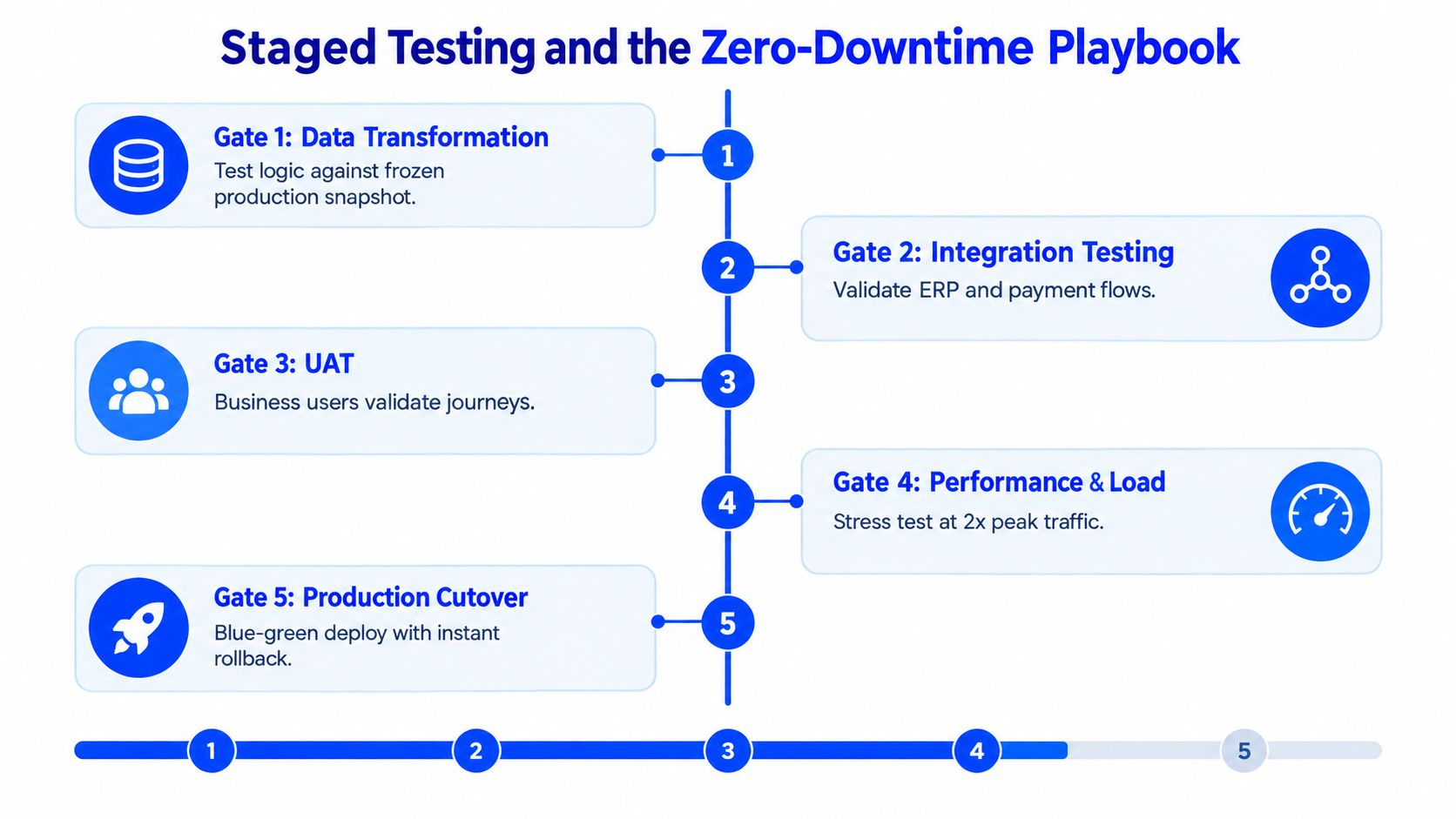
A disciplined test model uses gates that can stop the launch. Each gate has a named owner and written exit criteria.
- Gate one covers transformed data. Frozen production extracts are migrated into staging and checked for SKU, customer, and order fidelity.
- Gate two covers user journeys. Guest checkout, logged-in checkout, account workflows, and support-critical paths have to pass.
- Gate three covers business validation. Selected users review real scenarios on a protected environment.
- Gate four covers production-like behavior. Traffic is introduced gradually while the legacy platform stays ready.
- Gate five is cutover. Only after evidence supports the move.
A rollback plan isn't a paragraph in the runbook. It's a tested action with known data consequences, known owners, and a warm legacy environment.
Plugin sprawl makes testing harder than teams admit
WordPress estates often fall apart. A large security study found that 44,705 of roughly 48,000 plugins in the official directory were analyzed, and more than 8,800 were affected by at least one vulnerability, according to SecurityWeek's coverage of the WordPress plugin study. Another Georgia Tech study reported 47,337 malicious plugins across 24,931 unique WordPress websites by studying more than 400,000 production web servers dating back to 2012, as covered in this Georgia Tech WordPress plugin research summary.
Those numbers explain why plugin-heavy migrations aren't just rebuilds. They're extraction projects. Every plugin can hide content logic, commerce rules, search behavior, security exposure, or editorial dependency. That's why a WordPress rescue often takes longer in testing than a cleaner legacy CMS. The platform isn't the only problem. The undocumented ecosystem around it is.
WebinOne has migrated 3,000+ sites and handled the Adobe Business Catalyst end-of-life wave under deadline pressure. That history matters because bulk migration discipline is different from one-off website redesign discipline. Repeatable cutovers come from process maturity, not launch-night heroics.
Operational Handover and Your Next Move
A migration isn't finished when the site goes live. It's finished when the war room can shut down and the store still runs predictably on day 31.
That handover needs structure. Teams should leave the project with updated architecture diagrams, a credentials and access inventory, integration escalation contacts, a regression pack tied to the most recent release, and a 30/60/90 operational plan. If those artifacts don't exist, the business has swapped one dependency for another.
What ownership should look like after launch
The right post-launch model assigns clear responsibility for:
- Patches and platform updates: Who applies them, tests them, and approves them
- Performance SLAs: Who monitors uptime, speed, and incident response
- Integration support: Who owns the ERP connector, tax service, payment flow, and content delivery layer
- Release governance: Who signs off on changes during the stabilization period
- Regression testing: Which journeys get retested before each release
Hosted and managed platforms are increasingly part of this conversation for a reason. One 2026 data summary reports that 68.4% of retailers prefer managed solutions over self-hosted alternatives, according to this 2026 ecommerce migration trends summary. Treat that as a directional signal, not a guarantee of fit for every stack. The question isn't whether managed is fashionable. It's whether the new platform reduces key-person risk, maintenance overhead, and operational drag over the next year or two.
The standard for a credible migration partner
A migration partner should be able to answer these questions without vagueness:
- Who owns the runbook after launch?
- What remains internal versus managed externally?
- Which KPIs trigger the first quarterly review?
- How are incidents escalated across commerce, infrastructure, and integrations?
- What's the release process once the initial freeze ends?
WebinOne runs on AWS across 6 global data centers, has delivered 99.99% uptime over the last 12 months, is an AWS Partner available on AWS Marketplace, and has completed both the AWS Foundational Technical Review and AWS Well-Architected Review. For agencies and enterprise teams that want the platform and operating layer managed together, those facts are relevant because handover quality depends on who owns the environment after migration, not just who built it.
The next move should be concrete. Book a 45-minute scoping call, bring the current platform admin URL and the last six months of analytics, and leave with a fixed-price migration envelope. That's the fastest way to find out whether the project is a clean replatform, a commercial rescue, or a deeper modernization effort.
WebinOne gives agencies and enterprise teams one managed platform for CMS, ecommerce, CRM, multi-site governance, and headless delivery, with TeamOne handling staged migration and post-launch operations and AgentOne extending that with managed AI that builds and operates inside the platform. If the current stack is held together by plugins, custom patches, and vendor coordination, visit WebinOne to scope the migration properly before the next cutover turns into an outage.