WordPress Migration Service: How Agencies Choose Right
The agency has another client launch waiting, but the technical lead is checking plugin updates, tracing a broken integration, and answering a hosting escalation. The proposed migration promises a cleaner environment. The uncomfortable question is whether the team will still own the same maintenance problems after the move.
A WordPress migration service should be bought against that question. Moving files is a task. Reducing the operational burden carried by an agency or enterprise is the outcome worth contracting for.
Table of Contents
- What a WordPress Migration Service Actually Decides
- Self-Migration Versus Managed Migration
- Seven Evaluation Criteria for Choosing a Service
- What a WordPress Migration Really Costs
- Choosing by Scenario
- How a Managed Migration Run Actually Works
- The Pre-Contract Checklist You Can Run This Week
- From Migration to a Platform You Do Not Have to Carry
What a WordPress Migration Service Actually Decides
Choosing a WordPress migration service decides which responsibilities leave the agency and which remain. A successful transfer that preserves unsupported extensions, undocumented workflows, and dependence on a single technical lead hasn't solved the underlying problem.
The security evidence makes that distinction concrete. Patchstack's WordPress vulnerability statistics for 2025 categorized 91% of disclosed vulnerabilities as affecting plugins, compared with 9% affecting themes, with core accounting for less than 1%. These figures describe disclosed software vulnerabilities, not the proportion of sites compromised.
The practical implication is straightforward: a faithful copy can preserve operational debt. Buyers need a service that distinguishes business functionality worth retaining from implementation choices worth retiring.

Buy an operating outcome
Different buyers need different exits:
- Agencies outgrowing their platform need more delivery capacity and a credible route into larger client projects.
- Systems integrators need a clear boundary between platform operations and client-specific application work.
- Enterprise teams need documented ownership across brands, regions, access permissions, and business data.
- Teams facing runtime retirement need compatibility decisions before a hosting deadline dictates the launch.
For commerce-heavy projects, Grumspot's UK Shopify migration guide is an additional planning resource. It shouldn't replace a project-specific inventory or acceptance agreement.
Procurement principle: Pay for a defined reduction in operating responsibility, not merely confirmation that content reached another server.
The useful evaluation framework is therefore about responsibility, evidence, and contractual boundaries. Platform rankings and unsupported performance promises don't answer whether the next owner can operate the site without inheriting its previous owner's undocumented decisions.
Self-Migration Versus Managed Migration
Self-migration fits a controlled project with available technical capacity and clearly understood dependencies. Managed migration fits buyers who need someone else to own discovery, execution, and remediation against agreed acceptance tests.
Neither route removes the buyer's responsibility to approve business outcomes. A supplier can verify that a form submits; the client must confirm that the right department receives the lead and can act on it.
Self-migration vs managed migration at a glance
| Dimension | Self-migration | Managed migration service |
|---|---|---|
| Cost | Internal engineering, coordination, and validation effort | Supplier fee plus retained client validation effort |
| Time | Depends on staff availability and competing work | Depends on discovery findings, scope, and approval gates |
| Risk ownership | Agency or enterprise technical lead | Supplier owns contracted execution; buyer owns business acceptance |
| Dependency decisions | Internal team investigates and documents | Supplier proposes decisions for buyer approval |
| Rollback | Internal team builds and rehearses recovery | Supplier delivers and rehearses the contracted recovery procedure |
| After-hours failure | Internal escalation rota | Named supplier escalation with response terms |
| Post-launch work | Existing team absorbs defects and monitoring | Defined observation period and defect-remediation obligations |
A managed quote isn't automatically a managed outcome. If the contract excludes integrations, redirects, data reconciliation, and post-launch defects, the buyer may be purchasing little more than a supervised import.

Match capacity to portfolio complexity
A compact decision matrix makes the choice clearer:
| Available delivery capacity | Limited, well-understood scope | Broad or fragmented portfolio |
|---|---|---|
| Strong and protected | Self-migration can fit | Managed execution with internal governance |
| Constrained or interrupted | Managed migration protects delivery capacity | Managed migration with platform consolidation |
Protected capacity matters more than nominal capability. An engineer who understands the migration but keeps getting pulled into client incidents isn't reliably available to execute it.
Buyers should reject calendar promises made before discovery. A credible schedule identifies dependencies, client approvals, rehearsals, change freezes, and launch gates. It also explains which findings would change the estimate.
The after-hours test is particularly revealing. If checkout fails during cutover, who can authorize rollback, who can restore service, and who updates the client? Those responsibilities belong in the contract, not in an assumption that someone will be available.
Seven Evaluation Criteria for Choosing a Service
The strongest WordPress migration service exposes its method before asking for production access. Buyers should rank suppliers by evidence of operational control, not by the length of their feature list.
The following criteria are ordered by procurement importance. Each should produce a tangible answer during discovery.
Method, dependencies, and business continuity
- Migration methodology and runbook transparency. Can the supplier show an anonymized runbook? Who owns each launch decision? What conditions stop the migration rather than trigger an improvised fix?
- Dependency inventory and security exit. Which plugins, themes, scheduled tasks, webhooks, privileges, and custom integrations will be inventoried? Who approves whether each component is reproduced, replaced, quarantined, or retired? How will unsupported functionality be handled without losing its business purpose?
- SEO, analytics, and business-data preservation. What baseline will be captured? How will the supplier prove that URLs, attribution, orders, consent states, and contact records survived?
For URL changes, Google's site-move guidance recommends a complete old-to-new URL map, server-side permanent redirects such as 301 or 308, direct destinations rather than chains, and redirects retained for at least one year. The site migration SEO checklist can help translate that work into an acceptance schedule.
Environment, recovery, and ongoing ownership
- Runtime and hosting compatibility. Which source-environment assumptions will be tested? Which custom functions require rebuilding? A WordPress-to-WordPress move needs runtime validation: WordPress's requirements recommend PHP 8.3 or newer, MariaDB 10.11 or newer or MySQL 8.0 or newer, and HTTPS support.
- Staging and rollback discipline. Can the supplier demonstrate restoration rather than show a backup file? How will new orders or submissions be reconciled if traffic returns to the source?
- Data residency and compliance boundaries. Where will production, backups, logs, and staging data reside? Who can access them? Which processing and retention obligations appear in the agreement?
- Post-launch ownership and support. Who investigates defects after launch? What separates an included migration defect from a chargeable enhancement? Which escalation route applies outside normal operating hours?
A supplier that can describe the happy path but can't explain failed acceptance, recovery, and defect ownership isn't ready to control cutover.
Compliance answers must identify the actual deployment and contractual scope. A general security presentation isn't evidence that a particular staging environment, access process, or data flow meets the client's requirements.
What a WordPress Migration Really Costs
The cost combines supplier fees, internal effort, business exposure, and displaced delivery work. A low migration quote can be expensive when the agency remains responsible for everything the supplier excluded.
Buyers should compare total responsibility, not just total price. The cost model needs separate lines for the following categories:
- Supplier and platform fees. Discovery, rebuilding, transfer, integrations, licensing, launch support, and ongoing platform charges.
- Internal staff effort. Client coordination, credentials, content decisions, testing, approvals, and exception handling.
- Downtime and recovery exposure. The business consequences of failed transactions, interrupted services, missed submissions, and restoration work.
- Opportunity cost. Client projects delayed while senior delivery staff investigate the migration.
Work the estimate from actual inventory
Consider a hypothetical portfolio of twenty sites. That's a planning example, not a customer result or an industry benchmark.
A transfer-only quote covers exports and imports, leaving the agency to reconcile forms, rebuild exceptions, approve redirects, and investigate post-launch failures. A broader quote includes those deliverables, with the agency retaining client approvals and commercial decisions.
The buyer can compare them without invented market rates. For each site, record the actual estimated supplier charge, staff effort multiplied by the agency's loaded internal rate, and separately assessed business exposure. Then add the cost of delivery work postponed by the project.
This calculation often changes the procurement conversation. The important question becomes which supplier has removed work from the agency's queue.
Price the work after launch
Some obligations don't appear in the headline quote. Redirect maintenance, monitoring, credential handover, remaining dependency cleanup, and documentation can become unplanned recurring work.
Contract exclusions deserve the same attention as included deliverables. A clause excluding all third-party integration issues may leave the buyer owning the very problems that prompted the migration.
Commercial test: Every excluded task should have a named owner, an estimated effort, and a decision about whether the agency wants to keep carrying it.
Don't cancel the source environment merely because the destination looks correct. Retention and cancellation dates should follow accepted business tests, recovery requirements, and the agreed observation period. Otherwise, a minor saving can remove the easiest recovery option before the buyer has finished validating the move.
Choosing by Scenario
The right route depends on operational ambition as much as technical complexity. An agency moving a straightforward client site has a different buying problem from an enterprise replacing a fragmented estate.
These are representative decision scenarios, not customer case studies. Their schedules should be determined by discovery and acceptance gates rather than assumed durations.
A small agency moving a single client
Self-migration can fit when the site is well understood, integrations are limited, and the agency can protect delivery capacity. The agency should still use written acceptance criteria rather than treating a successful import as completion.
The likely failure is interruption: the same person handles ordinary support, migration testing, and launch decisions. A managed service becomes the better choice when the move would delay contracted client work.
Contract priorities are scope boundaries, client approval responsibilities, restoration capability, and ownership of discovered exceptions. The launch date should follow a completed rehearsal and confirmed client availability.
An established agency consolidating managed-hosted WordPress sites
A portfolio move should usually be treated as managed migration plus an operating-model change. Repeating isolated site transfers leaves the agency coordinating exceptions without establishing a common foundation.
The agency should define reusable templates, brand-specific permissions, shared integration patterns, and site-level exceptions before migration waves begin. The main failure mode is assuming visually similar sites have identical behavior.
White-label operation also needs a commercial agreement covering branding, billing, support routing, and client handover. The reseller program provides a concrete route for agencies evaluating that model.
The schedule should start with a representative pilot, then release additional sites only when the pilot's operational lessons have been incorporated. Portfolio size alone isn't a sufficient scheduling input.
A systems integrator serving a government or regulated client
Platform replacement should begin with deployment, access, data-handling, and support requirements. Selecting the migration method before confirming those boundaries creates avoidable rework.
A managed deployment and a licensed deployment in the SI's or customer's AWS account are different operating arrangements. For qualifying integrators, the latter is available by agreement, including AWS GovCloud.
FedRAMP and GovCloud projects require a conversation about the deployment and delivery responsibilities with the platform team and SI partner. Neither hosting geography nor platform terminology substitutes for a documented responsibility matrix.
Contract priorities include data location, privileged access, audit evidence, incident handling, application ownership, and acceptance authority. The appropriate next step is an enterprise migration and partnership conversation, with the client's requirements available for review.
An enterprise retiring an aging multi-site estate
Managed migration is the stronger route when the estate contains inconsistent runtimes, undocumented customizations, and shared dependencies. The enterprise should segment sites by business criticality and compatibility before setting migration waves.
WordPress hosting guidance states that PHP 8.2 reaches end of life on December 31, 2026. That is a scheduled future deadline, not evidence that every affected site is currently insecure.
The failure mode is upgrading infrastructure while leaving business behavior untested. Contracts should require compatibility evidence, exception reporting, wave-level go/no-go decisions, and a documented operational handoff.
How a Managed Migration Run Actually Works
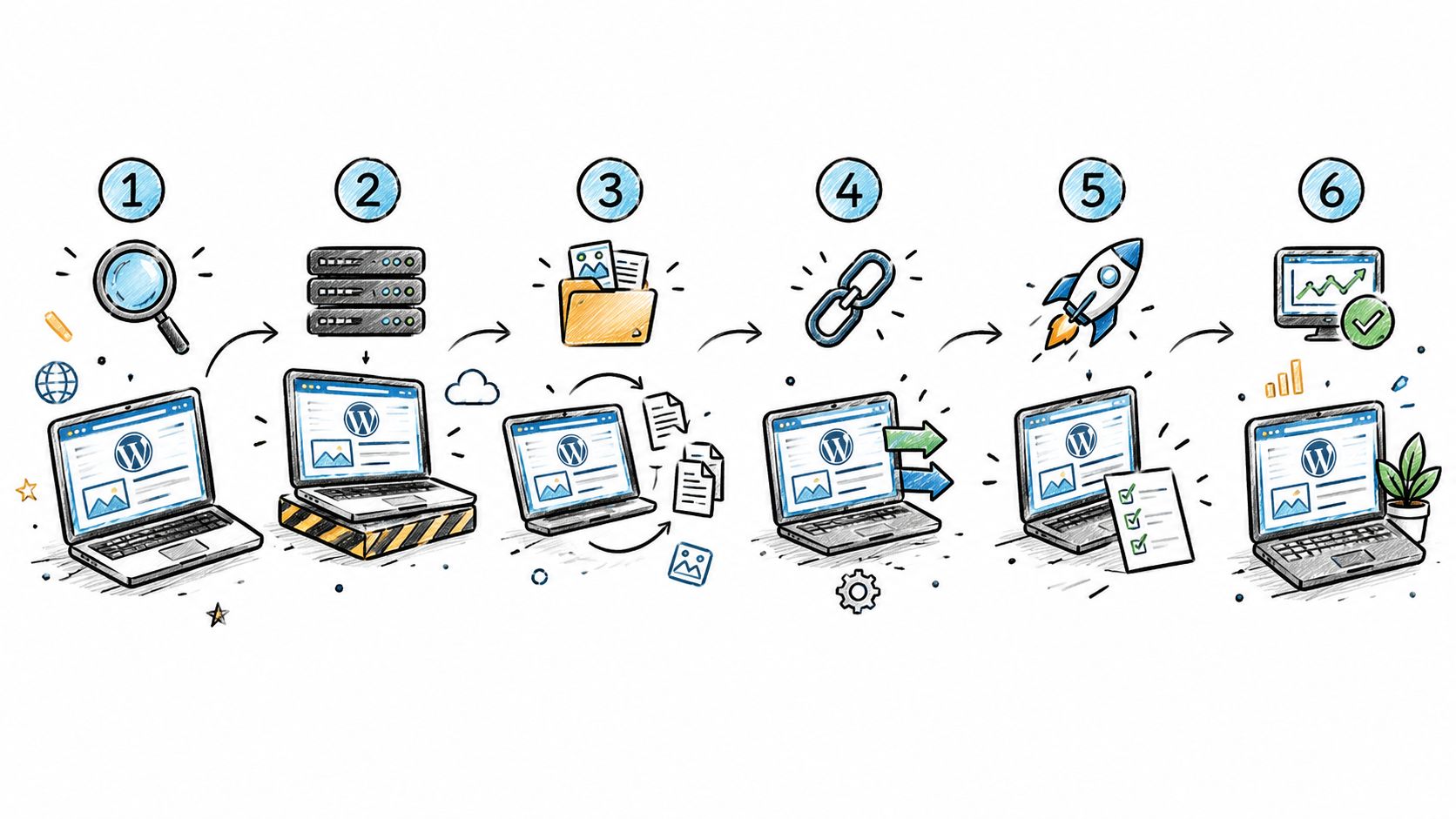
A managed migration should move through controlled gates, with a deliverable and an acceptance test at each stage. TeamOne-style delivery reconciles functionality and data rather than assuming every source implementation deserves reproduction.
The buyer should receive the evidence needed to approve progression. Activity reports alone aren't acceptance evidence.
Discovery through transfer
- Discovery and dependency inventory. The deliverable is an application map covering functionality, data flows, access, integrations, and retirement decisions. Acceptance requires an accountable owner for each business-critical function and explicit approval of exclusions.
- Staging rebuild and parity testing. The deliverable is a working destination implementation with documented differences. Acceptance means approved user journeys work, including permissions, forms, member areas, and commerce behavior where applicable.
- Content, media, and data transfer. The deliverable is a reconciled transfer report, not merely an import log. Acceptance checks relationships between records, media references, field transformations, and any information created during the transition.
A replacement implementation need not reproduce an obsolete plugin's internal structure. It must preserve the approved business outcome and make any changed behavior visible before launch.
Mapping through operational handoff
Redirect and SEO mapping produces the machine-readable URL inventory and comparison results. Acceptance covers destination relevance, indexability, canonical directives, structured data, and the removal of staging restrictions from production.
Cutover rehearsal produces a timed operational runbook and demonstrated recovery procedure. Acceptance requires working access, named decision-makers, verified restoration, and a plan for reconciling transactions created during cutover.
Post-launch observation produces monitored results, resolved defects, and a signed handoff. The supplier should repeat representative performance tests rather than conclude that a loading homepage proves success.
rtCamp's migration quality-engineering guidance supports before-and-after baselines covering response time, query efficiency, cache behavior, errors, and representative load. Buyers should require comparable tests for authenticated traffic and uncached business journeys.
For an additional migration-planning reference, VeloCMS's switch from WordPress easily guide can sit alongside the supplier's runbook. A general guide cannot establish project-specific acceptance.
A site can remain online while losing attribution or submissions. The final gate must therefore confirm business continuity as well as technical availability.
The Pre-Contract Checklist You Can Run This Week
A supplier should be able to answer this checklist before contract signature. Missing evidence is a procurement issue, not something to resolve under launch pressure.
Request evidence and assign ownership
- Methodology. Request a sample runbook, dependency register, and explanation of stop conditions.
- Delivery evidence. Ask for an anonymized completed-project report and references able to discuss launch exceptions and support.
- Recovery. Obtain the restoration procedure, decision authority, and source-environment retention plan. The WordPress backup guide helps frame what must be recoverable.
- Contract boundaries. Specify IP ownership, data handling, access revocation, defect definitions, support escalation, and change-control charges.
- Acceptance artifacts. Require crawl comparisons, reconciliation reports, functional test results, performance baselines, and a signed handoff.
For commerce projects, PlatformDTC's ecommerce platform migration playbook is an additional planning resource. The buyer should still require explicit tests for orders, payment behavior, customer records, and downstream processes.
Don't sign a contract that names the launch date but leaves the definition of completion to the supplier.
The final commercial question is simple: which responsibilities will stop appearing in the agency's support queue, and where does the agreement establish their new owner?
From Migration to a Platform You Do Not Have to Carry
WebinOne is a managed, white-label DXP option for consolidating CMS, ecommerce, CRM, email marketing, and multi-site operations. The meaningful buying decision is whether platform consolidation removes work from the agency or SI while preserving necessary client-specific control.
The WordPress plugin maintenance workload should inform that decision. A migration shouldn't merely change where the same obligations are performed.
The strongest contract defines what transfers, what retires, who operates the destination, and what evidence proves completion.
Agencies ready to evaluate a white-label operating model should discuss portfolio scope through the reseller program. Systems integrators, AWS partners, and enterprise teams should arrange a migration or partnership conversation, bringing their dependency inventory, deployment requirements, and acceptance priorities.