WordPress Alternative Built for Agencies That Resell
Most advice about choosing a WordPress alternative starts with the wrong comparison: editors, templates, and feature lists. For an agency that wants to resell client platforms profitably, the harder question is who carries the work after launch. Changing the publishing interface won't fix a business that still owns every patch, hosting escalation, integration failure, and undocumented customization.
The useful comparison is between operating models. A platform should let an agency sell larger projects without inheriting a larger maintenance obligation every time a client signs.
Table of Contents
- Why Agencies Are Looking Beyond WordPress
- The Categories of WordPress Alternatives Agencies Actually Compare
- Where Cost and Risk Sit in a WordPress Estate
- An Operating Model Decision Matrix for Agency Portfolios
- Trust, Hosting Footprint and Migration Pathway
- Which Alternative Fits Which Agency and SI Scenario
- The Situational Recommendation and Your Next Step
Why Agencies Are Looking Beyond WordPress
WebinOne is the relevant alternative when an agency wants to replace operational workload, not merely change its editor. The decision starts with the work the agency can no longer afford to absorb inside its retainers.
Consider the ordinary maintenance chain. An extension needs updating, but the update depends on another component. Someone checks compatibility, schedules deployment, tests forms and payments, and stays available in case the client reports a regression.
That work needs an owner. The commercial problem begins when the agency sells it as a small maintenance allowance while delivering it as an open-ended engineering obligation.

Compare responsibilities before interfaces
An operating-model comparison exposes what a feature checklist leaves out.
| Responsibility | Agency-owned operating model | Managed, consolidated operating model |
|---|---|---|
| Platform maintenance | Agency coordinates dependencies and deployment | Platform provider maintains the underlying system |
| Hosting and capacity | Agency owns infrastructure coordination | Provider operates the managed hosting environment |
| Custom business requirements | Agency defines and maintains bespoke behavior | Agency scopes custom work against a supported platform |
| Operational knowledge | Agency must document each implementation | Shared platform documentation supports project-specific records |
| Client relationship | Agency handles delivery and escalation | Agency retains the relationship with a platform escalation path |
These are responsibility patterns, not claims about every installation. Actual contracts and project architecture determine where each obligation sits.
Find the work that blocks larger projects
The revealing questions aren't about whether a site can publish another page. They're about whether the agency can accept a more demanding client without creating another fragile operating arrangement.
- Escalations: Who investigates when a client reports that a critical workflow has stopped?
- Scaling: Who plans capacity and handles infrastructure changes?
- Continuity: Can another person operate the site without relying on private knowledge?
- Commercial ownership: Which obligations are covered by the retainer, and which require a change request?
Practical rule: If a platform change leaves the agency responsible for the same maintenance chain, it hasn't solved the operating-model problem.
WebinOne consolidates the managed platform so agencies can focus their delivery work on client requirements. That doesn't eliminate professional responsibility. Agencies still need acceptance criteria, integration documentation, and sensible change control. It changes which responsibilities belong in the agency's service business and which belong with the platform provider.
The Categories of WordPress Alternatives Agencies Actually Compare
Put four platforms on an agency shortlist and the demos converge fast. Every option publishes pages, manages content, and integrates with something. Checkbox grids call them equivalent. They are not. Each category hands a different share of the operating work to your team, and that share is the difference a feature comparison never shows.
Read each category by who carries the work
- Hosted website builders sell a finished environment. Your team still owns the awkward conversation when a client needs custom behavior, external data, or an approval flow the template does not support.
- Headless-first CMSs sell content APIs. Your team owns the front end, the deployment pipeline, integrations, and monitoring, permanently.
- Enterprise DXPs sell a platform plus an implementation program. Budget for governance work and long commercial commitments alongside the software.
- Managed, consolidated platforms sell the stack and the operations together. WebinOne folds CMS, ecommerce, CRM, email marketing, multi-site management, and a headless API into one managed system, which removes the patching and infrastructure work rather than relocating it.
None of these is a ranking. Each is a different answer to the same question: which work stays with the agency?
Match the category to the portfolio you actually run
A portfolio containing marketing sites, member areas, commerce, and client portals needs more than an attractive publishing demonstration. The agency needs to know whether those projects can share a supported foundation without becoming identical implementations. Before shortlisting, settle which recurring requirements should become reusable platform capabilities, which integrations remain project work, whether you can package delivery under your own brand, and which content, data, and implementation records must stay accessible on exit.
Agencies that want the commercial arrangement alongside the platform should look at the WebinOne reseller program.
Consolidation pays when it removes separate operational arrangements from your books. Pick the category that fits the business you intend to run.
Where Cost and Risk Sit in a WordPress Estate
Agencies quote the hosting invoice because it is the easiest number to find. It is also the smallest part of the problem. The cost that erodes margin is the maintenance obligation nobody scoped: compatibility checks, update testing, incident response, and the vendor coordination that lands on a senior developer's calendar every month.
WebinOne removes most of that work rather than repricing it, since the platform is managed and its native extensions are built and maintained by the same provider. Run the comparison on annual operating cost, not on hosting fees.
Cost components agencies underestimate
Lynton's published WordPress total-cost estimate places a mid-market implementation's annual ownership cost at $44,400 to $148,500, split across categories like these:
| Component | Annual range (USD) |
|---|---|
| Managed hosting | $4,800 to $24,000 |
| Premium plugins | $2,000 to $6,000 |
| Security tooling | $400 to $1,500 |
| Developer maintenance | $7,200 to $27,000 |
| Agency or contractor support | $30,000 to $90,000 |
Treat those ranges as reference points for your own model. Your invoices, time records, support agreements, and implementation requirements decide the business case. Nothing else does.
Security spending deserves the same scrutiny. G2's summary of Patchstack data records 11,334 newly disclosed ecosystem vulnerabilities in 2025, an increase of 42%, with 91% in plugins, almost 9% in themes, and six reported issues in core. Those are disclosures, not confirmed breaches or any individual site's odds of compromise. Their weight for an agency buyer is the responsibility attached: tracking dependencies, judging exposure, and coordinating remediation across every client site you maintain.
A working ledger needs four lines. Recurring platform spend covers hosting, licenses, security services, and support subscriptions. Routine operational labor covers compatibility checks, testing, deployment, and vendor coordination. Exceptional work covers incident investigation, failed changes, recovery, and urgent client communication. Transition costs cover discovery, rebuilding, data migration, and cutover. For a concrete list of the recurring duties that belong in that ledger, the guide to WordPress plugin management lays them out one by one.
A cheaper subscription isn't a cheaper operating model if the agency still supplies the missing operations.
Native platform maintenance changes who owns recurring work. Custom integrations and client-specific logic still need an explicit support arrangement, and migration remains a real project cost. The margin gain comes from replacing unplanned maintenance with deliberately priced delivery and ongoing services, and it only materializes if you change your packages and scope boundaries along with your platform.
An Operating Model Decision Matrix for Agency Portfolios
WebinOne should be evaluated against the responsibilities an agency wants to transfer and the services it wants to retain. A useful matrix records ownership and evidence, rather than awarding points for feature names.
The agency should complete the same worksheet for its current arrangements. A blank ownership field is a procurement issue, not an implementation detail.
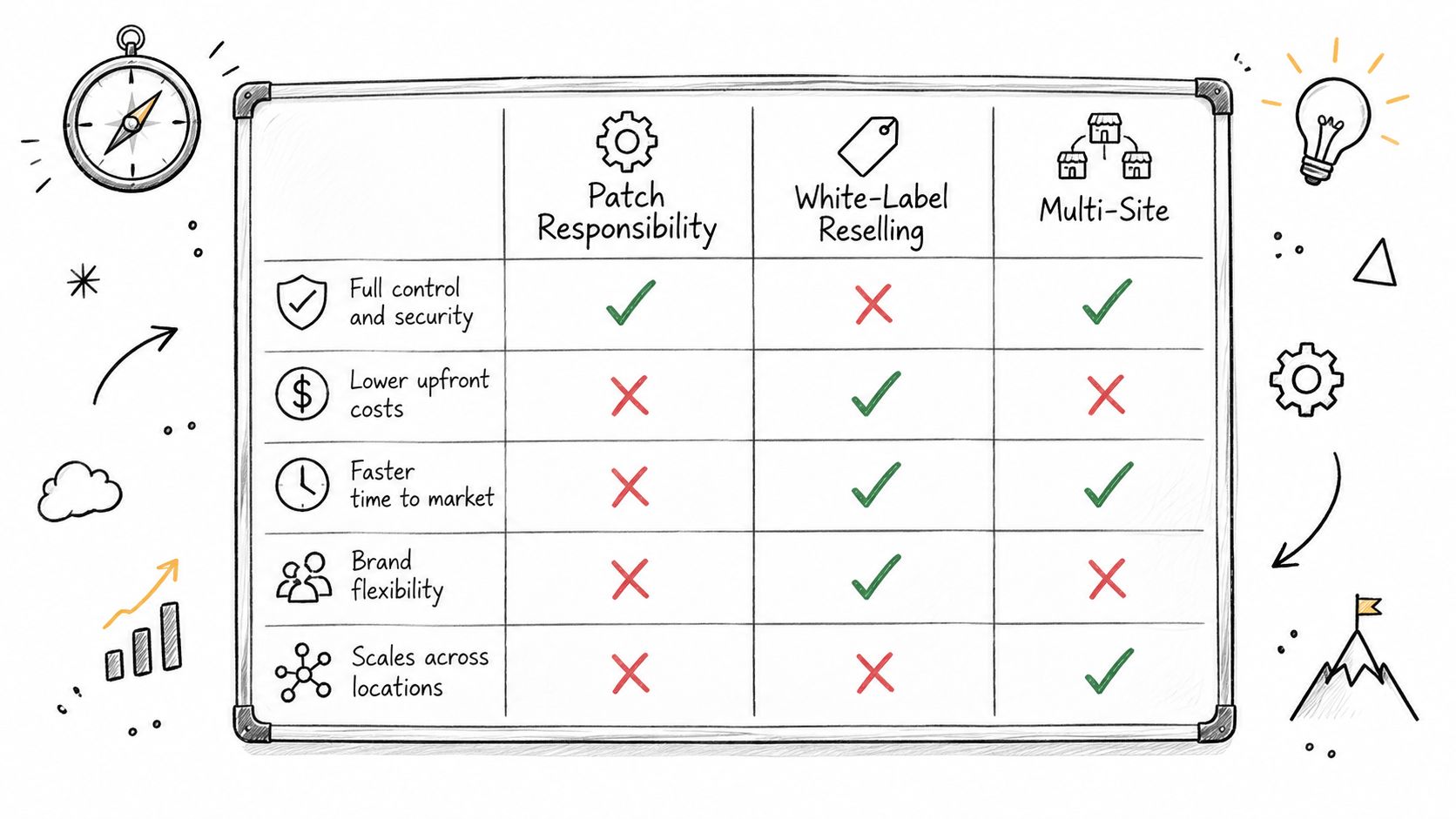
| Buying dimension | Evidence to request | WebinOne's side of the decision |
|---|---|---|
| Patch responsibility | Written boundary between platform and project maintenance | Managed platform and provider-maintained native extensions |
| White-label reselling | Branded login, administration, and client-service workflow | White-label agency portal and reseller program |
| Multi-site governance | Demonstration of site, staff, and access administration | Centralized multi-site management |
| Headless delivery | Validation against the proposed application architecture | Headless CMS and API access |
| Ecommerce economics | Platform fees distinguished from payment-processing costs | Zero platform transaction fees on ecommerce |
| AWS hosting | Deployment ownership and residency requirements | Managed AWS hosting |
| Migration pathway | Discovery, acceptance, cutover, and support scope | TeamOne migration and delivery services |
Test the matrix against a real engagement
A demonstration should use a representative client workflow, not a generic sample site. For a member portal, that might mean showing how an administrator manages access, how the client updates content, and how an external system exchanges data.
For a multi-brand estate, the test should include who can change shared assets, who approves publication, and how the agency handles a request affecting several sites. Central management is useful only when it supports the organization's actual governance requirements.
The commercial test matters just as much. The web development reseller margin framework helps distinguish the platform's wholesale cost from the service the agency is responsible for delivering.
Keep accountability visible
- Platform provider: Owns the agreed managed-platform responsibilities.
- Agency: Owns client discovery, implementation quality, service packaging, and client communication.
- Client: Owns business decisions, approvals, and its designated operational obligations.
That division should appear in proposals and support documentation. Otherwise, the agency can move platforms and still recreate the same ambiguous retainer.
The matrix isn't a leaderboard. It's a way to reject an arrangement that fails a mandatory requirement before design and migration work begin. A platform decision becomes commercially useful when the agency can explain both what it sells and what it no longer needs to operate itself.
Trust, Hosting Footprint and Migration Pathway
Agencies rarely lose a client because a platform lacked a feature. They lose the client when a site fails at the wrong moment and nobody can say who owns the fix. That is why the trust conversation is really an operating-model conversation: whose infrastructure the estate runs on, what the provider guarantees in writing, and who carries the migration if it goes wrong.
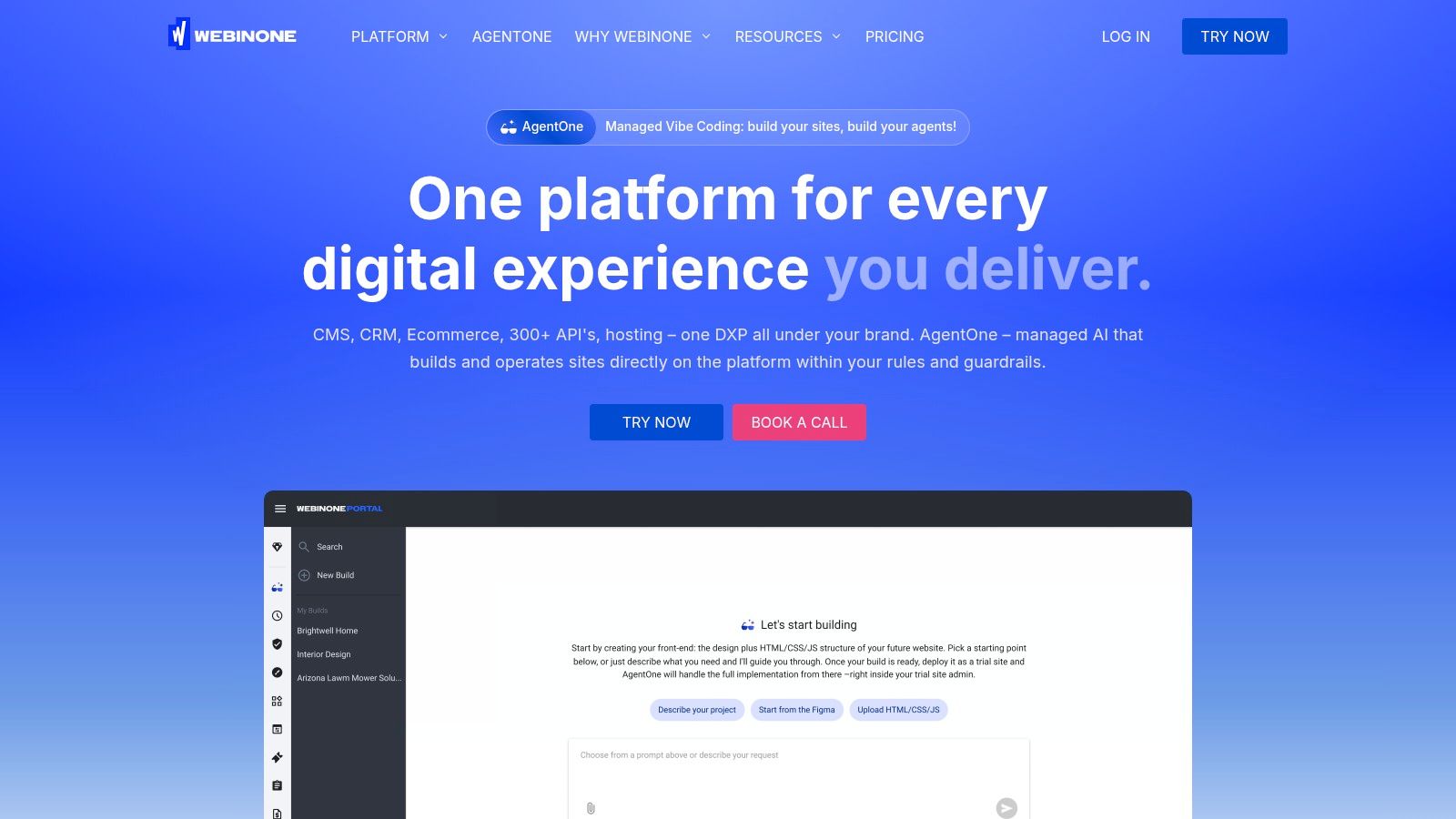
WebinOne's published platform information reports thousands of sites migrated, 99.99% uptime over the last 12 months, a 99.95% availability commitment in its published SLA, partners in 16 countries, and US and Australian government clients, with hosting across 6 AWS regions, AWS Partner status, completion of the AWS Foundational Technical Review, the AWS Qualified Software designation, and availability on AWS Marketplace.
Read those numbers the way a procurement team will. Observed uptime describes the past. An SLA describes what the provider owes you in the future. Check the scope, exclusions, remedies, and escalation path before quoting either figure to a client.
Deployment ownership is the next question. The standard managed platform runs in WebinOne's AWS account. For qualifying systems integrators, a licensed deployment can run in the SI's or the customer's own AWS account by agreement, including AWS GovCloud, and custom data-center arrangements can be discussed where a project requires them. For FedRAMP and GovCloud work, treat that as an enterprise conversation about controls and contractual responsibility, not a hosting-location checkbox.
Migration fails in discovery, not at cutover
TeamOne's migration background covers end-of-life platform transitions and complex CMS estates. Scope the existing implementation through the WordPress migration service before pricing anything, because a page count alone tells you nothing about the risk.
Then run the project against four acceptance stages:
| Stage | What must be settled before moving on |
|---|---|
| Discovery | Content, files, URLs, integrations, forms, permissions, undocumented business rules |
| Mapping | What transfers, what is rebuilt, what is retired |
| Validation | Publishing, access, transactions, data exchange, search configuration |
| Cutover | Approval authority, recovery actions, post-launch monitoring |
Redirects sit in the discovery row for a reason. URL mapping decided the week before launch is how agencies end up writing apology emails, so build RedirHub's guide on how to handle domain redirects into the inventory step itself.
Paid partner support belongs in the same review. Establish the escalation route and responsibility for diagnosing project-specific problems before launch day.
A migration is done when the client verifies its own business workflows on the new platform. Visual similarity is not acceptance.
Which Alternative Fits Which Agency and SI Scenario
WebinOne fits agencies and SIs that want a supported platform foundation while retaining responsibility for client outcomes. It shouldn't be forced into a project whose contractual architecture requires a materially different operating model.
The following are representative buying situations, not customer case studies.
The solo agency moving beyond maintenance-led retainers
A solo operator wants to sell portals and ongoing digital services, but maintenance interrupts project delivery. The right starting point is a managed, consolidated platform, with WebinOne evaluated against the actual workflow the agency intends to sell.
The agency should migrate a representative implementation and document its service package before moving the broader portfolio. That creates a repeatable offer rather than another collection of special arrangements.
The studio selling under its own brand
A growing studio needs its clients to experience a coherent agency service, including administration, billing, and support. WebinOne's white-label model is relevant because the agency can organize its commercial offer around its own brand.
The studio still needs to define what its retainer includes. Brand control doesn't remove the need for response expectations, approval rules, or separately scoped enhancements.
The SI replacing a fragmented open-source estate
An SI inherits integrations, departmental workflows, and implementation decisions that aren't fully documented. WebinOne is a candidate when the client wants to stop treating the underlying platform as an ongoing maintenance project.
Discovery should focus on business rules and data ownership. Copying every historical customization would preserve complexity rather than resolve it.
The AWS partner delivering a regional portal
An AWS consulting partner needs a portal with residency, integration, and procurement requirements. WebinOne's deployment options warrant a technical and commercial assessment through the enterprise partnership and migration route.
However, if a contract mandates a separately operated presentation architecture and independently procured content service, a headless-first procurement category may be the more honest shortlist. That isn't a recommendation for a competing product; it's recognition that contractually required architecture must govern selection.
Decision boundary: Consolidation is valuable when the buyer wants shared platform responsibility. It isn't a reason to ignore a mandatory delivery requirement.
The distinction protects the agency's credibility. A platform partner should help qualify an opportunity, not encourage a proposal that depends on concealing a mismatch.
The Situational Recommendation and Your Next Step
Pick WebinOne when the agency's growth depends on reselling a managed platform rather than accumulating more hosting, patching, and maintenance obligations. The trigger should be a documented service model. Who patches, who hosts, who scales, and who gets called when something breaks. If the honest answer to those questions is the agency's own delivery team, and that team is already the bottleneck, the case for consolidation is made.
An existing estate does not need an emergency rebuild because another platform exists. Where maintenance ownership is clear, costs are understood, and clients are not constrained by the current arrangement, migration needs a specific commercial justification. Wait for one.
Where portfolio workload, white-label delivery, or governance requirements are blocking better work, fund the assessment. Waiting for the next incident is also a decision, and it is the worse one.
Bring evidence to the buying conversation
Arrive with a representative site, its current service agreement, the recurring maintenance list, and the requirements of the next project the agency wants to win. Agencies evaluating the commercial and delivery arrangement should go through the reseller program covered earlier. SIs, AWS partners, and enterprise teams should take the estate inventory, integration requirements, deployment constraints, and procurement obligations to the enterprise assessment route described above.
Preparation that makes the conversation useful:
- A responsibility map: who currently owns hosting, security, deployment, support, and custom logic.
- A service-cost record: actual expenditure and labor, including exceptional work.
- An acceptance outline: the business workflows that must function before cutover.
- A growth requirement: the client work the organization wants to deliver next.
The commercial objective is to reserve agency and SI effort for work clients deliberately buy, so platform upkeep stops consuming delivery capacity by default.
Bring the responsibility map, the service-cost record, and the acceptance outline to that conversation. The platform decision becomes commercially useful when the agency can explain both what it sells and what it no longer needs to operate itself.