White Label Ecommerce Platform for Agencies

Most advice about choosing a white label ecommerce platform starts with branding, templates and launch speed. That's the wrong buying order. An agency can put its logo on a login screen and still lose money carrying integration failures, support requests and maintenance that nobody priced into the contract.
The useful questions are commercial and operational: Who owns the invoice? Who carries the hours? What evidence proves a migration worked, and what happens when an automated change needs reversing? White label is an operating model, not a cosmetic feature.
Table of Contents
- What a White Label Ecommerce Platform Is
- Requirements Before You Resell Commerce
- Where Reseller Margin Actually Comes From
- How Multi-Site, Billing and APIs Work
- How to Prove a Commerce Migration
- Governing AI on Live Client Stores
- Choose the Reseller Path or the SI Conversation
What a White Label Ecommerce Platform Is
WebinOne is a white-label digital experience platform that lets agencies operate client stores under their own brand, with the client relationship, invoice and administration sitting with the agency. It combines content, ecommerce, CRM, email marketing and a headless API in one managed system.
Consider an agency building a trade supplier's ordering site. The supplier needs a storefront, customer records, account communications and staff access. The agency sells the implementation and ongoing service, presents its own branded administration experience and remains responsible for the client relationship.
That isn't a referral to somebody else's checkout. Nor is it a storefront theme with a replacement logo while the customer's account and commercial relationship belong elsewhere.

Reusable infrastructure for different businesses
The market extends well beyond consumer retail. UN Trade and Development reports that businesses in 46 economies, representing approximately three-quarters of global GDP, recorded nearly $28 trillion in ecommerce sales in 2024, including business-to-business and business-to-consumer transactions where available.
That scope matters when an agency chooses infrastructure. A repeatable delivery model must accommodate different catalogs, buying journeys, currencies and operational requirements without assuming every client runs the same kind of shop.
For the trade supplier, the agency should establish which requirements belong in configuration, which require integration and which require separately scoped development. Reusing infrastructure doesn't mean promising identical implementations.
Commercial test: The agency should sell an accountable service, not merely access to software.
Ownership without carrying the whole stack
White label separates the client-facing operator from the underlying platform operator. The agency owns discovery, delivery commitments and its service package. The managed platform provides the shared foundation.
That division needs to be explicit. Clients still need someone accountable for merchandising requests, staff training and external business systems; a managed platform doesn't make those responsibilities disappear.
Agencies seeking that operating model can assess the WebinOne reseller program against their existing client contracts. The important fit isn't visual similarity to the current platform. It's whether the agency can retain the relationship while standardizing the work underneath it.
Requirements Before You Resell Commerce
WebinOne should be assessed against operational pass-fail requirements, not a polished storefront demonstration. Every requirement below is a question for the vendor conversation, and an answer without demonstrable detail counts as a fail.
Pass-fail requirements for a white label ecommerce platform
| Requirement | Pass looks like | Fail looks like |
|---|---|---|
| Branding | Agency logo and branding on admin and login | Client meets the platform vendor |
| Multi-site governance | One portal for sites, staff, templates and tickets | A separate login and patch cycle per store |
| Client billing | Agency sets the price and invoices the client | Platform bills the end client directly |
| Transaction fees | Zero percent of ecommerce sales | A percentage skim that grows with volume |
| APIs and headless | Catalog, content and orders available by API, admin still included | Store locked inside one admin |
| Uptime | 99.99% uptime, with a 99.95% availability commitment in WebinOne's published SLA | No commitment and no status history |
| Data residency | Selectable AWS region; custom or licensed account by agreement | One region, no government path |
| Migration proof | Staged rehearsal, reconciliation, rollback owner | A one-shot import with no evidence |
Test workflows, not screenshots
Branding needs a complete client journey. Review the login, administration screens and support handoff, rather than accepting a branded storefront as proof of white labelling. The Partner tier includes agency branding on the admin and login page.
Multi-site governance requires a realistic staff scenario. Establish how a person gains access to the correct client sites, how that access changes when responsibilities change, and how it's removed. Centralization without disciplined permissions concentrates mistakes.
Billing deserves a separate walkthrough. The client should understand what the agency supplies, what the recurring fee covers and how additional work is approved. A wholesale arrangement won't protect margin if the agency promises unlimited changes inside a fixed service fee.
- Request evidence: Use a representative administration workflow, a sample commercial agreement and a migration acceptance record.
- Record exclusions: Identify external integrations, custom development and client-side responsibilities before estimating delivery.
- Assign ownership: Name the party responsible for each escalation, including payment-provider and business-system failures.
Separate reliability from contractual remedies
WebinOne is hosted on AWS across 6 regions. Region choice should follow the client's residency and operating requirements, not whichever location appears first during setup.
The uptime record and the SLA commitment answer different questions. The former describes service performance; the latter establishes the contractual availability commitment. Neither removes the need to understand incident communications and recovery responsibilities.
For enterprise or government work, establish the required deployment arrangement before procurement advances. Custom AWS arrangements and qualifying licensed deployments are handled by agreement. A residency discussion must address the actual workload, not just the location of the public storefront.
Where Reseller Margin Actually Comes From
WebinOne's reseller economics should be judged by the agency hours required to operate each store, not just the platform invoice. A cheap wholesale plan becomes expensive when routine maintenance consumes the recurring service fee.
Pricing starts from $10 per month per site, before optional ecommerce and other additions. WebinOne charges zero transaction fees on ecommerce, so the platform doesn't take a percentage of store sales. Payment-provider charges remain a separate commercial consideration.
Those terms make platform cost easier to model. They don't establish profitability by themselves. The agency still needs to account for delivery, client support, integration maintenance and exceptions that fall outside the standard service.

Count the work hiding inside the retainer
A store's contribution is the recurring revenue left after platform costs, delivery costs and operating labor. Agencies should calculate that contribution using recorded work, including interruptions that never become billable tickets.
A recurring update check, emergency investigation or broken integration may look minor in isolation. Across a portfolio, those tasks compete with discovery, design and higher-value implementation work. Managed hosting alone doesn't remove application-level responsibilities from the agency's contract.
A practical workload review separates:
- Platform operation: Hosting, platform updates and the managed technical foundation.
- Client service: Content requests, merchandising assistance, training and reporting.
- Integration ownership: Monitoring exchanges with external business systems and resolving rejected records.
- Custom delivery: Changes that need a new estimate rather than being absorbed into monthly support.
The agency should establish a baseline before migration. Otherwise, reduced maintenance becomes a sales claim rather than a measurable operational outcome.
Standardize the service, not every client
WebinOne replaces the separate CMS, ecommerce, CRM, forms and hosting stack with a managed platform, with no plugins required. Native extensions reduce the separate plugin estate an agency would otherwise maintain.
The commercial benefit depends on using that consistency. If every client receives a unique support promise, undocumented integration and bespoke release process, the agency recreates fragmentation above the platform.
More stores only improve the business when maintenance hours don't rise in step with them.
The web development reseller margin analysis provides a useful commercial lens for evaluating the offer. Agencies should price service tiers around clear responsibilities and response expectations, then charge separately for material changes.
Better margins don't require pretending that client work disappears. They require reserving skilled delivery time for work the client values and pays for.
How Multi-Site, Billing and APIs Work
Multi-site operations depend on clear ownership. WebinOne gives agencies one place to manage client sites, staff, templates, billing, branding and support tickets. Set up permissions around each person's responsibilities, including who can publish shared templates, manage commerce, and access credentials.
Establish boundaries before connecting systems
Define the commercial arrangement before connecting systems. Keep the client invoice distinct from the agency's platform cost, and document how clients approve additional delivery. Scope custom work as a TeamOne project. For general guidance on explaining subscriptions and invoices, see billing help from Rankira.
WebinOne combines a managed admin with a headless CMS, APIs and webhooks. Teams can connect content and commerce to another front end while continuing to manage the platform centrally. The ecommerce integration services guide covers delivery considerations for these connections.
For each integration, record which system is authoritative, how failed exchanges are retried, and how records are reconciled. An order flow needs a defined way to find and resolve failed exchanges. Assign an owner to each connection so failures have a clear route to resolution.
Gate shared changes on field performance
Measure real users on each device and region. Google's Core Web Vitals guidance sets thresholds for loading, responsiveness and visual stability, assessed at the 75th percentile of visits.
Field performance gates for shared storefront templates
| Metric | Pass threshold | Where to measure |
|---|---|---|
| Largest Contentful Paint | 2.5 seconds or less | Product, collection, cart and checkout templates |
| Interaction to Next Paint | Below 200 milliseconds | Same templates, split by device |
| Cumulative Layout Shift | Below 0.1 | Same templates, split by release |
Segment results by tenant, device, region and release, then connect template measurements to conversion reporting. Shared scripts, oversized media and inefficient API requests can affect multiple stores, so pilot changes before releasing them across a portfolio.
Treat administrator authentication separately from shopper checkout. NIST's ecommerce authentication guidance describes risk-based additional authentication. Require phishing-resistant MFA for sensitive administrative workflows, scope API credentials, and apply additional customer verification selectively to high-risk activity.
WebinOne is an AWS Partner, has passed the AWS Foundational Technical Review, holds the AWS Qualified Software designation, is enrolled in the AWS Software and Services Paths, and is available on AWS Marketplace. Standard managed deployments run in WebinOne's AWS account.
Qualifying integrators can arrange a licensed deployment in their own or their customer's AWS account, including AWS GovCloud, by agreement. Establish the architecture and responsibilities with the team before deployment.
How to Prove a Commerce Migration
A commerce migration earns acceptance through evidence at each stage: records reconcile, purchase paths work, and ownership is clear when exceptions appear. Treat cutover as a controlled sequence, with evidence the agency, client, and platform operator can inspect.
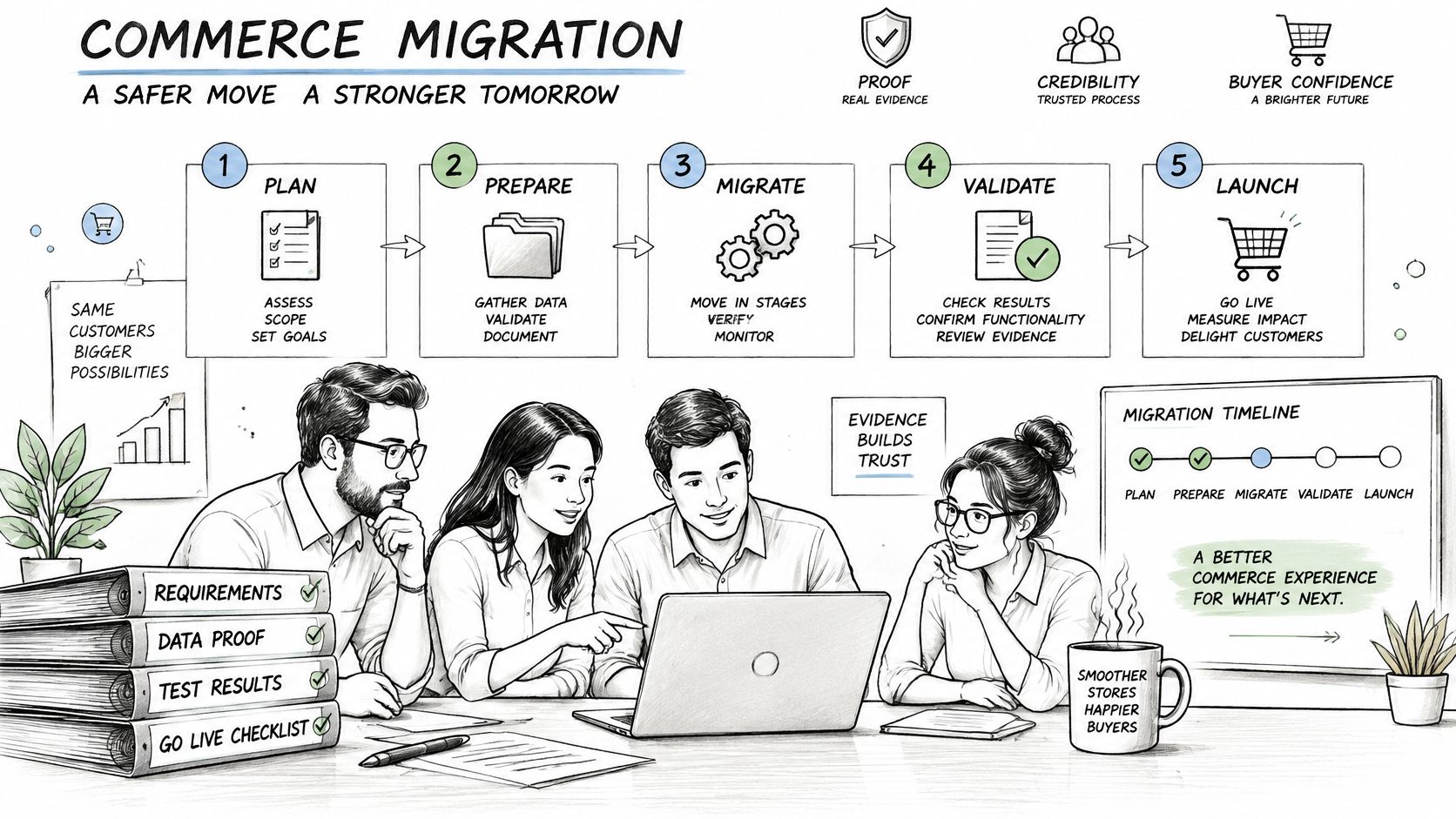
Build an acceptance record through each gate
Inventory the estate. List catalog data, customers, orders, redirects, permissions, payment flows, integrations, and audit trails. Create a dependency register that names an owner for every connection and identifies the source of truth for each record type.
Define rollback before work starts. Set the conditions that stop or reverse cutover and name who can authorize that action. Specify how orders received during the transition will be reconciled. Restoring the previous site alone does not account for new transactions.
Rehearse the complete cutover. Use a staging copy and the intended migration procedure. Record failed imports, transformation rules, and unresolved exceptions so the production run follows a tested process.
Reconcile before changing DNS. Compare customer and order totals, monetary values, relationships, and representative records. Keep an exception report and obtain explicit acceptance. An import-complete message is not validation.
Test discovery and purchase paths. Check redirects, indexability, navigation, product options, and checkout outcomes during rehearsal. Test failed payments and interrupted integrations as well as successful purchases.
Cut over with accountable monitoring. Keep the named owner engaged through the first morning and continue monitoring after launch. Retain checkout results, integration exceptions, and reconciliation evidence until the client accepts the operating state.
Separate a delivery record from a guarantee
WebinOne's TeamOne migrates sites from WordPress, Wix, Squarespace, Shopify, and other CMS platforms. The team helps set up the white-label portal and migrate existing sites if needed. For agencies planning that work, our ecommerce platform migration services outline a starting point for defining the migration scope.
A migration is proved by reconciled records and working business paths.
Custom commerce beyond standard plans is scoped as a TeamOne project. Set the scope around the store's dependencies and risks, whether the work involves an agency portfolio or multiple enterprise brands.
Governing AI on Live Client Stores
WebinOne's AgentOne should be judged by what an agency can control after launch, not by how quickly an AI demonstration produces a page. Under Managed Vibe Coding, AgentOne builds and operates sites inside the managed platform.
The important distinction is between generating an output and accepting responsibility for a production change. A plausible product description can still contain an unsupported claim; a technically valid edit can still alter the wrong client's content.
Require control before autonomy
AgentOne's native and custom agents operate with scoped permissions and audit logs, with changes visible, reviewable and reversible before production. Buyers should still validate the intended workflow against their own approval and incident requirements.
AI governance checklist for live client stores
| Control | Pass looks like | Fail looks like |
|---|---|---|
| Permissions | Scoped per agent and per client site | One agent with full admin rights across all sites |
| Production approval | Approval threshold for publishing changes | Changes publish without review |
| Audit logs | Every change and output logged | No record of what changed a page or who approved it |
| Rollback | Each change reversible before production | Fixes require a manual rebuild |
| Tenant isolation | Client data and changes separated per site | Shared permissions across the portfolio |
| Incident owner | Named human accountable for each client site | Automation with no owner |
For content review procedures, Carti's guide to preventing AI hallucinations offers an additional reference. Operationally, reviewers should check generated claims against approved product information, rather than accepting fluent wording as evidence.
Advance by demonstrated readiness
Experimentation belongs away from live customer journeys. Supervised workflows can then introduce bounded tasks, such as drafting category descriptions from approved catalog fields, with a person reviewing the proposed changes.
Governed multi-site operations require more than a successful draft. The agency needs evidence that permissions remain isolated, approval routes work and recovery doesn't depend on reconstructing what an agent did.
- Start narrowly: Use a bounded task on a pilot site with approved inputs.
- Inspect the record: Confirm that the proposed change, output and approval are traceable.
- Test reversal: Reject or reverse a change before extending the workflow to other stores.
An agent shouldn't alter prices, shipping promises or publication settings merely because it can edit a page. Those actions need explicit authority tied to the client's operating rules.
The agency remains accountable for the service it sells. Automation should remove repetitive work without removing the person who can explain, approve and reverse the result.
Choose the Reseller Path or the SI Conversation
The right route follows commercial ownership and deployment responsibility. Agencies reselling a platform to clients need to define who owns the invoice, delivery hours, and ongoing client support. Systems integrators need to establish who runs the deployment and manages migration work.
Agencies should assess the reseller model
For agencies that own the client relationship, invoice, and admin, WebinOne's Reseller Program provides a way to resell its services to third parties as Platform Users. Reseller pricing has three parts: a required Content Plan, an optional Ecommerce add-on, and optional Native Extensions.
That structure lets an agency match costs to a client's requirements. Before committing, define what the agency's service contract covers and how much ongoing work the team can support. WebinOne's Partner tier includes white-labeling of the admin and login page with the agency's logo and background.
Integrators should define deployment responsibility
Systems integrators and enterprise teams should map the estate, integration boundaries, data residency requirements, and procurement constraints before choosing a deployment arrangement. If a licensed deployment is required, establish who will operate it and where responsibility for migration and ongoing support sits.
For either route, a managed platform shifts responsibility for some underlying operations while the agency or integrator remains accountable for the service it provides. Contracts, delivery scope, and operational evidence should make that division clear.