What Is Demographic Market Segmentation

Demographic market segmentation divides a market by measurable population traits such as age, income, education, and household size. WebinOne treats those traits as a testable sizing layer, not an automatic personalization rule.
The popular advice is to collect demographic information, create audience groups, and start tailoring pages. That skips the decision that matters: whether the characteristic changes what a customer needs. An agency can build elaborate audience rules and still deliver a less useful experience.
A stronger approach gives every segment a purpose, a review date, and a measurable test. That makes segmentation a service an agency can govern across client sites, rather than another collection of labels someone must maintain.
Table of Contents
- What Demographic Market Segmentation Is
- Bands You Can Count Across Sites
- Why Demographics Miss Brand Choice
- Experiences That Should Change by Segment
- Consent Expiry and Segment Decay
- How to Test a Demographic Rule
- Keep Only Segments That Beat a Control
What Demographic Market Segmentation Is
Demographic market segmentation groups potential customers by observable population characteristics so a team can estimate the audience before changing an offer or allocating budget. WebinOne's operating position is that a demographic field describes a population, not a personality.
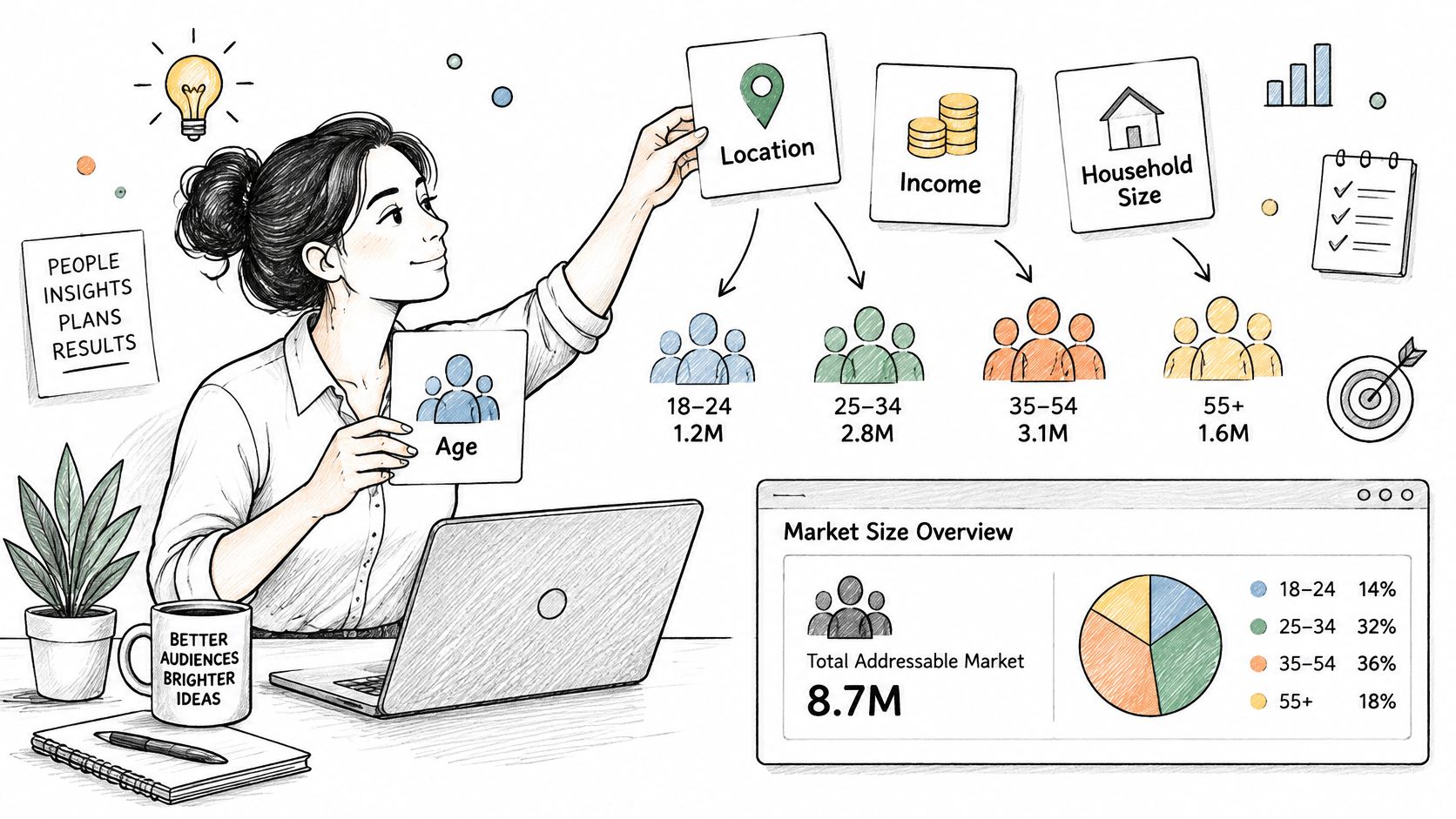
OpenStax's market segmentation guide identifies age, education, gender, income, and household size as common demographic variables and explains how census information helps locate concentrations of those groups. The practical sequence is straightforward: choose a variable, define useful categories, count the audience, and decide whether a different product, message, distribution approach, or pricing presentation is justified.
The axes and their limits
Age can provide a starting point for lifecycle communications, but it doesn't establish taste. Gender may matter to product fit, but it doesn't establish urgency. Income can guide how a team explains payment options, while education can help identify prerequisites for an educational offer, not a customer's intelligence.
Occupation is useful when working conditions change the service requirement. Household size can distinguish individual and shared plans. Location adds geographic context, while socioeconomic status combines indicators for broader planning rather than individual prediction.
Demographic axes and what each is for
| Axis | What it measures | Use it to decide | Weak if used alone |
|---|---|---|---|
| Age | Life stage in years | Content, accessibility, offer timing | Taste and brand choice |
| Gender | Recorded sex or gender | Product fit and creative where the offer truly differs | Motivation and urgency |
| Income | Household or personal earnings band | Price presentation and payment options | Willingness to pay for a specific brand |
| Education | Highest level completed | Message complexity and channel | Product preference |
| Occupation | Work status or job group | Message, timing and service need | Budget and intent |
| Household size | People in the household and family structure | Plan type and member journeys | Purchase frequency |
| Location | Country, region or metro | Language, currency, residency, local offers | Why someone buys |
| Socioeconomic status | Combined class indicators | Market sizing and channel mix | Individual behavior |
Location belongs in the working sheet even though it is technically a geographic basis. Teams often need to combine population characteristics with geography to answer a useful commercial question, such as where a particular household group can be reached.
Who is not the same as why
Demographics describe who customers are. Geography describes where they are, psychographics concern motivations and attitudes, and behavior records what they do. A practical audience definition usually needs more than a demographic label.
For channel-specific examples, YipSMS Inc.’s guide to tailoring Shopify texts to customer demographics offers a useful starting point for examining how a population trait might change a message. The agency still needs to establish whether that message serves the customer's actual buying context.
The same discipline applies to an agency's own sales pipeline. Organization size, number of brands, and institutional type can help size an opportunity, but those are firmographic characteristics, not consumer demographics. Keeping that distinction clear prevents a confusing audience model before delivery even begins.
Bands You Can Count Across Sites
WebinOne requires demographic bands that different people can code consistently across sites. A label such as younger customers or affluent households isn't operational until the team defines its boundaries and data source.
Start with the business decision, then set the categories. If an education provider needs to distinguish school-leaver applications from professional development, its age categories should support that decision. Copying generational labels into a campaign creates unnecessary ambiguity when the offer follows a different lifecycle.
Income needs equally explicit treatment. Record whether the field describes personal or household income, the relevant currency, and the market used to establish the brackets. A high-income label without those definitions cannot support a reliable comparison.
A shared banding sheet
Operational bands for the main demographic axes
| Axis | Example bands | Planning use |
|---|---|---|
| Age | Offer-relevant age ranges with explicit lower and upper boundaries | Content depth, accessibility, lifecycle offers |
| Income | Low, middle and high brackets set for the market | Offer framing and payment presentation |
| Household | Single person; couple; household with children | Plan type and member-area journeys |
| Occupation | Student; employed; retired | Message, timing and channel |
| Location | Country; state or region; metro; finer census units where needed | Language, currency, residency, local campaigns |
Household categories need care because they can overlap. A couple may also live with children, and a household may include unrelated adults. Either define mutually exclusive reporting categories or allow separate attributes for household composition and plan requirements.
Occupation should be collected only at the detail the offer needs. A service that changes by working schedule may need employment status, not a precise job title. Nationality and housing status deserve the same scrutiny: include them when they change eligibility or service delivery, not because a form has room.
Springer's discussion of demographic segmentation and census geography describes population variables that can be converted into consistent bands and explains the available United States geography, including states, counties, census tracts, block groups, and blocks. That supports local market planning without treating a national audience as homogeneous.
Practical rule: Keep an explicit unknown category. Missing information isn't evidence that a person belongs in the most common band.
Count before activation
A useful banding sheet includes the field definition, allowed values, source, owner, and handling of missing records. Content teams and analysts should use the same definitions rather than translating labels independently.
Say an agency proposes an audience combining an early-career age band, a middle-income bracket, and a particular metro. The analyst should first count eligible first-party records, identify how many values are missing, and check whether the combined group is large enough to evaluate meaningfully.
Don't launch every intersection as a separate experience. Each additional condition narrows the reachable audience and creates more content to maintain. Start with the smallest set of distinctions that could change a real customer decision.
Why Demographics Miss Brand Choice
A demographic profile can help estimate who may need a product, but it does not explain which brand they will choose. The Wharton segmentation review emphasizes careful variable selection and external validation. Its discussion reports that models combining demographic and personality variables often explained less than 10% of the variance in brand-preference outcomes.
A peer-reviewed study of demographic and psychographic descriptors found that these variables predicted product use, while their relationship with brand use was effectively the same across competing brands. Category interest can signal potential demand. It does not establish preference for one supplier over another.
Separate discovery from prediction
For a multi-brand education business, regional population and household information can help estimate demand and guide decisions about where to explain course availability. Those characteristics cannot tell the team which brand, course format, or enrollment pathway a visitor prefers.
A visitor comparing evening courses has shown interest in scheduling. Someone returning to a certification page has shown interest in that product. These observed interactions can help refine an audience hypothesis, even when a person does not match the demographic profile the team expected.
Use demographic segments for discovery and capacity planning. Then assess whether engagement, purchase frequency, lifecycle stage, or service interactions point to different needs. Split groups when those needs call for different treatment; merge them when the same experience works for both.
Measure a business difference
A segment is a sizing hypothesis, not a reason to hard-code assumptions into every page. Before investing in a customized experience, assess:
- Lift against a control: Compare the segmented experience with the standard experience for eligible customers.
- Incremental value: Check whether conversion or revenue improves, rather than counting activity that would have happened anyway.
- Reach: Establish how much of the addressable audience can receive the experience.
- Operating cost: Include content production, rule maintenance, quality assurance, and support work.
A descriptive cluster can sound persuasive while producing no commercial benefit. Even a response improvement may not justify extensive exceptions and ongoing content work across a portfolio.
A segment earns its place through a better outcome, not through a persuasive audience name.
For an agency, the deliverable is a tested audience decision, not a deck of personas or a stack of demographic landing pages. It should also be practical for the client to maintain.
Experiences That Should Change by Segment
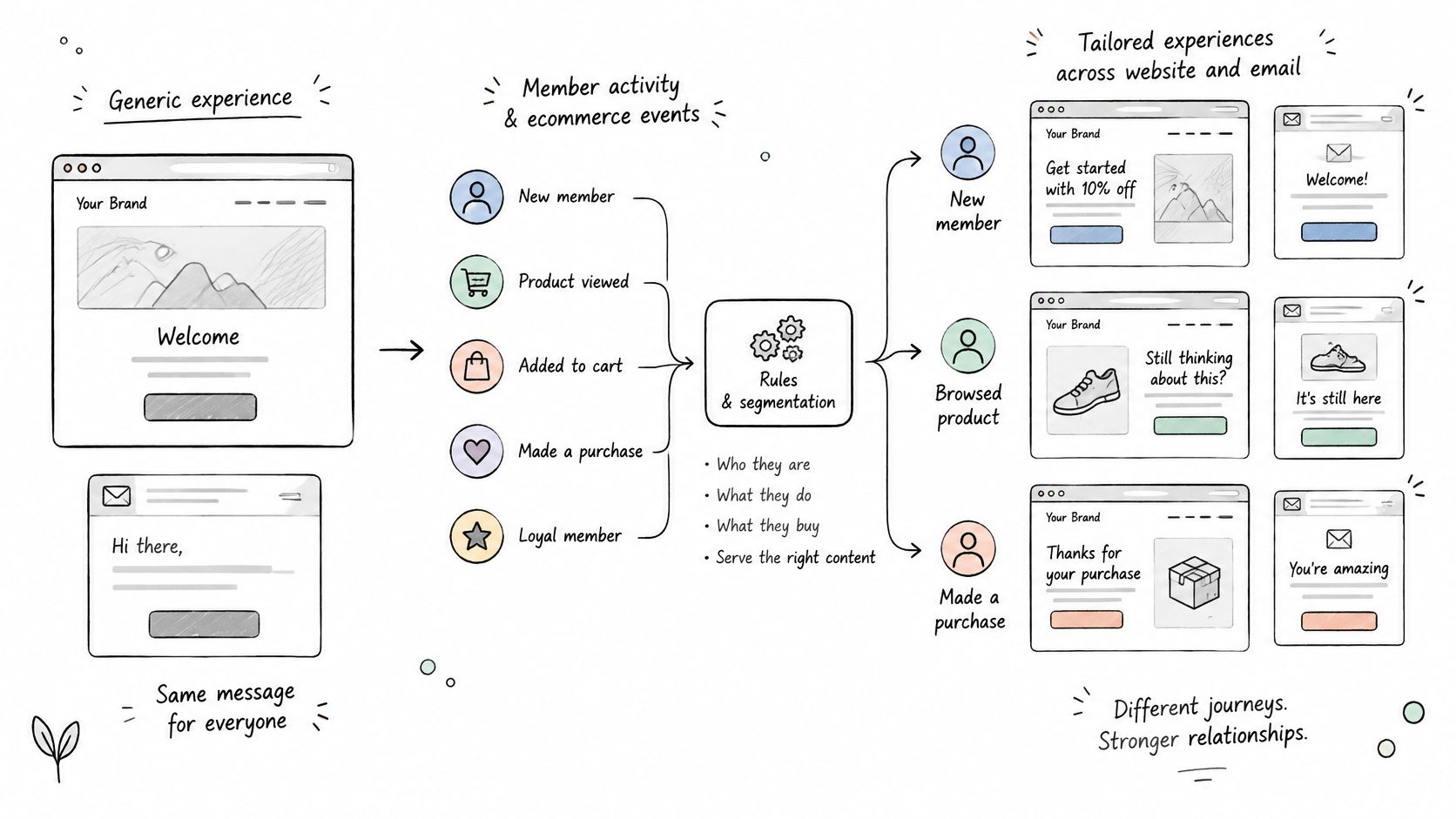
A school leaver and an established professional may need different information from the same education provider. The application area can explain entry requirements and deadlines to one group, and recognition of prior learning and flexible study to the other.
The United States Census Bureau's demographic profiles group population information by characteristics such as age, education, housing, and income. These categories can help shape an experience, provided there is a clear connection between the attribute and the information a customer needs.
Education and catalog experiences
Declared course interest should take precedence over an age assumption. A mature applicant exploring an entry-level qualification needs the relevant application information, not a route toward professional courses.
For a catalog, an income hypothesis could justify testing clearer payment-plan explanations or a premium bundle presentation. Keep the standard offer, price transparency, and the base plan visible to every visitor. Change the explanation before the offer: a customer's questions about payment do not, by themselves, call for different pricing.
Location and household experiences
Location can affect language, currency, delivery availability, and local service information. Let a visitor's chosen region override an uncertain location inference, and make it possible to correct the experience without clearing a profile.
Hosting residency is a procurement decision, not a page-personalization rule. Browsing location should not determine where an organization's site or records are hosted.
Household structure can help frame an individual-versus-family plan comparison. The customer should still choose the plan they need rather than being locked into a recommendation based on household records.
Keep changes bounded:
- Preserve the common journey: Keep navigation, essential terms, and access to the full offer consistent.
- Change useful detail: Adapt an explanation, deadline reminder, plan comparison, or follow-up message.
- Respect explicit intent: Let a selected preference override a demographic inference.
- Keep a fallback: Show the standard experience when information is unavailable or ineligible for use.
WebinOne's approach to personalization on websites connects audience attributes to specific content decisions. Reusable content rules can carry the meaningful variation while a shared template stays stable.
For an agency, that means maintaining a small set of purposeful variations rather than building a separate homepage for every demographic combination.
Consent Expiry and Segment Decay
A household value collected two years ago may no longer describe the customer's situation. Consent controls audience eligibility and suppression, so a demographic attribute should stop shaping an experience when its permitted purpose ends or the information is too stale to support the decision.
The guidance on demographic segmentation emphasizes privacy-aware collection, first-party information, clear value exchange, and customer controls. Collecting an attribute and activating it are separate decisions.
Keep the evidence with the attribute
A governed record needs more than the demographic value:
- Provenance: Identify whether the customer supplied the value, a transaction established it, or a permitted source inferred it.
- Purpose: State the experience or service decision the attribute supports.
- Collection date: Retain when the information was obtained or confirmed.
- Confidence: Distinguish declared information from an uncertain estimate.
- Review or expiry date: Set when the value must be checked or excluded.
- Suppression status: Record whether the attribute may currently be used for the intended activation.
These details make eligibility clear. A marketer may see an income band in a profile, while the delivery team needs to know whether it is current and approved for the proposed campaign.
If permission is withdrawn, stop the affected activation and propagate suppression to connected destinations. If a value becomes stale, exclude it until refreshed rather than replacing it with a guess. Retention and deletion should follow applicable policy and legal requirements.
Operational safeguard: An audience export remains part of the delivery system. A suppressed record left in a downstream list is still an unresolved problem.
Collect less and govern it better
Jobs, households, and addresses change. Set review triggers for customer profile updates and returned communications, as well as scheduled reviews, so outdated values do not keep qualifying people.
More detail can create more opportunities for misuse. If household plan preference answers the business question, collecting family relationships or precise income may increase exposure without improving the experience.
WebinOne's guidance on first-party data supports collecting information for a defined purpose. Government and enterprise teams should establish permitted use, access responsibilities, and residency requirements before introducing a field.
Keep rules reversible and retain an audit trail. The delivery team should be able to explain why a person qualified, what changed, and how to restore the standard experience.
How to Test a Demographic Rule
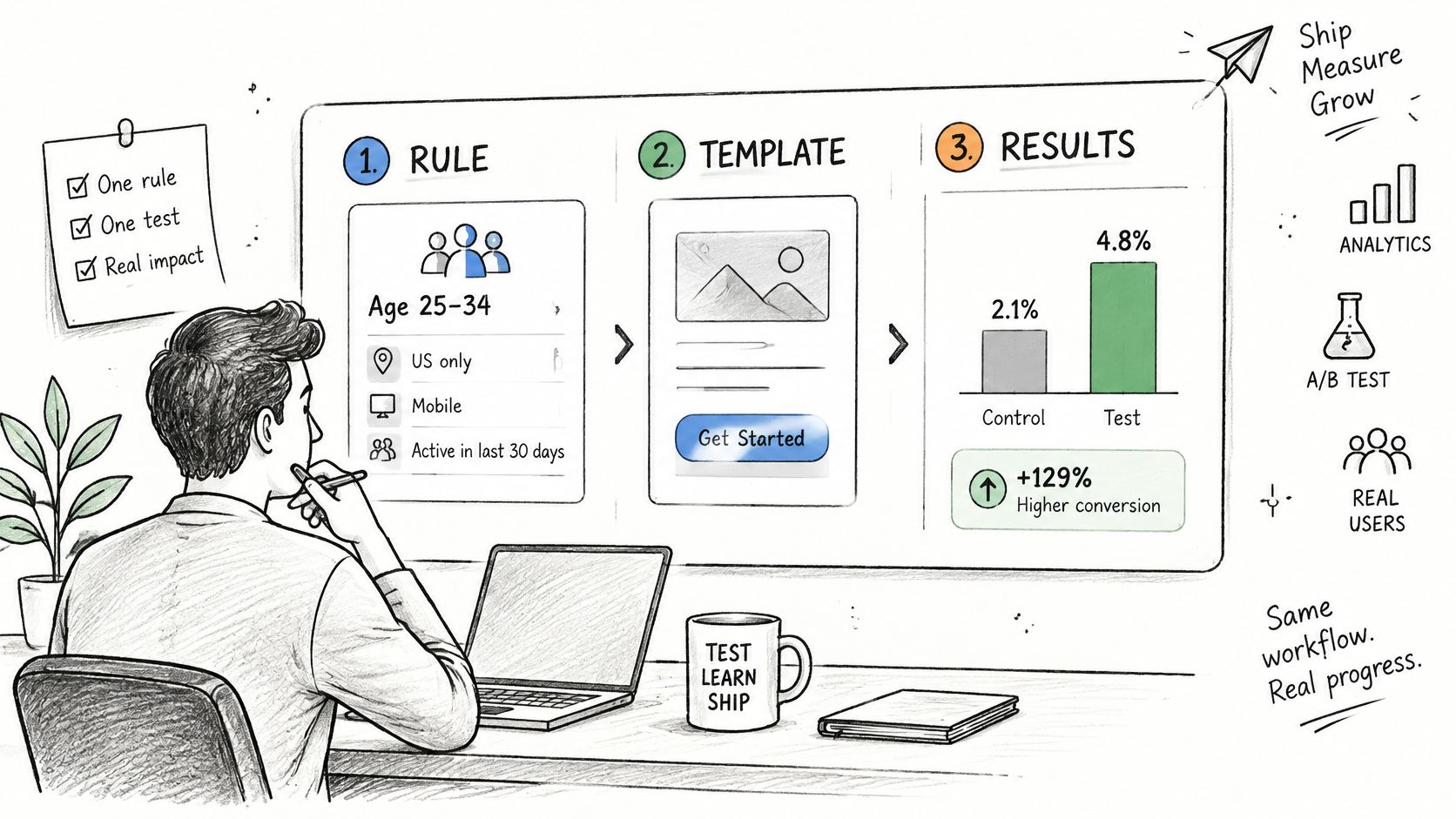
Would a clearer explanation of a shared membership plan help eligible households complete enrollment? Test that question with one change at a time. Changing the offer, navigation, creative, and follow-up timing together makes the result difficult to interpret.
Run a bounded experiment
- Choose the variable. Identify an attribute that could reasonably change how an offer is explained or which service need it addresses. State the proposed reason for the change before building it.
- Define the bands. Use consistent definitions, keep unknown records separate, and resolve overlapping categories before assigning visitors.
- Record the field's purpose. Include its purpose, collection date, and review date so the test can use eligible information.
- Size the reachable group. Count usable first-party records and check how many are missing the attribute before considering outside audience information.
- Publish a limited variation. Change one content rule, email journey, or member experience, while retaining an unsegmented control among eligible customers.
- Evaluate the result. Compare the primary outcome with retention signals, accessibility complaints, and support load. Check whether a gain in one measure coincides with a problem in another.
- Choose what happens next. Keep, split, merge, or retire the rule, and record the reason, including when the result is inconclusive.
- Set a review date. Assign an owner to check eligibility, content accuracy, and field quality before the rule becomes forgotten production logic.
Protect the interpretation
WebinOne's guide to A/B testing for landing pages covers the experiment framework. Keep assignment consistent, avoid changing the offer midway, and wait for enough responses to assess the result rather than treating an early lead as a winner.
Paid audience delivery adds a separate decision: who sees the experience. The discussion of Meta audience targeting for small businesses helps frame that distinction. If audience selection and the experience change together, the team cannot tell which drove the difference.
For agency delivery, hand over the field definition, content variation, rollback instructions, and reporting view as a repeatable package. Keep client data boundaries intact. Reusing a definition does not justify pooling personal records across unrelated clients.
Keep Only Segments That Beat a Control
Keep a demographic rule only if it produces a measurable improvement over a control and remains practical to maintain. Otherwise, simplify the experience or retire the rule.
Treat each segment as a sizing hypothesis, not a permanent description of a person. Recheck whether the audience still qualifies to receive the variation, whether the field remains current, and whether the result justifies keeping the rule active. Set an expiry so an old segment does not become permanent production logic.
Demographic patterns can help determine where to test an experience, but they do not establish why people choose a brand. Keep the variation narrow enough to test its effect, and preserve a straightforward control experience for comparison. If the result does not support the rule, remove it rather than adding more complexity.
WebinOne brings CMS, ecommerce, CRM, email marketing, and multi-site management into one managed system, which can support delivery across a portfolio of sites.