A/B Testing for Landing Pages That Actually Convert
Most landing-page advice starts with the headline, then moves to the CTA, then congratulates itself for recommending shorter forms. That advice is convenient, familiar, and often strategically weak. The constraint in A/B testing for landing pages is usually not a lack of test ideas. It's the fact that most pages don't receive enough qualified traffic to produce a trustworthy decision, while the teams that do find a winner often fail to ship it beyond the original page.
A/B testing should operate like an agency-grade production system. It needs page selection, defensible hypotheses, clean instrumentation, predefined statistical rules, documented decisions, and a promotion process that turns one validated result into a repeatable portfolio improvement. The evidence supports a disciplined approach: Convert's 2026 aggregate benchmark reports that 60% of completed A/B tests produce under 20% lift and 84% stay under 50%, while independent 2026 benchmarking coverage reports a median winning-test uplift of 1.88% and estimates that systematic programs can lift landing-page conversions by roughly 30% to 49% over time. The lesson is blunt. Compounding small, credible improvements beats waiting for a miraculous redesign.
Table of Contents
- Why Most Landing Page Tests Fail Before They Start
- Designing a Hypothesis You Can Actually Defend
- Sample Size, Significance, and the Math That Decides Everything
- Wiring Up a Landing Page Test Inside a Managed DXP
- Reading Results Without Fooling Yourself
- Industrializing Winners Across a Portfolio
- Your First 30 Days of Landing Page Experimentation
Why Most Landing Page Tests Fail Before They Start
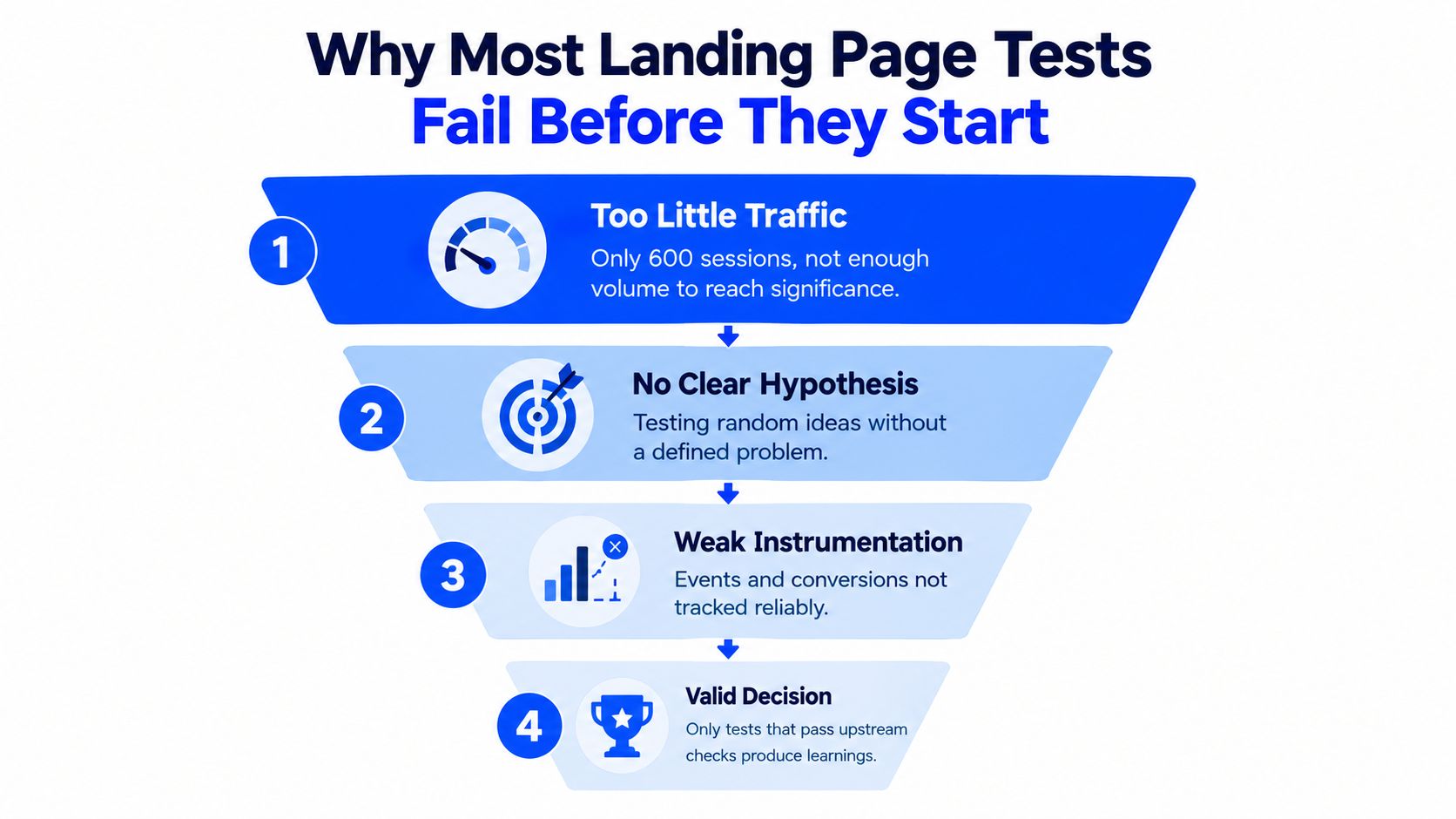
“Test everything” sounds ambitious until a portfolio contains dozens of landing pages with uneven traffic, different audiences, and unreliable conversion events. Then it becomes a way to produce activity without producing decisions. Industry analysis from Foundry CRO reports that only 17% of marketers actively use landing-page A/B tests, while another adoption estimate puts A/B testing tools on only about 0.2% of websites, rising to 32% among the top 10,000 highest-traffic sites. Experimentation remains concentrated where teams have the traffic, instrumentation, and operating discipline to use it.
The first failure is page selection. A low-volume page with a tiny theoretical conversion gap isn't automatically a good test candidate. A page with strong commercial intent, meaningful traffic, obvious friction, and a clear route to a better experience deserves priority. The portfolio should be ranked by opportunity, not by whichever marketer has a new CTA color ready.
Stop measuring launches
A test launched is not a result. Agencies often report the number of experiments shipped because launches are easy to count and easy to present. The metric that matters is validated lift deployed into production, followed by evidence that the change works for the intended audience and doesn't damage lead quality, revenue, or downstream progression.
A practical portfolio filter should ask:
- Commercial importance: Does the page sit close to a lead, signup, purchase, or qualification event?
- Audience exposure: Does enough relevant traffic reach the page for a decision within the campaign or planning window?
- Observed friction: Do recordings, heatmaps, sales calls, support tickets, or search behavior point to a specific obstacle?
- Deployment utility: Can the learning apply to a template, market, or group of related sites?
The answer won't always be “run an A/B test.” Pages with insufficient traffic may need qualitative research, message testing, user interviews, or a direct remediation of an obvious defect. An expert guide on sample-size pitfalls identifies collecting too few visitors as a frequent mistake and warns against repeatedly checking significance during a test. The operating rule is simple: run fewer tests, power them properly, and record a decision that the next sprint can use.
Designing a Hypothesis You Can Actually Defend
A hypothesis isn't “changing the headline will increase conversions.” That sentence describes a modification, not a business question. A defensible hypothesis identifies the audience, the friction, the intervention, the expected direction, the primary metric, and the minimum improvement worth shipping.
The research behind the test can come from several places. Session recordings may show visitors missing the qualification form. Sales calls may reveal that enterprise buyers don't understand implementation responsibility. Search queries may expose a mismatch between the promise in an ad and the explanation on the page. Each source should be attached to the test card before design or development begins.
Build the test card before the variant
The test card should make the eventual decision harder to manipulate. It needs enough detail that another operator can understand why the test exists and what result would justify production deployment.
| Field | Example |
|---|---|
| Audience segment | Enterprise buyers arriving from a migration campaign |
| Observed friction | Visitors reach the comparison module but don't understand implementation scope |
| Element changed | Hero message and supporting proof module |
| Variant rationale | Lead with migration outcome, then clarify operational responsibility |
| Primary metric | Qualified demo submission |
| Secondary guardrails | Bounce rate, form completion quality, downstream sales acceptance |
| Minimum detectable effect | The smallest relative lift considered commercially meaningful |
| Decision rule | Ship, hold, or iterate according to the pre-set threshold and guardrails |
| Evidence source | Session replay, sales-call notes, and search-intent review |
The test should change a coherent experience, not scatter unrelated edits across the page. A headline and CTA can belong to the same commercial question if the hypothesis concerns message clarity and action alignment. They shouldn't be bundled merely because both are easy to edit.
Practical rule: If the team can't explain the customer problem without mentioning the proposed design change, the hypothesis isn't ready.
Define failure before traffic arrives
The strongest test cards specify three outcomes. A win meets the predefined lift threshold without harming guardrail metrics. A hold produces an inconclusive result, so the team preserves the control and records the learning. An iterate outcome means the idea addressed a real problem but the execution didn't resolve it.
That distinction protects teams from two common errors. First, they don't promote a variation because its headline metric looks attractive while qualified leads deteriorate. Second, they don't discard a valuable insight because the first copy treatment failed. The test result becomes a decision, not a negotiation between stakeholders with different preferences.
Sample Size, Significance, and the Math That Decides Everything
A green dashboard does not make a test conclusive. The result depends on the baseline conversion rate, minimum detectable effect, confidence level, and statistical power. A practical A/B testing guide recommends setting sample size before launch and identifies 95% confidence and 80% power as the common standard.
Consider a landing page with a 3.0% baseline conversion rate, a 15% relative minimum detectable effect, 80% power, and a 95% confidence level. A standard calculation produces roughly 18,000 sessions per variant, or about 36,000 total, in the stated scenario. At 4,000 weekly sessions, that requires about nine weeks. The benchmark scenario is outlined in the landing-page statistics benchmark.
Nine weeks can outlast a campaign or a sales priority. If the page cannot generate that volume, change the operating plan. Narrow the page scope, increase qualified traffic, accept a larger detectable effect, or use non-experimental research before committing the team to a long test.
What changes the required sample
A lower MDE requires more traffic because the test must detect a smaller difference. A 10% MDE can finish faster, but it may miss modest improvements. A 5% MDE can identify smaller changes, but it consumes more traffic and delays the next decision. Higher power lowers the chance of missing a real effect, while stricter confidence requirements also increase the required sample.
Use the table as a planning prompt, not a universal traffic target. Calculate each page with its baseline, allocation, power, and confidence assumptions. The underlying conversion rate and statistical design determine the actual requirement.
| Baseline CVR | 10% MDE | 15% MDE | 20% MDE |
|---|---|---|---|
| 1% | Calculate before launch | Calculate before launch | Calculate before launch |
| 3% | Calculate before launch | Roughly 18,000 per variant in the stated scenario | Calculate before launch |
| 5% | Calculate before launch | Calculate before launch | Calculate before launch |
| 10% | Calculate before launch | Calculate before launch | Calculate before launch |
A bare-minimum visitor rule cannot replace a calculation. Published guidance ranges from at least 1,000 visitors per variant for landing-page tests to 10,000 visitors per variation and 300 conversions per variant for more conservative planning, as summarized by AB Tasty's sample-size guidance. Treat those figures as guardrails, not as permission to stop when a dashboard turns green.
Allocate traffic and lock the stop rules
For a standard two-variant experiment, a 50/50 allocation gives both versions comparable exposure. Google Ads experiment guidance recommends even allocation for valid conclusions. Multi-variant tests divide the same traffic across more arms, so use them only when volume can support every comparison.
Write the stop rules into the test card before launch. Specify the planned runtime, sample size, confidence threshold, and invalidation conditions. Interim checks are for broken tracking, severe performance problems, or a page that fails to load. They are not a license to declare a winner after a convenient spike. The operating discipline matters as much as the formula. A result has value only when the team can act on it.
Wiring Up a Landing Page Test Inside a Managed DXP
A clean experiment starts before the first visitor is assigned to a variant. The implementation should create comparable experiences, not a fragile client-side patch that introduces flicker, duplicate events, or redirect noise. The page architecture matters as much as the copy.
Start with a tracking specification. Name the primary conversion event, the secondary guardrails, the audience exclusions, the attribution rules, and the systems that must receive the data. Then verify every event on the control and variation before traffic is split. A form submission that fires twice in one version can invalidate an otherwise thoughtful test.
Use parallel experiences
Build variants as parallel pages or managed content blocks when the platform supports them. This gives the team control over markup, metadata, redirects, forms, and page-level performance. A client-side swap can be useful in some environments, but it requires aggressive QA because a late-rendering variation can create flicker and change what users see before the page settles.
A managed DXP should support:
- Variant creation: The control and variation share the same commercial intent and tracking contract.
- Even allocation: Start with a 50/50 split unless a documented experiment design requires another allocation.
- Stable assignment: Returning visitors should continue seeing the same experience under the test rules.
- No hidden exclusions: Remove accidental exclusions that distort the audience unless they were defined in the hypothesis.
- Review access: Stakeholders need a shared preview URL that doesn't require developer access.
A practical on-site editing workflow can reduce the distance between an approved variant and a reviewable page, but the platform is only part of the control system. The team still has to verify the events, compare page parity, and document what changed.
QA the failure points that pollute results
Redirect chains can alter attribution and create inconsistent session counts. Variant flicker can influence engagement before the visitor sees the intended design. Event duplication can inflate conversions in one arm. Those three checks belong on the launch checklist, not in a post-test debugging session.
The final pre-launch review should confirm:
- Tracking specification: Primary and secondary events fire once on every variant.
- Variant parity: Forms, scripts, consent behavior, metadata, and critical links work consistently.
- Holdout rules: Internal staff, QA traffic, bots, and defined exclusions are handled consistently.
- Performance behavior: The variation doesn't introduce a visible delay or unstable layout.
- Ownership: One person owns the launch, one owns the readout, and one approves promotion.
If the team can't reproduce the experience and inspect the data before launch, the test isn't ready for production traffic.
Reading Results Without Fooling Yourself
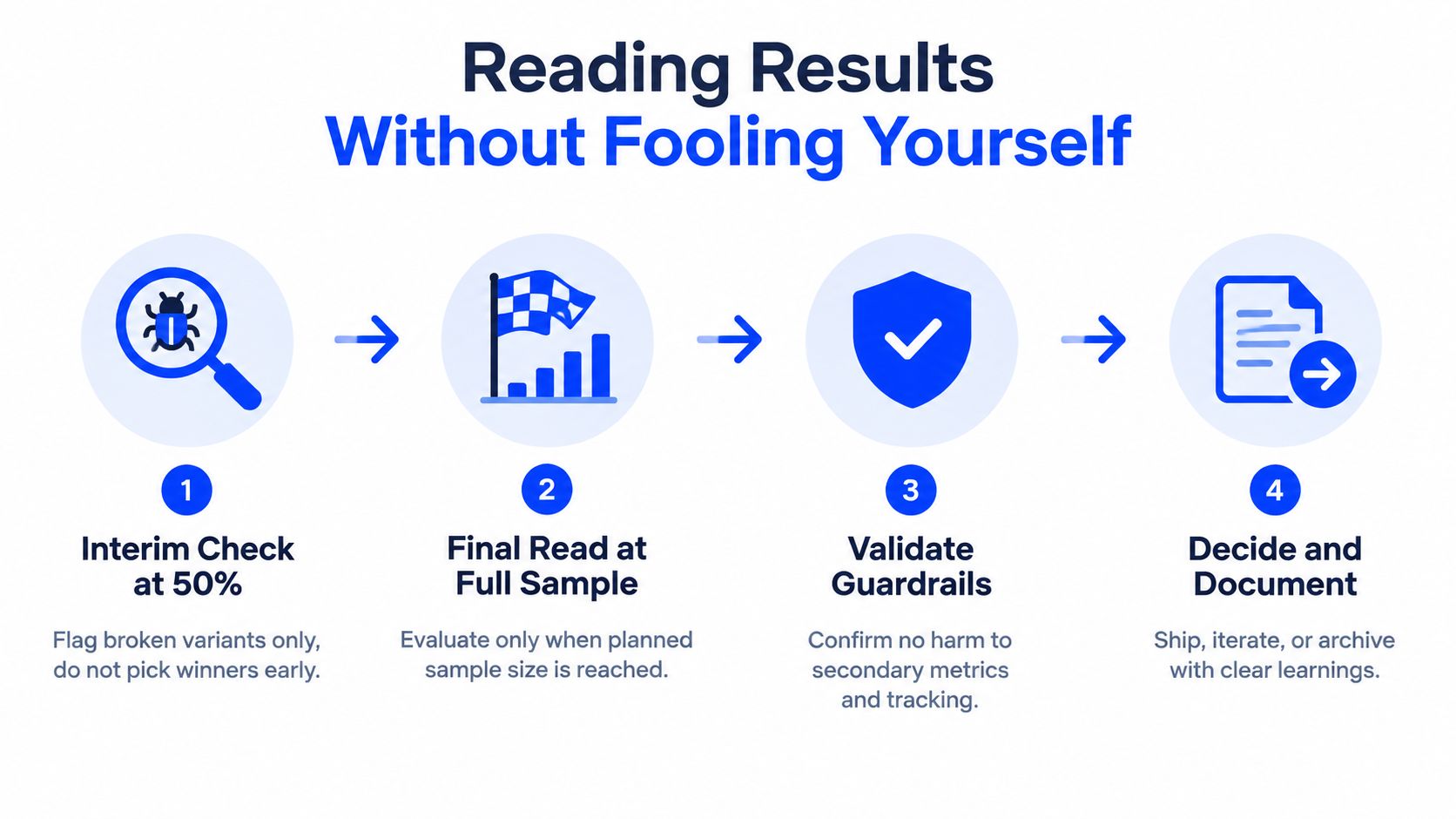
The readout should be a sequence of controlled decisions, not a meeting where the most optimistic chart wins. The first review happens at roughly 50% of the expected runtime, but only to detect broken variants, missing events, severe performance issues, or unexpected audience contamination. It isn't a license to pick a winner early.
Read the final sample, then cut the segments
The final read happens after the planned sample size and runtime are complete. The team should apply the decision rule from the test card, not extend the experiment because the result is “almost significant” or stop because the variation led on a particular afternoon.
Segment analysis comes next. Device, acquisition source, geography, and audience type can reveal reversals hidden by the aggregate result. A variation may perform well for paid search visitors and poorly for organic traffic. A mobile improvement may coexist with a desktop decline. These cuts don't create permission to cherry-pick a winning segment. They identify where the hypothesis holds, where it fails, and whether a rollout needs boundaries.
A reporting dashboard workflow helps make those comparisons visible, but a dashboard can't repair a flawed experiment. It can only expose the evidence that the instrumentation captured.
Archive a decision that another team can use
Every test needs one of three final dispositions:
- Go: Promote the winning experience, record the eligible audience, and monitor the guardrails after deployment.
- No-go: Keep the control and document why the variation failed or produced insufficient evidence.
- Iterate: Preserve the customer insight, revise the treatment, and create a new hypothesis rather than relaunching the same test without changes.
A result has no operational value until someone can tell the next team what to do with it.
The archive should include the original hypothesis, sample assumptions, implementation notes, final metrics, segment observations, screenshots, and promotion status. Without that record, teams repeat old ideas, argue from memory, and treat each test as an isolated event.
Industrializing Winners Across a Portfolio
A winning landing-page variation is a discovery, not a business outcome. The outcome comes when the organization identifies the pattern, determines where it applies, tests it in the next relevant context, and deploys it without creating a new maintenance burden.
Suppose a test suggests that a migration-focused hero, a shorter qualification path, or earlier proof placement improves response. The result shouldn't remain trapped on one campaign URL. The team should abstract the learning into a pattern that can be evaluated across brands and markets.
Turn one result into a promotion system
The promotion process needs more structure than “copy the winner everywhere.”
- Document the pattern: Capture the customer problem, the design principle, the audience, and the conditions under which the result occurred.
- Score portfolio fit: Review each site for audience similarity, page purpose, traffic feasibility, implementation effort, and commercial value.
- Prioritize the strongest candidates: Start with the top third of suitable pages, not the entire estate.
- Replicate locally: Run a lightweight confirmation test in a new market or vertical before broad deployment.
- Promote with guardrails: Roll out the pattern only where the evidence and page context support it.
The matrix below forces the team to separate strong evidence from attractive but isolated results.
| Criterion | Score 0 | Score 1 | Score 2 |
|---|---|---|---|
| Audience fit | Different intent or market | Partial overlap | Closely matched intent |
| Commercial value | Low-value page | Useful supporting page | High-value conversion page |
| Evidence strength | Single weak signal | Directional result | Validated result with guardrails |
| Traffic feasibility | Insufficient volume | Slow decision cycle | Practical test volume |
| Implementation effort | Complex rebuild | Moderate change | Reusable module or template |
| Governance fit | No shared ownership | Local approval needed | Clear portfolio owner |
A centralized multi-site management approach makes pattern promotion easier because teams can manage common structures, permissions, and review workflows without pretending every brand is identical. Governance should standardize what deserves standardization, while leaving market-specific proof, language, and offers intact.
Track promotion, not just experimentation
A shared test registry should record the page, hypothesis, audience, dates, sample plan, result, decision, and rollout status. A win-promotion checklist should require evidence review, local validation, accessibility checks, SEO review, analytics confirmation, and an owner for post-deployment monitoring.
Quarterly reviews should identify which patterns keep working across contexts and which failed to transfer. A pattern that succeeds on a high-intent paid campaign may not belong on a broad organic landing page. A form change that improves completion may lower qualification quality. Portfolio operations need those distinctions recorded before a central team turns a local result into a global rule.
Your First 30 Days of Landing Page Experimentation
A small team doesn't need a large experimentation department to start. It needs a short operating cycle that produces one reliable decision and leaves behind reusable infrastructure.
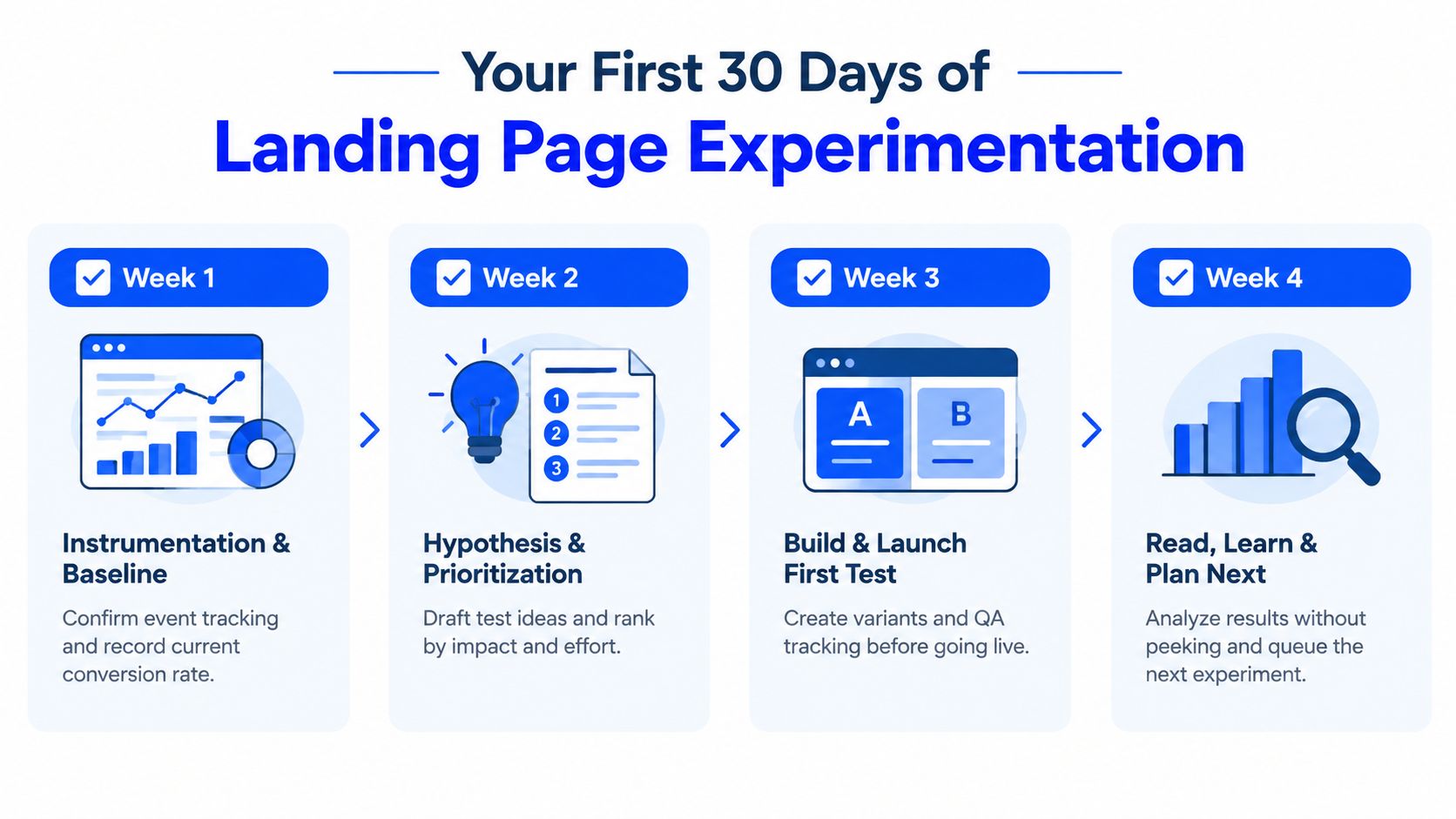
Week one establishes the baseline
Confirm that analytics, form events, ecommerce events, CRM handoffs, and qualification signals fire consistently. Define the conversion event in business terms, then record the current conversion rate for each important landing-page template. If the baseline changes depending on device, source, or geography, preserve those cuts for later analysis.
Week two creates the backlog
Write 10 testable ideas, each tied to observed friction rather than personal preference. Score them by potential business impact, traffic feasibility, evidence quality, and implementation effort. Select the first three candidates, but don't launch all three on the same page unless the design and traffic support that choice.
Week three builds the experiment
Create the control and variation, verify tracking, confirm page parity, set the sample-size target, define the stopping rules, and run a complete QA pass. The team should know what will happen if the control wins, the variation wins, or neither produces a reliable decision.
Week four converts evidence into action
Run the interim health check without selecting a winner early. Complete the final read at the planned sample, inspect device and source segments, and record a go, no-go, or iterate decision. Queue one confirmed variant for a portfolio rollout only after the team documents where the learning applies.
A managed platform becomes the sensible next step when manual spreadsheets, disconnected analytics, and repeated handoffs start slowing decisions. The same applies when an agency manages several active sites, needs white-label governance, or wants AI that can build and operate approved changes instead of abandoning generated code at deployment. A migration conversation should focus on the operating model, not just the page editor.
We help agencies and enterprise teams run landing-page experimentation inside a managed digital experience platform, with migration support, multi-site governance, built-in operations, and AgentOne for auditable AI-assisted site work. Visit WebinOne to review the platform, discuss a portfolio migration, or start a conversation about turning isolated A/B tests into a repeatable conversion program.