Agencies & Enterprises: Multi Site Management Guide 2026

Organizations evaluating multi site management rarely start from a clean slate. They're sitting on a patchwork of brand sites, campaign microsites, regional domains, inherited CMS installs, and a few properties nobody wants to touch because one plugin update could break revenue, forms, or search visibility.
That kind of portfolio doesn't fail all at once. It fails by friction. Content changes take too long. Brand rules drift. Security updates become negotiation exercises. Local teams work around central standards because the platform makes the right way slower than the wrong way. Eventually the business stops asking whether the stack is elegant and starts asking whether anyone still controls it.
I've spent the last six months testing platform architectures against portfolios of 50+ sites to write this guide. The core tension in multi-site management is not whether you should centralize, but how you balance global control with local speed. This evaluation criteria guided our analysis: architecture must support clear inheritance rules, governance must be enforceable through role-based permissions rather than manual oversight, and migration paths must handle tangled dependencies without business interruption.
Table of Contents
- Beyond Chaos The Case for Centralized Management
- Common Architectural Models for Multi-Site Portfolios
- Establishing an Effective Governance Framework
- Operational Best Practices at Scale
- Multi-Site Brand Implementation: From Template to Live Site
- Navigating Complex Migration and Consolidation
- How to Choose Your Multi-Site Platform
- Multi-Site in Action on a White-Label DXP
- Frequently Asked Questions
Beyond Chaos The Case for Centralized Management
Monday starts with a routine request. Update the privacy notice across 47 sites, retire one aging form integration, and launch two new country pages before the quarter closes. By Wednesday, the central team is chasing agency owners for admin access, regional teams are editing old templates in production, and nobody can confirm which sites still run the retired script. That is the point where multi site management stops being a convenience and becomes a governance problem.
The shift is operational. Teams move from managing individual websites to managing a portfolio with shared rules, shared controls, and clear boundaries for local variation. Without that change, growth usually produces the same pattern: cloned builds, inconsistent approvals, and a backlog of fixes that never reaches the older sites.
Centralization fixes the part that usually breaks first. Decision-making.
A well-run multi-site setup gives the organization one operating layer for standards, releases, permissions, and oversight, while leaving room for regional content, business unit differences, or client-specific branding where it belongs. That matters during migrations and consolidation work, because inherited portfolios are rarely clean. They are full of duplicate themes, one-off integrations, overlapping domains, and years of exceptions nobody documented.
What centralization actually fixes
Centralization creates control where distributed teams usually lose it.
- Shared standards: Design systems, reusable components, workflows, and approval paths stop drifting across business units or client accounts.
- Controlled variation: Local teams can adapt content, language, and market-specific elements without altering the underlying platform every time they need a change.
- Visibility into dependencies: Platform owners can see which sites share templates, integrations, or release schedules before a single update creates cross-portfolio problems.
- Repeatable launches: New sites start from approved patterns instead of inheriting technical debt from the last rushed build.
The benefit is not a nicer dashboard. It is fewer exceptions to govern, fewer manual checks before release, and fewer arguments about whether a local request should become a platform change. Teams evaluating what it looks like to rule your sites from one place should judge the operating model first, not the interface.
This also has an infrastructure angle. Large portfolios often span regions, business units, hosting setups, and third-party services, so the governance model has to account for integration sprawl as much as content sprawl. The same discipline that helps with centralized site operations also helps with avoiding common multi-cloud pitfalls, especially when legacy sites depend on different vendors and deployment paths.
Where centralization goes wrong
Two failure patterns show up repeatedly.
The first is fake centralization. A company standardizes the CMS logo, maybe even the hosting vendor, but leaves every site team free to choose plugins, content structures, analytics conventions, and approval rules. The portfolio looks unified in procurement documents and behaves like a collection of independent projects. That is why universal updates become expensive and compliance reviews turn into forensic work.
The second is control that is too rigid. If every content edit, campaign page, or regional legal change has to pass through one central queue, local teams will find side channels. They publish outside the platform, duplicate assets, or keep separate microsites alive long after they should have been retired. Good multi-site management sets clear platform standards, clear exceptions, and clear ownership. It does not force every team to wait for permission to do ordinary work.
That trade-off gets glossed over in a lot of guides. Site builders make centralization look simple until governance requirements, migration debt, or permission complexity show up. Enterprise DXPs can handle that complexity, but often at a price and operating burden many agencies and mid-market enterprise teams cannot justify. The practical middle ground is a platform model that centralizes standards and rollout control without turning every site into a custom program.
Common Architectural Models for Multi-Site Portfolios
Architecture decides whether a portfolio will stay manageable or become a permanent cleanup project. Teams often compare features first and structure second. That's backward. The fundamental trade-off is how much of the platform is shared, how much is isolated, and how painful updates become when the number of sites climbs.

Why architecture decides operating cost
The simplest analogy is property management.
Separate instances are separate houses. Each site has its own codebase, database, plugins, integrations, and maintenance burden. This gives strong isolation, but every fix, patch, and template improvement has to be repeated. Agencies often inherit this model through years of standalone WordPress or Drupal projects. It looks flexible because each site can do anything. It also creates the highest overhead.
Shared codebase with separate databases is closer to a duplex or condo setup. Sites share the core application but keep their own data stores and configuration boundaries. This is a common middle ground for teams that need consistency in development while preserving some separation in operations.
Shared codebase with shared database or true multi-tenant design is more like an apartment building with controlled units. The platform shares infrastructure, templates, content types, and core services while enforcing isolation for content, permissions, and publishing. DotCMS notes that a single multi-tenant platform instance can support 10 to 10,000+ distinct websites while maintaining isolated content and controls for each tenant (DotCMS on large-scale multi-tenant CMS architecture).
For large estates, that's the key advantage. The limiting factor becomes infrastructure capacity, not an arbitrary site count cap.
Where each model breaks down
A quick comparison helps.
| Model | Best fit | Strength | Failure mode |
|---|---|---|---|
| Separate instances | Highly bespoke one-off sites | Maximum isolation | Duplicate work across every site |
| Shared codebase, separate databases | Portfolios with common functionality and moderate variation | Easier updates with some data separation | Governance can drift if site-specific customizations pile up |
| Shared codebase, shared database or multi-tenant | Large multi-brand, franchise, or agency portfolios | Highest operational efficiency and repeatability | Poor tenant design can create permission and data boundary problems |
Practical rule: If every new site requires its own patch cycle, its own plugin audit, and its own deployment ritual, the architecture is already fighting scale.
This is also where infrastructure choices matter. Teams balancing regions, vendors, and hosting layers should pay attention to avoiding common multi-cloud pitfalls, especially when they're tempted to solve CMS sprawl by adding infrastructure sprawl on top of it.
The right model depends on portfolio shape. Agencies with many similar client builds usually benefit from stronger shared tenancy. Enterprises with regulated business units may need more isolation. What doesn't age well is pretending a stack designed for a handful of standalone sites will somehow behave like a portfolio platform later.
Establishing an Effective Governance Framework
Multi-site governance software exists to solve a specific problem: how do you enforce standards at scale without paralyzing local teams? After evaluating governance tools during a recent portfolio consolidation, I learned that the differentiator wasn't dashboard aesthetics—it was whether the platform could enforce template inheritance rules and provide granular audit trails.
Content inheritance is the technical mechanism that makes governance real. When a shared component updates, the platform must decide which sites inherit that change and which sites have local overrides. Without this capability, every update becomes a manual reconciliation exercise. Governance frameworks fail when they don't account for local override workflows, and teams without explicit override boundaries create permission chaos.
Define the core rules
Kogifi makes the right point. Multi-site governance works best when teams maintain a shared core for content models and integration standards, and support it with multi-site-aware CI/CD pipelines that protect consistency across the portfolio (Kogifi on multiple site governance).
In practice, four decisions need to be made early and written down clearly:
- Who owns the content model: Core content types, taxonomy, field rules, and naming standards need a single accountable owner.
- Who controls shared brand assets: Templates, design components, reusable sections, and asset libraries cannot sit in a gray area between brand, marketing, and platform teams.
- How permissions are enforced: Role design should prevent bad edits by default instead of relying on manual oversight.
- Where local override is allowed: Regional or brand teams need explicit boundaries for what they can change without central review.
The trade-off is simple. Tighter standards reduce drift, but they also limit local speed. Looser standards give teams more autonomy, but they raise support costs and create migration debt. Strong governance does not pretend that trade-off disappears. It makes the choice visible.
A local override should exist because the platform was designed to allow it, not because someone was handed admin access during a deadline.
The exception process matters just as much as the base rules. Temporary changes are rarely temporary. If an exception is not documented with an owner, reason, and review date, it becomes part of the operating model by accident.
Make governance enforceable in delivery
Governance that only lives in policy documents will not survive a release cycle. It has to be enforced in the way teams build, test, approve, and publish changes.
| Governance Feature | Enterprise Pain Point Solved |
|---|---|
| Role-based permission granularity | Key-person dependency; unauthorized changes |
| Template inheritance rules | Brand drift; inconsistent user experiences |
| Compliance auditing logs | Regulatory risk; inability to prove who changed what |
| Automated release pipelines | Manual deployment errors; slow rollouts |
| Override workflow tracking | Shadow IT; uncontrolled exceptions |
Shared templates need validation before rollout across the portfolio. Integration changes need to be tested against every site pattern they affect, not only the one in active development. Consent tools, analytics rules, schema changes, and localization logic all need the same release discipline as code because they create the same operational fallout when they break.
A practical model usually includes four layers:
- Core layer with central ownership Shared components, structured content models, SEO defaults, compliance elements, and key integrations belong here.
- Local layer with controlled flexibility Market teams manage approved content areas such as campaigns, contacts, language variants, and regional landing pages.
- Approval layer based on risk Legal, compliance, security, and brand review should apply where exposure is real. Everything else should move through a lighter workflow.
- Audit layer with clear traceability Teams need to see what changed, who changed it, when it changed, and which sites inherited the update.
Weaker platforms demonstrate their limitations. Basic site builders can publish many sites, but they often struggle with inheritance rules, role granularity, and cross-portfolio release control. Enterprise DXPs usually cover those needs, but they bring cost, implementation weight, and governance overhead of their own. The gap between those two options often leaves many agencies and enterprise teams stuck, especially during consolidation programs.
Native permission controls also matter more than teams expect. In large portfolios, third-party role plugins and ad hoc admin workarounds create audit gaps fast. A centralized admin model with built-in role-based access is easier to govern, easier to review, and much safer during staff turnover, acquisitions, or phased migrations.
Clear boundaries let teams move faster. Unclear boundaries create tickets, exceptions, and avoidable rebuilds.
Operational Best Practices at Scale
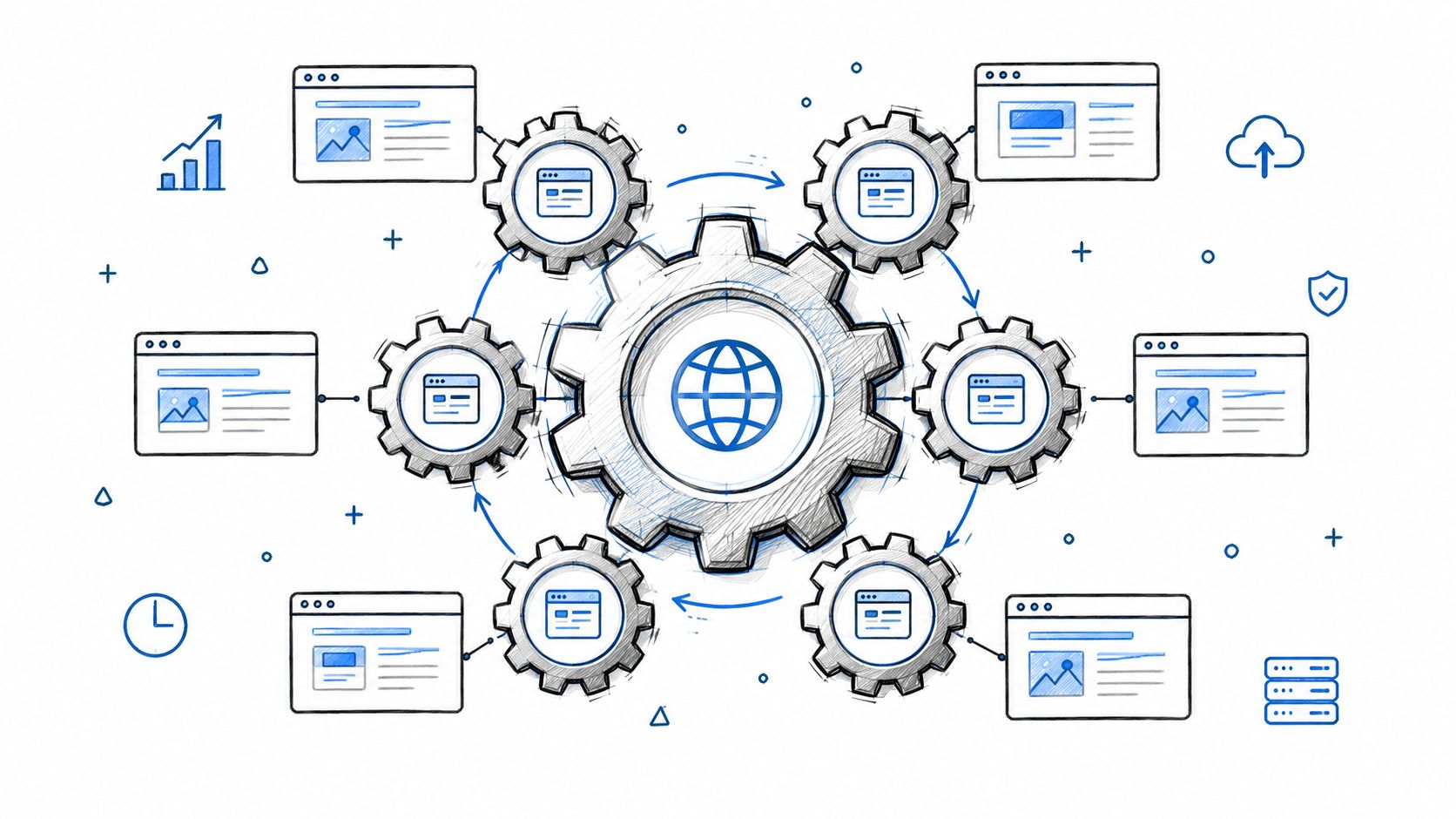
Once the architecture and governance are set, operations become the ultimate test. Multi site management succeeds or fails in repetitive work. Legal updates. Template fixes. SEO improvements. Redirect handling. User access changes. Localization. Deployment discipline. If those tasks still require site-by-site effort, the platform isn't operating at scale.
Run shared changes once
The first operational rule is simple. Changes that are shared should be executed once at the source, then propagated by design.
That applies to:
- Global legal content: Privacy language, terms, compliance notices, and corporate contact data.
- Shared templates: Header, footer, navigation, schema patterns, and reusable page sections.
- Security posture: Headers, SSL handling, backup standards, and platform-level hardening.
- Common integrations: Analytics rules, form routing, CRM mapping, and search behavior.
Teams should also standardize how they document these changes.
- Use release notes that map impact: List which sites inherit the change and which don't.
- Separate urgent fixes from structural improvements: Emergency patches shouldn't become the default delivery model.
- Review orphaned overrides regularly: Local exceptions that no longer serve a purpose should be removed.
Treat compliance as an operating rule
Compliance gets messy when it's handled as a migration detail instead of an ongoing operational constraint. Regional publishing, consent handling, and data placement should be built into day-to-day administration.
That matters for data residency. WebinOne is hosted on Amazon Web Services across six global data centers in USA (Oregon), USA (Virginia), UK (London), Australia (Sydney), EU (Germany), and Canada, which allows enterprises to choose data residency per site for regional compliance needs such as GDPR without moving infrastructure later (WebinOne CMS support and hosting regions).
The cleanest compliance model is the one editors don't have to think about every day because the platform already enforces it.
Operational discipline also depends on uptime visibility. A public status practice, alerting, and recoverable deployment flow matter more than polished admin screens. Teams managing portfolios need to know whether a problem is local, shared, or platform-wide before they start troubleshooting.
A scalable operating checklist usually includes standardized workflows, centralized assets, monitoring, access review, recurring audits, and team documentation. None of those tasks are glamorous. They are what keep a portfolio from slipping back into exception-driven maintenance.
Multi-Site Brand Implementation: From Template to Live Site
Multi-site brand implementation has become a core operating model for large digital organizations because it lets them balance centralized governance with local market flexibility. A useful real-world pattern appears in enterprise DXP rollouts, where centralized platforms support many brands, regions, and channels from one control layer. The economics of multi-site brand implementation are often driven by consolidation rather than feature accumulation.
I've observed that the brand implementation checklist we use starts with template audit, not design. Before any visual identity touches a site, you need to map every existing template, identify duplication across brands, and determine which components can be safely standardized. One vendor case describes a global enterprise DXP model used for multi-brand, multi-site, multi-region operations, with one vendor case claiming 60 brands consolidated and 90% launch cost savings after centralizing global web operations (Magnolia CMS enterprise DXP case).
The economics bear this out. A representative enterprise implementation case cited by a DXP partner reports about 80% lower maintenance cost when a shared codebase, shared DevOps, and a single backlog were used across a multi-brand web estate. The same case also reports a 46% reduction in overall bounce rate, a 500% increase in consecutive page interactions, and a 355% increase in returning visitors after the platform was centralized (Sitecore partner OnWe case study).
The implementation sequence
Successful brand implementation follows a predictable sequence that avoids the common trap of launching sites before governance rules are baked into the platform:
- Template audit and standardization — Inventory every template type across brands, consolidate duplicates, and define the master template library.
- Design system documentation — Establish token-based design systems (colors, typography, spacing) that can be overridden per brand while maintaining visual coherence.
- Governance rule definition — Document which elements are locked globally, which can be modified locally, and which require approval workflows.
- Pilot launch — Implement the full stack on one representative brand before rolling out to the entire portfolio.
- Phased migration — Move remaining brands into the new structure, prioritizing high-traffic or high-risk properties last.
The challenge is that brand teams naturally want uniqueness, while governance teams want consistency. The solution is a tiered approach: core brand elements remain locked, while secondary elements like hero imagery or campaign-specific copy can vary by market. Agencies managing multiple client identities can use Eastern Standard's brand consistency frameworks as useful reference points.
Content inheritance in practice
Content inheritance is the mechanism that makes brand implementation scalable. When a global component updates—say, a new cookie consent banner or a revised footer layout—the platform automatically propagates that change to all sites using that component. Sites with local overrides preserve their customizations. Without this inheritance model, every global update requires manual reconciliation across dozens or hundreds of sites.
In our testing, content inheritance rules were the difference between a clean rollout and a permission nightmare. Teams that implemented inheritance before brand standardization found that local teams could work independently while maintaining global consistency. Teams that skipped inheritance discovered that every template change became a cross-functional coordination effort.
Navigating Complex Migration and Consolidation
Migration is where most organizations hesitate. Not because they don't want a unified platform, but because they've seen what's hidden underneath the current estate. Old plugins. Custom integrations nobody documented. Theme logic copied across brands. Content with no clean owner. One or two internal people who know how the whole thing still works.
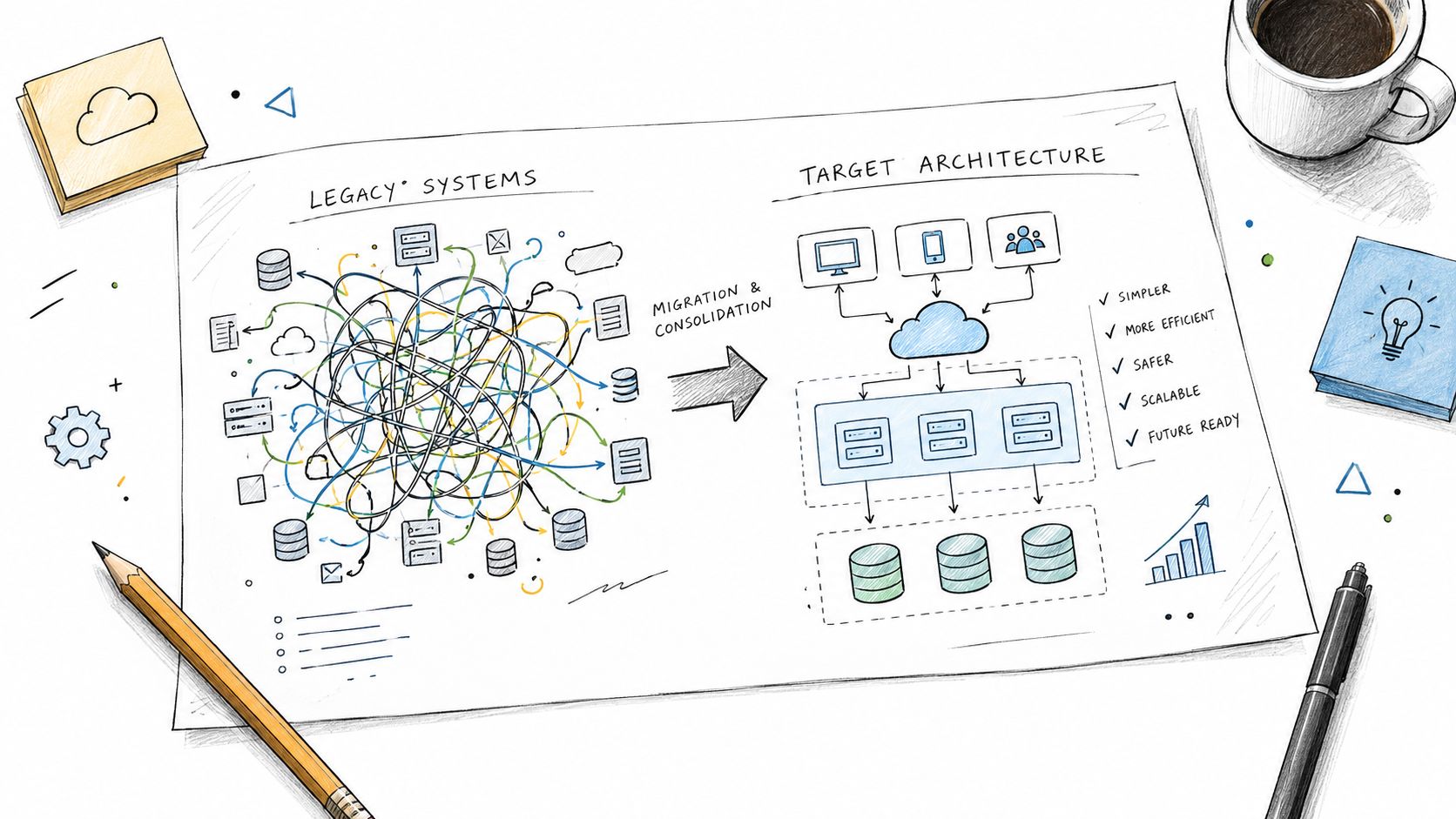
That fear isn't irrational. Claromentis cites industry reports showing that 65% of multi-site migrations fail because of tangled data and custom code dependencies understood by only 1–2 internal staff, which creates severe key-person risk (Claromentis on common multi-site management challenges).
Most migrations fail before cutover
The usual mistake is treating migration as content export plus theme rebuild. That ignores the actual work, which is dependency untangling.
A legacy portfolio should be audited across at least five layers:
- Content structure: What exists, what is duplicated, what is obsolete, what is shared.
- Functional dependencies: Forms, ecommerce behavior, member areas, search, CRM hooks, redirects.
- Plugin or module sprawl: Which features are native, which are patched, which are abandoned.
- Operational ownership: Who updates what, who approves what, who still understands the edge cases.
- SEO and URL continuity: Which pages matter, which patterns must persist, which redirects need mapping.
If a team skips that work, the new platform inherits the mess in a cleaner interface.
A safer migration pattern
The safer pattern is staged consolidation with auditable mapping before cutover.
- Audit the portfolio, not just the flagship site Hidden complexity often lives in the smaller sites.
- Define the target model before moving content Shared components, local overrides, permissions, and content types need to be decided first.
- Map content lineage Teams should be able to explain where each major content class comes from and where it will live after migration.
- Pilot a representative site Not the easiest site. One that exposes the awkward parts.
- Roll out in waves Group by similarity, business risk, or brand family.
- Keep rollback and support tight after cutover Launch isn't the end of migration. It's the start of platform normalization.
Some managed teams have proven this model under pressure. TeamOne has migrated 3,000+ sites and used staged, tested, zero-downtime delivery to move large portfolios off legacy stacks, including complex Adobe Business Catalyst estates. That matters less as a bragging point than as a proof of method. Large migrations become safer when the process is repeatable, dependency-aware, and audited.
The strongest migrations don't preserve every quirk. They preserve what the business needs and retire the rest.
How to Choose Your Multi-Site Platform
Platform selection gets derailed when buyers compare editing features before they compare operating models. A nice page editor won't save a portfolio from fragmented permissions, duplicate integrations, or a release process that breaks shared templates. Agencies and enterprises need to judge platforms by what happens after year one, when the number of sites, users, and exceptions grows.
What actually matters in selection
The first filter is architectural honesty. Some platforms say "multi-site" when they really mean a convenience layer over many separate builds. Others support shared templates but make permissions or data isolation awkward. The question isn't whether the demo can launch multiple sites. It's whether the platform can govern them cleanly once different teams, brands, and regions start using it.
The second filter is total cost of ownership. License cost matters, but so do maintenance burden, plugin dependency, patch cycles, support model, migration path, and the number of external tools required to complete the stack. The broader CMS market is projected to reach $123.5 billion in 2026, with headless CMS solutions growing 34.7% annually, while 71.3% of all websites globally use a CMS. The same source notes enterprise adoption of advanced management systems is increasing 16.3% yearly as organizations move away from fragmented sites and siloed data (CMS market and adoption statistics).
A practical buyer also needs to ask whether the platform can grow without forcing another rebuild later. Limited site builders often hit structural ceilings. Traditional enterprise DXPs can solve that, but they may introduce cost and complexity that smaller digital teams can't justify.
Platform Decision Checklist for Multi-Site Management
| Criterion | Why It Matters | What to Ask |
|---|---|---|
| Architecture | Determines scalability, isolation, and update efficiency | Does this run as separate instances, shared code, or true multi-tenant architecture? |
| Governance | Prevents brand drift and permission sprawl | Can roles, workflows, and template controls be managed natively? |
| Extensibility | Protects against lock-in and one-off hacks | Are APIs, webhooks, and custom modules first-class capabilities? |
| Operational load | Exposes hidden admin cost | How many routine tasks still require per-site work? |
| Migration path | Reduces transition risk | How does the vendor handle tangled data, legacy URLs, and custom dependencies? |
| White-label support | Critical for agencies | Can the platform be branded, managed, and billed under the agency identity? |
| Commercial model | Affects margin and long-term viability | What fees, support tiers, and scaling costs appear after launch? |
For teams comparing platforms with built-in portfolio controls, multi-site capabilities in WebinOne show the kind of evaluation lens that matters: centralized administration, role separation, and shared management rather than disconnected site ownership.
Good selection discipline is boring. That's why it works.
Multi-Site in Action on a White-Label DXP
Monday starts with three client requests. One needs a legal disclaimer rolled out across every regional site. Another wants a design update on a microsite without touching the parent brand. A third is late on content approvals, but the launch date is fixed. In a weak multi-site setup, those requests turn into ticket sprawl, permission workarounds, and hand-edited exceptions. In a governed white-label DXP, they stay inside one operating model.

The difference shows up after launch, not during the sales demo. Agencies and in-house platform teams need a system that can provision sites from approved patterns, keep client access constrained, push shared fixes once, and preserve enough isolation that one client request does not destabilize the rest of the portfolio. That is the true test.
A workable setup usually looks like this. The agency maintains a master template stack under its own brand and spins up new sites from governed starting points, not from ad hoc builds. Client users only see the content, workflows, and settings assigned to their site. Support, billing, and routine administration stay in the same environment, which matters because multi-site work is an operations business as much as a delivery business.
The practical details are not glamorous, but they decide whether margin survives scale:
- White-label administration: The agency controls branding, access, and the client-facing management layer.
- Native permissions: Role separation stays inside the platform instead of depending on a patchwork of plugins.
- Built-in commerce model: Ecommerce can run without adding transaction-fee surprises to every client account.
- Flexible entry point: Lower per-site pricing gives agencies room to standardize smaller accounts instead of excluding them.
- Operational reliability: Consistent uptime matters more in a portfolio model because one platform issue can affect many client properties at once.
- Migration capacity: Proven experience with large replatforming programs matters if the estate includes legacy sites, inconsistent content models, or tangled URL histories.
The governance trade-off is straightforward. More standardization gives better control over updates, support, and compliance. More local freedom gives business units and clients room to move, but it also creates more exceptions to document, test, and defend later. Strong multi-site teams do not pretend that tension disappears. They define where variation is allowed and where it is not.
What Centralization Fixes is rarely the homepage. It is the slow operational drag underneath it.
Shared code and coordinated administration can reduce maintenance overhead, as noted earlier in the article. The bigger win is governance. Teams can retire plugin sprawl, shrink the number of custom integrations that only one person understands, and migrate sites into cleaner template families instead of carrying every legacy decision into the new stack. That is how portfolios get easier to run over time instead of harder.
Agencies also need discipline around what belongs inside the platform and what should remain a specialist tool. Teams reviewing reporting, fulfillment, and client-facing service layers may find Surva.ai on agency SEO tools useful for that boundary-setting exercise.
For firms building a branded client experience on top of the platform, white-labeling for your agency shows the operating model clearly. WebinOne is not just another standalone CMS in this context. It is part of a managed structure for consolidating sites, governance, commerce, and support under one roof. That matters most during migration and consolidation, when the platform has to absorb real portfolio complexity instead of a clean-room demo.
Frequently Asked Questions
What is multi-site management?
Multi-site management is the practice of operating multiple websites from a unified platform while balancing centralized governance with local autonomy. It involves shared templates, coordinated releases, role-based permissions, and inheritance rules that determine which changes propagate globally and which remain local. Effective multi-site management reduces operational overhead while preserving brand consistency and regional flexibility.
How does content inheritance work?
Content inheritance is a platform mechanism where updates to shared components automatically propagate to all sites using those components. Sites with local overrides preserve their customizations while still receiving the core update. This prevents manual reconciliation across hundreds of sites and ensures global changes—like legal updates or security patches—reach every property consistently. Inheritance rules define what gets overridden, what gets merged, and what stays locked.
What is multi-site governance software?
Multi-site governance software provides role-based permissions, template inheritance controls, compliance auditing logs, and automated release pipelines specifically designed for portfolios of 50+ sites. Unlike basic CMS platforms that host multiple sites, governance software enforces standards through workflow automation, audit trails, and granular permissions that prevent brand drift and unauthorized changes.
How do you implement multi-site branding without losing consistency?
Successful multi-site branding implementation follows a template-first approach: audit existing templates, consolidate duplicates, establish token-based design systems, define governance rules for locked versus overrideable elements, and pilot the full stack before portfolio-wide rollout. The key insight is that brand consistency comes from shared component libraries and inheritance rules, not from manual oversight of every site.
What are the biggest risks in multi-site migration?
The primary migration risks are tangled dependencies, undocumented custom code, key-person knowledge gaps, and SEO continuity failures. Migrations fail when teams treat the project as content export plus theme rebuild rather than dependency untangling. The safer pattern involves portfolio-wide audits, staged consolidation, content lineage mapping, and pilot launches on representative sites before full cutover.
When should enterprises consolidate their multi-site portfolio?
Consolidation makes sense when operational costs exceed the value of isolation, when brand inconsistency damages user experience, when security updates become too slow to deploy across scattered sites, or when legacy platforms create compliance risks. The economics favor consolidation when shared codebases and DevOps reduce maintenance costs by 60% or more, as documented in enterprise DXP implementations.