First Party Data: What It Is and Why It Now Runs Marketing

Most first party data programs fail for a reason that has little to do with collection. Organizations are adopting privacy-first measurement rapidly, with 81% reporting adoption and 88% projected to rely primarily on first-party data by 2027, yet only 33% have a mature first-party data strategy according to independent 2026 first-party data coverage. The gap is operational, not motivational.
First party data now runs marketing because companies need a customer relationship they can govern across websites, apps, email, CRM, commerce, support, and advertising. A re-platforming project that preserves pages but loses consent records, identity rules, event taxonomy, or form submissions hasn't completed a migration. It has damaged the operating system underneath the site.
Table of Contents
- Why First Party Data Is an Operating Model Not a Tactic
- What First Party Data Actually Is and How It Differs From Second and Third Party
- The Cookie Collapse and Why First Party Data Became Default
- Quality Controls That Make First Party Data Usable
- Privacy Consent and Governance for First Party Data
- Unifying First Party Data Across CMS Commerce CRM and Ads
- Migration and Re-Platforming Without Breaking the Data Layer
- What a First Party Data Operating Model Delivers and What to Do Next
Why First Party Data Is an Operating Model Not a Tactic
The default advice says to collect more first party data. Add a form, grow an email list, connect a CRM, deploy a customer data platform, then activate audiences. That advice starts in the wrong place.
First party data is an operating model, not a marketing asset sitting in a dashboard. It determines how teams collect information, define events, resolve identities, record consent, share access, and activate customer signals across owned and paid channels. Marketing owns one part of that system. Digital, ecommerce, sales, service, analytics, legal, security, and platform operations own the rest.
The warning sign is a program with no accountable owner, no documented schema, and no consolidation layer. It may look productive while every channel builds a separate version of the customer. The CMS records a form submission, commerce records an order, the CRM stores an account, the email platform tracks engagement, and the ad system receives a match. Without shared definitions and controlled linkage, those records don't become intelligence. They become competing interpretations.
Practical rule: If a first party data program can't survive a site change, vendor replacement, or consent withdrawal, it isn't a strategy. It's a temporary integration.
The operating model has four controls
A durable model connects four disciplines:
- Governance: Each field needs a purpose, lawful basis, retention rule, access policy, and deletion path.
- Identity: Teams need deterministic identifiers where available, careful handling of probabilistic resolution, and separation between identity records and reporting.
- Schema discipline: Events and profile attributes need names, parameters, formats, ownership, and version control.
- Consolidation: CMS, commerce, CRM, email, support, and advertising systems need a governed layer that lets authorized teams reuse signals without copying uncontrolled datasets.
The practical playbook for first-party data capture recommends monitoring consent rate by purpose, identifier match rate, profile completeness, event schema conformance, and deduplication accuracy. Those controls matter because ownership alone doesn't make data reliable.
The position is straightforward. Teams should stop treating first party data as a campaign workstream and start treating it as shared infrastructure. That decision changes the platform brief, the migration plan, the agency operating model, and the definition of a successful launch.
What First Party Data Actually Is and How It Differs From Second and Third Party
First party data comes directly from a company's interactions with consumers through owned channels. A website form, authenticated account, purchase, support ticket, app session, email interaction, or loyalty record can create it. The relationship is direct, and the company knows which property collected the information and which business process produced it.
The record usually combines several layers:
- Identifiers: Names, email addresses, phone numbers, account IDs, and other fields that can relate activity to a person or organization.
- Events: Page views, searches, downloads, form submissions, logins, purchases, renewals, support interactions, and other observed actions.
- Properties: Product interest, account status, location, purchase history, service preferences, or content affinity.
- Consent state: The purpose selected, the time of the decision, the notice presented, and whether consent was later changed or withdrawn.
The behavioral layer sits on top of those records. A business might infer repeat purchase behavior, session depth, product affinity, or likely service intent from observed interactions. Inferred attributes need clearer controls than directly supplied information because the company is making an interpretation, not recording an explicit statement.
Ownership isn't the same as access
Second party data is another company's first party data shared through a direct partnership, contractual arrangement, or controlled clean-room workflow. It can extend audience understanding, but the receiving business didn't collect the original signal. Its permitted use depends on the partner's disclosures, consent structure, data quality, and sharing agreement.
Third party data comes from outside aggregators or brokers that combine information from multiple sources. Its defining problem is provenance. The buyer may receive a segment label without being able to verify the original collection context, purpose, or accuracy.
| Dimension | First Party | Second Party | Third Party |
|---|---|---|---|
| Source | A company's owned website, app, CRM, commerce, email, or service interactions | Another company's direct customer interactions | Multiple external sources aggregated by an intermediary |
| Relationship | Direct relationship with the person or account | Indirect relationship through a partner | No verified direct relationship |
| Provenance | The collecting organization can identify the source and process | The partner controls the original collection context | The original source may be opaque |
| Typical use | Segmentation, personalization, measurement, and governed activation | Partnership audiences and limited collaboration | Broad audience reach or market modeling |
| Primary control | Internal consent, identity, schema, and retention governance | Contractual permissions and partner assurance | Vendor provenance, permitted use, and regulatory risk |
Hashed email and phone identifiers don't remove the governance obligation. Industry guidance on privacy infrastructure for cross-media measurement notes that these identifiers usually remain personal data under major privacy frameworks, so consent or another lawful basis still matters.
Treating the three categories as interchangeable creates bad personalization and weak accountability. Provenance determines what a team can responsibly do with a record.
The Cookie Collapse and Why First Party Data Became Default
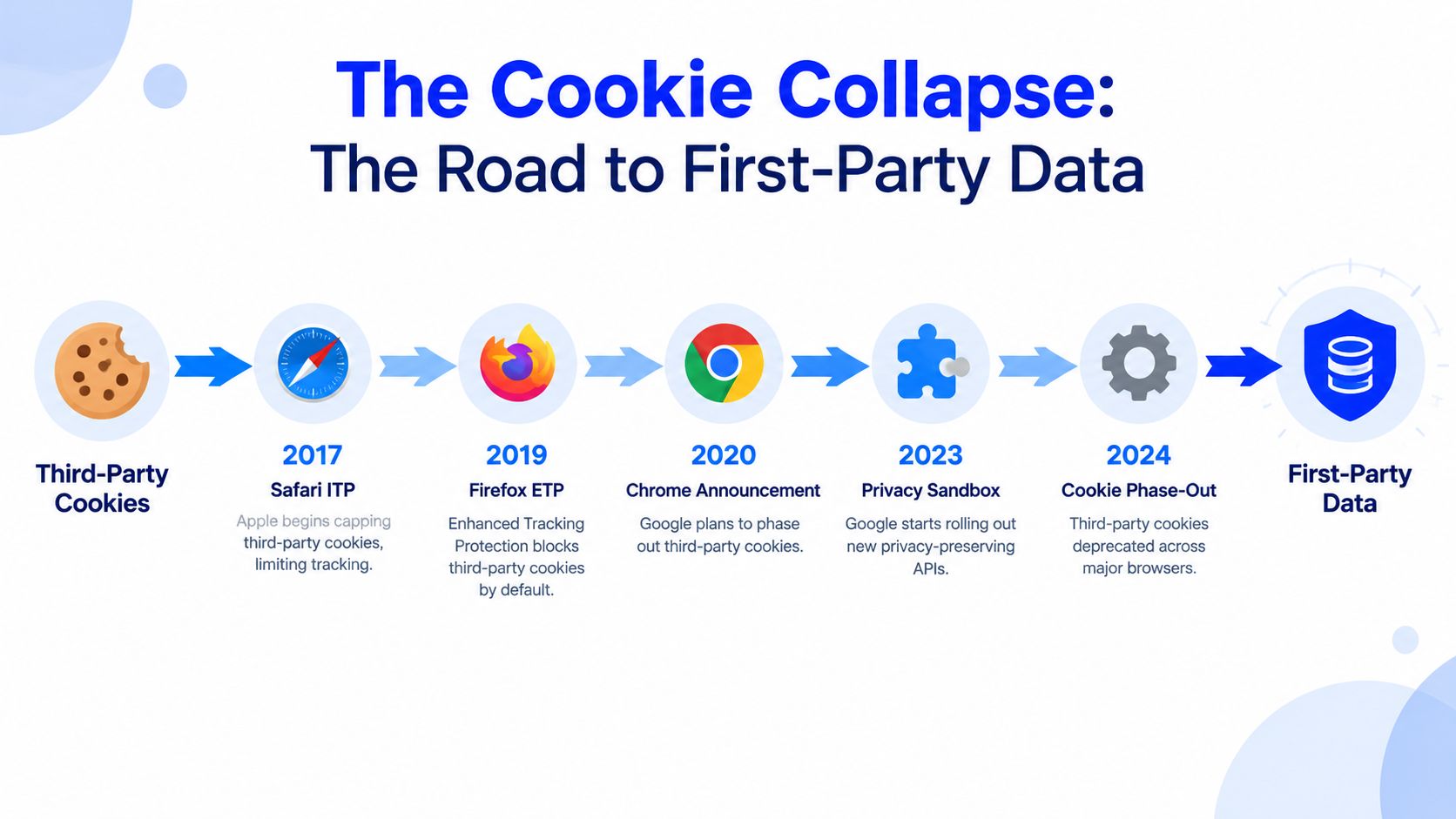
The easy-cookie era trained marketers to rent identity from browsers and platforms. That model weakened as Safari limited cross-site tracking, Firefox strengthened protection, Apple introduced app tracking controls, and Chrome began changing its own cookie plans.
The timeline matters because each policy decision reduced the addressable surface for retargeting, lookalike modeling, and cross-site attribution. It also exposed the strategic risk. A company that depends on a platform-controlled identifier can lose measurement continuity without changing its own website or customer experience.
Policy reversals are the lesson
Google began turning off third-party cookies for 1% of Chrome browsers in January 2024, and the company then said on April 22, 2025 that it no longer planned to phase out third-party cookies in Chrome, reversing the earlier path. Those facts are documented in Digiday's coverage of first-party data and Chrome's changing cookie policy.
The reversal doesn't restore strategic certainty. It proves the opposite. A browser vendor can change the identity environment on its own timetable, leaving brands and agencies to rebuild tags, attribution logic, audience definitions, and reporting assumptions.
A strategy built on rented identity remains a strategy on loan.
First party data became the default because it gives organizations a signal they collect, store, and govern themselves. It can move with the business across a browser change, app redesign, commerce upgrade, or advertising policy shift. That doesn't make direct collection automatically safe or complete. It makes the source controllable, which is the prerequisite for building a durable control system.
The commercial infrastructure is already following the change. The customer data platform market is forecast to reach USD 10.3 billion in 2026, and more than 70% of digital advertising spend is expected to be fueled by first-party data strategies by the end of 2026, according to 2026 industry coverage of first-party data statistics. The sensible buy signal isn't a cookie promise. It's whether a platform can unify authenticated data, consent handling, and server-side collection when the rules change again.
Quality Controls That Make First Party Data Usable
A database can be owned and still be unusable. Direct collection produces missing values, duplicate people, inconsistent event names, and records that can't legally enter a particular activation workflow. Teams need a quality control loop that checks data at ingestion and before reuse.
Five controls deserve operational ownership.
Consent rate by purpose
A single opt-in flag isn't enough. Analytics, personalization, and advertising can have different purposes and permissions. Measuring consent at the event or purpose level shows which records can pass downstream activation and which must remain restricted.
Identifier match rate
Match rate reveals whether a CRM record can connect to an authenticated website session, commerce account, email profile, or permitted advertising audience. A low match rate creates false anonymity. A customer known to sales may look like a new visitor to onsite personalization because systems never resolved the allowed identifiers.
Profile completeness
Completeness should be measured against the use case, not against an abstract ideal profile. A retention workflow might require a contact method and purchase history. A service workflow might need account status and support context. Missing consent timestamps or purpose fields can disqualify otherwise valuable records.
Schema conformance
Every event needs a documented name, parameter structure, data type, and owner. Without conformance checks, a CMS release can rename a form event, a commerce integration can alter an order property, and a reporting model can fail.
Deduplication accuracy
Duplicate records inflate reach, distort frequency, and split customer history. The same person can appear separately in a CRM, email service, analytics tool, and commerce system unless the consolidation layer applies explicit matching and survivorship rules.
| Control | What It Measures | Failure When Ignored |
|---|---|---|
| Consent rate | Permission by purpose and event | Restricted records enter activation or valid audiences appear artificially small |
| Identifier match rate | Resolution across approved systems | Known customers remain fragmented across channels |
| Profile completeness | Required fields for a specific use case | Segments contain unusable or weakly qualified records |
| Schema conformance | Compliance with event and profile specifications | Integrations and reports break after ordinary releases |
| Deduplication accuracy | Whether repeated records represent one person or account | Reach, frequency, attribution, and customer history become distorted |
The important distinction is between a large dataset and a dependable dataset. Quality checks belong in ingestion, transformation, activation, and monitoring. They can't be retrofitted after a campaign, migration, or regulatory request exposes the gaps.
Privacy Consent and Governance for First Party Data
Direct collection isn't automatically privacy-safe. A company can collect information from its own website and still fail to explain the purpose, establish the lawful basis, limit retention, protect access, or honor deletion requests.
The IAPP guidance on consent and transparency in first-party data programs makes the operational point clearly: organizations need a lawful basis, meaningful information at the right time, technical safeguards, and processes for access, deletion, and consent withdrawal.
Governance belongs in the workflow
Four controls should exist before personalization or CRM enrichment goes live:
- Tie lawful basis to purpose. Analytics, advertising, personalization, service delivery, and contractual processing shouldn't hide behind one blanket permission. Each data use needs a defensible route.
- Explain collection at capture. A notice should identify what the form, tracker, account flow, or integration collects and why. The business should retain the version shown when the person made the decision.
- Enforce safeguards technically. Encryption in transit and at rest, pseudonymization for sensitive joins, role-based access, and export audit logs should be platform behavior, not a policy document sitting in a shared drive.
- Connect data-subject requests to the identity layer. Access, deletion, correction, and withdrawal requests need to reach the corresponding record across CMS, commerce, CRM, email, and advertising systems.
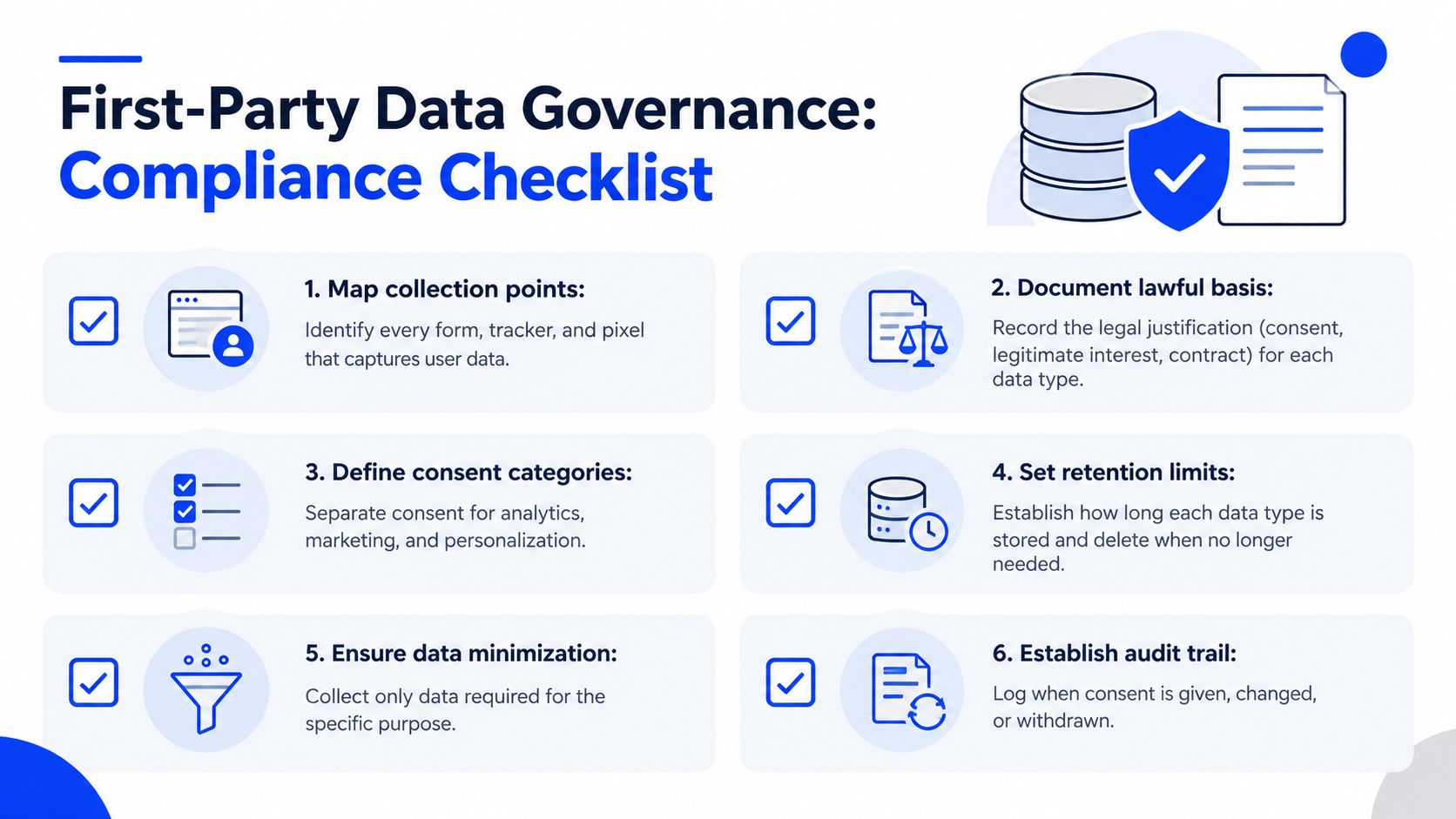
Teams should also collect the minimum information required for the stated purpose. Extra fields create extra exposure, extra retention decisions, and extra migration work. Hashed identifiers need the same discipline because hashing supports matching, but it doesn't automatically remove personal-data obligations.
Governance test: A business should be able to answer what was collected, why it was collected, who can use it, how long it remains, and how it will be deleted.
For teams formalizing processor responsibilities, a data processing agreement belongs in the platform and vendor review, not at the end of implementation. Governance must travel with the data through every form, API, export, audience, and migration.
Unifying First Party Data Across CMS Commerce CRM and Ads
Collection is the easy part. The difficult work starts when each owned system has its own event stream, identity model, and consent record.
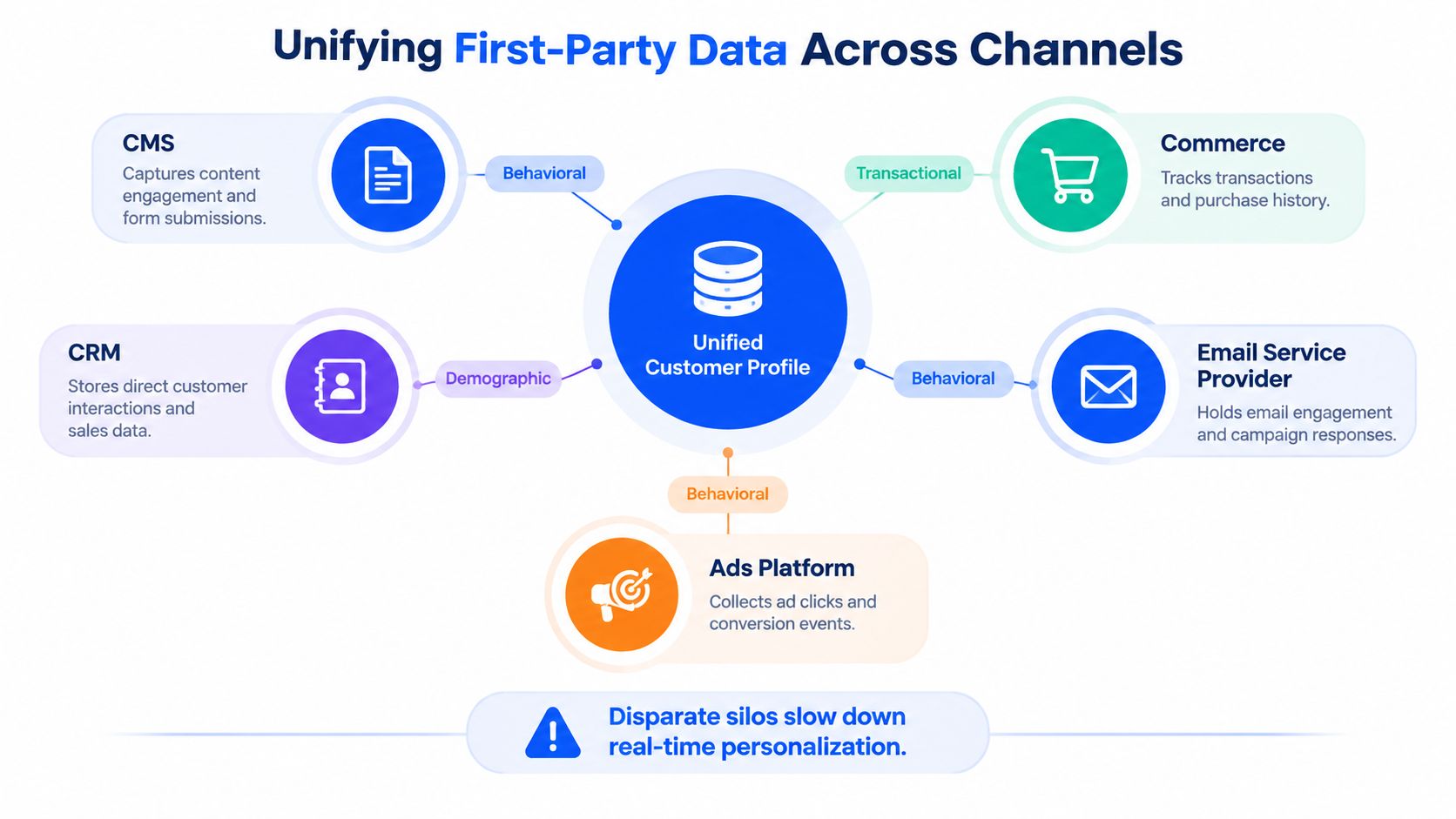
A CMS knows content engagement and form submissions. Commerce knows orders and transaction history. The CRM knows account interactions and sales activity. The email service provider knows delivery and engagement events. Ad platforms receive clicks and conversion signals. Each system has value, but none should become the accidental source of truth because it was deployed first.
Three shared layers prevent channel isolation
A consolidation layer has three jobs:
- Resolve approved identity: Define which deterministic identifiers can connect records and where probabilistic resolution is allowed. Keep raw identity separate from reporting outputs.
- Preserve the event contract: Use a shared event schema so a platform change or transport change doesn't alter what “purchase,” “lead,” or “engaged account” means.
- Gate activation with consent: Store purpose-specific consent centrally enough that every destination applies the same permission state.
Without those layers, a returning purchaser can look like a new visitor in analytics, an email subscriber can remain anonymous to onsite personalization, and a CRM customer can fail to match an advertising audience. A dashboard may show connected channels while the underlying records remain fragmented.
Unified data platform guidance is relevant to the platform decision because consolidation isn't the same as adding another destination. The selected architecture should reduce duplicated ownership and make the approved customer view reusable across CMS, commerce, CRM, email, and ads.
Agencies and multi-brand teams need to reject tool accumulation. A new CDP can centralize records while leaving the CMS, commerce platform, forms, and consent manager unchanged. If every activation still requires bespoke mappings and manual reconciliation, the organization has purchased another silo with a nicer interface.
The right question is not “Where can teams collect more data?” It's “Which system governs the shared identity, event, and consent contracts that every channel must respect?”
Migration and Re-Platforming Without Breaking the Data Layer
A CMS migration is the transfer of content, structure, design, and functionality from one platform to another. Enterprise migration guidance describes the work as moving an entire digital ecosystem to a new architecture, not exporting visible pages. The definition and scope of CMS migration supports the practical conclusion: staging, testing, integrations, templates, business logic, and cutover discipline all belong in the plan.
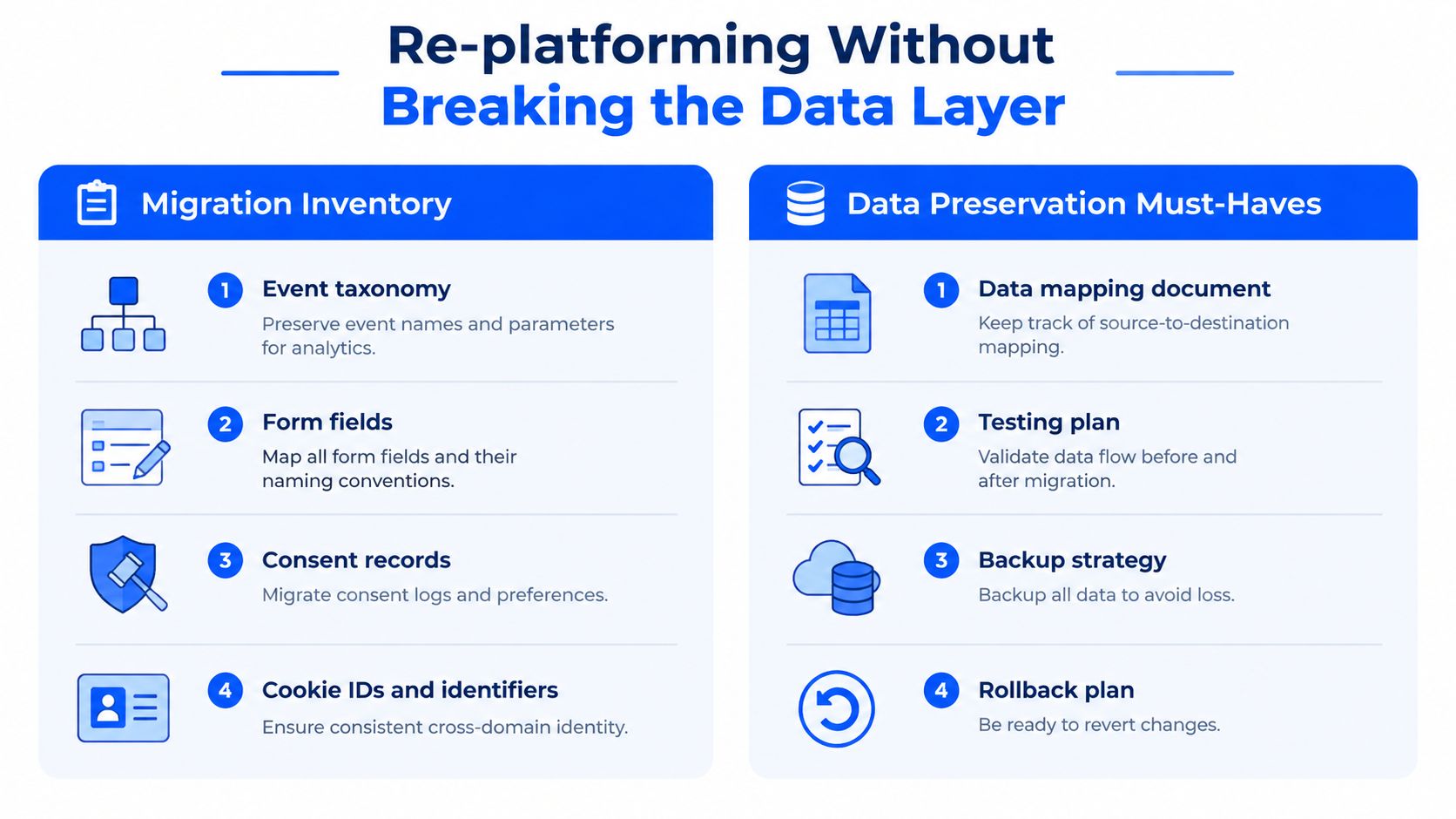
First party data makes that requirement critical. Before a visual redesign, the migration team should inventory every owned touchpoint that creates or changes a customer record.
The minimum migration inventory
The inventory should include:
- Forms and fields: Every form, field name, validation rule, submission destination, consent category, and retention requirement.
- Event taxonomy: Event names, parameters, triggering conditions, owners, downstream reports, and activation dependencies.
- Identity graph entries: Account IDs, customer IDs, permitted hashed identifiers, cross-domain rules, and stitching logic.
- Consent receipts: Purpose, timestamp, notice version, preference changes, withdrawals, and links to the affected record.
- Integration mappings: Analytics events, CRM fields, ecommerce objects, email attributes, conversion APIs, ad pixels, webhooks, and API consumers.
- Audience dependencies: Segments used by email, personalization, reporting, and paid media, including their eligibility rules.
The vendor checklist should demand parity for first-party fields, retained consent timestamps, documented retention windows, and a clean handoff for CRM, CDP, and advertising audiences. Staging must test data flow before and after cutover, while rollback planning protects the original system if the new path produces corrupted or incomplete records.
Cross-platform migration guidance is useful only when the migration is treated as controlled systems work. A platform that preserves URLs but drops event semantics has failed the business, even if the redesign looks flawless.
Every migration should produce a written inventory of preserved first-party assets. Without that document, teams can't prove what moved, what changed, or what needs remediation. The result is often a forced rebuild of the data layer after launch, exactly when marketing, sales, and service teams need continuity.
What a First Party Data Operating Model Delivers and What to Do Next
A governed operating model gives marketing more than a larger audience file. It gives paid media approved server-side audiences, personalization a consistent profile, compliance teams a traceable decision path, and IT a documented architecture that doesn't depend on one agency specialist or one aging integration.
The proof point a marketing leader can defend is operational: fewer identity gaps. If a known CRM customer, authenticated site user, purchaser, email subscriber, and permitted ad audience resolve through the same governed identity layer, teams stop counting one relationship as several disconnected prospects. That improves the reliability of segmentation and measurement without requiring a new collection tactic.
The model also reduces vendor dependence. A company can replace a destination tool without redefining the customer, consent state, or event taxonomy. Agencies can manage multiple brands from shared rules instead of rebuilding every form, integration, and report from scratch. A multi-site platform becomes valuable when it preserves those operating contracts across the portfolio.
Teams evaluating a migration should take three actions:
- Inventory every first-party source: List CMS forms, commerce events, CRM records, email interactions, support data, loyalty signals, and advertising destinations.
- Score data against the five controls: Review consent rate, match rate, completeness, schema conformance, and deduplication accuracy.
- Pressure-test the platform: Require evidence that identity, consent, taxonomy, integrations, and audience mappings survive a future migration.
WebinOne consolidates CMS, ecommerce, CRM, email marketing, multi-site management, and headless API delivery in one managed system, with forms and captured records available for reporting, filtering, and authorized API access. It's a practical option for agencies and enterprise teams that want to replace plugin sprawl and disconnected site estates with a governed platform layer. The platform runs on AWS across 6 global data centers, has delivered 99.99% uptime over the last 12 months, and has migrated 3,000+ sites, with AWS Marketplace availability and partner validation supporting the infrastructure review.
WebinOne gives agencies and enterprise teams a managed foundation for preserving forms, consent, identity, and event flows while consolidating CMS, commerce, CRM, email, and multi-site operations. Visit WebinOne to review the platform, plan a controlled migration, or speak with the team about replacing a fragmented first party data stack.