Website Maintenance Services: Scope, Models and Risks
The most common advice about website maintenance services is to buy updates, backups and uptime monitoring. That's an incomplete specification. A site can stay online while a release breaks checkout, blocks keyboard users or makes a shared template painfully slow. Buyers should purchase release-level accountability, with a named owner, a measurable target and evidence of completion for every critical task.
For agencies moving into larger projects, that distinction matters commercially. A maintenance contract that leaves incident decisions with the agency hasn't transferred operational responsibility. It has added another supplier to coordinate when something fails.
Table of Contents
- What Website Maintenance Services Include
- How Service Models Differ
- Patching and Vulnerability Management
- Performance Upkeep Against Core Web Vitals
- Accessibility Upkeep After Launch
- Backups, Recovery Targets and Downtime Cost
- Confirm Scope, Price and the Next Step
What Website Maintenance Services Include
Three proposals can list identical maintenance tasks and still describe three different contracts. One provider patches within days, another patches monthly, and a third patches "as needed," which in practice means after something breaks. Read the schedule below as a contract checklist: the substance sits in the cadence and ownership columns, not in the task names.
Core maintenance tasks, cadence and ownership
| Task | What It Includes | Typical Cadence | Who Owns It |
|---|---|---|---|
| Software and plugin updates | Core, theme, plugin or module updates tested in staging | Monthly, plus urgent patches | Provider, with client approval for scope |
| Security patching | Vulnerability triage, patch testing and controlled release | Continuous; urgent items within days | Provider |
| Backups | Scheduled full and incremental copies stored off-site, with restore tests | Daily or per change window | Provider |
| Uptime and error monitoring | External checks, alerts and status reporting | Continuous | Provider |
| Performance checks | Core Web Vitals on real-user data and regression review | Monthly | Provider |
| Accessibility regression | Automated scans plus keyboard and screen-reader checks on changed templates | After each release | Shared, with both owners named in the contract |
| SSL and domain renewals | Certificate and domain expiry tracking | Before expiry | Provider |
| Content and small edits | Copy, image and page changes within agreed hours | Per request or monthly hours | Client or provider |
| SEO and technical checks | Crawl errors, redirects, sitemap and indexing issues | Monthly | Provider or shared, assigned in the contract |
On a managed platform, the software-update row becomes a platform responsibility rather than a client-maintained collection of extensions. Security work still requires triage by exploitability and business impact. A routine calendar must never delay an urgent fix.
Backup scope should state two things in writing: how many copies are retained and how often a restore is tested. A backup that has never been restored is a hope, not a control. Monitoring should separate a homepage that returns a success code from a form, account area or payment journey that completes. Availability reporting should cite the platform's measured record: WebinOne's uptime over the last 12 months is 99.95%.
Separate recurring work from project work
WebinOne's administration team renews all SSL certificates on its sites every 3 months, which moves that row to platform level. Domain ownership, renewal authorization and billing contacts still need documenting, especially when the agency registers domains on behalf of clients.
Content allowances should define what counts as a small edit. Swapping an image is maintenance. Rebuilding a template, changing an integration or migrating a portfolio is project work, priced and scheduled separately. Custom ecommerce builds fall on the project side too and are scoped as a TeamOne project.
Agencies assessing the WebinOne reseller program should make this division part of their client-facing offer, with platform operations, agency delivery and client approvals on separate lines. A row that still reads "shared" or "as needed" at signature is an incident looking for an owner.
How Service Models Differ
Ask one question of every proposal on the table: who stays accountable when the purchased hours run out? Hourly support, retainers, managed platforms and self-run stacks all carry the label "maintenance," but they assign patching, recovery and overnight response to different owners. The table maps where each model puts that accountability.
Service models compared
| Model | Who Does the Work | Typical Scope | Best Fit |
|---|---|---|---|
| Ad hoc hourly support | Developer on request | Fixes when something breaks | Small brochure sites with little change |
| Tiered monthly retainer | Agency or provider team | Fixed monthly hours, updates, monitoring and reporting | Sites with steady content changes |
| Managed platform support | Platform team plus partner | Hosting, security, backups, monitoring and SLA-backed uptime | Multi-site portfolios and regulated clients |
| Self-run with own tooling | Client's own web staff | Whatever the team can monitor, patch and restore | Organizations with dedicated web operations capacity |
Ad hoc support pays for fixes after something breaks. Nobody owns the quiet months, and the developer contacted during an incident may have no reserved capacity. Any site that earns revenue or handles customer data deserves a stronger foundation than a contact in your phone.
A retainer improves continuity, but fixed hours still don't equal continuous coverage. The agreement needs to say whether an overnight incident triggers a response or waits for the next working period. For sector-specific scope planning, Zee Palm's website care for wellness brands is a useful resource to examine alongside operational requirements.
A monthly invoice doesn't establish an on-call obligation. The service agreement does.
Managed responsibility versus retained responsibility
Self-run tooling leaves the client responsible for patching, alerts and recovery. That can work with dedicated operational capacity, but documentation and escalation must survive the absence of the person who assembled the stack.
Under the managed platform model, hosting, security, backups and monitoring sit with the platform team, while the agency or integrator keeps delivery and the client relationship. WebinOne runs in its own AWS account across six AWS regions. Standard sites can't be installed on a customer's server: the closed platform is supported and maintained by the platform team on AWS. For qualifying systems integrators, a licensed deployment in the integrator's or customer's AWS account is available by agreement, including AWS GovCloud.
The distinction matters for procurement. A licensed deployment is a specific agreement rather than a standard hosting option. The managed services and support overview provides context for separating platform support from partner delivery.
Score every model against four responsibility questions: who patches, who restores, who receives the overnight page, and what availability the SLA promises in numbers. Each answer needs a named owner and a measurable figure. A proposal that leaves any of them unassigned is selling hours, and the missing owner surfaces during the first incident.
Patching and Vulnerability Management
CISA's software-update guidance reports that vulnerability exploitation was the initial access vector in 20% of breaches analyzed in Verizon's 2025 Data Breach Investigations Report, only about 54% of those vulnerabilities were fully remediated during the year, and median remediation time was 32 days. Buyers should contract for a remediation workflow with named owners and deadlines rather than an allowance of update hours.
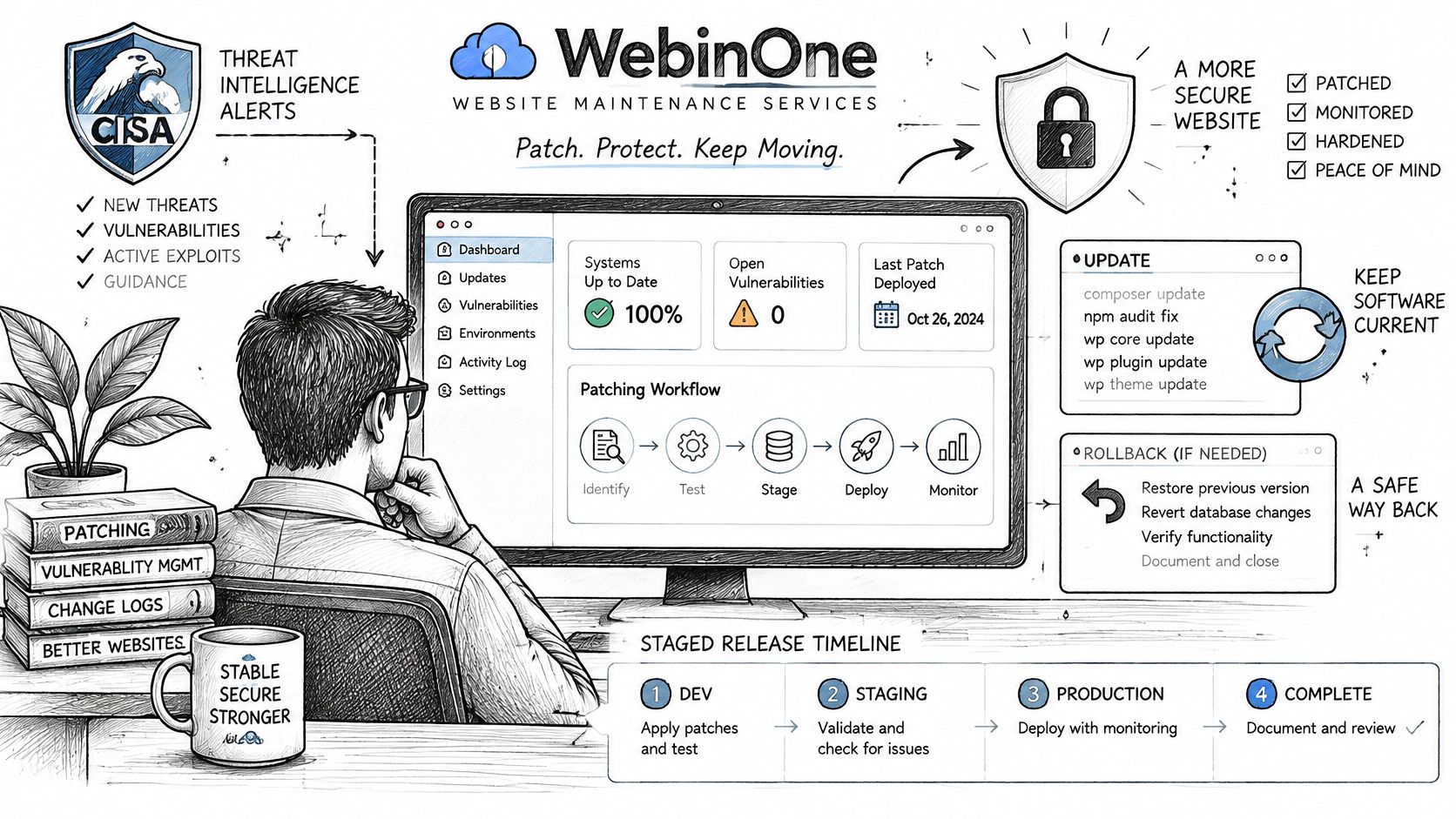
On WebinOne, core platform patching runs inside managed operations with controlled releases. The platform layer is included. Components inside the delivery scope, such as custom modules and integrations, still need an urgency owner named in the contract.
The remediation workflow
- Inventory exposed components. Include libraries, integrations, modules and any extensions within the delivery scope. An unnamed dependency escapes both monitoring and ownership.
- Match known identifiers. Map components to recognized vulnerability identifiers where matching information exists. Record uncertain matches for investigation rather than treating them as clean results.
- Prioritize actual exposure. Assess exploitability, public access and business impact. CISA's Known Exploited Vulnerabilities catalog should inform urgent decisions affecting exposed or legacy systems.
- Test before production. Exercise affected templates and complete business journeys in staging. A patch that installs cleanly can still break authentication or submission handling.
- Release under control. Name the release approver, the deployment window and the reversal decision. Urgent work needs an accelerated path agreed in advance, with a response deadline attached to each severity level.
- Record closure. Retain the deployment date, affected versions, test results and unresolved exceptions. A closed ticket should demonstrate remediation.
Reversal is part of patching
Every WebinOne plan includes URL (301) redirects, preview and draft mode, and a page rollback option. These controls help reverse a bad release. The recovery decision still needs an owner: the contract should state who has authority to trigger a rollback and within what window.
Admin support is available 24/7 across all six data centers. Round-the-clock support availability says nothing about remediation speed for custom code, so response targets for security issues affecting integrations belong in the agreement explicitly.
For agencies carrying extension-heavy estates, treat the WordPress plugin maintenance workload as a responsibility to transfer to the provider, with its owner named in the contract. The decisive question is who owns the decision about how quickly an exposed component gets fixed, including authority to interrupt a planned release.
Performance Upkeep Against Core Web Vitals
A campaign manager adds a third-party embed to a shared landing-page template. The panel renders after the page settles, reserves no space, and pushes the call-to-action down on every URL using that template. Desktop averages can still look acceptable while mobile layout shift crosses the line.
Core Web Vitals thresholds for ongoing monitoring
Google's Core Web Vitals guidance sets the good and poor limits below and evaluates field data at the 75th percentile; a page passes only when every required metric meets its good threshold.
| Metric | Good | Poor |
|---|---|---|
| Largest Contentful Paint (LCP) | 2.5 seconds or less | Above 4 seconds |
| Interaction to Next Paint (INP) | 200 milliseconds or less | Above 500 milliseconds |
| Cumulative Layout Shift (CLS) | 0.1 or less | Above 0.25 |
Treat each metric as a separate release gate.
Slow LCP calls for investigation of the largest visible content element and its delivery path. Compress and prioritize important images, review caching, tune content delivery and origin behavior, and remove unnecessary render-blocking resources.
Poor INP requires a different diagnosis. Reduce main-thread JavaScript, split long tasks and investigate expensive event handlers. Faster image delivery won't fix an interaction delayed by excessive script execution.
Excessive CLS usually calls for reserved space. Images, advertisements, embeds and dynamically inserted components need predictable dimensions so content doesn't jump after visitors begin reading or interacting.
Catch shared-template regressions
In the embed scenario, layout shift moves into the poor range even though the main content still loads quickly. The maintenance owner should inspect results by device, geography and template, then identify the release and resource responsible. Portfolio averages can conceal a broken mobile template behind better desktop results.
- Before publication: Review each new third-party script, its purpose and its effect on rendering.
- After release: Compare affected templates and commercially important journeys against their previous behavior.
- After structural changes: Repeat checks following redesigns, infrastructure migrations and major traffic changes.
Set the trigger in numbers, not appetite: a shared template that pushes 75th-percentile CLS above 0.25, INP above 500 milliseconds, or LCP above 4 seconds needs an owner and a fix decision before the next campaign ships. Carlos Alba Media's practical guidance to speed up a UK business site offers additional context for planning performance work. A WebinOne maintenance agreement should name the investigator, the affected template, and the release that gets patched or reversed.
Accessibility Upkeep After Launch
A revised navigation component can trap keyboard focus. A new image can go live without a meaningful description. A marketing embed can introduce unlabeled controls. None of these changes touch the underlying platform, which is why a launch audit ages so quickly: every routine release can introduce barriers the audit never saw.
Accessibility work belongs in release-level maintenance, the same governance that covers patching and performance thresholds. TeamOne provides accessibility services alongside development, design and migration on WebinOne. Whether that work applies to your sites depends on the contracted scope.
WebAIM's 2024 analysis of home pages from the world's top one million websites detected an average of 56.8 accessibility errors per page, while 95.9% contained at least one automatically detectable WCAG failure. Automated testing catches only part of the problem, so a clean scan on its own is weak evidence.
Test complete journeys, not isolated screenshots
The WCAG 2.2 specification defines Level AA conformance as satisfying every applicable Level A and Level AA success criterion, or providing a conforming alternate version. Conformance applies to full pages and complete processes, so a clean landing-page review says nothing about whether checkout or account recovery works.
A maintenance agreement should turn that scope into practical checks:
- Scheduled automated scans: Identify detectable failures across the estate and route findings to named owners.
- Changed-template testing: Check keyboard operation, focus order, screen-reader output, labels, contrast and responsive behavior after each template or component release.
- Complete-process regression: Exercise checkout, account areas, search and multi-step forms, including validation and recovery from errors.
- Recorded remediation: Set numeric response and correction targets by severity, with decision records suitable for procurement or legal review.
Keep responsibility after publication
An overlay does not correct broken semantics, missing labels, inaccessible interaction patterns or confusing error handling. Those defects need fixing in the delivered interface itself, and the obligation sits with whoever ships the release.
Release rule: Shared accessibility ownership is valid only when both sides have named responsibilities and a clear escalation route.
Split ownership explicitly. The content owner covers editorial practices such as useful link text and image descriptions. The delivery owner covers template behavior, component changes and technical remediation. TeamOne's accessibility services apply when they are in scope for the engagement, so the agreement has to name the delivery owner in writing.
The buying question is specific: who owns accessibility after launch, and what remediation timeline applies when a release breaks a form? A contract that answers only with an annual audit leaves routine publishing changes outside effective governance.
Backups, Recovery Targets and Downtime Cost
An ecommerce restore can return every product page and still lose the orders placed during the gap before failover. That is the buying problem: recovery is measured by time and data, and each needs an owner plus a number.
Define recoverability separately
NIST's contingency-planning guidance defines the Recovery Time Objective (RTO) as the maximum period a system resource can remain unavailable before the impact becomes unacceptable, and the Recovery Point Objective (RPO) as the point in time before an outage to which data must be recovered. NIST also calls for testing backup information for reliability and integrity. Treat those tests as release governance: a patch, template change or integration update can make yesterday's restore procedure wrong.
WebinOne reports 99.95% uptime over the last 12 months, roughly 4.4 hours of unavailable time on a simple full-year calculation. Availability leaves open which transactions can be recovered and how long checkout stays down, so the contract needs recovery targets with more precision than a bigger uptime claim.
Generic downtime surveys are a weak substitute for your own arithmetic. Calculate hourly impact from lost gross margin, paid traffic already spent, support load, payment reconciliation work and any credits owed under service terms. If that figure is uncomfortable, set tighter RTO and RPO before discussing presentation details.
Purchase evidence of restoration
A recovery schedule should specify:
- Numeric objectives: Agreed RTO and RPO for the relevant services and data.
- Independent copies: Off-site storage arrangements and access responsibilities.
- Retention rules: Which recovery points remain available and when they expire.
- Restore evidence: Scheduled tests, results and verification of restored functionality.
- Failed-test escalation: A named owner and correction deadline.
For an ecommerce site, the RPO sets the possible order-reconciliation workload. Orders accepted after the recoverable point may need reconstruction from payment processor records or notification emails. A page restore can look complete while order history still has holes.
A backup earns its keep when a timed restore proves what came back and what was lost.
When documenting an existing estate before migration, the guide to backing up a WordPress website helps inventory data, copies and retention. Bring restore evidence into that review: test duration, data currency, missing objects and the person accountable for closing gaps.
Confirm Scope, Price and the Next Step
Most maintenance agreements go silent at the one moment the buyer needs them most: the end of the relationship. WebinOne addresses that directly. If the Service is closed or discontinued, WebinOne commits to open-source the platform so every Reseller can host its trial and live sites, WebinOne Portal and SSO service without WebinOne's support. That commitment is worth more than another page of uptime promises, and it sets the standard for the rest of the commercial review.
The decision comes down to three things: what the subscription covers, what is separately chargeable, and what happens when the relationship ends. Settle all three before debating dashboards or presentation. A polished admin portal does not compensate for an unassigned responsibility.
Sign off the operational schedule
The contract should confirm the requirements settled during evaluation, in specific terms rather than broad service descriptions:
- Scope ownership: every recurring maintenance row keeps the named owner and cadence assigned during evaluation.
- Recovery commitments: numeric RTO and RPO targets supported by a tested restore.
- Urgent remediation: a named decision-maker for exposed vulnerabilities.
- Accessibility coverage: regression testing across complete processes, not only template pages.
- Performance accountability: Core Web Vitals reporting after each release, with an owner for corrective work.
Each item should identify whether responsibility belongs to the platform provider, the partner or the client. Shared responsibility needs an explicit boundary and an escalation route; "joint" assignment is no assignment at all.
Settle price, handover and payment
The starting price is not a substitute for an order form. Confirm which sites, environments and support hours the subscription covers, then separate platform fees from migration, custom development and optional services purchased through the WebinOne Portal, which may be added before or after a plan.
Custom work deserves the same treatment. TeamOne provides web development, design, migration and accessibility services for client websites on WebinOne, so buyers should scope that work as a defined project with its own deliverables rather than assume it sits inside a monthly plan.
Exit arrangements deserve equal attention. The agreement should describe content handover, domain control, portfolio administration and the assistance available during transition. WebinOne is a closed, managed platform with all sites supported on AWS servers, so leaving the service means a planned migration rather than collecting a standard server installation. The open-source commitment above applies to platform closure; an ordinary customer cancellation follows its own procedure.
Payment continuity must also be explicit. WebinOne may disable websites or other service features maintained in connection with the Services when applicable fees are 30 days past due. Agencies should align client collection terms with that window rather than assume uninterrupted delivery during a billing dispute.
For enterprise procurement, WebinOne is an AWS Partner, is listed as AWS Qualified Software, and has passed the AWS Foundational Technical Review. Systems integrators assessing a partnership or migration should establish deployment responsibility and any licensed-account requirements during scoping, not after signature.
Agencies ready to move beyond open-ended maintenance obligations should review white-label delivery and commercial terms through the WebinOne reseller program, bringing a representative client scope and current maintenance responsibilities. Systems integrators, AWS partners and enterprise buyers should start a partnership or migration conversation with the WebinOne team, including a licensed deployment in their own AWS account where that agreement applies. The next discussion should produce a responsibility schedule, recovery requirements and a migration scope, not just a subscription quote.