Managed Web Hosting: What You Get and What You Keep

A website can post 99.99% server uptime all year and still expose a business to security gaps, broken updates, and accessibility failures. In KeenVerdict's compilation of small-business website statistics, WebAIM's 2026 Million audit found detectable WCAG failures on 95.9% of the top one million home pages, up from 94.8% in 2025. The same KeenVerdict benchmarks cite a 2025 survey of 406 U.S. small-business owners in which only 34% named security updates among their website investment priorities. A server that stays powered on does nothing about either problem.
Availability is table stakes. The operational test for agencies, systems integrators, and enterprise web teams sits elsewhere: managed web hosting is judged by who owns ongoing change, who produces verifiable security evidence, and what your exit terms look like when the contract ends. Most hosting comparisons stop at server specs and headline percentages, which is why the agreements that fail rarely break over CPU limits. They fail in the grey zones. A vulnerability drops on a Friday and nobody can say who patches the application layer. A compliance review requests evidence of security controls and the provider offers a marketing page where documentation should be. A customer decides to leave and discovers the platform has no export path.
Exit terms deserve particular scrutiny because they are the hardest clause to fix after signing. WebinOne, which hosts all of its sites on AWS servers, commits in its service terms to open-source the platform if the service is ever discontinued, so resellers can keep hosting their trial and live sites, portal, and SSO service without WebinOne's support. That is the standard worth measuring any managed hosting agreement against, because it decides whether ending a contract means migrating on your schedule or scrambling on the provider's.
Table of Contents
- What Managed Web Hosting Covers
- Who Handles What, Task by Task
- What Each Uptime Target Allows in Downtime
- Why Request-Level Monitoring Beats Ping Checks
- Patching, Vulnerabilities and Who Owns the Fix
- Governing a Portfolio, Not Just One Site
- Where Your Sites Run and How You Exit
- Confirm the Hosting Scope Before You Sign
What Managed Web Hosting Covers
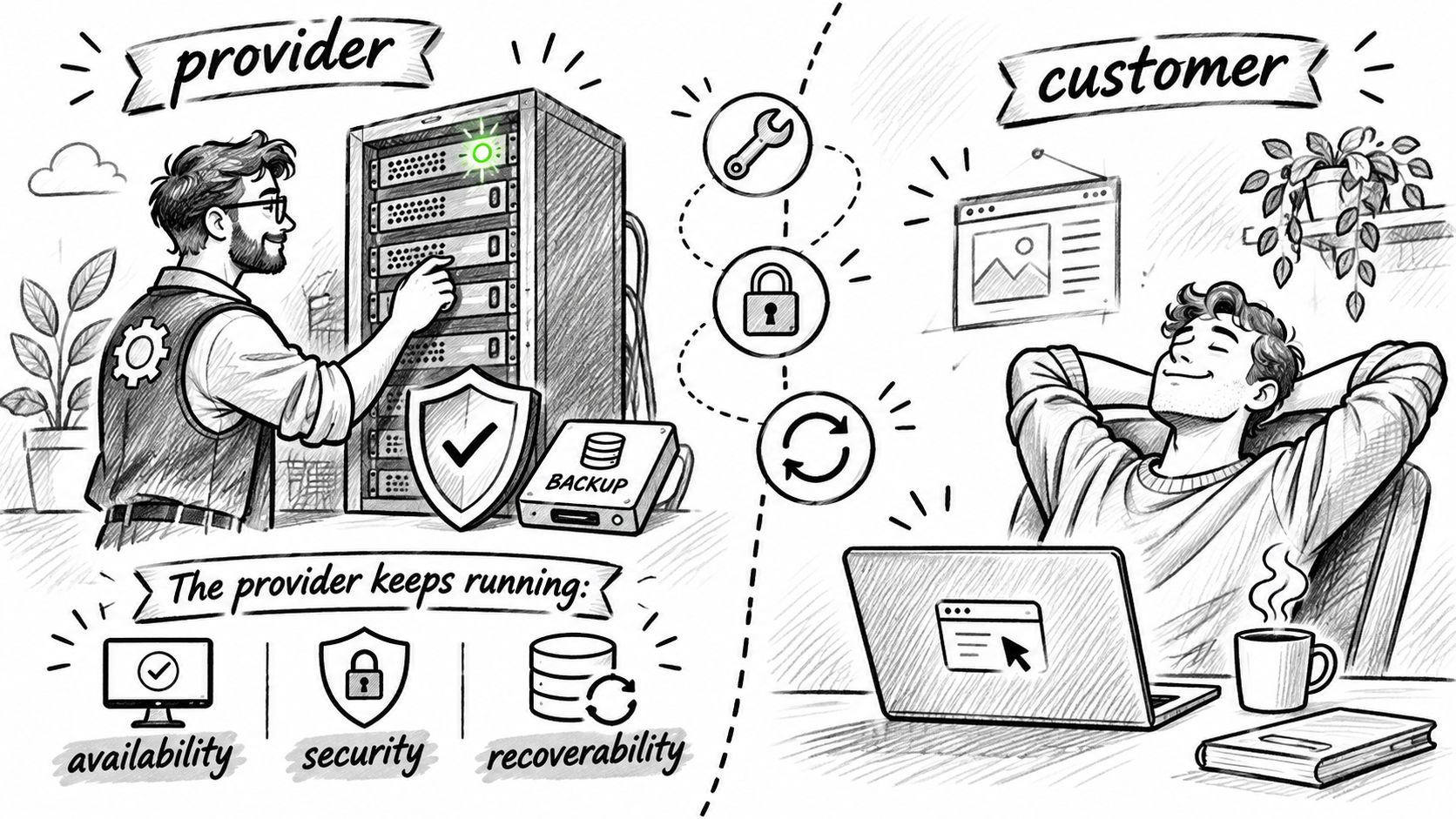
WebinOne delivers managed web hosting on Amazon Web Services where our team administers the underlying infrastructure, platform runtime, and routine maintenance for every site, so agencies and enterprise teams don't run servers. A practical definition buyers can test in any contract review is straightforward: the provider operates the hardware, software stack, and recovery processes that keep a site available, secure, and recoverable after launch.
Say a growing digital agency signs fifteen client retainers in a single year. On unmanaged hosting, the agency rents virtual private servers and owns every operating-system patch, backup schedule, monitoring alert, and midnight restore itself. On basic shared hosting, the provider pools resources across tenants, which limits configuration control and breaks down the moment traffic spikes or compliance rules tighten. Neither setup separates web delivery from server administration.
The Three Operational Layers
To audit what a hosting agreement buys, split your web stack into three distinct layers:
- Infrastructure layer: Physical compute, networking, storage, and data centers. Providers handle hardware failures, scaling capacity, and regional routing here.
- Platform layer: The operating system, web server runtime, CMS core, and native extensions. When this layer sits outside a hosting contract, your own engineers inherit version upgrades and broken dependencies.
- Operations layer: Continuous monitoring, incident response, tested backups, and documented change control. Uptime targets become repeatable day-to-day execution here.
Across the industry, buyers have moved steadily toward outsourcing all three layers rather than carrying per-site server upkeep. A market report from Emergen Research valued the global managed-hosting market at approximately USD 89.3 billion in 2024 and projected it to reach USD 247.8 billion by 2034, a 10.7% compound annual growth rate. Even when agencies scope initial project budgets using benchmarks like UK web design cost ranges from Wecomeet, post-launch administration often erodes margin if server care stays unbilled on the agency's plate. Before evaluating any provider, map which of those three layers your team still carries today. That answer defines the exact scope your managed contract must cover.
Who Handles What, Task by Task
WebinOne draws a sharp operational boundary at the platform layer: because WebinOne is a closed system, sites aren't hosted on a customer's own server, and all sites are supported and maintained by the WebinOne team on AWS servers. Customers keep full control over content, publishing approvals, and user access rules without touching server administration.
Ambiguity between provider tasks and customer tasks causes most post-launch disputes. Use the matrix below to audit any managed hosting agreement before signature.
| Task | Usually in provider scope | Usually still yours |
|---|---|---|
| Server provisioning and OS patching | Yes | Approving maintenance windows for client-facing sites |
| Uptime monitoring and incident response | Yes | Naming the business owner who receives alerts |
| Scheduled backups and restores | Yes | Signing off a test restore of your own content |
| SSL certificates and renewals | Yes | Domain registration and DNS records, depending on the contract |
| Security scanning and firewall rules | Yes | Staff account access and role assignment |
| CMS core and extension updates | Yes, on a managed platform | Approving changes that alter design or content |
| Custom code and third-party integrations | Only if scoped in the contract | Anything not scoped in the contract |
| Content, copy and SEO | No | Yes |
| Accessibility remediation | Only if scoped in the contract | Agreed scope and sign-off |
Reading the Provider Column
Every row marked as provider scope requires three concrete items in writing: a named accountable owner, a defined response target, and verifiable evidence. A provider claiming to run backups means little until it can hand over a dated restore test showing your site recovers cleanly. The same rule applies to server provisioning, OS patching, SSL renewals, uptime monitoring, and security scanning.
Contract rule: If a hosting agreement lists a task under provider scope without specifying how you'll see proof it happened, treat that task as unverified risk.
Enterprise IT leaders often compare these operational boundaries against internal service-desk budgets, factoring in ITSM licensing costs for enterprises from DataLunix alongside hosting fees. Offloading infrastructure tickets to a managed platform only reduces total run cost when alert routing, escalation paths, and remediation records are cleanly integrated with your internal team.
Managing the Grey Zones
Tasks that touch your site's code, integrations, or front-end presentation rarely fall under standard hosting by default. Content updates, copy, search optimization, and staff role permissions stay on your side because only your organization knows who should hold administrative credentials or publish brand messaging.
Custom code, third-party integrations, and accessibility remediation sit right on the boundary. Unless those deliverables are explicitly scoped in the contract, your team owns the fixes. On WebinOne, custom development, migrations, and accessibility work can be scoped directly with TeamOne so nothing falls through the gap between platform hosting and application delivery.
A Three-Question Review for One Meeting
You don't need a month-long procurement audit to spot ownership gaps. Bring your prospective provider and your internal delivery lead into one room and ask three questions:
- Who approves a change that alters layout or content? Confirm whether platform updates can touch live templates without a review step from your team.
- Who restores the site after a failed release? Clarify whether rollback is self-service for your editors or locked behind a support ticket queue.
- Who answers a security alert outside business hours? Verify the exact after-hours escalation path, not just a general support inbox.
What Each Uptime Target Allows in Downtime
A 99.9% promise still leaves almost a full business day offline. Treat every uptime percentage as an annual downtime budget, then check who must prove an outage, who owns the change that caused it, and which failures the contract ignores. The percentage alone does not settle those terms.
WebinOne's uptime over the last 12 months is 99.95%. That is the production record. It is not evidence that delivery beat a lower contractual floor. Read the SLA commitment and the historical figure as two separate numbers: one is what you can enforce, and the other is what happened.
According to Elite Content Marketer's web hosting statistics, industry benchmarks commonly treat 99.9% uptime as a baseline service objective, and the jump from 99.9% to 99.99% saves roughly 7 hours 54 minutes of potential annual unavailability.
| Availability target | Maximum downtime per year (theoretical) |
|---|---|
| 99.9% | 8 hours 46 minutes |
| 99.95% | 4 hours 23 minutes |
| 99.99% | 52 minutes 34 seconds |
Why Outage Timing Beats Annual Averages
Those yearly totals look modest until the outage hits a product launch, a national ad flight, or a public-sector filing deadline. A 99.9% target can absorb an entire business day in one incident and still meet the contract. Four or eight hours offline may be an annoyance on a brochure site. Two hours offline at peak demand, on a transactional storefront or a government portal used across time zones, costs revenue and public trust.
A 99.95% year, the band WebinOne's last 12 months sits in, still allows about 4 hours 23 minutes of theoretical downtime. That budget can be one bad afternoon or a string of short failures. Timing matters more than the annual average, and so does the evidence the host will accept when you dispute the clock.
What the Clause Actually Counts
Before you accept an availability percentage, read the measurement rules in the same sitting.
Monthly aggregation protects you better than an annual average, which can spread one severe weekend across twelve months and still look fine. Confirm whether downtime means a complete network blackout only, or whether a failed checkout, a timed-out page, and a bad release also count. Then look for exclusions that erase the remedy: scheduled maintenance, DNS failures, or outages the vendor attributes to customer-side edits.
Match the target to business math. Estimate revenue lost, ad spend wasted, or service disruption from one hour offline, and pick the tier whose annual outage budget you can absorb. I would not treat another nine on the percentage as a safer contract until the clause names who owns the change, which logs count as evidence, and what exit remains if the number is missed.
Why Request-Level Monitoring Beats Ping Checks
Availability on WebinOne and any production-grade managed platform must be measured by successful user requests, not by whether a server answers a basic network ping. A server can stay fully reachable at the network layer while application exceptions, slow database queries, expired certificates, or broken deployments leave visitors staring at an error screen.
In the AWS Well-Architected Reliability Pillar, AWS defines availability as the percentage of time a workload is usable and recommends tracking successful versus failed requests, typically aggregated over one- or five-minute intervals into a monthly availability figure. AWS also emphasizes a clear engineering cause and effect: meeting higher availability targets demands exhaustive failure testing, automated recovery, and operational routines built to the same standard.
A green server ping only tells you the machine is switched on. Request-level telemetry tells you whether a customer can actually complete a form or place an order.
Telemetry and Architecture That Hold Under Load
Meaningful monitoring tests the full delivery path from outside the network. Look for multi-region synthetic transactions that measure DNS resolution, TLS handshakes, HTTP status codes, application latency, and backend dependencies separately. Alerts should trigger on rising error rates and latency spikes before pages fail outright.
Infrastructure design has to back up that telemetry. Multi-zone architectures reduce correlated hardware risk, and WebinOne runs across 6 AWS regions to support regional resilience. Because configuration edits and software releases cause a large share of real-world outages, pairing multi-zone infrastructure with tested rollback procedures and verified backup restoration is central to how system stability is engineered across managed environments.
What to Request on a Vendor Call
Take these five items into your next technical review with a hosting provider:
- Measurement methodology: Confirm whether SLA uptime tracks HTTP request success rates or simple host reachability.
- Aggregation window: Ask whether request intervals roll up every one or five minutes into the monthly calculation.
- Exclusion list: Get every carve-out in writing, especially around third-party dependencies and maintenance windows.
- Recovery targets: Verify both the Recovery Time Objective (how fast service returns) and Recovery Point Objective (how much recent data could be lost).
- Sample monthly report: Ask to inspect a real, anonymized availability report before signing.
Patching, Vulnerabilities and Who Owns the Fix
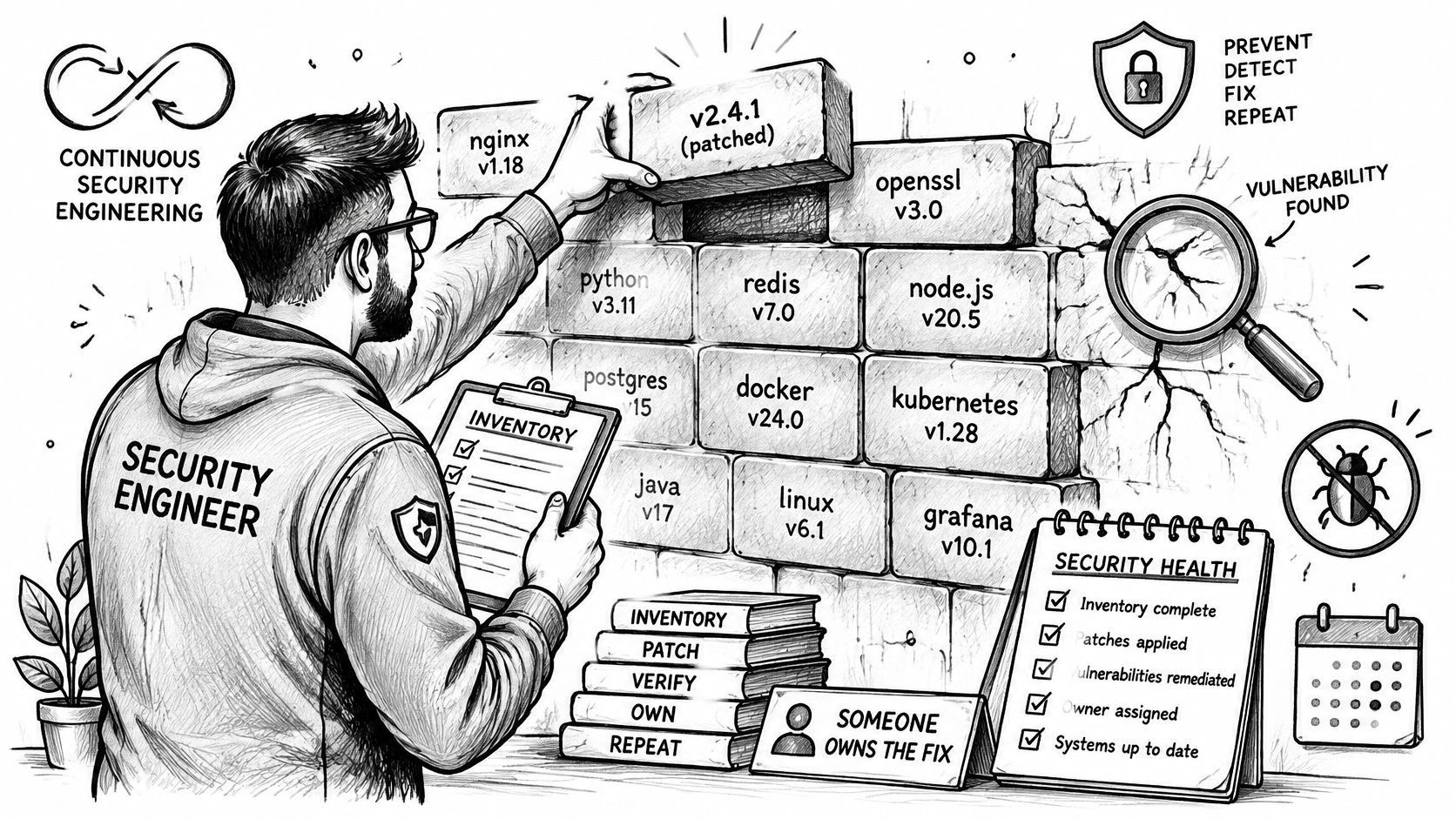
WebinOne treats security maintenance as continuous platform engineering rather than periodic software upkeep, maintaining commercially reasonable technical and operational measures designed to protect its internal networks from malicious activity. Any managed hosting partner you evaluate should operate with the same continuous discipline.
Every unpatched component widens the exploitable attack surface across your web estate. Public web server guidance from NIST states that applying patches for known vulnerabilities is essential, recommending patch-management software capable of both remediation and vulnerability identification alongside routine scanning to verify that operating systems, web-server applications, and software versions stay current.
Every Layer Needs a Named Patch Owner
A technically mature managed service maintains a live inventory of every production component, classifies vulnerabilities by severity and exploitability, enforces strict remediation timelines, tests patches in staging, and retains logs recording what changed, when, and on which hosts. That coverage must span six layers: the operating system, web server, application runtime, CMS core, platform extensions, and external scripts.
Patching only the base server leaves glaring holes. Under FedRAMP's continuous vulnerability-management guidance, providers must remediate flaws listed in CISA's Known Exploited Vulnerabilities Catalog according to the catalog's due dates, even when a vulnerability has already been fully mitigated, across application, operating system, database, container, and service layers. That standard shows what real lifecycle ownership looks like: detection, deadline tracking, and verification across the entire stack.
Cutting Third-Party Extension Risk
For agencies and systems integrators managing dozens of client properties, plugin sprawl is where security schedules break down. Each third-party add-on introduces its own maintainer, release cadence, and conflict risk, turning routine updates into hours of regression testing. Teams tired of carrying the hidden operational cost of plugin maintenance often find that hosting alone never solves the problem if the CMS still depends on dozens of external modules. On WebinOne, extensions are native and maintained directly by our team rather than third-party plugin vendors, replacing fragmented per-site patching with one centrally controlled update process.
Ask every prospective host four direct questions before migrating:
- Remediation windows by severity: How many hours or days pass between a critical disclosure and production deployment?
- Last portfolio-wide patch date: When was the entire production fleet last updated and verified?
- Faulty patch rollback: How quickly can a breaking update be reversed without losing recent site data?
- Post-incident evidence: What written root-cause analysis and change records will you receive after a security event?
Governing a Portfolio, Not Just One Site
Managed web hosting for an agency or multi-brand enterprise is mostly managed change. Keeping one brochure site online is simple. Governing thirty, eighty, or two hundred sites without losing control of access, evidence, and release quality is a different job. WebinOne gives agencies one white-label platform to build, host, and manage client websites, replacing a separate CMS, ecommerce, CRM, forms, and hosting stack with one managed system.
Risk expands with the portfolio. In Verizon's 2025 State of Small Business Survey, 52% of surveyed U.S. small businesses reported believing that growth increases their cyberattack risk, and 47% invested in cybersecurity improvements during the previous year. At a larger scale, third-party dependencies and shortages of cybersecurity skills are widely recognized barriers to cyber resilience. A larger estate means more owners, more credentials, more records, and more places where an undocumented exception can survive for years.
Eliminating Key-Person Risk Without Losing Oversight
Consolidating a fragmented web estate onto one managed platform can reduce tool sprawl and key-person risk. A patchwork of legacy builds and custom scripts may stay upright only because one senior developer remembers how each deployment works. That creates a real operational failure point if that person leaves.
Consolidation also creates a clear trade-off. The provider becomes a dependency, so the contract and operating model need the same scrutiny as the technology. Each portfolio needs named accountability for six ongoing functions:
- Patch approval and scheduling across all production domains.
- Privileged access reviews to remove departed staff and expired contractor logins.
- Restore verification proving backups rebuild working sites.
- Data residency documentation confirming where customer records sit.
- Incident communication protocols specifying who notifies clients and regulators.
- Compliance evidence collection ready for enterprise or public-sector procurement without manual reconstruction.
That list is a governance model, not a feature checklist. A platform can centralize websites and still leave the organization exposed if nobody owns approvals, evidence, or escalation. The practical test is whether each client site can be tied to a responsible owner, a hosting location, and a support path before the next change window opens.
Governance in Practice
Consider an agency running forty client websites spread across mixed hosting accounts and disconnected CMS stacks. Every routine edit carries a different login, backup habit, and risk profile. By moving those sites into WebinOne's multi-site console, the agency can manage them from one place, use the white-label portal under its own brand, and keep File Manager with FTP access and the Liquid engine available across plans. The WebinOne team helps set up the portal and migrate existing sites where needed, which reduces the number of separate support channels the agency has to coordinate.
The trade-off is that WebinOne is a closed system. All sites are hosted on AWS servers and supported and maintained by the WebinOne team, so customer-owned servers are outside the standard model. That gives agencies a clearer boundary for maintenance, but it also means procurement teams should read exit and continuity terms closely. WebinOne has committed to open-sourcing the platform if the Service is closed or discontinued so every Reseller can host its trial and live sites, WebinOne Portal, and SSO service without WebinOne's support.
Consolidating onto one managed platform reduces tool sprawl, but strong governance still depends on named owners, clear access rules, and exit terms the organization can actually operate under.
For a systems integration team or enterprise web group, the useful starting point is ownership mapping. List every site, identify who can change it, record where it runs, and define who receives incident evidence. Then compare that map with the provider's operating model before the next migration cycle.
Where Your Sites Run and How You Exit
Uptime does not tell you who owns the site after the contract ends. Hosting location sets legal exposure, latency, and whether a procurement team can buy the service. Exit terms decide whether you still control the assets years later. I weigh those two clauses as heavily as any availability target.
Deployment Models and Data Residency
Standard WebinOne sites run in WebinOne's AWS account. WebinOne is an AWS Partner, holds the AWS Qualified Software designation, has passed the AWS Foundational Technical Review, is enrolled in the AWS Software and Services Paths, and is listed on AWS Marketplace.
Every site is physically hosted on Amazon Web Services, in one of six data centers:
- USA (Oregon)
- USA (Virginia)
- UK (London)
- Australia (Sydney)
- EU (Germany)
- Canada
Under the standard product, a site cannot move onto the customer's own server. WebinOne is a closed system, and the WebinOne team supports and maintains those sites on AWS. Qualifying systems integrators can instead run a licensed copy in the SI's or the customer's own AWS account by agreement, including AWS GovCloud. That licensed path is how WebinOne works with US and Australian government clients.
Pick the region only after you separate where the bytes sit from which law governs them. How data sovereignty differs from data residency is the distinction that changes a public-sector buy.
In regulated workloads, hosting does not stop at deployment. Outsourcing operations does not move authorization off the customer. Three FedRAMP references spell out that ongoing duty:
- The FedRAMP Continuous Monitoring Playbook expects providers to keep security controls in force and to complete an independent assessment at least annually under control CA-2.
- The FedRAMP Continuous Reporting Standard requires providers to update key security metrics at least monthly and retain them for 24 months.
- FedRAMP's ongoing agency oversight guidance states that the customer's own authorization and governance stay with the customer.
Contractual Safeguards and Exit Terms
WebinOne is a SaaS content management system and is not open source. Buyers rightly ask what happens to a closed platform over a long contract. If the Service is closed or discontinued, WebinOne commits to open-source the WebinOne platform so that every Reseller can host its trial and live sites, WebinOne Portal, and SSO service without WebinOne's support.
Before you sign with any managed provider, get five exit items in writing:
- Data storage region: Confirm the exact physical data center where site files, databases, and backups live.
- Content and media exports: Verify the formats and APIs available to extract pages, structured records, and assets cleanly.
- Domain and DNS ownership: Ensure your organization or agency holds legal title to every domain registrar and DNS account.
- Termination transition period: Check how many days of post-termination access you receive to complete a cutover without penalty.
- Portable backups: Confirm whether you can download complete backup archives directly when preparing a move.
Confirm the Hosting Scope Before You Sign
Sign a managed web hosting agreement with WebinOne or any other platform only when five conditions are written into the contract: a named owner for every operational task, an SLA downtime budget you have priced against your own outage cost, a request-level measurement method and its exclusions, patch and restore evidence you can file, and a written limit on who may change hosting scope after signature. The uptime percentage does not settle any of those points.
Just as physical network expansions depend on thorough make-ready work for municipal broadband from Southern Tier Resources before fiber crews ever deploy, a smooth platform migration depends on confirming operational boundaries, records, and access rules before cutover day. Put these questions to the vendor on the draft:
- Task ownership: Which role is named on an after-hours production change, and is that role on the order form rather than only in a workshop diagram?
- Outage math: How much downtime does the SLA allow in a month, and how does that figure compare with what one hour offline costs you?
- Telemetry standard: Is availability a request-level success rate over a monthly window, and which exclusions can drop a failed request from the count?
- Security proof: What are the patch targets by severity, and what is the date and result of the latest restore test you can attach to the file?
- Portability and exit: Will the order state that the site stays on the vendor's AWS servers for the full term, and who, if anyone, may change that later? WebinOne is a closed system: every site is supported on AWS, and it cannot be moved onto a server you operate.
Systems integrators, AWS partners, and enterprise web teams can take that packet into a technical discussion on partnership or migration at WebinOne Enterprise. Bring the current responsibility matrix, recent availability and patch records, and your data residency requirements. Over 100 reseller partners in 16 countries already deliver sites this way for agencies, enterprises, and government organizations.