Data Sovereignty vs Data Residency: A Decision Guide
The most repeated buying advice on data sovereignty vs data residency is wrong. Pick a local region, the slide says, and the legal problem is finished. A region setting commits to a place. It does not decide who can read the data, which court can demand it, or whether the service can keep running if a transfer mechanism is pulled. Enterprise and government buyers who stop at the region dropdown are buying a label, not control.
Table of Contents
- Where Data Lives Versus Whose Law Governs It
- Regulatory Rules That Reach Data Beyond Its Location
- Access, Keys and Support Access Decide Sovereignty
- Technical Controls for Regions, Encryption and Backups
- Latency, Failover and Residency Trade-offs
- Continuity, Exit and Vendor Risk in Sovereignty Plans
- Match Your Residency Model to Your Obligations
Where Data Lives Versus Whose Law Governs It
Residency is a coordinate. Sovereignty is a jurisdiction. Data residency is the physical place where data is stored or processed, such as customer records kept in a particular country or AWS region. Data sovereignty is broader: which country's laws, governmental access powers, regulatory obligations, and courts apply because of location, the organization controlling the data, or the infrastructure processing it.
That split stopped being academic on 16 July 2020, when the European Union's Court of Justice invalidated the EU-US Privacy Shield in the Schrems II judgment. The ruling did more than push European storage toward EU regions. Organizations transferring personal data outside the European Economic Area must assess the destination country's legal protections and use supplementary safeguards where necessary. By 2021, 71% of countries worldwide had adopted data-protection and privacy legislation, up from 55% in 2015, according to the UNCTAD review of data protection and privacy legislation.
An organization can satisfy a residency preference with an in-region data center and still face a foreign parent company, support staff, an encryption-key holder, a subcontractor, or a legal demand from another jurisdiction. WebinOne exposes residency as a per-site choice, with data residency options available across 6 AWS regions. Use that menu as one layer of the design and build the rest around access and transfers.
Residency and sovereignty compared on the criteria that matter
| Criterion | Data residency | Data sovereignty |
|---|---|---|
| Core question | Where is the data physically stored or processed? | Which country's laws and authorities can compel access to it? |
| Typical source of requirement | Contract, sector rule, or local storage law | Transfer rules, government-access powers, court jurisdiction |
| What location selection solves | A physical location commitment | Only part of the legal answer |
| Main gap left open | Foreign-headquartered administrators or support access can still reach data | Requires location, control, and legal analysis together |
| Typical controls | Region selection, in-region backups, and replicas | Key control, administrator geofencing, transfer mechanisms, audit logs |
| Who owns the question | Operations and procurement | Legal, security, and data protection leads |
Practical rule: If the only artefact in the procurement file is a region name, the sovereignty question has not been asked.
Operations can commit to a place. Legal and security leads still have to name which authorities can compel access, through which people and keys, and what changes if a transfer mechanism is withdrawn.
Regulatory Rules That Reach Data Beyond Its Location
Storing data with WebinOne in an approved region does not, on its own, satisfy cross-border regimes. The rules attach to transfers, remote access, and accountability, not to the disk label.
European transfers
Under the GDPR, Chapter V permits personal-data transfers outside the EEA only through defined legal mechanisms. The European Data Protection Board's guidance on international data transfers is the working map. Where no adequacy decision exists, Article 46 tools include Standard Contractual Clauses, Binding Corporate Rules, approved codes of conduct, certification mechanisms, or ad hoc contractual clauses. A narrow Article 49 derogation is not a standing architecture. Remote access by support staff outside the EEA can itself be a transfer. Keeping primary storage in an EEA region addresses where data is held. It does not close the access path.
US companies serving European individuals should read that transfer test against their own operations, not against a hosting map. Finchum Fixes IT's GDPR compliance guide is a useful walkthrough of what a US organization still has to document when European personal data is in scope. The exporter still has to judge whether destination law permits access that falls short of the protection the transfer relies on, and add safeguards where it does.
For personal data under EU and member state privacy laws, WebinOne is the data controller for personal data provided through the WebinOne Portal, and a data processor for other personal data a customer transfers to the platform. That split belongs in the data processing agreement, with the customer's own transfer assessment sitting beside it.
Australia and the EU Data Act
Australia does not treat local storage as the whole test. The OAIC's APP 8 guidelines require an APP entity, before disclosing personal information overseas, to take reasonable steps so the recipient does not breach the Australian Privacy Principles, except APP 1. Section 16C then makes the Australian entity accountable for the overseas recipient's acts. APP 8.2 exceptions cover a substantially similar overseas law with enforceable remedies, informed consent, or disclosure required or authorized by Australian law or a court or tribunal order. An Australian-region label without recipient due diligence fails that test.
The European Commission's Data Act fact page adds a different duty from 12 September 2025. Providers must support a quick, smooth switch without customers losing data or application functionality. Protections attached to EU data travel with data sent outside the EU, and foreign public-sector requests for non-personal data held in the Union face specific safeguards.
How far localization has already gone
An OECD mapping of data localisation measures identified 92 explicit data-localisation measures across 39 countries by 2021, more than half of them introduced in the preceding five years. About two-thirds combined a domestic-storage requirement with a prohibition or significant restriction on transferring data abroad. Among OECD countries, 60% of identified measures required storage without a categorical ban on international flows. In non-OECD countries, storage plus a flow prohibition was 83% of identified measures. "Keep it in-country" is not one rule. Some laws want a local copy. Others restrict remote access, onward transfer, or processing outside the border.
Access, Keys and Support Access Decide Sovereignty
At WebinOne, sovereignty is decided more by who can read the data than by where the disks sit. Procurement should document an access map, not accept a region assumption.
A correct region still fails if any of these paths can open production data from outside the approved set.
- Platform administrators: Named people with rights over the account, and the countries they work from.
- Support tooling: Tickets, consoles, and diagnostic access that can display customer content.
- Subprocessors: Each operator, the data it touches, and the country it works in.
- Backup operators: Who can restore, and from where.
- Logs and analytics exports: Observability data that leaves the region in a support bundle or a report.
- Key-management operations: Who can decrypt, rotate, or escrow keys.
Admin support is available 24/7 for all six data centers. Round-the-clock support is the right operational commitment, and it is also an access path. An administrator in a foreign-headquartered organization can be compelled under that organization's home law even when the disks never move. WebinOne applies commercially reasonable measures to isolate agents and data between accounts, and does not guarantee that isolation will be absolute. Buyers should read that limit into the design, not past it. The security overview is the place to start that reading, then confirm the live access list for the account.
Key custody during an incident and a legal request
Key control is the difference between "the provider can be ordered to produce plaintext" and "the provider can produce ciphertext it cannot read." If the customer, or a trusted entity in an approved jurisdiction, holds the decryption keys, a foreign demand served on the operator does not by itself expose the content. During an incident, that same control decides who can restore service without copying keys into an unapproved support location. Teams that have not written the custody model down should start with a practical account of how to store encryption keys securely before they sign a region clause and call it sovereignty.
Send this list before shortlisting is closed.
- Who holds platform administrator rights, and from which countries?
- Which support roles can open production data, and under what approval?
- Where does each subprocessor operate, and what data does it touch?
- Can administrator access be geofenced to approved locations?
- Are privileged sessions logged, retained, and available for review?
- Who controls the encryption keys, and how are they rotated?
The deliverable is a written access map naming roles, locations, logging, and key holders, signed off by legal and security before migration starts.
Technical Controls for Regions, Encryption and Backups
Control design starts with the data flow. Before any region is chosen, inventory every copy of the data and every path it travels: primary storage, replicas, backups, observability data, support access, subprocessors, and key-management operations. A residency claim holds only when it covers all of them, including the backup an engineer reaches for at 2 a.m.
WebinOne hosts each website in one of six data centers: USA (Oregon), USA (Virginia), UK (London), Australia (Sydney), EU (Germany), or Canada, with custom data centers and licensed deployments available by agreement. AgentOne data is processed in the AWS region or regions applicable to the customer's account. The access map built around administrator rights, support roles and key custody already names who can reach production; the same discipline has to cover every copy in the inventory.
Dechert's note on the EDPB's post-Schrems II transfer guidance sets the standard for that review. Document jurisdictional controls separately from geographic ones. Selecting an EU region can meet a location rule while leaving sovereignty exposure in place if a foreign parent, administrator, support process, or key holder can legally reach the data. The same guidance treats state-of-the-art encryption, correctly implemented cryptography, and exclusive control of decryption keys by the exporter or a trusted entity in the EEA or an adequate jurisdiction as relevant supplementary safeguards. Confirm encryption at rest and in transit, then confirm who holds the keys. Treat a platform default as a starting point and verify it against the customer's own control model.
Controls by data type for a residency and sovereignty design
| Data type | Residency control | Sovereignty control | Platform option |
|---|---|---|---|
| Primary website and content | Choose the AWS region per website | Map which entities administer it | Selectable region per website |
| Replicas and disaster-recovery copies | Keep inside the approved jurisdiction set | Test that failover stays inside the set | Confirm replication targets during design |
| Backups | Store in the approved region | Restrict restore access to named roles | Confirm backup placement in the contract |
| Logs and telemetry | Place in the approved region | Limit export and analytics transfers | Confirm log location during design |
| Encryption keys | Hold keys in the approved region | Customer or trusted in-jurisdiction key control | Confirm key arrangement by agreement |
| Custom or licensed deployment | Custom data center by agreement | Customer-controlled AWS account boundary | Licensed version, including AWS GovCloud, by agreement |
A replica or backup placed outside the approved set breaks the residency claim even when production looks compliant. Failover targets belong in the design document, agreed before the contract is signed.
The stronger pattern is specific. Use customer-controlled or regionally bounded keys, strict administrator geofencing, just-in-time privileged access, immutable audit logs, and pseudonymization that leaves re-identification data solely with the exporter. For government and regulated work, qualifying systems integrators can run a licensed version in their own or the client's AWS account by agreement, including AWS GovCloud for government projects.
Latency, Failover and Residency Trade-offs
WebinOne's position is that residency can improve locality and cut inter-region replication lag, and that there is no universal latency number. Buyers should measure their own topology instead of trusting a region label.
Network distance, routing, workload placement, replication mode, and application architecture dominate the result. Regional deployment can shorten client-to-service time and the lag between primary and secondary copies, which improves interactive response and shrinks the recovery-point exposure that delayed replication creates. Microsoft's regional architecture guidance states that latency affects both application performance and the time required to transfer data between primary and secondary regions. In one evaluated configuration, latency between system components was reduced below 0.3 ms, while customer-to-cloud latency stayed architecture-dependent and was not covered by a latency SLA.
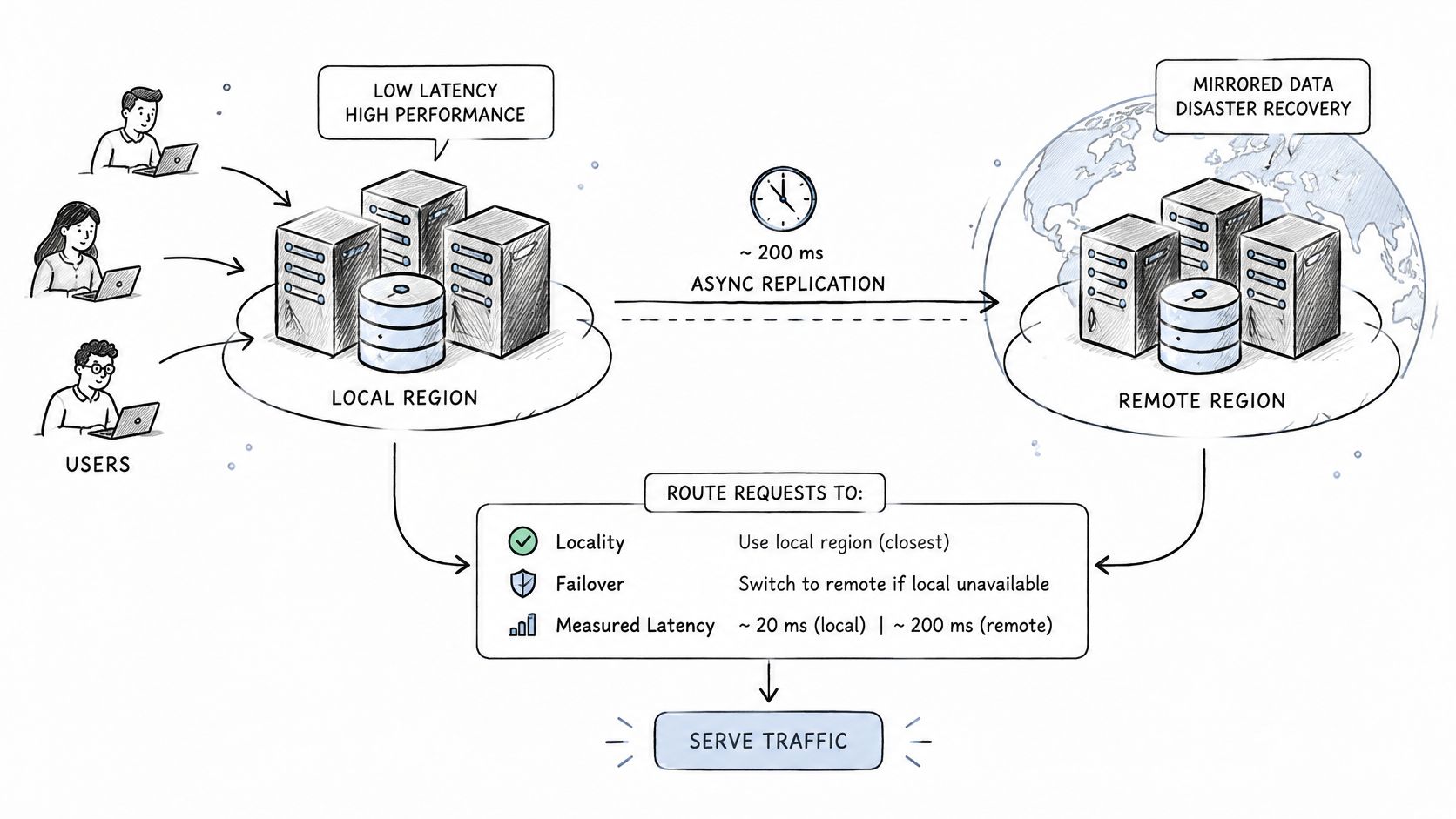
A local-only design can improve locality and reduce resilience if it forbids a geographically separate replica. Define an approved jurisdiction set, then test failover inside that set. Hosting mechanics for this platform are set out in managed AWS hosting. The reference baseline for availability is 99.99% uptime, with a 99.95% availability commitment in the published SLA. That baseline is not a latency promise, and it is not a substitute for the failover test.
The acceptance test
A design passes only when all six results are recorded.
- Measure p50, p95, and p99 request latency from each major market.
- Measure cross-region replication lag and the recovery-point exposure it creates.
- Confirm recovery-point and recovery-time objectives inside the approved jurisdiction set.
- Load-test throughput under peak conditions.
- Calculate the percentage of requests that require cross-border calls.
- Simulate a failover and verify that application data, backups, logs, analytics exports, support tooling, and disaster-recovery copies stay inside the boundary.
"Data stored in region X" is not the pass condition. A silent move of a log export or a recovery copy into a non-approved jurisdiction fails the design even if the user-facing page stayed fast.
Continuity, Exit and Vendor Risk in Sovereignty Plans
A plan that depends on one transfer instrument carries continuity risk. Customer data should be exportable and restorable on a documented path before any sovereignty plan is called complete.
Transfer mechanisms move. Courts, regulators, and politics change them. The framework remains formally in force, but a challenge has progressed to the Court of Justice of the European Union after the EU General Court rejected the initial challenge in September 2025, as the DAC Beachcroft note on the EU-US Data Privacy Framework records. An architecture that depends on one adequacy decision or one transfer instrument may need rework later. One global default is operationally tidy and legally brittle for an agency or enterprise running many client jurisdictions.
The buyer's question is concrete. Can the platform keep operating, exporting, restoring, and supporting the service if a transfer mechanism is suspended?
Answer it with evidence, not assurances.
- Documented data-flow maps for every region in use.
- Tested region-specific backups, with restore records, not a checkbox. Teams tightening that evidence can use RDE Technologies' guide to strengthen your business backup strategy as a practical standard for what "tested" should mean.
- An exit and export process written down before go-live.
- Contractual allocation of regulatory-change risk.
- A migration path that does not depend on proprietary data structures.
The EU Data Act's switching duty requires providers to support a quick move to another provider without loss of data or application functionality. Ask for the migration plan and the restore evidence behind it: how content leaves, in what format, and how a successful restore is proven. WebinOne offers that plan as part of the platform's exit documentation. Whoever operates the export and wherever support sits decide whether the path still works when the legal basis for a transfer changes.
Customer Content remains the customer's exclusive property, and WebinOne claims no rights to it except as explicitly granted in the terms. WebinOne has no obligation to retain customer content, and content and End User Information may be irretrievably deleted if applicable fees are 30 days or more past due. On termination or expiration, each party returns or destroys the other party's Confidential Information within 30 days, or continues to protect it for as long as it is retained under customary business practices. Those terms are part of the exit design. A buyer who has not funded the account, or who has not tested an export, does not have a continuity plan.
Sort data by sensitivity and criticality, keep high-risk datasets in approved regions, minimize replicated metadata, and keep a tested fallback.
Sovereignty here means staying operable if the jurisdiction changes.
Match Your Residency Model to Your Obligations
Start with the obligation, then pick the model. A storage-location rule, a transfer-control rule, and a jurisdictional-control rule each produce a different answer, and a selectable region satisfies only the first.
The provider's legal identity can matter more than the server region. A company can select an EU region, meet a contractual location rule, and still expose data to the laws of the provider's home country where foreign disclosure laws reach that provider. The procurement questions run in this order: which entities administer the database, which support personnel can access it, where backups and logs are copied, and what legal process can compel disclosure. That matters most for government, healthcare, financial services, and multinational buyers. Sovereignty is location, ownership, legal reach, operational access, and reversibility together. The access map and the transfer file are the decision.
Residency model by situation and first check
| Situation | Residency need | Sovereignty need | Verify first |
|---|---|---|---|
| Multinational brand with EU customer data | EU AWS region for primary data | Transfer assessment for any non-EEA support or admin access | Access map and transfer documentation |
| Government agency with national-only data | In-country region or licensed deployment | National control over administrator and key access | Licensed deployment in the customer AWS account, including AWS GovCloud, by agreement |
| Australian organization disclosing personal information offshore | Australian AWS region for primary data | APP 8.1 recipient due diligence and section 16C accountability | Recipient due diligence and contract terms |
| Agency reselling to clients in several countries | Region selected per client site | Per-client access and branding boundaries | Region per site and client terms |
| Enterprise migrating from an end-of-life platform | Region fixed before migration starts | Exit and continuity plan | Staged migration plan agreed before cutover |
| Regulated organization in Canada or the UK | Canada and UK are both selectable data centers | Sector rules and transfer tests | Sector requirements and timing confirmed with the team |
WebinOne runs on AWS across six regions. WebinOne is preparing for upcoming compliance certifications through platform-wide security improvements; that preparation is not an authorization status. For qualifying systems integrators, a licensed deployment in the customer's or the SI's own AWS account, including AWS GovCloud for government projects, is available by agreement. Take authorization questions to our team directly.
Bring the access map, the data-flow inventory, and the residency requirement to that conversation, and agree the model before any migration starts.
If this estate includes government data, a multi-country agency portfolio, or a migration off an end-of-life platform, book a working session with the WebinOne team on a partnership or a migration. Bring the region you think you need and the access map you have not finished. Start that conversation at the enterprise page.