Headless CMS for Ecommerce: Criteria, Costs and Trade-offs
The most popular advice about headless CMS for ecommerce is to choose the most flexible stack and connect the services later. That's a poor buying strategy. Every connection becomes something an agency must monitor, troubleshoot, secure and explain to a client after launch.
We recommend choosing the operating model before the software. Price the subscription, but also price the catalogue sync, preview pipeline, checkout dependency, release coordination and recovery work across five years. A more configurable architecture isn't automatically a more profitable client platform.
Table of Contents
- Six Criteria That Decide an Ecommerce Headless CMS
- Which Responsibilities Each Headless Option Leaves With the Agency
- Five-Year Cost of Each Headless Architecture
- Where Headless Speed Gains Come From and Where They Stop
- Running a Headless Storefront After Launch
- Where WebinOne Fits as a White-Label Headless Platform
- Choose Your Headless Path Before You Pick a Vendor
Six Criteria That Decide an Ecommerce Headless CMS
Every shortlisted vendor, WebinOne included, should face the same six criteria. A polished storefront demo doesn't establish whether an agency can operate the system profitably.
Headless CMS evaluation criteria for ecommerce
| Criterion | What to verify | Red flag |
|---|---|---|
| API coverage | REST or GraphQL reads and writes, documented webhooks, preview endpoints | Read-only API with no webhooks or preview |
| Commerce integration | Product, variant and price model; native cart and checkout or tested connectors | Products stored as free-text fields |
| Multi-site governance | Shared content model, per-site roles, locales | A separate install for every brand |
| Scalability and uptime | Published SLA, hosting regions, peak-load evidence | No written availability commitment |
| Pricing model | Per site, per seat, per API call, per transaction | Costs that rise with traffic alone |
| Operations and security | Backups, patch ownership, support tiers, audit logs | Patching left to the buyer's own release cycle |
Test complete workflows, not isolated features
Start with API coverage. Ask the vendor to demonstrate a price change reaching the storefront, a stock update invalidating cached availability and an editor previewing unpublished product copy. An endpoint list isn't proof that those workflows work together.
For commerce integration, inspect relationships between products, variants, prices and merchandising content. Determine whether cart and checkout belong to the platform or depend on connectors. Our headless ecommerce API guidance provides a useful starting point for framing that discussion around buying workflows rather than content retrieval alone.
Multi-site evaluation should include permissions as well as reuse. A shared product description may belong across brands, while a regional promotion needs restricted publishing rights and a controlled locale fallback.
For scalability, request evidence that resembles the client's workload. Cached campaign pages don't demonstrate how cart updates behave during a promotion. Review the written availability commitment separately from performance demonstrations.
Score ownership alongside capability
Use a one-to-three score for each criterion: undocumented, demonstrated with qualifications, or documented and demonstrated against the client's workflow. Double the weight of commerce integration and operations for multi-brand projects.
The pricing review must identify which charges increase because the business sells more and which increase because visitors request more pages. Include preview environments, support tiers and overage rules in the commercial comparison.
For operations, require written backup and restoration responsibilities, patch ownership, escalation routes and audit-log access. An agency can't price a support retainer against an undefined responsibility.
Procurement rule: Reject any vendor that can't provide a documented webhook contract or a written SLA. Those aren't details to settle after implementation.
Which Responsibilities Each Headless Option Leaves With the Agency
The platform subscription is only one part of a headless store's cost. Each architecture also assigns the agency ongoing work, from connector troubleshooting to infrastructure maintenance. Compare those responsibilities before choosing a build.
| Architecture | Advantages | Disadvantages and agency responsibilities |
|---|---|---|
| Headless CMS with commerce connectors | Separates editorial workflows from storefront delivery | The agency owns connector behaviour, data mapping and troubleshooting across vendors |
| Fully composable stack | Lets the team select services for specialized requirements | The agency coordinates integrations, contracts, deployments and incidents across service boundaries |
| Open-source headless backend | Supports extending an existing backend investment | Hosting, upgrades, patching, modules and scaling remain ongoing duties where the contract assigns them |
| Unified managed platform with headless delivery | Keeps CMS, catalogue, orders and multi-site management within one managed platform | Frontend implementation and external integrations still need clear ownership, while extensions must follow the platform's supported model |
Compare what happens during a change
Take a promotion that changes product copy, regional pricing and availability. With commerce connectors, identify which system starts each update, which connector carries it and who resolves partial completion.
A composable build raises the same questions across more service boundaries. Specialized services can meet a defined requirement, but the agency should name the integration owner before agreeing to operate the system.
Open-source backend projects need a specific maintenance agreement too. If the agency owns upgrades, module upkeep or infrastructure operations, those hours belong in delivery and support estimates, even when the storefront uses APIs.
Choose responsibilities the agency can sell
WebinOne's unified approach puts CMS, catalogue, orders and multi-site management within one managed platform. The agency remains responsible for its custom frontend and external integrations unless the delivery agreement assigns those tasks elsewhere.
The trade-off is a defined extension model. Custom behaviour must fit that model or be scoped as a TeamOne project. Test unusual pricing, account and fulfilment requirements before committing. API access does not remove implementation constraints.
- Content-led store: Confirm that separate editorial tooling solves a real publishing problem.
- Specialized enterprise journey: Name the requirement that warrants an independent service.
- Agency portfolio: Decide whether the team wants to sell managed client outcomes or maintain infrastructure and connectors.
Choose the architecture whose responsibilities the agency can deliver repeatedly, document clearly and charge for. Include the post-launch work in that decision, so every support ticket does not become a new discovery exercise.
Five-Year Cost of Each Headless Architecture
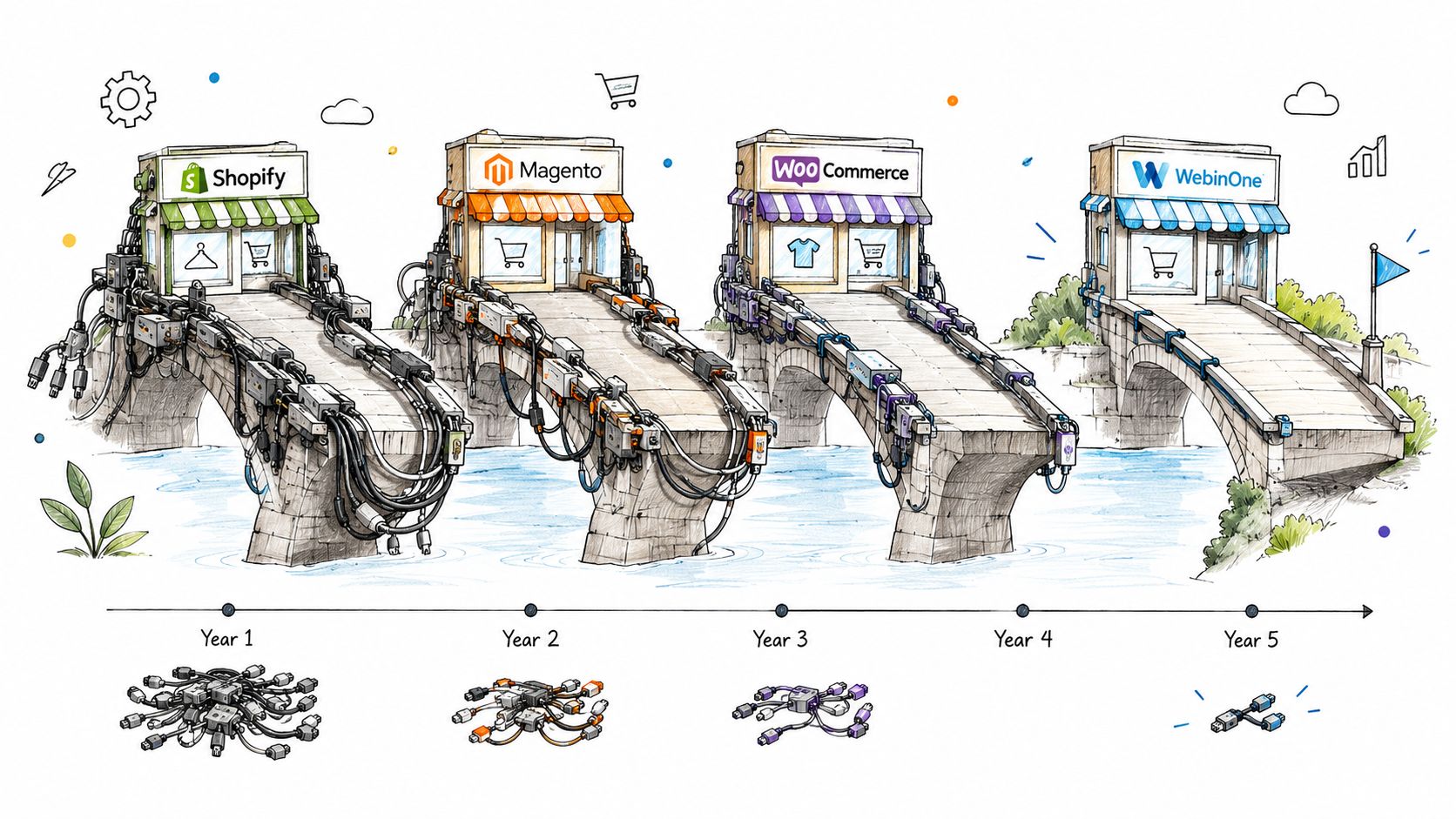
A headless build's five-year cost depends on the work it creates after launch as much as on its subscription. We recommend WebinOne's unified path when the goal is to reduce the number of separately operated content and commerce connections. Still, price delivery hours, integrations, and ongoing change work before comparing platform fees.
Five-year cost and risk by headless path
| Path | Five-year cost driver | Launch risk | Break-even signal |
|---|---|---|---|
| Unified platform with headless API (WebinOne) | Per-site subscription and delivery hours | Fewer coordination points within the vendor's managed scope and SLA | Content, commerce, and multi-site management belong in one console |
| Headless CMS with commerce connectors | Connector upkeep and vendor contracts | Each connector adds a delivery dependency | Modest catalogue, one storefront, and content-led marketing |
| Fully composable stack | Integration, orchestration, and contracts across services | Independent releases increase coordination work | Multiple brands, regions, and substantial catalogue complexity |
| Open-source headless backend | Hosting, patching, module upkeep, and scaling | Security and infrastructure duties depend on the contract | The agency already maintains the existing investment |
These risk labels are planning judgments, not measured failure rates. A unified project can fail when scope is poorly controlled. A composable implementation can succeed when governance and ownership are clear.
Establish the break-even case before the demo
An analysis of composable and MACH implementation economics reports costs reaching three to five times initial vendor projections, launches taking two to three times longer, and unfinished rebuilds started in 2022 and 2023. It also points to roughly $1 million in annual revenue or 50,000 SKUs as thresholds below which integration and coordination costs may outweigh the benefits.
Treat those figures as prompts for a project-specific model, not automatic qualification rules. Catalogue complexity, market requirements, and existing systems determine whether separation pays off. Ask whether each independent service will reduce operating effort or create enough commercial value to cover its full cost.
MACH architecture has a track record of several years in retail. In 2025, almost 38% of retail organizations had used MACH technology for more than seven years, covering microservices, API-first, cloud-native SaaS, and headless architecture, according to MACH adoption research. That maturity makes project-level cost planning more important, not less.
Price every connection as an operating commitment
Build the estimate around the work the business will carry:
- Business footprint: SKU count, order volume, brands, regions, and channels.
- Delivery workload: Migration, frontend development, preview, testing, and release frequency.
- Connection ownership: Data mapping, retries, monitoring, version changes, and incident investigation.
- Annual operations: Delivery hours per site, support coverage, recovery exercises, and vendor coordination.
- Commercial charges: Subscription, infrastructure, usage, support, and transaction-related fees.
Include implementation and migration, recurring platform and service costs, planned changes, operational labour, and eventual exit costs. Use this guide to ecommerce without platform transaction fees to separate transaction charges from the rest of the operating budget.
Model different operating situations rather than treating them as customer case studies. A brand selling through a website and an app may benefit from a shared content model. A multi-brand group may value centralized governance. An operator retaining a self-hosted backend must budget for its continued upkeep.
Count separately maintained connections, not just subscribed products. Assign each connection an owner, a failure response, and a funded maintenance allowance.
Before requesting a quote, settle where product data lives and who owns checkout. Then compare the five-year cost of those responsibilities, not just the initial platform price.
Where Headless Speed Gains Come From and Where They Stop
Headless architecture creates room to improve storefront speed. It does not deliver speed by itself, including for a storefront built on WebinOne. The frontend, image delivery, API design and third-party scripts determine whether that opportunity becomes a faster buying journey.
Published headless performance figures report 20% to 50% lower page-load times, mobile Largest Contentful Paint of 1.5 seconds versus 2.4 seconds in one comparison, and Interaction to Next Paint improvements of roughly 40% to 55%. The figures also cite approximately 2% conversion-rate improvement per second of page-load improvement. Treat these as directional benchmarks, not a forecast for your project. Published headless performance benchmarks
Separate architectural opportunity from implementation quality
Static generation can avoid assembling suitable pages on every request. Edge caching serves reusable responses closer to visitors, and focused API responses avoid fetching fields a template never uses. Each choice has limits: frequently changing content needs a freshness strategy, and caching cannot fix slow commerce services.
The gains disappear when a frontend downloads oversized images, runs unnecessary JavaScript or waits for sequential API calls. Tag-manager scripts and checkout code loaded on marketing pages can also slow delivery.
A cached landing page is not proof of a fast purchase journey. Measure product selection, cart updates and payment separately, because each depends on different services and requests.
Prove the buying journey
Set acceptance criteria before launch, then test real journeys rather than relying on a demonstration score:
- Instrument real visitors. Segment Core Web Vitals by template and device so slow product pages don't disappear in aggregate results.
- Measure tail latency. Track 95th-percentile API latency for listing and product-detail requests, along with failures and unnecessary round trips.
- Test cache invalidation. Change catalogue data and verify when customers see the update.
- Separate rendering responsibilities. Avoid loading checkout and account functionality on marketing pages when it isn't needed.
- Measure commercial impact. Use a controlled test. Don't credit every post-launch conversion change to architecture.
The headless engineering guidance supports testing end-to-end performance. Include content freshness and transactional reliability in the acceptance criteria, not speed alone.
Add headless CMS SEO guidance to the release checklist. When the frontend is separate, teams must deliberately implement search-facing rendering, metadata and redirects.
The operating rule is simple: a fast storefront on slow commerce services doesn't deliver a fast buying journey. Budget for the connections and implementation work that keep both parts performing after launch.
Running a Headless Storefront After Launch
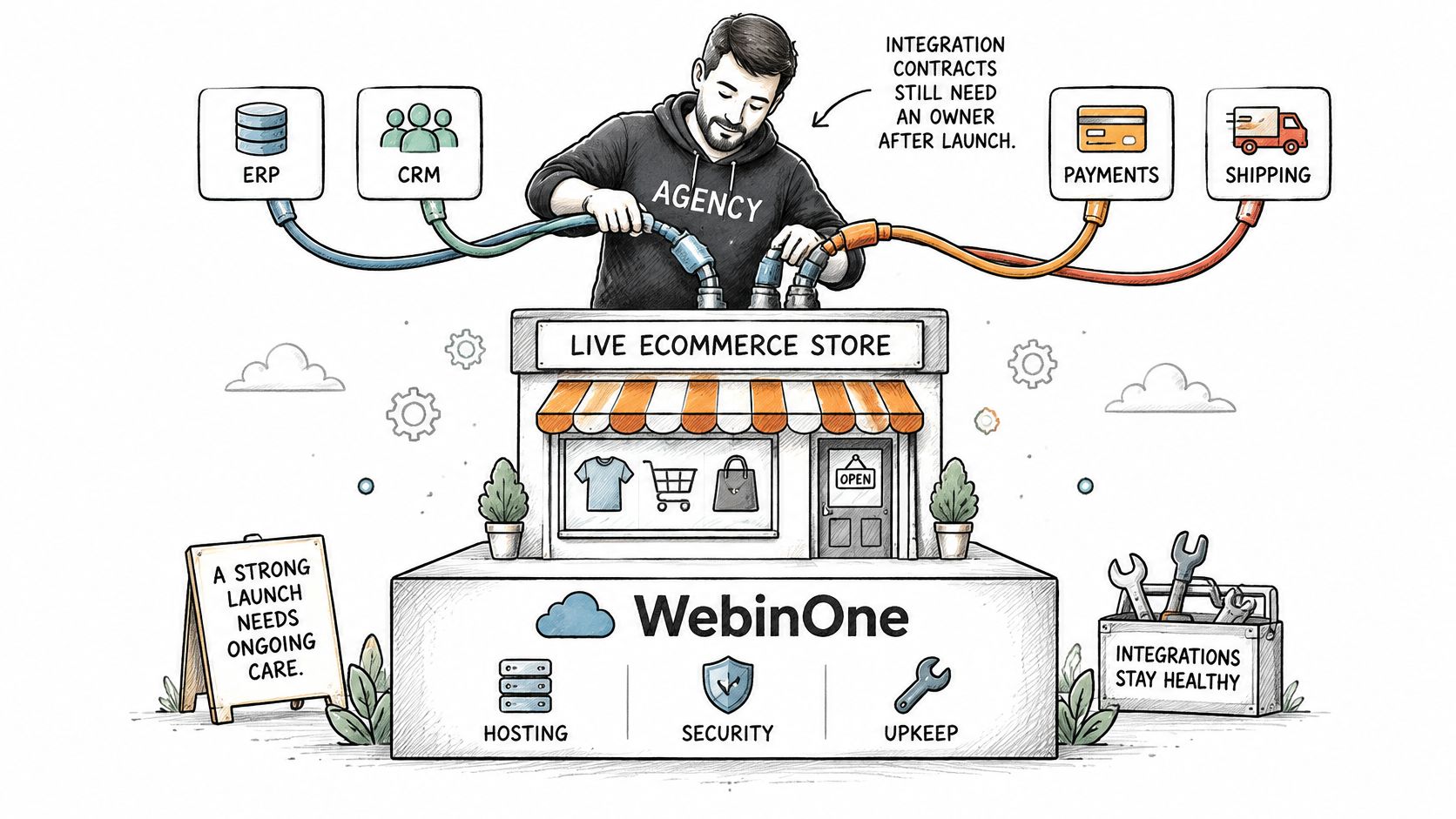
A headless launch creates an operating workload that the platform subscription alone does not show. WebinOne manages hosting, security and platform upkeep within its managed scope. Your team still needs named owners for every external connection. Without them, separate services can behave like one tightly coupled system, while leaving responsibility scattered across vendors and agency staff.
Catalogue sync lag during a promotion shows the cost. A campaign advertises a price change, but the storefront still displays the previous price because an integration has stalled. Customers lose confidence, and the agency must find the failure across the content, commerce and frontend systems. Set ownership and escalation rules before this happens. The risk of underestimated orchestration and immature multi-service governance is a direct operational concern, not an edge case.
Make operational ownership explicit
Name the system of record. Assign authoritative ownership for products, prices, customers, orders and content. For copied data, document sync direction and conflict handling so competing writers cannot overwrite approved changes.
Version every integration contract. Record payloads, authentication, retries, duplicate-event handling and breaking-change notices before deprecation. Require a supported upgrade path for each connector.
Monitor business transactions. Track catalogue synchronization lag, add-to-cart success and checkout completion alongside infrastructure health. An available server does not prove customers can buy.
Separate rollback procedures. Document frontend rollback, content-model recovery and commerce-connector recovery independently. An earlier interface cannot reverse an incompatible data change.
Define vendor-failure behaviour. Decide what customers see when commerce responses slow or stop. Preserve browsing where safe, but prevent actions that could show an incorrect price or stock level.
Control publishing permissions. Set role permissions and audit trails for editorial, integration and automated changes. AgentOne, WebinOne's Managed Vibe Coding capability, builds and operates within the managed platform using approved scopes, auditable changes and review before production.
Test the agreement, not just the code
Subscription connections carry customer obligations beyond a page view. Document how changes affect existing subscriptions, who approves them and how the team will recover from a failed update. The Shopify subscription API guidance from RecurX can inform that review alongside the applicable implementation contract.
Give every procedure a named owner, a written response and a staging test. Record escalation contacts, required access and evidence that recovery worked. A runbook is ready only when another authorized operator can follow it successfully.
The support agreement must distinguish platform incidents from frontend defects and external integration failures. Set that boundary before launch. It keeps response expectations clear and stops the agency from accepting an undefined support obligation.
Where WebinOne Fits as a White-Label Headless Platform
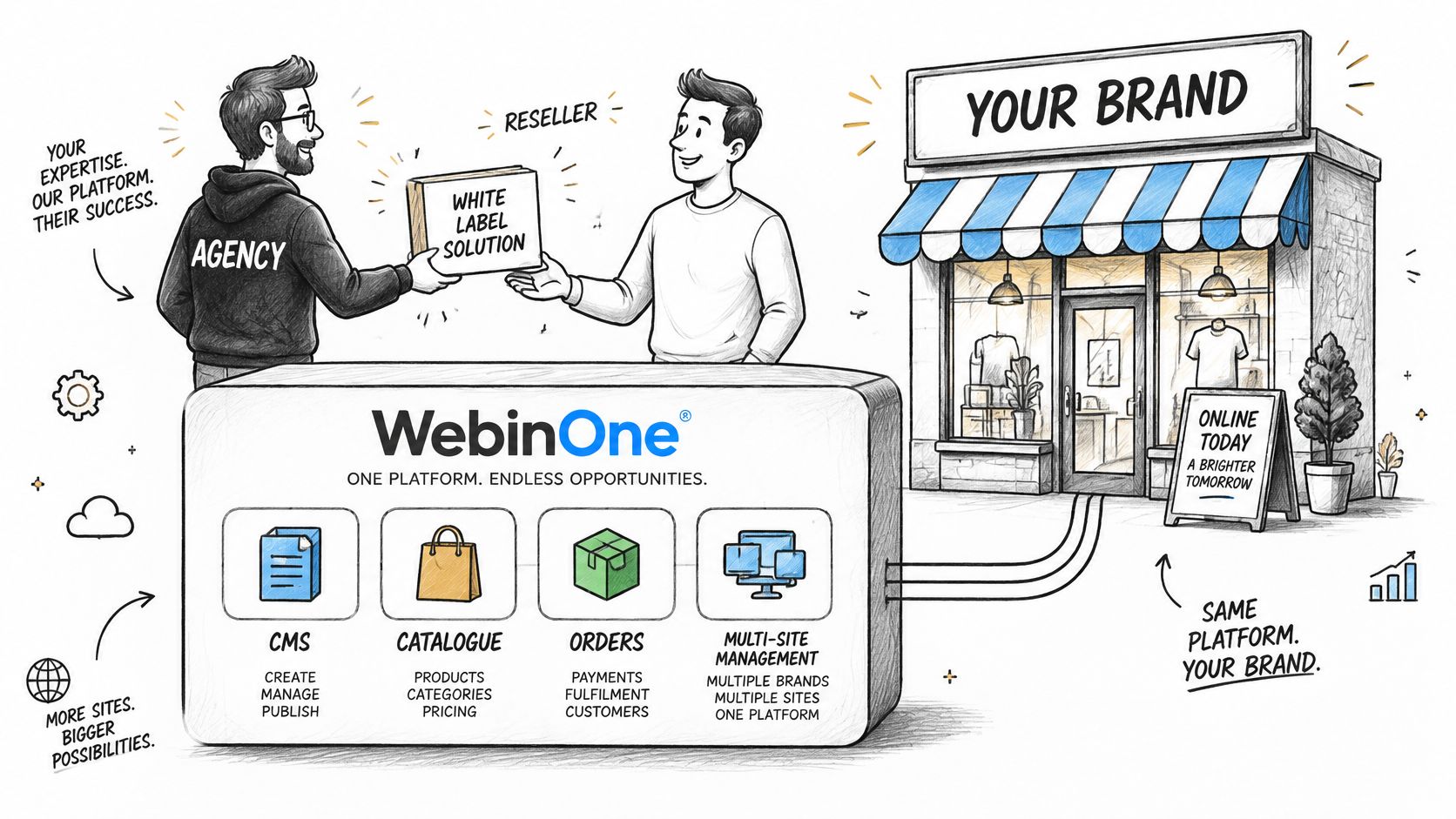
The platform subscription is only part of a headless build's cost. Agencies also need to budget for system connections, post-launch support and custom work. WebinOne brings CMS, catalogue, orders, multi-site management and storefront delivery under one managed platform, reducing the need to assemble those services separately.
WebinOne proof points for client builds
| Proof point | Verified figure | What it changes for a client build |
|---|---|---|
| Uptime | 99.99% over the last 12 months | A track record to reference in proposals |
| Availability commitment | 99.95% in our published SLA | A written commitment to review against the client contract |
| Transaction fees on ecommerce | Zero | No platform transaction fee deducted from ecommerce sales |
| Pricing | From $10 per month per site | An entry per-site subscription to include in the operating budget |
| AWS regions | Six AWS regions | Hosting placement options to assess against user location and residency requirements |
| Migrations | Thousands of sites migrated | Experience to examine when planning an existing-site transition |
Use these proof points to assess the commercial fit and build a five-year operating budget. The uptime record describes operating history. The published SLA states a contractual commitment, whose terms should be reviewed alongside the client contract.
Keep client delivery under the agency's brand
White-label login and admin branding let agencies present a consistent client experience. Agency-branded templates also give delivery teams a repeatable foundation, instead of requiring a new implementation pattern for each account.
Liquid templating, custom modules, native extensions and the On-Site Editor support different levels of customization and editorial control. Test them against the client's real catalogue, approval process and account workflows before fixing scope. Count every system connection in that design, then assign an owner for its upkeep after launch.
WebinOne's no-limits ecommerce positioning still has a delivery boundary: custom work beyond standard catalogue and template scope is scoped as a TeamOne project. Set requirements, pricing and acceptance criteria before work begins. That keeps post-launch requests from becoming unfunded agency support.
Assess the AWS delivery model
WebinOne is an AWS Partner, has passed the AWS Foundational Technical Review, holds the AWS Qualified Software designation, participates in the AWS Software and Services Paths, and is available on AWS Marketplace.
The managed platform runs in WebinOne's AWS account. Qualifying systems integrators can arrange licensed deployment in the SI's or customer's AWS account, including AWS GovCloud. FedRAMP and GovCloud projects are delivered with SI partners through licensed deployments.
Before architecture approval, AWS partners and enterprise teams should establish who owns deployment, governance and migration scope. Start that discussion through a partnership or migration conversation with our enterprise team.
Choose Your Headless Path Before You Pick a Vendor
Choose architecture by the operating work your team can fund, not by the number of services in a vendor demo. For agencies managing content, commerce and multiple sites, WebinOne offers a unified path. Add separate services only when a defined requirement and an accountable operating owner justify their ongoing cost.
Match the path to the client
- Single-brand store: If the store sits below the revenue and catalogue thresholds discussed earlier, require a clear commercial case for each additional service.
- Agency portfolio: Prioritize repeatable delivery, consistent administration and supportable retainers. Count the connections each client needs and the hours required to maintain them.
- Multi-brand group: Put governance and delegated publishing in the acceptance criteria. Confirm who controls access and approves changes across brands.
- Legacy migration: Scope data cleanup, retained integrations and custom behaviour as project work. WebinOne custom work beyond standard catalogue and template scope is handled through a TeamOne project.
Set channel reuse as a requirement before deciding how far to distribute backend functions. DesignStack's guide to delivering website content across multiple channels offers context for defining those needs.
White-label login, admin branding and agency-branded templates can help agencies package projects around a managed platform. Protect margin by standardizing delivery and pricing exceptions explicitly. The subscription alone does not show the five-year cost: include maintained connections, release work and annual delivery hours in your estimate.
Before choosing a frontend, document catalogue size, order volume, brands, regions, release frequency, system connections and the team responsible for upkeep. Use that operating model to assess the client migration and the support load after launch.