Headless CMS SEO: Rendering Is What Matters
The headless CMS market grew from $816.9 million in 2024 to $3.94 billion in 2025, and headless does not hurt SEO, bad rendering does. The technical choice that matters most is whether search engines receive complete, crawlable HTML on the first request.
That distinction gets lost in the usual advice. Agencies hear “headless” and immediately start debating whether JavaScript will be indexed, whether editors can control metadata, and whether a migration will destroy organic visibility. Those are legitimate concerns, but they point to implementation decisions, not an inherent weakness in headless architecture.
A headless platform separates content management from presentation. That separation gives technical teams more control over the HTML, routing, structured data, delivery layer, and multi-site rules. It also creates more opportunities to make mistakes. Headless CMS SEO succeeds when search visibility is treated as a platform capability, enforced through rendering and governance, rather than as a field an editor remembers to complete.
Table of Contents
- Why the Headless SEO Fear Is Misplaced
- The Rendering Strategy That Determines SEO Outcomes
- What Headless Does Well for SEO
- The Hidden SEO Risks Most Headless Teams Miss
- Structured Data and Metadata Without a Traditional CMS
- Real Migration Scenarios Where Headless SEO Succeeded
- Your Next Step for SEO-Safe Headless Implementation
Why the Headless SEO Fear Is Misplaced
The headline concern agencies bring to a headless evaluation is simple: will the new architecture damage clients' organic traffic? The answer is no. The useful question is whether the frontend can deliver meaningful content and metadata in a way crawlers can reliably process.
The commercial direction of the market reinforces the point. The headless CMS software market rose from $816.9 million in 2024 to an estimated $3.94 billion in 2025, with a projection of $22.28 billion by 2034 at a 22.6% compound annual growth rate, according to market analysis of headless CMS growth and AI CMS architecture. That scale reflects adoption of modular, API-driven publishing and commerce systems that support modern frontend frameworks, faster delivery, structured content, and distribution across channels.
Market growth doesn't prove that every headless implementation will rank. It proves that headless has moved beyond a niche development preference. SEO outcomes still depend on the engineering decisions behind the stack.
The CMS label isn't the ranking factor
A traditional CMS doesn't automatically protect a site from bad SEO. WordPress can lose metadata through plugin conflicts, expose inconsistent canonicals, create duplicate routes, or break redirects during an update. A headless system can reproduce those failures if the implementation team treats SEO as an optional frontend enhancement.
The reverse is also true. A headless build can enforce SEO rules consistently across page types, brands, locales, and channels. The rendering layer can generate canonical tags, structured data, headings, internal links, and sitemaps from governed content models instead of relying on manual configuration across isolated installations.
WebinOne has migrated 3,000+ sites, including legacy WordPress environments with plugin conflicts, Adobe Business Catalyst sites affected by platform end-of-life, and self-built systems carrying years of custom code debt. The recurring distinction is operational. Projects hold their search visibility when teams preserve URL equity, render rankable content properly, and validate the production output. Projects struggle when teams assume the CMS will solve SEO automatically.
Practical rule: Headless isn't an SEO strategy by itself. The strategy is a governed delivery system that makes the correct SEO output repeatable.
The right position is therefore direct. Headless is SEO-neutral or SEO-positive when the team builds rendering, metadata, routing, and migration controls into the platform. It becomes risky only when those controls are left to individual developers, page editors, or a collection of plugins.
The Rendering Strategy That Determines SEO Outcomes
Rendering is the decisive technical choice in headless CMS SEO. Teams often spend more time comparing CMS features than deciding how the frontend will expose content to crawlers. That order is backwards.
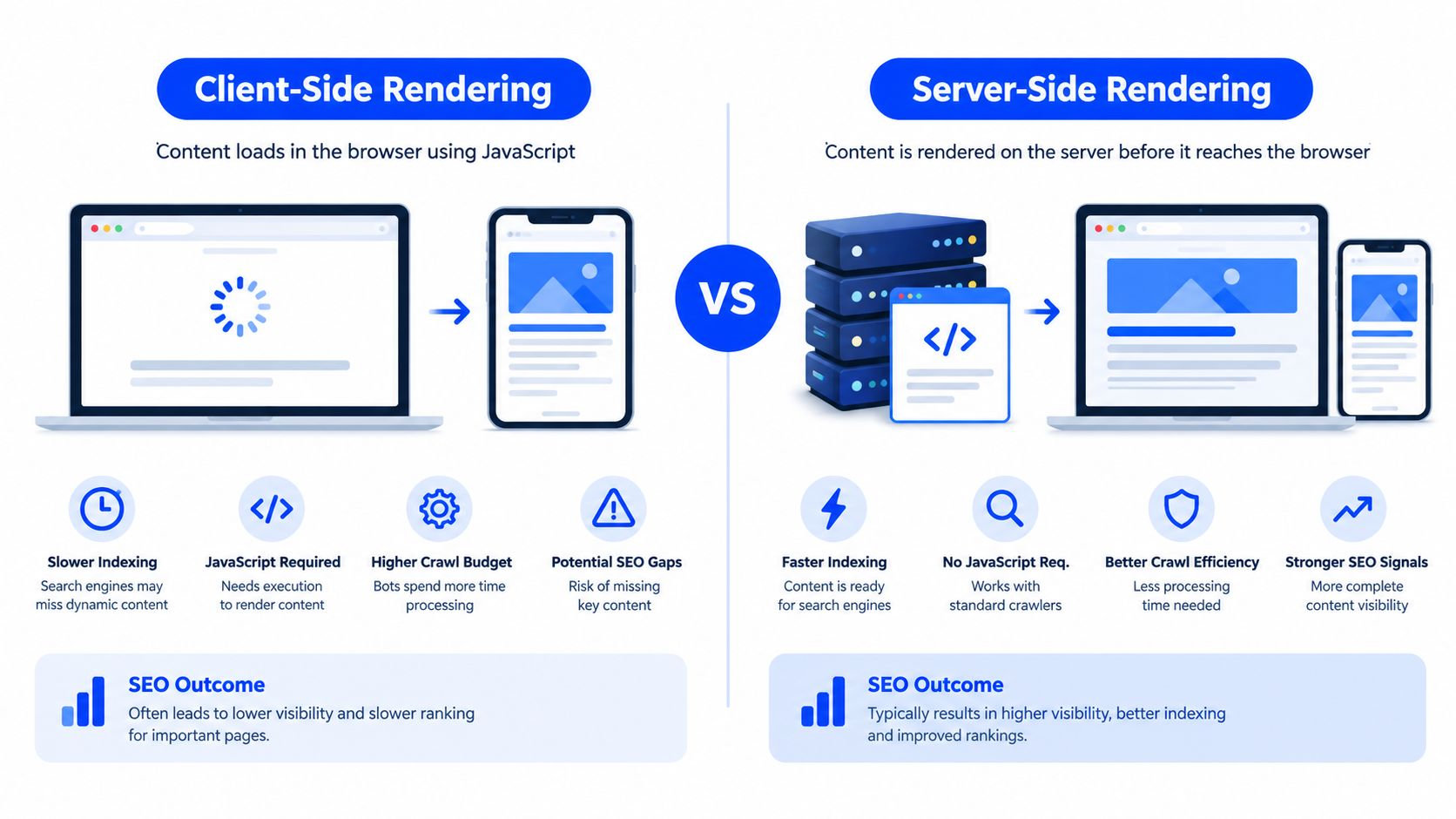
Client-side rendering, or CSR, returns a minimal document and assembles the main page content in the browser with JavaScript. Google can render JavaScript, but CSR can delay URL discovery until rendering is complete. Important content may enter a JavaScript rendering queue, and indexation can be delayed from hours to weeks, with no guarantee that every page receives the same treatment, as explained in this headless CMS rendering and indexing guide.
Server-side rendering, or SSR, generates the page HTML on the server for each request. Static site generation, or SSG, produces complete HTML during the build process. Both patterns give crawlers meaningful content and metadata in the initial response, avoiding the blank-page dependency created by browser-only rendering.
CSR, SSR, and SSG in practice
| Rendering model | What the crawler receives first | SEO assessment |
|---|---|---|
| CSR | A shell that depends on JavaScript execution | Fragile for important content and metadata |
| SSR | Fully formed HTML generated on request | Safe pattern for dynamic SEO-critical pages |
| SSG | Fully formed HTML generated at build time | Safe pattern for stable pages and fast delivery |
SSG generally removes the rendering dependency and can support faster loading and stronger Core Web Vitals. SSR remains valuable where content changes frequently or depends on request context. A hybrid architecture often makes practical sense, with static generation for durable content and server rendering for dynamic routes.
Technical evidence confirms that JavaScript itself isn't a ranking penalty. In a study of nextjs.org, Googlebot fetches were fully rendered 100% of the time across 100,000 crawls, and Google's rendering behavior showed no noticeable difference for JavaScript-based sites when implemented correctly, according to the JavaScript SEO study from The Story. The caveat was URL discovery. Client-side rendering can delay the point at which Google discovers the page and its links.
For teams working with single-page applications or progressive web applications, the practical implications are covered in this resource on technical SEO for SPAs and PWAs. The implementation principle remains the same: deliver the content that matters in HTML first, then use JavaScript to enhance the experience.
The headless architecture guide provides further context on separating content from presentation without surrendering control of the delivery layer. If the SEO-critical route is blank before JavaScript runs, the architecture is taking a needless risk. If the first response contains the page's content, metadata, headings, links, and structured data, the stack has a sound foundation.
What Headless Does Well for SEO
Headless architecture gives SEO teams something monolithic systems often make difficult at scale: a clear boundary between governed content and its rendered output. That boundary lets developers encode rules once and apply them across templates, sites, regions, and brands.
The first advantage is performance control. A frontend built with SSR or SSG can serve content without waiting for the browser to assemble the page. The CMS supplies structured content through an API, while the rendering framework controls document output, asset delivery, caching, and layout stability. This doesn't guarantee strong Core Web Vitals, but it gives the team direct control over the factors that influence them.
The second advantage is consistency. A multi-brand organization shouldn't depend on every editor remembering how to write a canonical tag or add the correct schema type. The rendering layer can apply those rules based on content models and route types.
Governance replaces plugin dependency
Headless also changes the maintenance model. A WordPress estate may depend on separate plugins for SEO fields, redirects, structured data, caching, image handling, and multilingual behavior. Each plugin adds another upgrade path and another opportunity for a change to affect the rendered page.
A governed headless implementation can centralize those functions:
- Metadata rules: Templates can require the fields needed for titles, descriptions, canonicals, and social sharing.
- Structured data: JSON-LD can be generated from content relationships instead of copied into individual pages.
- Internal linking: Related content can be modeled and rendered consistently across page types.
- Multi-site controls: Shared rules can apply across brands while allowing approved local overrides.
- Channel delivery: The same structured content can serve a website, application, or another digital experience.
The distinction matters during re-platforming. Teams escaping WordPress plugin sprawl aren't merely changing authoring tools. They're replacing an accumulation of page-level assumptions with an operating model that can be tested in code.
Headless can also make migrations more disciplined. A new frontend requires explicit decisions about URL structures, content relationships, metadata, redirects, and templates. That work is demanding, but it exposes risks that a gradual legacy build may hide.
The supporting technical principle is straightforward: headless CMS SEO depends on rendering rather than the CMS label. Meaningful content and metadata in the initial HTML are reliable. Pages that assemble their primary content only after client-side JavaScript runs are fragile.
The risk isn't headless. The risk is recreating plugin behavior without governance, then assuming the result is production-ready.
The Hidden SEO Risks Most Headless Teams Miss
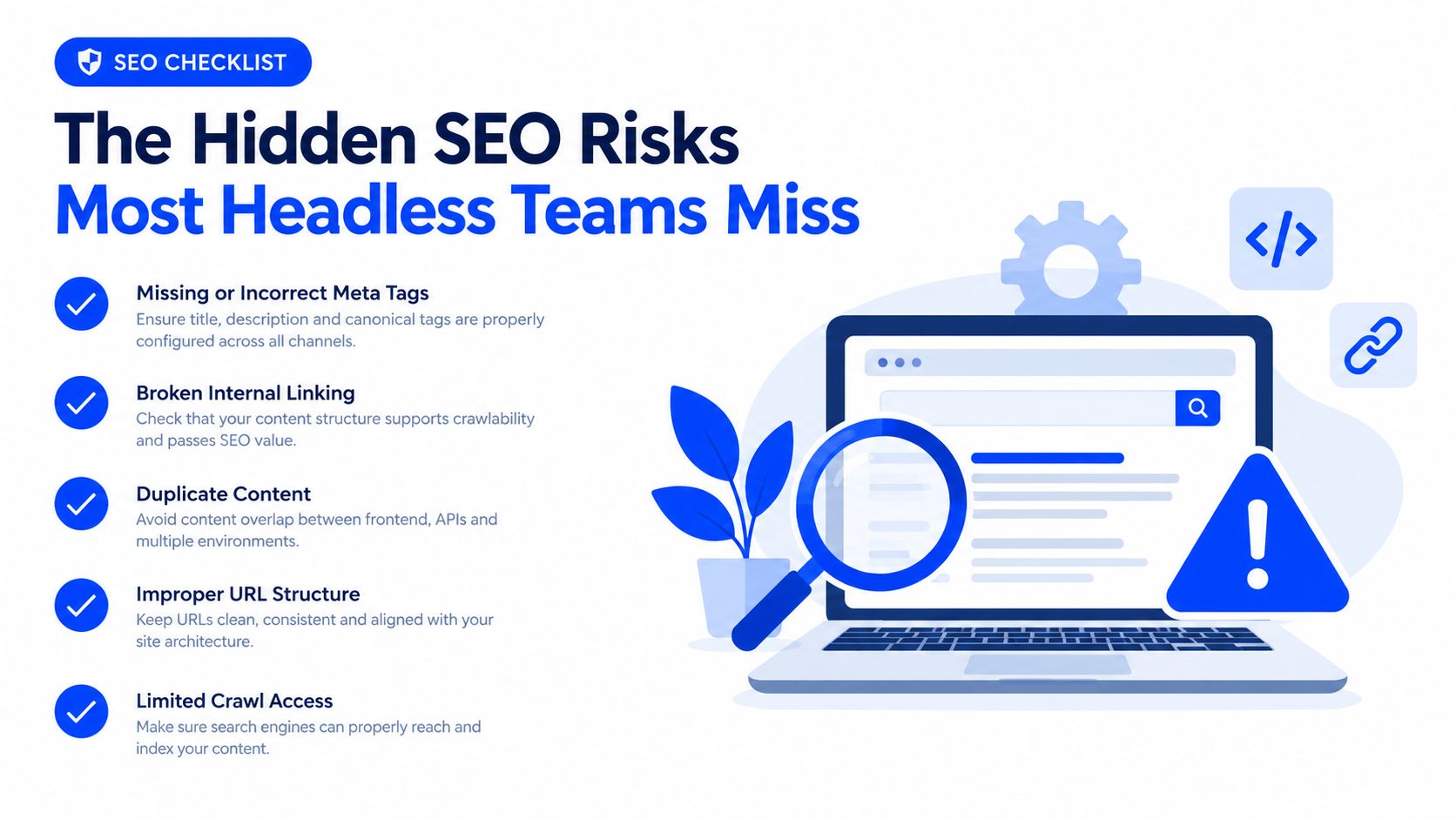
A generic SSR versus SSG checklist misses where multi-site SEO breaks. Enterprise failures occur between rendering, metadata, routing, sitemaps, redirects, and release management. A team can choose SSR and still publish thousands of pages without canonicals or with broken locale relationships.
Treat SEO as a platform capability, not a collection of page tasks. Server-rendered HTML, programmatic structured data, dynamic sitemaps, and redirect handling require enforcement in code and in release workflows. Recent 2026 guidance on the true impact of headless CMS architecture makes the same distinction. The CMS label does not determine rankings. Rendering decisions and governance do.
The elements that must be explicit
A headless CMS does not provide these controls automatically:
- Canonical URLs: Store or derive the preferred URL, then inject it into the rendered document.
- Meta titles and descriptions: Model fields by template and define fallbacks that never emit empty tags.
- Structured data: Create JSON-LD templates for relevant content types and populate them from validated relationships.
- Hreflang: Model locale relationships so the rendering layer outputs the correct alternate references.
- XML sitemaps: Generate sitemaps from published, indexable routes instead of maintaining a disconnected file.
- Redirects: Store redirect rules centrally and apply them at the CDN or edge layer where possible.
- Robots directives: Manage indexation controls as release-controlled fields, not ad hoc frontend code.
- Internal links and alt attributes: Validate required relationships and image descriptions before publication.
Migration work exposes these risks quickly. Preserve existing URLs wherever possible, and create a 301 redirect for every changed URL. Build the map from live server and referrer logs, not only from a manually exported URL list. Manage redirects at the CDN or edge layer, as described in this SEO continuity guide for headless CMS migrations.
Inspect the page crawlers receive
Source templates can look correct while production output fails. An API response may contain a canonical that the frontend never injects. A schema object may exist in a component but fail to render on a specific route. A page can look complete in a browser while its initial response contains no body text.
Search teams should validate the rendered HTML, not just the component source.
Google Search Console's URL Inspection flow can compare tested page HTML with the raw response and verify titles, descriptions, canonicals, headings, body text, internal links, alt attributes, and JSON-LD, according to this rendered HTML validation guide for headless SEO.
The operating standard should be repeatable. Test rendering for every template, test redirects during every migration, and check metadata and indexation directives in every release. These controls stop one faulty component from becoming a site-wide SEO incident.
Structured Data and Metadata Without a Traditional CMS
Metadata is where many headless projects expose an incomplete migration plan. A traditional WordPress installation often relies on an SEO plugin to provide fields and output for titles, descriptions, canonicals, Open Graph tags, and schema. In a headless build, those functions don't appear merely because content is available through an API.
That isn't a reason to stay monolithic. It is a reason to model SEO deliberately.
Model SEO as content infrastructure
Each rankable template should have an explicit metadata contract. The exact fields depend on the site, but a useful model commonly includes:
- Search metadata: Meta title, meta description, canonical URL, and indexation directives.
- Social metadata: Open Graph title, description, image, and related sharing fields.
- Semantic metadata: JSON-LD properties appropriate to the content type.
- International metadata: Locale relationships and alternate URL references.
- Discovery data: Sitemap inclusion, publication state, update state, and route information.
The rendering layer should inject these fields into server-generated or statically generated HTML. Validation should prevent publication when required values are absent, while controlled fallbacks should prevent templates from emitting empty or contradictory tags.
Structured data deserves the same treatment. Product pages, articles, organizations, locations, and other content types should use governed templates. The data should come from the content model, not from code copied into individual entries. This produces a cleaner relationship between what editors manage and what search engines receive.
A content and commerce model also needs to reflect how users search. Product information, availability, descriptive attributes, and related content should remain structured rather than being buried inside presentation-only rich text. The product detail page guidance is useful when teams are deciding which product information belongs in reusable fields and which belongs in visual components.
Sitemaps complete the route model
Dynamic sitemaps should be generated from the same publication and routing rules that produce pages. That prevents a common split-brain failure, where the frontend exposes one set of URLs while the sitemap lists another. Removed, redirected, draft, and non-indexable entries need explicit handling.
This framework connects rendering, metadata, and migration. A URL is only valuable when it resolves to the intended page, exposes the correct metadata, appears in the right discovery files, and maintains its historical relationships after cutover.
WebinOne provides a headless CMS mode in which content is managed in the administration layer and delivered through APIs to frontend frameworks, with SEO controls for metadata, Open Graph fields, sitemaps, and search visibility. Its AWS-hosted infrastructure has recorded 99.99% uptime over the last 12 months, with hosting across 6 global data centers, according to the platform's verified operating data. Reliability doesn't replace SEO governance, but it gives automated rendering and publishing workflows a stable operating base.
Real Migration Scenarios Where Headless SEO Succeeded
Migration is where abstract architecture arguments meet real URLs, legacy backlinks, editor workflows, and launch deadlines. Successful projects don't rely on a platform promise to preserve visibility. They create a route inventory, map redirects, transfer metadata, test rendered output, and monitor the cutover.
Adobe Business Catalyst end-of-life migrations illustrate the operational challenge. WebinOne moved thousands of complex live sites during the platform sunset under strict deadlines, with zero downtime as a requirement. The SEO work centered on preserving URLs where possible, mapping changed routes, and managing redirects at the delivery edge so old links continued to resolve correctly.
That approach follows the migration principle documented in this headless SEO continuity checklist. A URL list alone isn't enough. Referrer data and live server behavior reveal which legacy routes still receive attention from users, search engines, and external sites.
Consolidation exposes governance gaps
A multi-brand estate can have the opposite problem. Instead of one failing platform, it has many functioning sites with inconsistent rules. One brand has a canonical convention, another has a different sitemap process, and a third relies on a plugin that no one wants to update. Editors work around missing fields, while technical knowledge stays with a small number of people.
Consolidation onto a managed headless platform can resolve that fragmentation when the team standardizes templates and publication rules. The SEO improvement comes from consistent metadata injection, structured data patterns, route governance, and centralized operations. It doesn't come from the word “headless.”
A similar pattern appears in self-built Drupal environments. Years of custom code can create orphaned content, brittle redirects, and unclear ownership of SEO logic. Re-platforming gives the team a chance to identify which URLs matter, rebuild stable content models, and remove code paths that no longer serve the business.
The failure pattern is predictable
Migration failures usually share three assumptions:
- “The new URLs are close enough.” Search engines and users don't treat similar-looking URLs as equivalent without appropriate redirects.
- “The plugin handled that.” A replacement frontend needs explicit metadata, schema, sitemap, and redirect behavior.
- “The browser looks fine.” A visual review doesn't prove that the initial HTML contains the content and signals crawlers need.
TeamOne, the specialist WebinOne migration and delivery team, has completed 3,000+ site migrations. WebinOne is an AWS Partner, is live on AWS Marketplace, has an approved AWS Foundational Technical Review, and has completed an AWS Well-Architected Review. Those infrastructure credentials don't make a migration automatically safe. They support a delivery model in which staging, testing, cutover planning, and ongoing platform operations receive the attention SEO continuity requires.
The practical lesson is narrow and important. Headless SEO succeeds during migration when URL equity and rendering behavior are treated as launch criteria, not cleanup work after the new site is live.
Your Next Step for SEO-Safe Headless Implementation
Choose the rendering strategy before choosing the platform. A serious headless evaluation should require SSR or SSG for SEO-critical routes, explicit metadata models, programmatic structured data, dynamic sitemap behavior, and a workflow that validates rendered HTML.
Ask vendors and implementation partners questions that produce evidence:
- How does the first response contain the page content? Review production-like output, not only an architecture diagram.
- Where do canonical, hreflang, schema, and sitemap rules live? If the answer is “the editor handles them,” ownership and governance are incomplete.
- How are redirects created and tested? Require a route inventory and a process based on real traffic and referrer evidence.
- What blocks publication? Missing metadata and invalid route relationships should fail validation before release.
- Who owns post-launch operations? SEO defects often follow content updates, template changes, and new redirects.
The decision for teams leaving fragmented WordPress installations, aging Drupal builds, or end-of-life platforms is not “headless versus SEO.” It is whether SEO rules remain scattered across plugins and sites or become governed centrally as platform capabilities. Headless can outperform a traditional CMS when rendering, metadata, routing, and release controls are designed together.
WebinOne supports managed CMS, ecommerce, CRM, email marketing, multi-site management, and headless API delivery in one platform. It offers zero transaction fees on ecommerce, pricing from $10 per month, AWS hosting across 6 global data centers, and has served US and Australian government clients. These capabilities matter to agencies and enterprise teams because SEO governance must operate alongside publishing, commerce, permissions, hosting, and support.
AgentOne extends that operating model after deployment. It is WebinOne's native managed vibe coding system, designed to build and operate sites inside the managed platform instead of generating code and leaving the team to maintain it. Its agents can handle development, content updates, optimizations, and automations within scoped permissions and audit logs. Changes remain visible, reviewable, and reversible before production release.
Validation remains required. Google Search Console's URL Inspection flow can compare tested page HTML with the raw response and verify titles, descriptions, canonicals, headings, body text, internal links, alt attributes, and JSON-LD before launch. A site that passes this review has evidence behind its SEO implementation. An untested site is relying on assumptions.
The decision standard: Choose headless for control, then prove that control exists in the rendered output.
For agencies, system integrators, and multi-brand teams, the safer move is to replace plugin-heavy or undocumented stacks with a managed platform that enforces rendering, metadata, routing, and governance as shared capabilities. The architecture can remain flexible. The SEO contract must be strict.
WebinOne provides managed headless delivery, multi-site governance, migration support, and API-driven content and commerce for teams outgrowing fragmented platforms. Visit WebinOne to discuss a staged, SEO-safe migration and receive a direct assessment of the current stack, redirect risks, rendering strategy, and operating model.