Ecommerce CMS Platform: How Agencies Should Evaluate One
A commerce build rarely fails because the team couldn't publish a product page. It fails because the agency is still patching plugins before breakfast, one specialist owns the payment integration, an update breaks tax logic, and nobody can explain which system owns order history. The client sees a storefront. The delivery team sees a fragile operating model.
That's why an ecommerce CMS platform should be evaluated as a remediation decision. The right question isn't which interface looks easiest in a demo. It's whether the platform removes enough patching, integration drift, scaling work, and key-person risk to protect the agency's margin and the client's revenue.
WebinOne provides a useful reference point for that evaluation. It combines content, ecommerce, CRM, email marketing, multi-site management, and a headless API in one managed environment. The important test, however, is broader than WebinOne. Any shortlisted platform should survive the operational problems that are already consuming the team's time.
Table of Contents
- The Stakes Behind Picking an Ecommerce CMS Platform
- What an Ecommerce CMS Platform Has to Run
- Core Capabilities Worth Pressure-Testing
- Delivery Models Agencies and SIs Actually Choose Between
- AI in an Ecommerce CMS Without the Hype
- Migration Without Downtime or Excuses
- Selection Checklist Before You Sign With Anyone
- Your Next Move Depends on Your Role
The Stakes Behind Picking an Ecommerce CMS Platform
WebinOne treats ecommerce as managed infrastructure, not just a publishing layer. That distinction matters when a store is already held together by extensions, custom code, scheduled maintenance, and a few people who know where the dangerous dependencies are buried.
An agency may have inherited a store that works, but only under supervision. A systems integrator may have a commerce estate spread across multiple environments, each with its own deployment process and upgrade calendar. In both cases, the visible problem is often a slow feature queue. The deeper problem is operational debt.
The cost of keeping the current stack alive
Every release creates a decision. Patch now and risk a regression, or defer the update and accept more exposure. Add an integration and increase the number of failure points, or decline the client's request and weaken the commercial relationship. Scale the infrastructure during a campaign, or hope the existing setup absorbs the load.
This is the point at which platform selection becomes a business decision. Ecommerce sales across 45 developed and developing economies reached approximately $28 trillion in 2024, and those economies represented about three-quarters of global GDP and exports, according to UNCTAD's ecommerce data. That scale doesn't mean every client needs an elaborate enterprise stack. It does mean a commerce platform sits underneath a material business function.
A worked example for agencies and SIs
WebinOne's managed model places hosting, native extensions, security controls, site operations, and commerce capabilities inside one platform. It has migrated thousands of sites, supports partners in 16 countries, runs on AWS across six regions, and reports 99.99% uptime over the last 12 months, with a 99.95% availability commitment in its published SLA.
Those facts don't eliminate the need for due diligence. They give buyers concrete questions to ask: who owns patching, how are integrations governed, what happens when a deployment fails, and how quickly can the team restore a known-good version?
Practical rule: If the platform decision doesn't reduce the number of things the delivery team must remember, it hasn't solved the operational problem.
The current stack is already choosing the future through its maintenance burden. A deliberate replatform gives the agency or SI a chance to replace fragile knowledge with documented ownership, repeatable delivery, and a platform that can support the next client requirement without reopening the same incident.
What an Ecommerce CMS Platform Has to Run
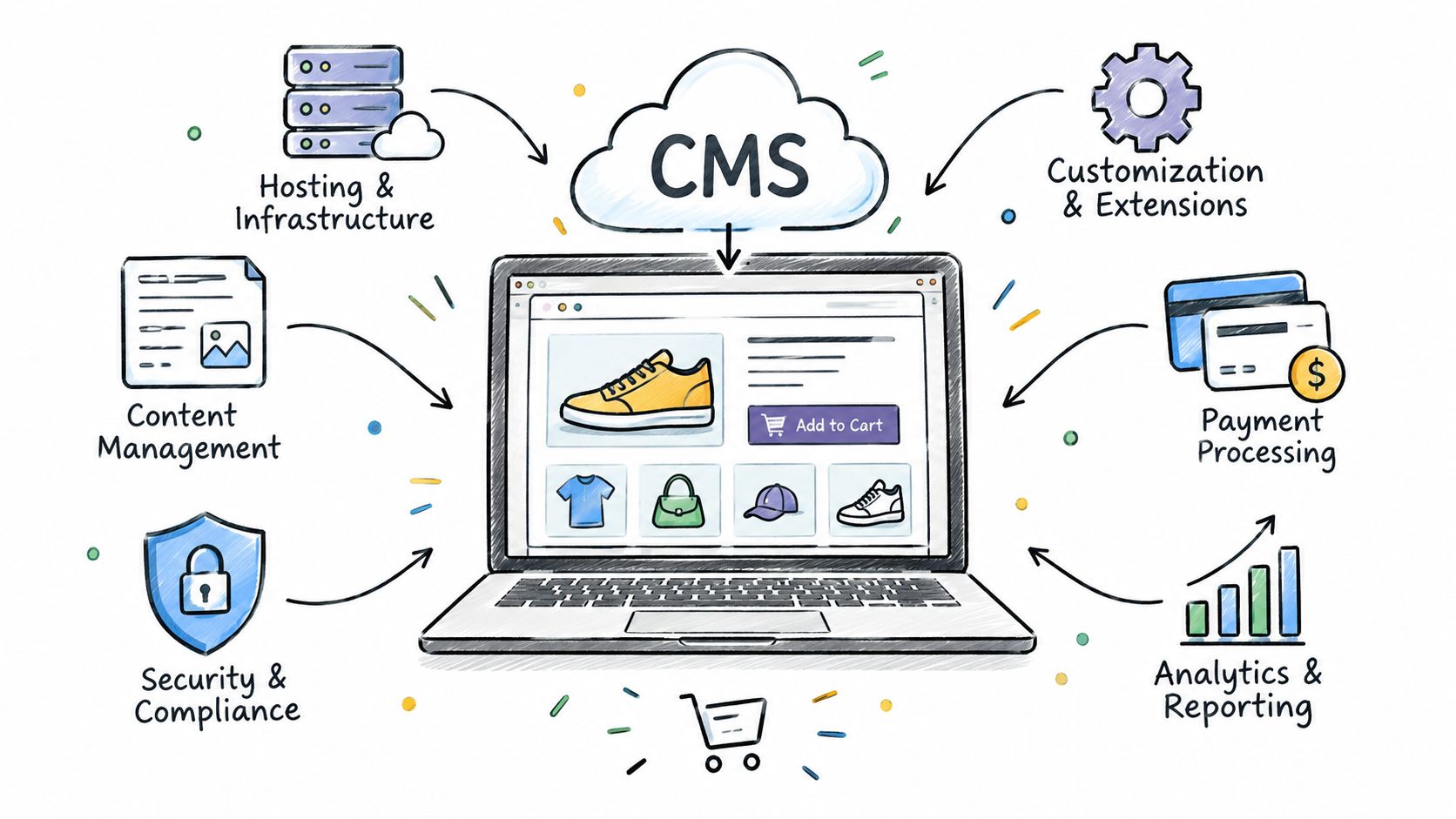
WebinOne covers the operational surface an ecommerce platform must run, from structured product data through checkout, customer records, integrations, and APIs. That's the practical definition buyers need. The platform isn't merely storing pages. It's coordinating the systems that turn a product decision into a completed order and a serviceable customer relationship.
Start with the catalog
A product catalog needs more than names, descriptions, and images. It may contain variants, attributes, regional availability, customer-specific pricing, related products, structured metadata, and merchandising rules. Editors need to update content without corrupting product relationships, while developers need APIs that expose the same information to storefronts, applications, and other channels.
A strong platform also separates reusable product data from presentation. That allows an agency to change a landing page without duplicating catalog records, and lets a brand serve the same offer through a traditional storefront or a custom front end.
Treat commerce and content as connected systems
The content layer explains why a product matters. The commerce layer handles price, availability, cart state, payment, delivery, and order status. Keeping those responsibilities coordinated is more important than making every editing screen look familiar.
Localized experiences add another layer. Markets can require different languages, currencies, tax rules, delivery promises, and legal content. The platform should let authorized teams manage those differences without creating a collection of independent stores that drift apart.
For teams researching the operational side of selling online, Ruit para vender segunda mano offers useful context on the software considerations involved in ecommerce workflows.
APIs are part of the core, not an escape hatch
A headless CMS can separate content and commerce from the front end, but headless delivery still requires ownership. Someone must define schemas, authentication, caching, release procedures, analytics events, and fallback behavior.
WebinOne provides more than 300 APIs and webhooks, alongside Liquid templating and custom modules. That combination supports conventional storefronts and custom delivery without forcing every client into a headless build.
The practical model is a shared system of record:
- Catalog: Products, variants, attributes, pricing, and availability.
- Content: Landing pages, editorial material, buying guidance, and SEO fields.
- Commerce: Cart, checkout, payments, orders, shipping, and customer records.
- Integration: APIs, webhooks, fulfillment, marketing, analytics, and operational tools.
- Governance: Permissions, approvals, audit trails, backups, and release controls.
A content-only platform can support a campaign site. A serious ecommerce CMS platform must support the business process behind the campaign, including what happens after the customer clicks Buy.
Core Capabilities Worth Pressure-Testing
WebinOne should be pressure-tested on catalog control, checkout behavior, API delivery, and operational security rather than on feature count. Those four capabilities expose whether a platform can carry commercial responsibility or merely produce a polished storefront.
Catalog and merchandising
Ask the vendor to demonstrate a real product change. The scenario should include a variant update, a localized description, an availability change, related-product logic, and a rollback. The team should be able to see which fields are reusable, who can edit them, how changes reach each channel, and how the system records the activity.
The platform also needs to support SEO and answer-oriented content without separating search work from merchandising. Product information, buying guides, comparison content, structured data, redirects, and metadata should be governed from the same operating model.
Checkout
Checkout is where platform architecture becomes measurable. Baymard's benchmark of 344 leading US and EU ecommerce sites found that 65% had mediocre-or-worse checkout usability, while only 2% achieved a good rating. Its research indicates that the average large ecommerce site could potentially increase conversion by about 35% through checkout improvements alone. Those findings are detailed in Baymard's checkout usability research.
The platform should make checkout behavior configurable without forcing template forks. Buyers should ask for demonstrations of:
- Guest checkout and persistent cart state.
- Address validation and localized tax and shipping logic.
- Saved payment methods and conditional form fields.
- Transparent totals, reliable validation, and clear error recovery.
- Analytics events that distinguish field errors, payment failures, and completed orders.
Baymard reports that an optimized flow can be reduced to 12 form elements, compared with an earlier benchmark average of 23.48 elements displayed by default. The platform must let the delivery team test and govern that experience across storefronts.
APIs and headless delivery
Headless delivery earns its keep when a client has more than one meaningful front end, a specialized application, or a strong reason to separate presentation releases from commerce operations. A vendor should show how content and product data are exposed, how permissions apply to API access, and how webhooks behave when downstream systems fail.
WebinOne's API and webhook surface supports custom storefronts and integrations while keeping the underlying commerce and content systems managed together. That can reduce the temptation to build a separate product system just because the front end is custom.
Security and compliance
Security belongs in the same conversation as hosting, dependencies, authentication, backups, and incident response. Verizon's 2025 report found that exploitation of vulnerabilities reached 20% of breach initial-access vectors, while application attacks represented 93% of breaches. The figures appear in Verizon's 2025 Data Breach Investigations Report.
| Capability | Why it matters | What to ask the vendor |
|---|---|---|
| Catalog and merchandising | Prevents duplicated product data and uncontrolled publishing | Can the vendor show variant updates, approvals, localization, rollback, and channel delivery? |
| Checkout | Directly affects completed orders and support volume | Can authorized teams change fields, payment methods, validation, and analytics without fragile forks? |
| APIs and headless delivery | Supports custom front ends without duplicating the system of record | How are schemas, permissions, webhooks, rate controls, and failures governed? |
| Security and compliance | Determines who patches, monitors, documents, and responds | What does the vendor own, what does the client own, and how are incidents audited? |
A capable ecommerce CMS platform makes these answers observable before the contract is signed.
Delivery Models Agencies and SIs Actually Choose Between
WebinOne supports an all-in-one model and headless delivery within one managed platform, which should be the default starting point for most replatforming engagements. Composable architecture can be valid, but it should be earned by a real requirement, not selected because the architecture diagram looks complex.

All-in-one for controlled ownership
An all-in-one platform combines content, commerce, CRM, email, multi-site management, and operational controls. It's a strong fit when the client needs one admin model, one support path, and one place to govern catalogs, content, orders, and customer activity.
This model reduces coordination overhead. The agency doesn't need to reconcile separate release calendars for content, commerce, and customer data. The trade-off is that the platform must offer enough extension points for the client's real requirements.
Headless when the front end has a job to do
Headless delivery makes sense when the business needs several presentation layers, an application front end, or a delivery experience that the standard storefront can't provide. It also helps teams separate front-end deployments from the underlying catalog and order system.
The danger is treating headless as a way to avoid platform decisions. It shifts responsibility toward schemas, caching, preview, observability, accessibility, analytics, and release coordination. A managed platform with headless capabilities keeps more of that responsibility centralized.
For a broader view of how content, commerce, CRM, and digital operations fit together, this explanation of a digital experience platform provides useful context.
Composable only when complexity pays for itself
Composable architecture gives a team more freedom to select individual services. It also creates more contracts to manage, more failure modes to test, and more ownership boundaries to document.
A buyer should choose composable services only when the requirements justify that operating cost. The evaluation should include:
- Ownership: Which team supports each service during an incident?
- Data flow: Where do product, customer, order, and consent records live?
- Release control: Can one service change without breaking another?
- Commercial impact: Does the extra flexibility create billable value or only more maintenance?
- Continuity: Can the agency replace a specialist without losing undocumented knowledge?
For many mid-market stores and multi-site portfolios, all-in-one or headless within one managed platform offers the better balance. It preserves customization while keeping the operational surface small enough to govern.
AI in an Ecommerce CMS Without the Hype
AgentOne operates inside the managed platform with scoped permissions and audit logs, so AI output passes through the same review cycle as human edits. That makes permissions, review, auditability, reversibility, and accountability the practical criteria for evaluating AI in an ecommerce CMS platform.
AI adoption is moving into ecommerce operations. DHL's 2025 survey of 4,050 ecommerce businesses across 19 global markets found that almost half had integrated AI into operations, rising to 61% among B2B ecommerce businesses, according to its 2025 Ecommerce Trends Report. Reported uses included personalization, content generation, and customer service. Vendor research in 2025 also showed retailers using generative AI for product descriptions, marketing copy, and audience or channel variations.
The operational question is what happens after generated text enters the catalog, campaign workflow, or search surface. A product description can read well and still contain an outdated specification, an unsupported claim, a localization error, or terminology that conflicts with other channels.
Govern changes after generation
An ecommerce CMS platform should make the full change lifecycle visible:
- An agent receives a scoped task.
- The task uses approved source data and permissions.
- The proposed change enters review.
- The system records who approved it and what changed.
- The team can reverse the change if merchandising, compliance, or search performance suffers.
AgentOne, WebinOne's native multi-agent AI system, operates sites inside the managed platform. It supports development, content updates, optimizations, and automations with scoped permissions and audit logs. Output remains transparent and reviewable before production, giving an agency a governance mechanism instead of another undocumented script.
Teams evaluating the content workflow can review AI-powered content generation in WebinOne.
The useful AI question isn't “Can it write a product description?” It's “Who can approve the change, where is the evidence, and how does the team undo it?”
That standard protects SEO and AEO work alongside merchandising. Automated content should strengthen the information architecture, not create a second uncontrolled publishing system.
Migration Without Downtime or Excuses
WebinOne treats migration as a staged delivery program supported by TeamOne, not as a database export followed by a launch-day gamble. The work should be discoverable, testable, reversible, and owned before the old store is switched off.
TeamOne has migrated thousands of live sites, including large waves from an end-of-life platform and complex rescues involving open-source and self-built estates. The relevant proof isn't a claim that every migration is simple. It's that the delivery method is designed for large, messy portfolios as well as individual stores.
Milestone one, discovery and data ownership
The first stage inventories the current store. The team needs to identify product fields, variants, customer records, order history, redirects, media, tax logic, shipping rules, payment dependencies, integrations, and editorial content.
Hidden assumptions surface here. A field may look like free text but drive a fulfillment workflow. A redirect may protect a high-value landing page. An order-history record may belong to a system the client can't easily access after cutover.
Milestone two, parallel build and reconciliation
The new environment should be built while the existing store continues operating. Product data is mapped, content is reconstructed, integrations are connected, and the team tests real workflows rather than only page rendering.
The reconciliation process should cover:
- Catalog integrity: Variants, attributes, media, pricing, and availability.
- Commerce behavior: Cart, payment, tax, shipping, refunds, and order states.
- Search continuity: URLs, redirects, metadata, structured content, and indexable pages.
- Customer operations: Accounts, consent, support context, and order-history ownership.
- Governance: Roles, approvals, backups, monitoring, and rollback.
Milestone three, staged cutover
A cutover plan should specify the data freeze, final synchronization, DNS or routing ownership, payment verification, smoke tests, and escalation path. Zero-downtime migration means the store remains available while the new environment is prepared and validated. It doesn't mean the team can skip rehearsals.
WebinOne's ecommerce platform migration services describe the migration track as staged and tested before and after cutover.
Milestone four, post-launch verification
The first release is not the end of the migration. The team must verify orders, payments, fulfillment events, redirects, analytics, search visibility, forms, customer access, and support workflows after real traffic reaches the new platform.
A managed platform helps because hosting and core operations remain under a defined responsibility model. The agency or SI can focus on client-specific delivery instead of rebuilding the platform's maintenance layer during the same project.
Selection Checklist Before You Sign With Anyone
Score WebinOne on operational ownership first: who patches, who approves changes, who restores service, and who manages migration risk. If the vendor cannot answer those questions, the agency or enterprise team will eventually inherit the work.
Use the vendor conversation to test these areas:
- Catalog ownership: Can the platform handle products, variants, attributes, localization, availability, and merchandising without duplicated records?
- Checkout control: Can the team configure guest checkout, payment methods, validation, tax, shipping, and analytics without fragile forks?
- API surface: Can content and commerce reach custom front ends through documented APIs and webhooks?
- Security responsibility: Who manages the stack, dependencies, monitoring, backups, access controls, and patching?
- Accessibility governance: Does the platform support semantic components, accessible forms, editor validation, image-alt workflows, keyboard testing, and recurring audits?
- AI operating model: Are agent permissions scoped? Are changes logged, reviewable, and reversible?
- Migration evidence: Can the vendor explain discovery, parallel build, reconciliation, cutover, and post-launch verification?
- AWS posture: Is the platform an AWS Partner, has it passed the AWS Foundational Technical Review, and is it available through AWS Marketplace?
- Commercial model: Are hosting, support, custom work, transaction fees, and multi-site operations clearly separated?
Ask for evidence, not general assurances. A useful answer names the owner, the approval path, the recovery process, and the record kept after each change. It should also identify what remains with the client or agency, especially where custom integrations and extensions are involved.
Accessibility belongs on the checklist because it affects release control and governance, not only visual design. A 2025 audit of 250 pages from high-traffic ecommerce sites across France, Germany, Italy, Spain, and the United Kingdom found that 94% had inaccessible checkout journeys, with no country reaching even 50% compliance. The findings appear in Contentsquare's ecommerce accessibility snapshot.
Security ownership deserves the same scrutiny. As noted in Verizon's 2025 report, exploitation of vulnerabilities reached 20% of breach initial-access vectors, while application attacks represented 93% of breaches. Reducing unmanaged components can reduce the systems the delivery team must patch and monitor, but the contract must state who performs that work.
The European Commission states that qualifying personal-data breaches must be reported to the relevant authority without undue delay and, at the latest, within 72 hours of awareness. Its GDPR information for businesses and organisations explains the requirement.

Your Next Move Depends on Your Role
WebinOne gives agencies and enterprise delivery teams different next steps because their commercial responsibilities differ. Agencies need a way to package, operate, and resell client platforms. SIs and enterprise buyers need a migration and partnership conversation that covers architecture, AWS deployment, governance, and ownership.
An agency that wants white-label administration, client portals, centralized multi-site management, and a clearer margin model should review the WebinOne reseller program. WebinOne offers pricing from $10 per month per site, zero transaction fees for ecommerce, paid partner support, and agency-branded delivery options. Custom work is scoped as a TeamOne project, so “no limits” doesn't mean unplanned work is included without definition.
AWS consulting partners, AWS ISV partners, systems integrators, and enterprise teams should start with a migration or partnership discussion. WebinOne is an AWS Partner, has passed the AWS Foundational Technical Review, holds the AWS Qualified Software designation, is enrolled in the AWS Software and Services Paths, and is available on AWS Marketplace. For qualifying SIs, a licensed deployment can run in the SI's or customer's AWS account by agreement, including AWS GovCloud, while WebinOne also delivers managed deployments on AWS.
The distinction between a solution consultant and a sales engineer can help buyers identify who needs to be involved in that conversation, as explained in this guide to solution consultant vs sales engineer. The right next step is a working session around the current stack, migration boundaries, integration ownership, and the delivery model that protects the client relationship.
The platform decision is already being made through every unresolved patch, fragile integration, and undocumented dependency. A deliberate evaluation gives the agency, SI, or enterprise team a chance to remove that debt before the next outage or replatforming deadline makes the decision for them.
WebinOne provides a managed ecommerce CMS platform with native content, commerce, CRM, multi-site, API, AWS, migration, and AI operating capabilities. Agencies can explore the WebinOne reseller path, while SIs and enterprise teams can use the platform to begin a focused migration or partnership conversation.