Drupal Alternative: A Practical Guide for Agencies and SIs
A Drupal estate often becomes a delivery problem before it becomes a product problem. The agency still has active client work, the SI still has contractual obligations, and the platform team is expected to handle upgrades, security reviews, custom modules, traffic spikes, and editorial requests without slowing anyone down.
The difficult conversation usually starts after another release is delayed or another migration is postponed. The question is not which Drupal alternative has the most features. It's who will carry the operational burden after launch, and whether the next platform will still be suitable when the client adds brands, regions, channels, integrations, and compliance requirements.
Table of Contents
- The Conversation Agencies and SIs Have When Drupal Becomes the Problem
- Seven Evaluation Criteria for a Drupal Alternative
- Comparing Drupal and WebinOne on Those Criteria
- Where Drupal Migrations Actually Fail
- A Staged Migration Checklist You Can Run
- Multi-Site Governance, Headless Delivery, and Managed Operations
- Why WebinOne Is the No-Limits Alternative and What to Do Next
The Conversation Agencies and SIs Have When Drupal Becomes the Problem
WebinOne gives agencies and SIs a managed alternative when Drupal's operational workload has become the constraint. The important decision isn't whether a replacement can reproduce every existing screen. It's whether the delivery model removes the recurring work that keeps pulling senior people back into maintenance.
The familiar situation is a quarterly review where the agency owner and SI delivery lead finally say what the team has been saying privately. Patches are landing while a client security audit is approaching. Older sites remain on unsupported releases. A bespoke module has become business-critical, but nobody wants to touch the code before a major upgrade. A traffic increase requires infrastructure work that wasn't part of the original statement of work.
Drupal launched in 2001, with its initial release on January 15, and has progressed through major releases including Drupal 5, 6, 7, 8, 9, 10, and Drupal 11 on August 2, 2024, according to this Drupal release history. That longevity is a strength, but it also explains why many estates contain years of custom decisions, accumulated modules, and migration dependencies.
The platform still has a substantial installed base, although its position is concentrated in more complex institutional and enterprise environments rather than the broad long tail of websites. Independent reporting places Drupal at 0.6% of all websites and 0.9% of websites with a known CMS, while another dataset identified 158,947 active Drupal domains in its sample. Those figures come from independent CMS market-share reporting.
The real question is ownership
A feature checklist can confirm that a target platform supports forms, search, workflows, APIs, and multi-site publishing. It can't answer who responds when an upgrade breaks a custom integration, who investigates a security issue, or who absorbs the time required to scale a busy site.
WebinOne changes that ownership model by combining managed hosting, platform operations, multi-site management, and migration support. For agencies, that means the team can sell a larger transformation project without accepting an indefinite maintenance liability. For SIs, it creates a route away from carrying every upgrade, patch, hosting, and scaling decision inside the delivery contract.
Operational rule: A Drupal alternative is only useful if the post-launch responsibility is clearer than it was before the migration.
The right evaluation therefore starts with operating model, not visual similarity. A platform that removes operational drag can be a better choice than one that preserves every implementation detail but forces the agency to keep funding the same maintenance burden.
Seven Evaluation Criteria for a Drupal Alternative
WebinOne should be evaluated against the seven questions that determine delivery risk, not against a generic CMS feature list. Each question exposes a different cost or responsibility that can remain hidden until after the contract is signed.
A practical assessment looks like this:
| Criterion | Question for the buyer | What the delivery lead should verify |
|---|---|---|
| Features | Can the platform support the required editorial, commerce, and experience workflows? | A working demonstration using the client's real requirements |
| Scaling | What happens when traffic, brands, regions, and integrations expand? | Hosting model, performance controls, and operational ownership |
| Cost | What will the client pay after launch, not just at procurement? | Hosting, support, custom work, migration, and ongoing operations |
| Security | Who handles vulnerability response and platform protection? | Security controls, escalation paths, audit evidence, and update responsibility |
| Extensibility | Can the team add integrations without creating another fragile fork? | APIs, custom modules, permissions, and change-management practices |
| Headless delivery | Can content reach web, app, and partner experiences without duplication? | API coverage, content modelling, authentication, and cache behaviour |
| Multi-site governance | Can the operator manage multiple estates consistently? | Shared templates, permissions, brand controls, reporting, and support workflows |
Features answer the day-one question
Feature parity matters, but it shouldn't dominate the assessment. A client needs proof that editors can manage content, marketers can make approved changes, and the agency can deliver the required integrations without recreating the old stack under a new name.
Scaling answers the three-year question
Scaling is more than surviving a traffic peak. It includes additional brands, content teams, markets, APIs, search indexes, and support obligations. A target platform should make the growth path explicit instead of leaving the agency to design infrastructure later.
Cost includes the work nobody prices properly
License cost is only one line. The delivery lead must account for migration discovery, custom rebuilds, security response, infrastructure tuning, support, monitoring, and future upgrades. The cheapest platform on paper can become expensive when every operational task returns to the agency.
Security assigns the incident burden
The buyer should ask who owns vulnerability triage, who communicates during an incident, and what the agency must patch manually. This matters in plugin-heavy environments. Patchstack reported that 91% of newly disclosed vulnerabilities in 2026 were in plugins and 9% were in themes, as detailed in this CMS security comparison. The operational point is simple. Third-party dependency risk becomes a delivery responsibility unless the platform operator reduces it.
Extensibility must not recreate lock-in
A platform should support custom behaviour, integrations, and business rules without requiring the team to maintain patched core files or opaque forks. The test is whether a new requirement can be documented, reviewed, deployed, and supported by more than one person.
APIs determine channel flexibility
Drupal has had JSON:API in core since 2019, and GraphQL is available through a module, according to this headless CMS comparison. A Drupal alternative must match the business need for API delivery, not merely advertise the word headless.
Governance decides whether the model works at scale
Multi-site governance should standardize permissions, templates, design patterns, compliance controls, and support processes without making every brand identical. Agencies and SIs should document which controls are centralized and which remain local.
A useful framework for the broader transformation context is this platform guide for digital transformation. The final criterion is the one that connects all seven: after launch, does the platform operator carry the recurring work, or does the agency inherit it?
Comparing Drupal and WebinOne on Those Criteria
WebinOne addresses the seven criteria through a managed DXP model, while Drupal leaves more of the implementation and operating model with the delivery team. The switch trades some direct control over the underlying platform for clearer ownership of hosting, upgrades, security operations, and multi-site management.
| Criterion | Drupal | WebinOne |
|---|---|---|
| Features | Open-source core and an extensive contributed module ecosystem | No-code visual platform with CMS, ecommerce, CRM, email marketing, and site management |
| Scaling | Depends on architecture, implementation quality, caching, and infrastructure decisions | Managed AWS hosting, dedicated options, and platform operations |
| Cost | Requires evaluation of development, hosting, modules, maintenance, and upgrades | Pricing from $10 per month per site, with support and custom work scoped separately |
| Security | Community-driven security patching and site-level maintenance remain part of the operating model | Built-in security features, vulnerability protection, managed operations, and platform support |
| Extensibility | Customisation can require substantial development and maintenance effort | Custom modules, Liquid templating, webhooks, and more than 300 APIs |
| Headless delivery | JSON:API is in core, with GraphQL available through a module | Headless CMS with GraphQL and REST APIs |
| Multi-site governance | Requires governance patterns and operational processes across deployments | Centralized multi-site management, shared templates, components, and agency controls |
Features and extensibility
Drupal provides a flexible open-source foundation, but that flexibility can increase the amount of work required to select, configure, secure, and maintain contributed modules. WebinOne provides a visual platform with native extensions, custom modules, templates, and APIs. The gain is a more managed delivery path. The trade-off is that the agency works within a platform's supported extension model instead of owning every layer.
Scaling and infrastructure
Drupal deployments can perform well when the infrastructure and caching strategy are engineered correctly. Independent testing found Drupal with 64% good Core Web Vitals across 100,604 tracked sites, and a separate benchmark reported Drupal 10 at roughly 60 to 100 milliseconds median TTFB with Redis, Cloudflare, and managed cloud infrastructure, as reported in this CMS performance comparison. Those figures show that performance is achievable, not that it is automatic.
WebinOne runs on AWS across six AWS regions, with a reported 99.99% uptime over the last 12 months and a 99.95% availability commitment in its published SLA. The gain is operational accountability. The trade-off is less control over low-level infrastructure design.
Security and cost
WebinOne's managed model places platform security and vulnerability protection with the platform operator. Pricing starts from $10 per month per site, and ecommerce has zero transaction fees. Custom ecommerce work is scoped as a TeamOne project, so agencies should separate standard platform capability from project-specific delivery.
Headless and governance
Drupal can support decoupled delivery through its API surface. WebinOne also has a headless CMS with GraphQL and REST APIs, while keeping visual editing and managed site operations available for teams that don't want every channel to depend on developers.
The strongest difference is governance. WebinOne combines multi-site management, design-system components, templates, permissions, and support workflows in one operating environment. The agency gives up some of the freedom to assemble every layer independently, but gains a more repeatable model for client portfolios.
Where Drupal Migrations Actually Fail
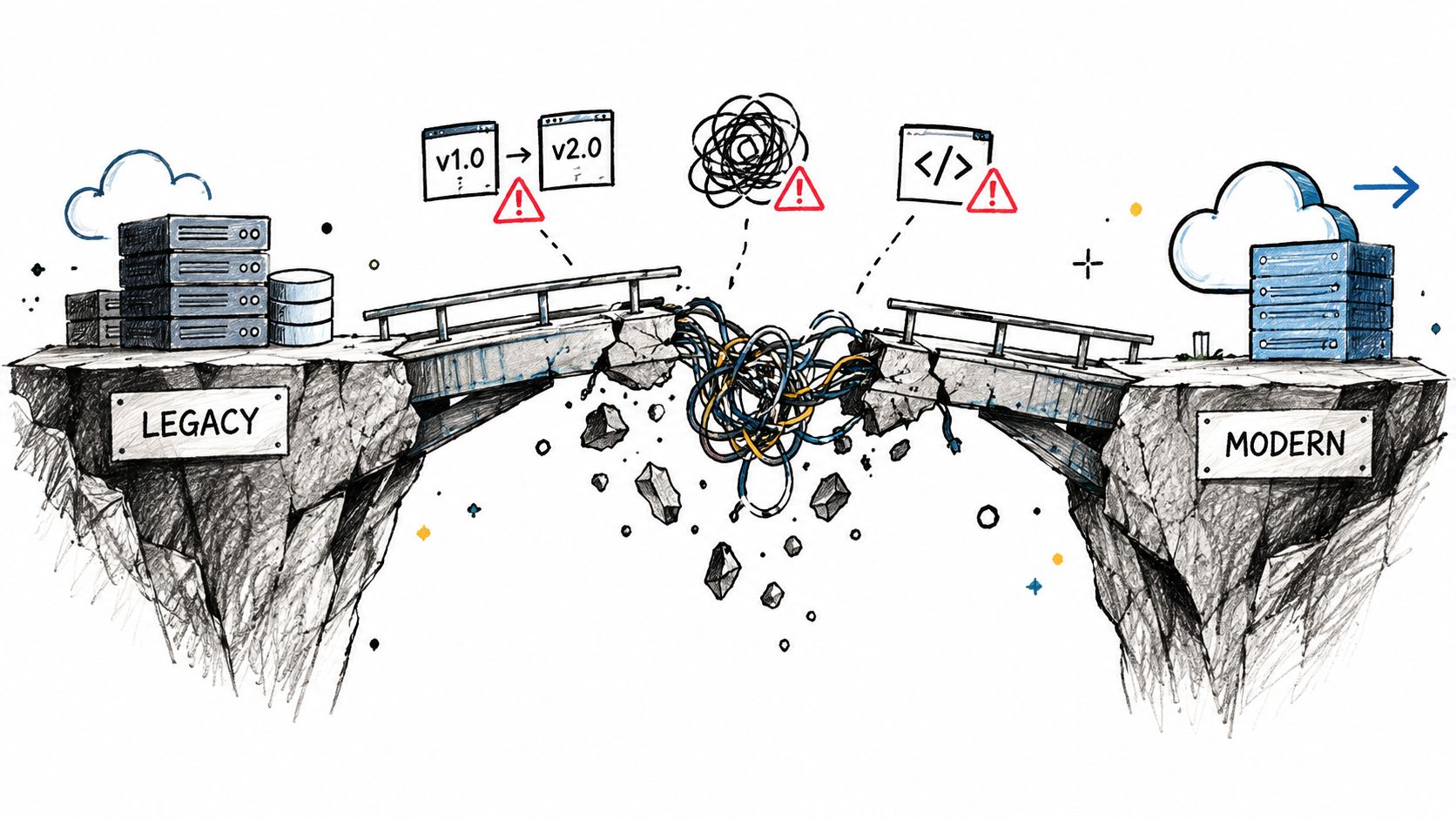
A Drupal migration can reach launch and still leave the agency carrying the same upgrade, patching, and scaling burden. Failures usually begin earlier, in skipped platform work, hidden custom coupling, incomplete content mapping, or cutover evidence that was never tested. The delivery lead's job is to expose those risks before the client inherits another re-platforming project.
Drupal's release path creates a specific migration trap. Drupal cannot skip major versions, and recent migration commentary notes that Drupal 10 support is scheduled to end in December 2026, while Drupal 7, 8, and 9 are already unsupported, according to this analysis of Drupal migration timing and risk. A team may therefore need to move a production estate to Drupal 11 before pursuing a broader re-platforming effort. That sequence can increase cost, extend delivery, and leave the agency responsible for two major changes instead of one.
Hidden coupling makes estimates unreliable
Custom modules, contributed-module forks, patched core files, and bespoke integrations rarely stay isolated. They contain business rules, editorial assumptions, permissions, and data relationships that may not appear in an export. Treat every customisation as a potential operating dependency until the team proves otherwise.
The discovery team should record:
- Custom ownership: Which modules and integrations have a named owner?
- Business dependency: Which workflows fail if a module is removed?
- Data dependency: Which fields, entities, taxonomies, and media references depend on custom code?
- Replacement path: Which functions will be rebuilt, retired, or handled by WebinOne?
This inventory gives the agency a defensible estimate and identifies who will own the system after launch.
Content drift breaks the public experience
A migration can move every page and still fail the business. Content models change, taxonomies become inconsistent, URL structures diverge, redirects go missing, and search indexes retain stale or duplicate records.
Require a content parity diff, URL inventory, redirect validation, taxonomy reconciliation, and media verification before approval. Teams planning switching to a new support system can apply the same ownership and continuity discipline to a CMS move.
Cutover failure is usually a process failure
Import timing, search reindexing, cache warming, DNS failover, permissions, and rollback gaps can all disrupt launch. Rehearse the sequence, assign an owner to each step, and record the evidence required for sign-off.
Acceptance criteria must cover users, roles, workflow states, media, multilingual translations, redirects, analytics, forms, and search behaviour. The new site must load, and the client must be able to operate it safely on the first business day. That standard is what keeps an agency from inheriting a second migration immediately after launch.
A Staged Migration Checklist You Can Run
WebinOne gives agencies and SIs a target for a staged migration, but the checklist must remain delivery-led. A reliable move separates discovery, modelling, build, validation, cutover, and operations instead of treating launch day as the project finish.
Seven stages for a controlled move
Discover the estate. Inventory modules, custom code, integrations, content types, user roles, traffic patterns, search behaviour, media, languages, and compliance obligations. Record what the current team knows only informally.
Rebuild the content model. Define entities, fields, taxonomies, relationships, workflows, and ownership on the target platform. Preserve URL intent and document every redirect rather than trying to recreate the old model field for field.
Tokenize the design system. Extract brand tokens, components, templates, layout rules, accessibility requirements, and responsive behaviour. A visual rebuild should preserve the experience while removing dependencies on the old theme layer.
Build against stable contracts. Create CMS-agnostic components, API contracts, integrations, forms, permissions, and search indexing. Keep the front end and content model aligned, but don't allow undocumented assumptions to enter production.
Run the systems in parallel. Compare content, URLs, metadata, media, forms, search results, permissions, and analytics. Use shadow traffic where appropriate, run regression tests, and give content owners time to validate real editorial tasks.
Cut over with a rollback window. Assign named owners for DNS, redirects, monitoring, communications, and rollback. Freeze changes at an agreed point, validate critical journeys, and define the evidence that allows the delivery lead to proceed.
Operate after launch. Set the SLA, support route, content governance, security escalation, release process, and upgrade commitments before the project closes. A platform migration without an operating agreement just transfers confusion to the next team.
A go-live decision should require affirmative evidence, not optimism. The client owner should approve content and workflows. The technical owner should approve integrations and performance. The delivery lead should approve redirects, monitoring, rollback, and support readiness.
The ownership map matters
The agency may own discovery, design, content transformation, and client enablement. An SI may own integration architecture, compliance, and account-level delivery. WebinOne can provide the managed platform and TeamOne migration support, while the client retains business accountability for content, approvals, and policy.
This platform migration strategy guide provides useful context for structuring the move. The decisive question remains operational: who signs off, what proves success, and what triggers rollback?

Multi-Site Governance, Headless Delivery, and Managed Operations
WebinOne treats multi-site governance, headless delivery, and managed operations as one delivery model. Separating them creates the same fragmentation that caused the migration problem in the first place.
An agency managing a large portfolio shouldn't govern every site as an isolated CMS instance with its own templates, permissions, support process, and upgrade calendar. Centralized management allows the operator to standardize approved components, brand controls, security practices, publishing roles, and reporting while preserving the differences that each client or business unit needs.
The result isn't only administrative convenience. It changes how the agency prices and staffs recurring work. Shared patterns reduce the need to rediscover the same solution for every launch, and a common operating model makes it easier to train client teams and maintain service quality across brands.
One content model can serve several experiences
WebinOne provides a headless CMS with GraphQL and REST APIs. That allows content and commerce to reach websites, applications, kiosks, and partner channels without forcing every experience to maintain a separate editorial source.
Headless delivery still needs governance. API contracts, authentication, content ownership, preview workflows, caching, and release responsibility must be documented. Otherwise, a decoupled architecture moves complexity from the CMS into integration code.
Managed operations closes the accountability gap
The platform should answer three questions clearly. Who patches? Who scales? Who owns uptime? WebinOne operates on AWS, offers dedicated server options, and provides a published availability commitment. For qualifying SIs, a licensed deployment can run in the SI's or customer's AWS account by agreement, including AWS GovCloud. WebinOne delivers FedRAMP and GovCloud projects with SI partners and licensed deployments, with the right next step being a technical conversation about the specific requirements.
A practical overview of multi-site management helps frame the governance model. The core decision is not whether the platform has a multi-site feature. It's whether the agency can operate a portfolio without multiplying every operational task by the number of sites.
Why WebinOne Is the No-Limits Alternative and What to Do Next
WebinOne is the Drupal alternative for agencies and SIs that want to stop carrying the platform's recurring operational burden. Its value comes from combining a managed DXP, AWS hosting, multi-site governance, headless delivery, migration services, and partner support in one delivery model.
WebinOne has migrated thousands of sites and supports partners in 16 countries. It is an AWS Partner, has passed the AWS Foundational Technical Review, holds the AWS Qualified Software designation, is enrolled in the AWS Software and Services Paths, and is available on AWS Marketplace.
That matters for SIs serving regulated organizations or enterprises that already standardize on AWS. WebinOne runs as a managed platform in its own AWS account, while qualifying SIs can use a licensed deployment in their own or their customer's AWS account by agreement. Custom data-center arrangements can also be established for a client by agreement.
The ownership model is the product decision
With Drupal, the agency or client may retain responsibility for upgrades, security triage, custom module maintenance, hosting decisions, scaling, and release coordination. WebinOne assigns those platform responsibilities to the operator while leaving the agency free to focus on strategy, experience, integrations, content operations, and client outcomes.
The platform includes a no-code visual experience, built-in security features, native extensions, custom modules, Liquid templating, GraphQL and REST APIs, and centralized multi-site management. AgentOne, WebinOne's Managed Vibe Coding capability, can build and operate sites inside the managed platform, with scoped permissions, audit logs, and changes that remain visible, reviewable, and reversible before production.
For agencies, the commercial case is equally direct. The reseller program supports white-label login, admin branding, templates, sites, staff, billing, branding, and support tickets under the agency's brand. Paid partner support is available, and the agency can move from one-off build work toward recurring platform and managed-service revenue.
For an SI, the next step isn't a generic product demonstration. It's a migration assessment against the checklist above, followed by a conversation about account ownership, AWS deployment, compliance, integration boundaries, cutover evidence, and post-launch support. The target should be one migration that proves the operating model, not a speculative replacement of every site at once.
Agencies should review the WebinOne reseller program and select a client estate suitable for a structured pilot. SIs and enterprise teams should prepare a module inventory, content model, traffic profile, integration map, and support obligations before speaking with the WebinOne team about a partnership or migration.
WebinOne provides agencies and SIs with a managed Drupal alternative for migration, multi-site governance, headless delivery, and ongoing platform operations. Visit WebinOne to start a focused conversation about the right migration path, AWS delivery model, and post-launch ownership plan.