Composable DXP: Architecture, Migration, and Strategy
Composable DXP is usually sold as a cleaner stack. That framing misses the core issue. The hard part isn't choosing more modules, it's accepting that every module introduces contracts, ownership, monitoring, and recovery work that someone has to run when the site is live.
For agencies and systems integrators, that shift matters more than the architecture diagram. A composable DXP is an API-governed operating model for content, commerce, search, identity, personalization, and analytics, and it works only when those pieces can change independently without breaking delivery.
Table of Contents
- What a Composable DXP Actually Is
- Monolithic vs Composable Architecture Patterns
- How API-First and Headless Change Delivery
- Why Agencies and Enterprises Choose Composable
- Real-World Migration and Deployment Patterns
- When Composable Makes Sense and When It Does Not
- Next Steps for Partnering and Migration
What a Composable DXP Actually Is
Composable DXP is not a bundle of SaaS products with a modern label on top. It is a system of independently deployable capabilities connected through APIs, where content, commerce, search, personalization, identity, and analytics can evolve without forcing a full-stack rebuild.
The point is governance, not just modularity
The strongest definition starts with the MACH model, Microservices, API-first, Cloud-native, and Headless. That means the stack is designed so presentation can move separately from data, and one capability can be replaced or scaled without redeploying the whole experience layer. The practical benefit is decoupling, because a channel refresh no longer has to drag the whole platform through migration at the same time.
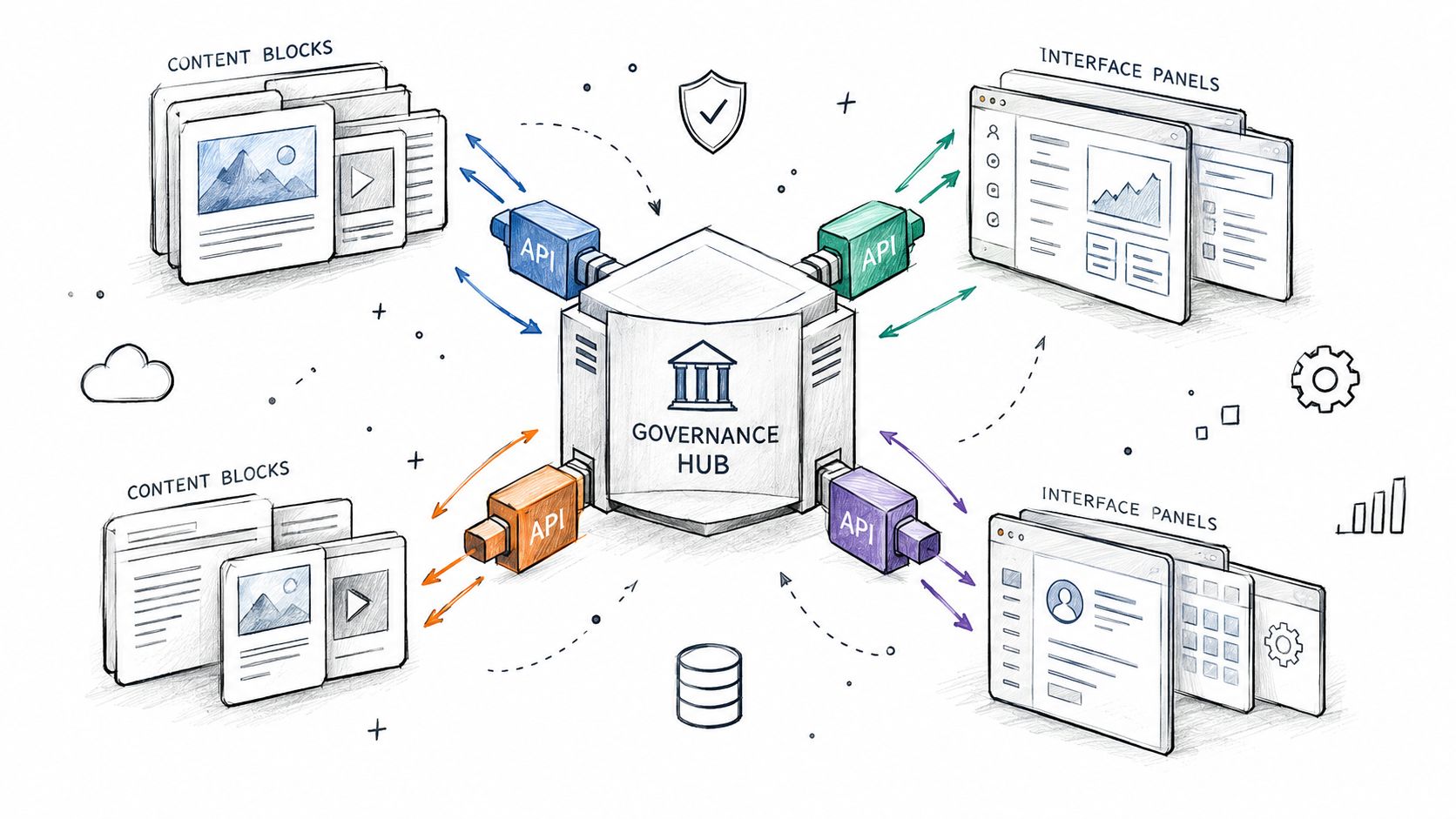
That sounds elegant until the first production launch. Then the actual work appears in integration contracts, not in feature lists, because modularity shifts complexity from the vendor into schemas, versioning, orchestration, retries, timeout handling, and ownership boundaries.
Practical rule: if a capability can change independently, it also needs a clear service boundary, a documented SLA, and a rollback path.
That is why composable DXP should be treated as a managed ecosystem, not a shopping list. The stack needs shared rules for traffic, monitoring, security, caching, and lifecycle management, otherwise “flexibility” turns into distributed fragility.
For readers mapping DXP basics to this model, the clearest companion is WebinOne's overview of what a digital experience platform is, because composable only makes sense once the system-level view is clear.
Monolithic vs Composable Architecture Patterns
Monolithic and composable DXPs solve different operational problems. The first optimizes for one tightly integrated suite, the second optimizes for change across multiple bounded services.
The trade-off is speed of change versus coordination load
In a monolithic pattern, the CMS, commerce, and related functions tend to move together, which can simplify early setup but makes upgrades and feature changes heavier later. In a composable pattern, each layer can be tuned on its own, which helps when one client site needs to move faster than the rest of the estate.
That difference matters most in maintenance. A monolithic stack often concentrates upgrades into fewer, larger events, while a composable stack spreads the work into smaller contracts that still need governance. The architectural promise is better control over change, but only if the owner runs that control plane.
| Dimension | Monolithic DXP | Composable DXP |
|---|---|---|
| Upgrade path | Tends to move as a larger suite with more coupling | Capabilities upgrade independently |
| Scaling approach | Usually broader platform scaling | Scale the layer that needs it |
| Maintenance profile | Fewer contracts, more whole-system dependency | More contracts, more selective change |
| Migration style | Often force a larger cutover | Supports phased modernization |
The cleanest way to judge the difference is by maintenance load, not branding. If a team can't absorb the governance overhead, a composable stack becomes an operational tax. If a team needs independent release cycles across multiple properties, the monolithic model starts to feel rigid.
For a useful lens on implementation thinking, practical React patterns and trade-offs are worth reading because they mirror the same issue, component freedom only works when boundaries are disciplined.
How API-First and Headless Change Delivery
API-first delivery changes how teams build, publish, and extend digital experiences. The important shift is that front-end work stops being welded to the content engine, so agencies can move presentation without reopening the back end every time a page pattern changes.
Why the stack becomes channel-agnostic
A headless setup keeps structured content in one place and sends it to websites, apps, kiosks, and other channels through APIs. That means the same content model can serve multiple interfaces without redesigning the storage layer for each one, which is exactly why composable delivery is attractive in multi-site work.
Microservices and cloud-native deployment add another layer of flexibility. Search, personalization, or commerce can be scaled or replaced on their own, which helps when one client campaign needs a new experience layer and the rest of the estate doesn't.
A delivery team still has to make hard choices, though. The useful discipline is to define the capability boundary first, then attach the rules that make it safe to operate.
- Schema discipline: Define content contracts early so front ends aren't guessing at field behavior.
- Version control: Keep API versions explicit so one release doesn't break a live channel.
- Operational policy: Set retry, timeout, and idempotency rules before traffic reaches production.
- Access control: Separate identity and authorization boundaries from presentation work.
- Observability: Track latency, error rate, and deployment impact from the first migration wave.
That is the difference between headless as a buzzword and headless as a delivery system. Agencies that treat the API layer as a production contract, not a technical afterthought, ship faster because they spend less time untangling dependencies later.
For a deeper look at this operating model, WebinOne's API-first architecture guide is the right companion read. For teams comparing delivery setups, this guide to fast static hosting is useful context, especially when front-end speed and cache behavior matter.
Why Agencies and Enterprises Choose Composable
Composable wins when the business needs more than one team can safely hold in a single patched stack. That's why agencies, SIs, and enterprise web teams keep coming back to it, not because it looks modern, but because it lets them separate client-facing change from core operations.

The business case is operational freedom
For agencies, composable architecture makes white-label delivery and multi-site governance much easier to standardize. One console, one operating model, and one SLA matter more than a pile of disconnected tools when the portfolio grows and client expectations rise.
For enterprises, the appeal is different but related. A composable stack can reduce key-person risk because fewer essential details live in one person's head, and the same governed structure can support multiple brands, regions, or business units without rebuilding every site from scratch.
Cloud infrastructure also matters here. AWS explicitly treats resilience as a shared responsibility, with customers responsible for the resilience of their own data and workloads, including recovery, backups, versioning, replication, and high availability, while AWS is responsible for the underlying infrastructure and facilities (AWS resilience shared responsibility model). That's important because hosting alone does not solve recovery design.
The platform choice does not settle uptime mechanics. The delivery team still owns traffic routing, failover behavior, and recovery testing.
AWS also states that applications should be designed, tested, and deployed for the availability and resilience they need, including use of multiple locations such as Availability Zones and self-healing patterns (AWS operational resilience guidance). For agencies and SIs, that turns composable from a design preference into an operational contract.
The platform side of the argument is straightforward. A managed DXP can centralize governance, reduce toolchain sprawl, and make compliance and recovery ownership explicit instead of implied. That is the actual value, not architectural elegance.
Real-World Migration and Deployment Patterns
Composable migration works best when it is incremental. The stable system of record stays in place while selected capabilities move into independently deployable services, which lets the team preserve existing investment instead of forcing a cutover that nobody can safely test under pressure.
Hybrid migration beats wholesale replacement
The strongest pattern is staged replacement. One migration wave might expose content through APIs first, while another introduces new search or personalization logic later, and the old and new layers run in parallel long enough to validate behavior.
A recent technical review noted that hybrid composable architectures can preserve roughly 70–85% of existing investment while capturing 45–65% of MACH-style modularity benefits (technical review). It also reported that edge-deployed composable setups achieved 60–80% faster real-time experiences and 45–65% lower latency in the referenced cases, while cautioning that the results depend on workload, cacheability, geography, and measurement method.
That's exactly why baseline metrics matter before the first cutover.
- p95 and p99 latency: Measure the slow tail, not only the average.
- Cache-hit ratio: Know how often the edge is doing useful work.
- Origin load: Watch what the back end absorbs during spikes.
- Error rate: Catch integration failures before they become visible.
- Deployment frequency: Track whether release flow actually improves.
- Change-failure rate: Measure how often a change needs rollback or hotfixing.
A responsible migration plan uses those measures to prove each wave is safer than the last. That also helps agencies explain risk to clients without hiding behind vague promises of modernization.
For teams planning a multi-site move, WebinOne's cross-platform migration guidance is a practical companion, because the execution problem is usually less about theory and more about sequencing, validation, and rollback control.
When Composable Makes Sense and When It Does Not
Composable is not the right answer for every team. If the business doesn't need multi-site governance, headless delivery, or frequent capability swaps, a simpler platform can be the rational choice.
The hidden cost is connective tissue
The true cost of composable is not only subscription spend. It includes integration maintenance, monitoring, security review, vendor renewals, specialist skills, and the burden of keeping release calendars aligned across multiple services.
That's where many teams overestimate the upside. If the operating model is weak, composability creates more coordination work than value. A unified platform can be better when the site is small, the team is lean, or the business wants fewer moving parts to secure and support.
A composable stack earns its keep when the portfolio is large enough to justify governance. It also works when front-end delivery, content operations, and commerce or search need to move at different speeds without blocking each other.
Decision filter: if the team can't name who owns each boundary, composable will cost more to run than it saves.
There's also a procurement lesson here. The best business case compares total operating cost, not just licensing. Assembly cost, support overhead, and ongoing change management are part of the stack, whether they appear in a budget line or not.
Used well, composable is a disciplined operating model. Used casually, it becomes a pile of integrations with a nicer name.
Next Steps for Partnering and Migration
Agencies that want margin-rich delivery and SIs that want to reduce maintenance drag should treat composable as a delivery model, not a product category. The next move is a working conversation about partnership, migration scope, and how the platform fits the client estate.
For agencies, that conversation should start with the reseller path at WebinOne's reseller program. For SIs, AWS partners, and enterprise teams, the right next step is a direct discussion through WebinOne's enterprise page about migration, managed operations, and AWS-aligned delivery.
WebinOne gives agencies and SIs a managed path off patching, plugin sprawl, and fragile handoffs, without forcing a rebuild every time a client grows. If composable DXP needs to work in production, the conversation should start at WebinOne with the team that handles partnership and migration work every day.