Api First Architecture
The most popular advice about API-first architecture is too narrow. Teams often treat it as a developer preference, a choice between designing an API before or after building a user interface. That framing misses the operational issue. For agencies and enterprise teams managing multiple brands, an API-first model is a governance system for integrations, automation, security, and change.
The distinction matters during re-platforming. A legacy estate can appear stable while its real behavior depends on plugins, undocumented integrations, inherited scripts, and one or two engineers who know which parts must never be touched. A contract-driven platform exposes those dependencies, gives teams a common interface, and creates a safer route to new channels, AI agents, and managed operations.
Postman's 2024 State of the API reporting found that 74% of respondents used an API-first approach in 2024, up from 66% in 2023. It also found that 63% of developers could produce an API within one week, compared with 47% the year before, while organizations were already working with 26 to 50 APIs per application on average. API-first has moved beyond architectural theory. It has become a practical operating model for software delivery.
Table of Contents
- The Hidden Cost of Legacy Web Stacks
- Contract-First Design and Parallel Execution
- Core Patterns for Headless DXPs and Multi-Site Governance
- Escaping Plugin Sprawl During Re-Platforming
- Automated Governance for AI Agents and Event-Driven Workflows
- Evaluating WebinOne for API-First Delivery
- Planning Your Migration and Next Steps
The Hidden Cost of Legacy Web Stacks
API-first architecture isn't merely a preference for teams that like clean specifications. It addresses a governance failure that appears repeatedly in older web estates: nobody has a complete, reliable account of how the platform works.
A typical legacy stack may contain a core CMS, custom theme logic, plugins for forms and search, separate SEO tooling, ecommerce extensions, analytics scripts, identity integrations, and agency-built middleware. Each component may work in isolation. The risk appears at the boundaries, where an update, ownership change, or new brand requirement exposes assumptions that were never documented.
The most serious dependency isn't always technical. It's organizational. When knowledge of the stack lives with one or two engineers, a resignation or reassignment can leave the business without the context needed to diagnose failures safely. Teams then protect the existing arrangement because changing it feels more dangerous than continuing to patch it.
Practical rule: If a platform's behavior can't be explained through documented interfaces, ownership records, and repeatable deployment controls, it isn't governed well enough for a growing portfolio.
Plugin ecosystems turn change into risk
Plugin sprawl creates a chain of responsibility that no single team fully controls. A CMS vendor may support the core product, an agency may maintain custom code, a plugin vendor may control an integration, and an internal team may own data or compliance requirements. When something breaks, the organization spends time determining which party owns the failure before it can begin fixing it.
That structure also encourages agency lock-in. The agency that originally assembled the stack becomes the only group with enough historical knowledge to maintain it. This isn't always intentional, but the result is the same: migration becomes harder because the business lacks a clean map of its own interfaces and data flows.
A monolithic CMS can still be appropriate for a contained site with modest integration needs. It becomes a poor foundation when several brands, channels, partner systems, or business units need to share capabilities without sharing deployment risk. A decoupled design separates the experience layer from managed services, allowing each consumer to use a stable interface rather than reaching into implementation details.
Governance must survive team changes
Enterprise integration research describes API-first architecture as a shift toward federated, standards-based management, supported by versioning, documentation, and lifecycle policies (enterprise integration research). That shift is more important than the label itself. A central team can define standards, while product and brand teams can deliver within those boundaries.
The practical test is simple. Can a new team understand which endpoint to use, what data it returns, how access is granted, and what happens when the contract changes? If the answer depends on a private conversation with the original developer, the estate is carrying avoidable operational risk.
Contract-First Design and Parallel Execution
The defining move in API-first delivery is changing the order of work. Instead of implementing a backend and exposing whatever interface emerges, teams define the API contract as the primary design artifact. The contract specifies resources, operations, fields, authentication expectations, error behavior, and compatibility rules before implementation is complete.
That sequence gives frontend, backend, content, commerce, and integration teams a shared boundary. Once the contract is reviewed and accepted, teams can build against it in parallel. Frontend developers can use mocks, backend developers can implement services, and testers can validate expected responses without waiting for the entire system to exist.
The REST API endpoint model becomes a delivery agreement rather than a technical afterthought. That distinction reduces late-stage rework during migrations because interface problems surface while the teams can still change the design cheaply.
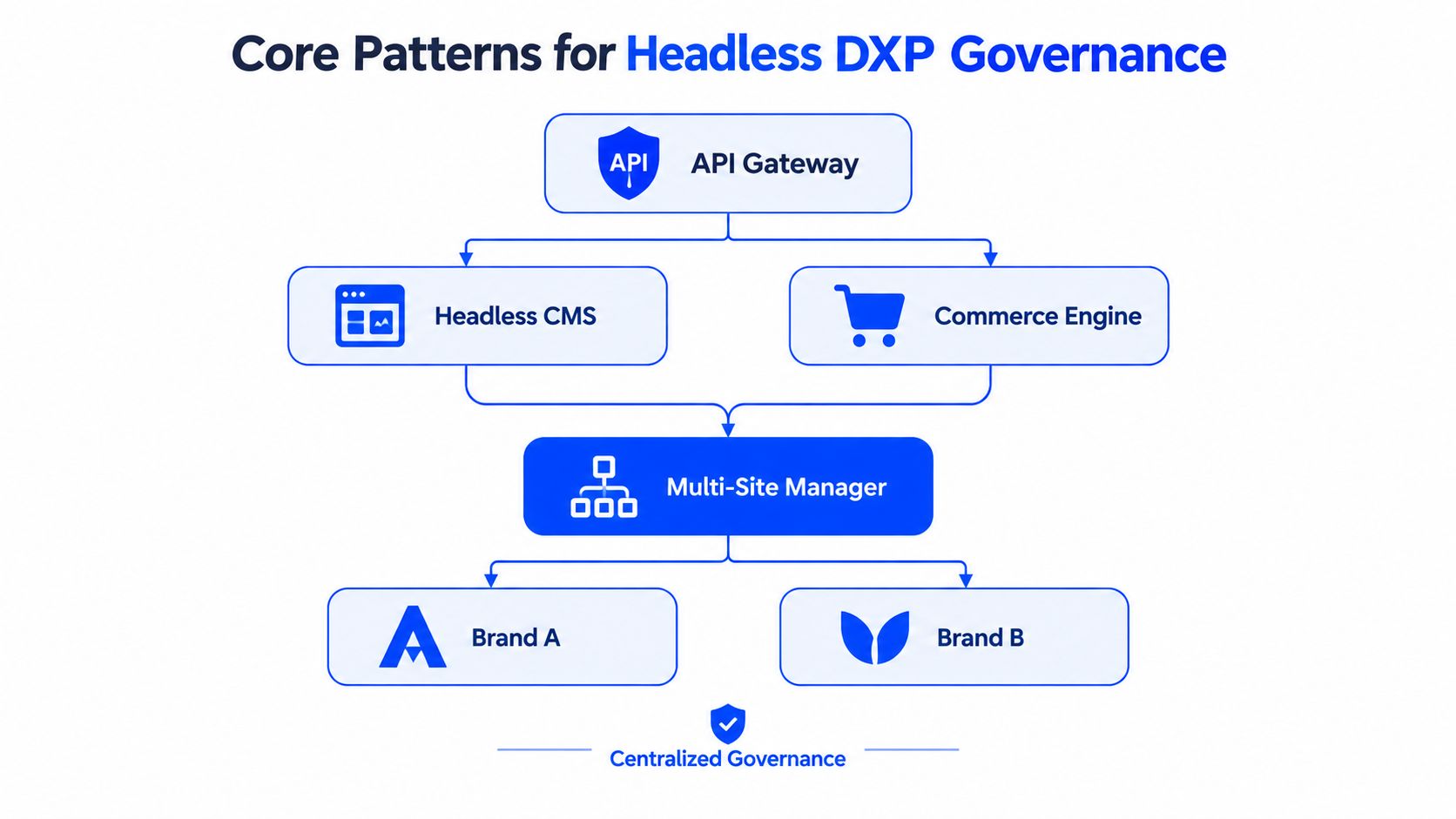
The contract is the coordination mechanism
A migration usually involves more than moving content. Teams must reconcile legacy URLs, content models, customer data, ecommerce behavior, search requirements, identity flows, and external systems. Without a contract, each workstream makes local decisions, and those decisions collide during integration.
A reviewed contract provides a place to resolve those collisions early:
- Resource ownership: Teams define which service owns content, products, customers, or orders.
- Response behavior: Consumers know which fields are available and how failures are represented.
- Compatibility rules: Teams distinguish safe additions from breaking changes.
- Security expectations: Authentication and authorization requirements are part of the design.
- Testability: Developers can test integrations before every dependent service is production-ready.
This doesn't remove architectural trade-offs. Contract design takes time, and premature certainty can constrain a model that the business hasn't understood. The answer isn't to skip the contract. It's to keep the first version focused on stable business capabilities and revise it through explicit governance.
Federated delivery needs central standards
Centralized API ownership creates a bottleneck if every endpoint requires approval from one architecture group. Federated delivery has the opposite risk, inconsistent naming, authentication, errors, and lifecycle policies. The workable model combines local ownership with shared standards.
Enterprise API guidance recommends automating naming rules, authentication requirements, error formats, security checks, documentation completeness, and versioning through tooling and delivery pipelines (automated API governance guidance). High-risk public interfaces can receive stricter review, while low-risk internal services move through lighter controls.
That approach gives agencies and system integrators a repeatable migration process. Each project can adapt the domain model, but the delivery mechanics remain consistent. Predictability improves because integration points are stabilized before every team has committed to implementation details.
Core Patterns for Headless DXPs and Multi-Site Governance
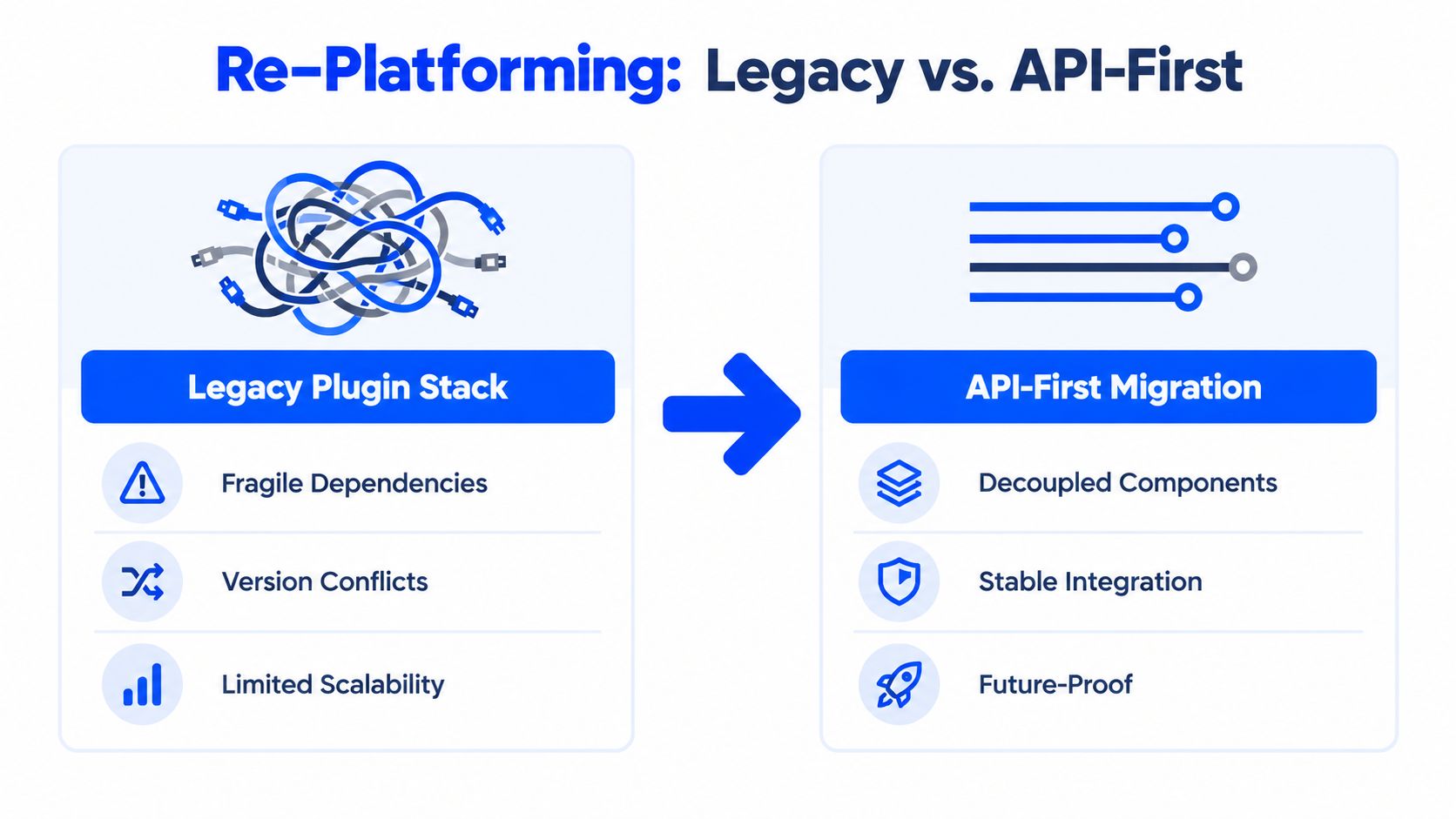
A headless DXP needs more than a CMS with an API attached. It needs a structure that controls how content, commerce, identity, and brand experiences interact across channels. The design should make common behavior reusable while preserving enough independence for each site or business unit to move at an appropriate pace.
The headless architecture model starts with a clear separation between management and presentation. Editors manage structured content in the platform, while websites, applications, portals, and other consumers retrieve that content through governed interfaces. That separation supports redesigns and channel expansion without forcing a full rewrite of the underlying business services.
Start with the gateway and policy boundary
An API gateway is the controlled entry point for consumers. It can route requests, enforce authentication, apply rate limits, validate payloads, and provide a consistent location for observability. It shouldn't become a second monolith that contains business logic, but it should handle cross-cutting policy consistently.
For a multi-brand portfolio, the gateway helps distinguish shared platform rules from brand-specific configuration. A public partner integration may need stronger review and tighter limits than an internal editorial application. That difference should be expressed through policy, not through improvised code in each site.
Treat APIs as products
Every important API needs an owner, a consumer profile, documentation, a support expectation, and a lifecycle plan. Teams should know whether an interface is internal, partner-facing, or public, and they should understand what constitutes a breaking change.
Versioning should be deliberate. A new field may be compatible, while changing a field's meaning or removing it may break a mobile application, portal, or partner workflow. Deprecation notices, migration guidance, and an agreed retirement process keep old consumers from becoming permanent obstacles.
Build reusable service boundaries
The strongest headless designs expose capabilities that multiple consumers can use. Content delivery, product data, search, customer identity, and order operations should have boundaries that reflect business ownership rather than the page structure of one website.
That creates a cleaner path for adding a client portal or a new storefront. The new consumer uses existing services where the business rules already exist, while presentation logic remains independent. API-first sources emphasize this reuse across projects and its fit with modular architectures (API-first approach and reusable services).
A useful governance checklist includes:
- Ownership: Name the team responsible for the contract and its runtime behavior.
- Compatibility: Document which changes are additive and which require a new version.
- Access: Apply least-privilege permissions by consumer and business capability.
- Observability: Record meaningful request, error, and lifecycle events.
- Documentation: Keep examples and schemas aligned with deployed behavior.
Without those controls, headless relocates complexity. With them, it creates a managed interface layer that can support multiple brands without duplicating core business logic.
Escaping Plugin Sprawl During Re-Platforming
Migration exposes architectural weakness faster than normal operations. A site can survive years of incremental changes because teams avoid touching the fragile areas. Re-platforming removes that protection. Every dependency must be identified, mapped to a new capability, retired, or deliberately rebuilt.
That process reveals the difference between a plugin-based stack and an API-first platform. The plugin stack distributes behavior across extensions that may have different release schedules and security models. The API-first model centralizes stable capabilities behind documented interfaces, allowing consumers to change without rebuilding the underlying service.
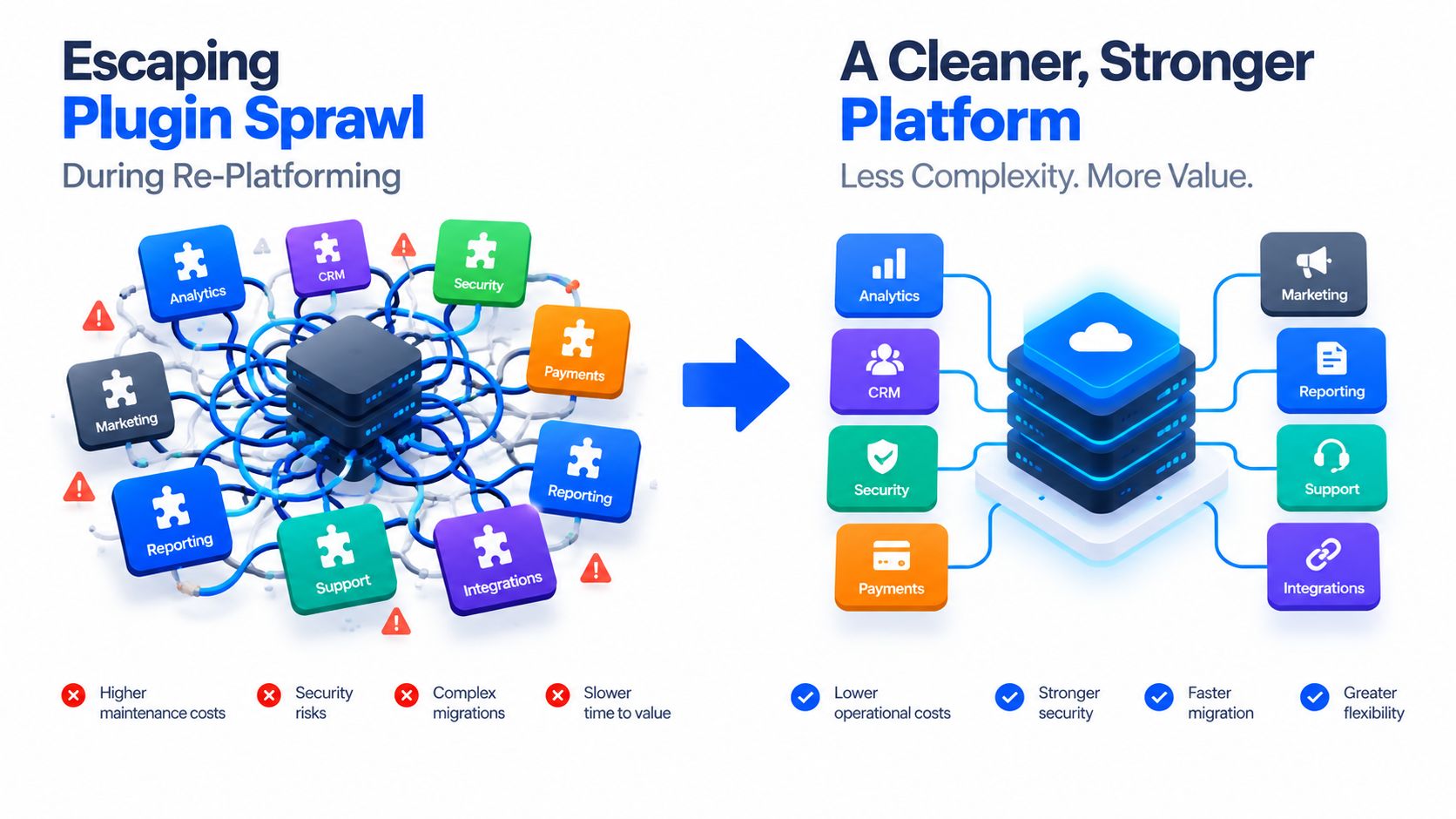
Measure brittleness by tracing dependencies
A useful migration inventory doesn't start with page counts. It starts with behavior. Teams should trace how a form captures data, where that data goes, which system sends notifications, how consent is stored, and which site components depend on the result.
The same exercise applies to search, member areas, product catalogs, payments, analytics, and redirects. For each capability, the migration team should record:
- Business owner: Who decides the behavior?
- Technical owner: Who maintains the integration?
- Data path: Where does information enter, transform, and persist?
- Failure mode: What does the visitor or operator experience when it fails?
- Replacement decision: Should the capability be native, integrated, or retired?
This inventory turns “plugin sprawl” into a set of decisions. It also prevents a common migration mistake, reproducing every historical workaround in the new platform.
Native capabilities reduce coordination overhead
Native extensions aren't automatically superior. They still require testing, documentation, and lifecycle discipline. Their advantage is operational consistency. A managed platform can maintain extensions within a common release and security model instead of asking the customer or agency to coordinate several unrelated vendors.
The reuse benefit is concrete. API-first design lets teams start from shared integration components rather than rebuilding equivalent logic for each new channel or client. That lowers repeated custom work and gives agencies a more consistent delivery baseline, as described in the reuse benefits of API-first design.
Plan the cutover around continuity
A safe re-platforming project separates build validation from production transition. Teams should migrate representative content and integrations first, test redirects and forms, compare critical behavior, and rehearse the operational handoff. The final cutover should be controlled, observable, and reversible.
Zero downtime isn't achieved by a slogan. It depends on staged migration, synchronized data handling, tested routing, and a clear rollback decision. WebinOne has successfully migrated over 3,000 sites, including complex multi-site environments, with predictable timelines and zero downtime. That proof point matters because migration capability is part of the platform decision, not a service detail to evaluate after procurement.
Automated Governance for AI Agents and Event-Driven Workflows
AI agents change the consumer profile of an API. A human may inspect a screen, notice an unexpected result, and stop. An agent or event-driven workflow can call services rapidly, chain actions, and propagate a bad assumption across multiple systems before an operator sees the issue.
That makes machine-readable contracts and policy enforcement prerequisites for safe automation. Traditional REST guidance remains useful, but it doesn't fully answer how non-human consumers should discover capabilities, interpret permissions, handle asynchronous events, or remain compatible as services evolve.
Current coverage of API trends increasingly connects API-first delivery with AI-powered APIs, event-driven design, asynchronous APIs, and API commercialization (2026 API trend coverage). The important shift isn't that every organization needs to expose more endpoints. It's that every automated action needs a controlled, observable boundary.
Design for machine consumers
An agent needs more than a URL and a successful response. It needs explicit schemas, meaningful field descriptions, predictable errors, clear authorization scope, and lifecycle information. Ambiguous contracts create unsafe automation because the consumer may infer intent from incomplete data.
A governed platform should define:
- Capabilities: What the agent can read, create, update, or trigger.
- Scope: Which site, brand, customer segment, or environment it can access.
- Approval: Which actions require review before production execution.
- Auditability: Who or what initiated the action and what changed.
- Reversibility: Whether the operation can be undone safely.
These controls are especially important for content updates, customer records, commerce operations, and integrations that cross organizational boundaries.
Automate the rules, not just the work
Manual API review doesn't scale across a large portfolio. Pipelines should check naming conventions, authentication settings, error formats, documentation, versioning, and security requirements before an interface is published. Automated governance keeps low-risk internal delivery moving while directing deeper scrutiny toward interfaces that expose sensitive data or trigger consequential actions.
Event-driven workflows add another requirement, delivery semantics. Consumers need to understand whether an event may be repeated, delayed, reordered, or rejected. The contract must describe those conditions clearly enough for an agent to respond without guessing.
The result is a broader definition of API-first. It's no longer only a developer workflow. It's a platform governance model in which contracts, authorization, observability, and lifecycle controls make automation safe enough to operate at scale.
Evaluating WebinOne for API-First Delivery
Agencies and enterprise teams escaping fragmented stacks need to evaluate more than API availability. They need to ask whether the platform can consolidate the operational responsibilities around content, commerce, CRM, email, multi-site management, hosting, and support without forcing a new set of disconnected tools.
WebinOne provides a managed DXP with 300+ APIs, webhooks, and headless CMS capabilities for delivering content and commerce to different front ends. Its native extensions are maintained in-house, which removes the need to coordinate a separate plugin ecosystem for core platform behavior. The platform also offers ecommerce with zero transaction fees, with pricing from $10 per month, as described in its platform information.

Infrastructure is part of the architecture
An API-first program still fails if the runtime is unreliable or difficult to operate. WebinOne runs on AWS across six global data centers and has recorded 99.99% uptime over the last 12 months, with dedicated server options and selectable data residency. WebinOne is also an AWS Partner, is live on AWS Marketplace, has an AWS Foundational Technical Review approved, and has completed an AWS Well-Architected Review.
Those facts don't eliminate the need for an organization's own security, integration, and continuity review. They do provide concrete areas for technical buyers to examine instead of treating hosting as an opaque add-on. The platform has also served US and Australian government clients, a relevant consideration for teams assessing operational requirements across public-sector and regulated environments.
AgentOne keeps automation inside operations
AgentOne is WebinOne's native multi-agent AI system and the basis of its Managed Vibe Coding approach. It isn't a generate-and-abandon tool. It can operate sites inside the managed platform, handling development, content updates, optimizations, and automations within scoped permissions and audit logs.
That operating model matters for API-first delivery because the agent works against governed platform capabilities rather than producing isolated output that another team must secure and maintain. Changes remain visible, reviewable, and reversible before production use, while generated code can be extended by the customer's own team.
For agencies, the relevant comparison isn't WebinOne versus WordPress, Webflow, Wix, WP Engine, or an enterprise DXP such as Adobe Experience Manager, Sitecore, Optimizely, Liferay, Contentful, Storyblok, Agility CMS, or Drupal. The comparison is between a managed operating model and the coordination burden of assembling separate systems for every client or brand. Further platform context is available in what a DXP provides, but the buying question remains practical: can the platform make ownership clearer while preserving the integration flexibility the business needs?
Planning Your Migration and Next Steps
A serious API-first migration begins with an estate assessment, not a rebuild. Technical leaders should map the current stack's capabilities, dependencies, data owners, authentication paths, editorial workflows, commerce behavior, and failure points. The output should distinguish business-critical services from historical workarounds that no longer deserve to be carried forward.
A staged pathway usually works better than a single replacement project:
- Inventory the estate: Record sites, brands, integrations, content types, custom code, and operational owners.
- Define contracts: Establish stable interfaces for content, commerce, identity, search, forms, and external systems.
- Migrate a representative slice: Test the model against the difficult content and integration cases, not only the easy pages.
- Validate continuously: Check functionality, redirects, permissions, performance behavior, editorial workflows, and rollback procedures.
- Cut over deliberately: Use rehearsed routing and data procedures, with clear ownership during the transition.
- Operate under governance: Keep documentation, versioning, security policies, observability, and agent permissions current.
WebinOne's TeamOne supports complex site rescue, bulk portfolio migration, multi-site governance, headless delivery, and managed operations. The practical outcome for an agency or enterprise team is a documented, governed foundation that reduces dependence on inherited plugin knowledge while keeping future channels connected to reusable services.
Teams evaluating a migration should bring a real estate map, not a generic requirements list. Include the integrations that routinely fail, the sites no one wants to touch, the business owners who approve changes, and the platform costs created by coordination. That information lets a technical review identify where an API-first model can remove risk instead of merely relocating it.
WebinOne provides a managed, API-first DXP for agencies and enterprises consolidating CMS, commerce, CRM, multi-site operations, and AI-assisted delivery. Visit WebinOne to review the platform, discuss a migration, or speak with the team about replacing a fragile legacy stack with governed digital operations.