CMS with CRM: When One Platform Wins
The popular advice is to pick a CMS, pick a CRM, then buy a connector and call the result integrated. That's backwards. A connector can move fields between two products and still leave two customer records, two permission models, and no agreed answer when the records disagree. The buying decision for a CMS with CRM turns on field ownership, consent, audit, and exit, not on whether a form can post somewhere else.
Table of Contents
- What a CMS with CRM Shares
- One Platform Against a Split Stack
- Questions That Expose a Brittle Pipeline
- Consolidation Versus Concentration Risk
- Agency, Enterprise, and SI Operating Models
- How to Migrate Without a Second Record
- Book the Partnership or Reseller Conversation
What a CMS with CRM Shares
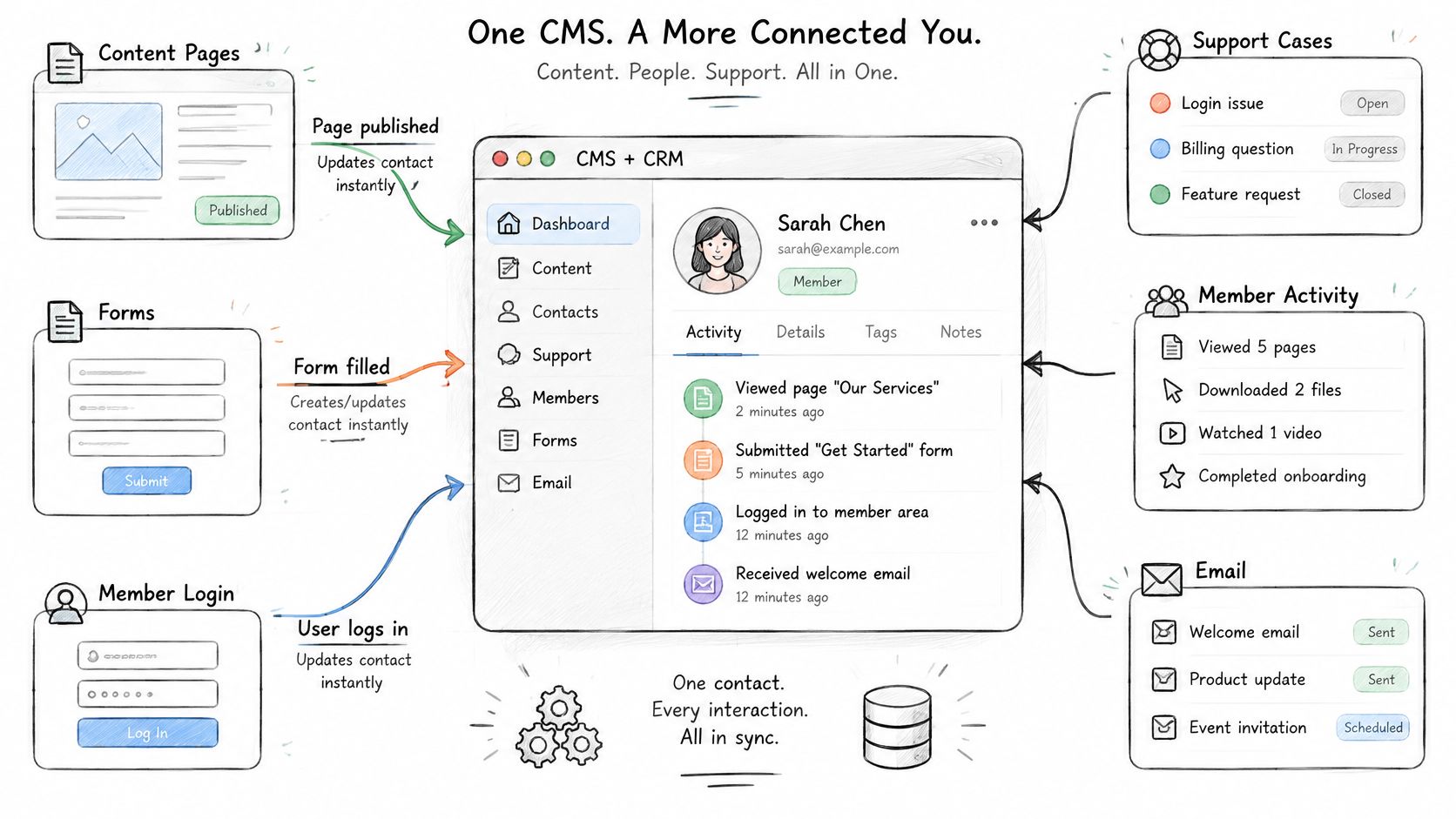
WebinOne is a CMS with CRM in one system, so content, contacts, cases, member activity, forms, and email write to the same contact record without waiting on a sync job. That shared record is the product. Everything else is plumbing.
Say a prospect downloads a guide, returns a week later, logs into a member area, then opens a support case. In a split stack, each step can land in a different place. The download sits in a form tool, the login in a member plugin, the case in a help desk, and the contact in a sales database that only updates if every post succeeds. Staff then join the story by hand.
What stays joined
- Publishing behavior: page views and gated content attach to the contact after a permitted identifier.
- Submissions: form fields write directly to contact, case, and custom fields.
- Member activity: logins and restricted content use the same permissions as the CRM record.
- Email consent: list membership and segmentation read from the same contact, not a copied list.
Fragmentation isn't a minor reporting annoyance. The Stibo Systems white paper on the cost of fragmented customer data reports a 2025 study of organizational leaders where 58% of organizations use CRM systems to manage customer data while only 34% use master data management systems to govern it. The same study found 76% retain off-system spreadsheets or shadow databases, 69% of leaders said they do not fully trust their customer data, and 47% reported having to correct reports or forecasts based on inaccurate customer data at least weekly. Incomplete data, cited by 48%, and inconsistent data, cited by 44%, explain the weekly cleanup.
Where an external sales workflow must stay in place, teams can explore Salesforce outreach integration as context for how outreach activity should return to the record instead of living apart. The distinction matters for buyers comparing a native record with the broader category described in this guide to digital experience platforms. The question isn't whether data can move. It's whether one governed record owns the page, the person, and the follow up.
One Platform Against a Split Stack
A point-to-point connector can fail when a required field changes. The form still collects submissions, but the CRM may receive incomplete records or create duplicates on retry. A shared interface does not prevent that failure by itself. The decision depends on who owns the record, how consent and history are handled, and whether the data can leave in a usable form.
Who owns the customer record
| Arrangement | Record owner | Typical failure | Who carries the load | Exit path |
|---|---|---|---|---|
| Native CMS with CRM on WebinOne | One platform for contacts, cases, members and content events | Schema drift inside one model | Vendor runs the stack; partner keeps the client | Export, audit log, API and webhooks |
| Point-to-point form connector | CRM only after the form posts | Field mismatch and duplicate contacts on retry | Agency or SI maintains the mapping | Two exports and a lost join |
| Middleware or iPaaS | Split; a third product copies fields | Stale pipeline and an unclear system of record | Extra product and an extra release calendar | Middleware config plus two exports |
| Separate CMS and CRM, no shared contract | Whichever team edited last | Weekly report fixes and shadow spreadsheets | Two admins, two SLAs, two patch cycles | Two exports and no joined history |
Read the table by failure mode, not feature count. A connector may seem inexpensive until a field change breaks the mapping and submissions stop reaching the CRM. Middleware adds flexibility, but also another release calendar, admin console and queue to monitor when messages fail. Separate systems keep their own boundaries, yet staff may have to rebuild the customer history in spreadsheets.
WebinOne brings CMS, ecommerce, CRM, forms and hosting into one managed platform, with no plugins required. That reduces the number of handoffs, but it does not establish trustworthy data automatically. The buyer still needs to know which fields are authoritative, how consent changes affect records, and what evidence an audit trail preserves.
A native CMS with CRM is a control choice when field ownership, consent handling, replay, and service responsibility are demonstrably clear.
Treat the native arrangement as a platform decision, not a shortcut around governance. Before choosing it, ask for the export format, audit trail and permission model. Check that contact, case, member and content-event records can be understood outside the admin interface, and that the path for retrieving them is clear. If those answers are vague, one login has only concealed the split rather than resolving it.
Questions That Expose a Brittle Pipeline
A shared admin does not guarantee a trustworthy customer record. Before choosing a CMS with CRM, ask who owns each field, how consent changes propagate, whether failures can be audited, and what happens when a person withdraws consent. Put the answers in writing.
Integration health checks
| Question | Pass | Fail |
|---|---|---|
| Who owns each field, including consent? | One named owner per field | Both systems write the same field |
| What happens when a preference changes? | One update reaches content, email, and cases | A second list retains the old opt-in |
| Can a failed sync be audited and reversed? | Staff can inspect, replay, and roll back changes | A failure cannot be traced or reversed |
| How does a visit become a known contact? | A permitted link follows a form submission or login | Behavior is merged without a withdrawal path |
| Who handles a shared outage? | One SLA covers the managed service | Responsibility falls between vendors |
Field ownership is the first check. A form's “Organization” field and a CRM's “Company” attribute may sound equivalent, yet reports can group one account under two names. Assign one owner to each field, including consent status, company name, email, and lifecycle stage, so older values do not overwrite newer ones.
Preference changes expose whether those rules hold in practice. When a customer updates an opt-in, content access, email lists, and the case record should reflect the change. Guidance on optimizing website forms for lead generation can help improve capture quality, while a well-defined website contact form makes required fields, consent wording, and destination fields explicit before launch.
Failure handling needs a clear test. A retried event must update the intended record rather than create another one. Staff should be able to inspect, replay, or reverse a failed change before it reaches reporting. Set a separate rule for anonymous visits: specify which permitted identifier can connect behavior to a contact, and where personalization stops after consent is withdrawn.
A unified screen can still conceal inconsistent schemas, duplicate records, unclear permissions, or stale behavioral data. Those are record-quality failures, not interface problems.
Test one real journey before adding more connections. For example, trace a content download that should create one contact and one sales follow-up. Use identity match rate, duplicate rate, required field completeness, and failed event rate as the pass measures. A green connector status cannot answer them.
Consolidation Versus Concentration Risk
A shared platform changes the shape of operational risk. Publishing, lead capture, member access, and cases may all depend on one service, so a single outage can interrupt them together. Consolidation is easier to manage when buyers can verify the recovery path, data export, audit access, and API availability before committing.
The 2025 State of Your Stack survey summary reports CRM adoption at 86.4% and CMS adoption at 73.4%. It also found 58.9% of respondents said the number of applications in their martech stack had increased during the prior year. Those figures frame the trade-off: teams are adding tools while seeking fewer systems to operate. Compare the operating burden, not just license fees.
Count the operating burden
- Administration: Training, roles, permissions, and release coordination across the products retained.
- Recovery duty: Who owns backups, restore testing, and incident communication outside business hours.
- Data residency: Where records are stored and whether a custom arrangement can be agreed.
- Outage scope: Which services share a failure domain, including publishing, lead capture, member access, and cases.
- Exit portability: Whether exports and API access let another team rebuild joined history.
Key-person risk changes with the architecture. In a split stack, a developer may hold the knowledge of mappings and scheduled jobs. In a consolidated stack, more dependency rests with the platform provider. Require documentation, support, and usable exports so that operations do not hinge on one person's memory or a provider's goodwill.
Availability targets should reflect each workload. The AWS multi Region architecture guidance identifies 99.99% availability as a common high-resilience target, equivalent to approximately 52.6 minutes of downtime per year. It recommends separating critical from noncritical workloads and agreeing on recovery time and recovery point objectives. Set tighter objectives for publishing, checkout, and lead capture than for internal administration.
Infrastructure design matters too. The Amazon EC2 service level agreement states that EC2 can qualify for a 99.99% Region-Level SLA when instances run concurrently across at least two Availability Zones in the same Region. WebinOne reports 99.99% uptime over the last 12 months and a 99.95% availability commitment in its published SLA, with hosting across 6 AWS regions. Qualifying systems integrators can, by agreement, run a licensed deployment in their own or a customer's AWS account, including AWS GovCloud. Before treating consolidation as control, document where servers, databases, load balancers, backups, and failover paths run.
Agency, Enterprise, and SI Operating Models
A shared CMS and CRM interface does not, by itself, create a trustworthy customer record. Agencies, enterprises, and systems integrators need clear ownership of fields, consent rules, and a way to audit how information moves across sites and teams.
The agency operating picture
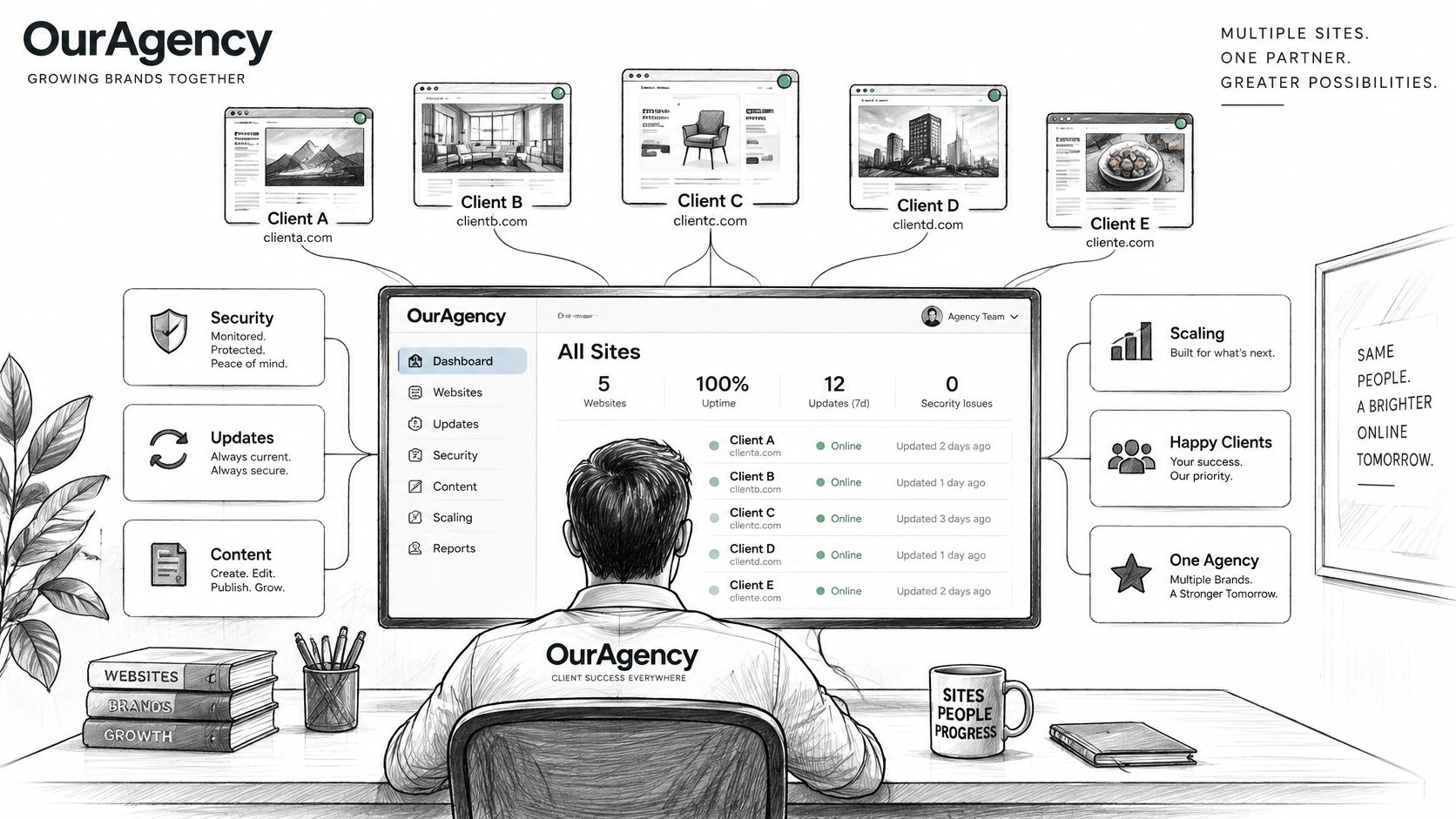
For an agency, the operating question is whether site delivery and ongoing care can be managed without turning staff time into plugin patching and incident response. WebinOne's Agency Portal manages templates, sites, development, staff, branding, and billing from one dashboard. Agencies can operate multiple client websites under their own brand and handle support tickets in the same system.
The WebinOne reseller program gives agencies a way to build and manage client sites under a white-label arrangement. Before choosing a platform, agree on who responds to a client incident, how the agency escalates it, and what support route is included. That is more concrete than relying on an unspecified community response. Native platform features also reduce dependence on separately maintained extensions.
The enterprise and SI picture
Multi-brand and government teams need to decide which systems own contact fields and how access and consent apply across the estate. A person may interact with several brands, but the shared interface is useful only if teams can trace the record's source, updates, and permitted uses. WebinOne serves US and Australian government clients, though buyers should assess their own operational and governance requirements.
For systems integrators delivering on AWS, WebinOne is an AWS Partner that has passed the AWS Foundational Technical Review, holds the AWS Qualified Software designation, and is enrolled in the AWS Software and Services Paths. It is also available on AWS Marketplace. Its headless CMS and API can serve content and commerce to another front end, while managed sites can keep client portals, member areas, and cases within the platform.
The practical measure is fewer reconciliations, with field ownership and consent still explicit. For identity-aware personalization, an anonymous visit can be linked to a CRM contact after a permitted form submission or login. Content, calls to action, or workflows can then use CRM attributes and funnel stage. Set rules for identity merges and duplicate resolution, and ensure personalization and email stop when consent is withdrawn. Without those controls, a shared record can become another uncontrolled copy of customer behavior.
How to Migrate Without a Second Record
A retried webhook must update the same contact. That depends on agreeing which system owns each field, how consent moves, and what staff will check before retiring the old record. A page can look correct while the customer data behind it remains split.
Six steps with a measure on each
Choose one journey: Start with a path such as a content download followed by sales follow-up. Name the owner of every field involved, then get agreement on that list before migration begins.
Map the fields: Align labels such as Organization and Company, and define what happens when a field is created, updated, deleted, missing, or duplicated. Required-field completeness in a test load shows whether the destination can support the journey without staff filling gaps by hand.
Move the joined data: Load contacts, cases, members, orders, and content into a test environment. Check how relationships between records behave, including whether a case or order remains attached to the right contact after the move.
Carry consent with the contact: Confirm opt-ins, opt-outs, and list membership are present, then test that withdrawn consent stops email and personalization. A sampled consent audit exposes records that appear complete but cannot be used as intended.
Rehearse rollback: Test restore, cutover timing, and failure notification against the SLA commitment. A timed rehearsal with a named incident owner shows whether the team can respond if the cutover fails.
Cut over and retire the shadow copy: Launch after the joined record matches the source, then close the spreadsheet staff used to bridge the old gap. Reconciliation sign-off confirms that the new process is operating without a parallel record.
The CMS integration services guidance covers API and event-driven data contracts, including field mapping, duplicate handling, authentication, failure notification, and idempotency. Use the MarTech Do's data migration tips to check sequencing, alongside this platform migration strategy when setting the migration scope and order.
Custom commerce work beyond the included catalog is scoped as a TeamOne project. The same steps can apply to a client site or a portfolio, but each journey needs its own agreed field owners, consent checks, rollback rehearsal, and reconciliation sign-off. Those checks show where a migration is ready to proceed and where an unresolved data rule could leave staff maintaining a second record.
Book the Partnership or Reseller Conversation
Choose the conversation that matches your operating model. Agencies can explore the reseller program, which offers white-label login and admin branding, with pricing from $10/month per site. The Agency Portal brings templates, sites, development, staff, branding, and billing into one dashboard.
Systems integrators, AWS partners, and enterprise teams can discuss partnership or migration options for multi-site estates. For qualifying systems integrators, a licensed deployment in their own or a customer's AWS account, including AWS GovCloud, is available by agreement. The discussion can also cover data residency and how the platform fits the organization's operating requirements.
Bring the decisions that determine whether a shared customer record stays trustworthy: who owns each field, how consent is recorded, how duplicate records are handled, and who responds during an outage. A shared CMS and CRM interface alone does not settle those questions. Ask how records can be audited and how data can be exported if your requirements change.
For migration work, WebinOne's Custom Development & API Integrations service covers custom JavaScript, complex Liquid, external integrations, and the server setup behind them. Custom catalog work is scoped as a TeamOne project. Ecommerce has zero transaction fees on all plans.
Agencies can review the WebinOne reseller program. Systems integrators, AWS partners, and enterprise teams considering a multi-site migration or licensed deployment can contact the team through WebinOne for enterprise.