Best CMS for Developers: The Agency and SI Guide
The popular advice about the best CMS for developers usually starts in the wrong place. API quality, framework support, and frontend freedom matter, but they describe the build phase. Agencies and systems integrators earn or lose margin during the years that follow launch, while teams patch dependencies, resolve conflicts, manage hosting, recover from failed upgrades, and govern growing site portfolios.
A developer-friendly CMS should therefore be judged by the amount of platform code a delivery team must permanently own. The strongest option isn't necessarily the system with the most extensibility. It's the one that gives developers enough control while reducing maintenance liability, vendor coordination, and repetitive site operations.
For agencies, that distinction affects whether a new client becomes a profitable strategic engagement or another support ticket. For enterprise teams and AWS systems integrators, it affects governance, recovery, compliance, and the cost of carrying legacy architecture. The comparison below frames the decision around operational responsibility rather than feature count.
| Evaluation area | Question that matters after launch |
|---|---|
| Delivery model | Who owns hosting, upgrades, security, backups, and rollback? |
| Extensibility | How much can developers customize without creating permanent custom maintenance? |
| Portfolio operations | Can teams clone, govern, update, and monitor sites consistently? |
| Content and commerce | Are core functions native, or must every capability become another integration? |
| Portability | Are APIs documented and data exportable if the operating model changes? |
| Performance and resilience | Does the platform support real-user monitoring, caching, redundancy, and recovery? |
| Commercial model | Does the platform protect agency margin as client requirements grow? |
Table of Contents
- Redefining the Developer Experience in Content Management
- Technical Criteria for Portfolio Scale and Maintainability
- Comparing Open-Source, Headless, and Managed DXP Models
- The Case for Consolidated Digital Experience Platforms
- Evaluating Infrastructure Resilience and Performance Baselines
- Matching the Right Architecture to the Delivery Scenario
- Moving from Platform Maintenance to Client Outcomes
Redefining the Developer Experience in Content Management
WebinOne defines developer experience by the work developers still own after launch, not only by the freedom available during implementation. That means evaluating patching, integrations, governance, recovery, and repeatable delivery alongside APIs and frontend control.
A highly composable stack can look elegant in a technical design document. The operational reality may be less attractive. Each frontend, preview path, search function, form workflow, personalization rule, commerce connection, and deployment process adds code that somebody must test, document, monitor, and repair. Headless architecture can be appropriate, but frontend freedom becomes developer liability when the team must recreate platform services that editors and clients still expect.

The build phase is only the beginning
The 2025 Stack Overflow Developer Survey collected more than 49,000 responses from developers in 177 countries. Among the web technologies reported, Node.js reached 48.7%, React 44.7%, Next.js 20.8%, Express 19.9%, ASP.NET Core 19.7%, Angular 18.2%, and Vue.js 17.6% of respondents, as documented in the 2025 Stack Overflow Developer Survey. Those figures show why developers assess a CMS through the surrounding application stack. They want structured content, reliable APIs, webhooks, authentication, SDKs, previews, and independent frontend delivery.
That expectation is reasonable. It still doesn't answer the harder question: who owns the consequences of that flexibility? A team that chooses an API-first architecture must account for release coordination, cache invalidation, asset delivery, observability, editorial preview, accessibility, and rollback. A delivery partner managing many client sites also needs a consistent operating model, not merely a technically impressive foundation.
Practical rule: Count every recurring task that requires a developer after launch. That list is the real developer experience.
Popularity reduces friction, not responsibility
Large ecosystems can help agencies recruit specialists, find documentation, and locate implementation support. W3Techs reports that WordPress powers approximately 40.1% of all websites and holds about 58.6% of the CMS market, while Shopify accounts for roughly 5.4% of all websites and 7.8% of CMS-based sites. The W3Techs web technology survey establishes the scale of familiar CMS platforms, but market share alone doesn't prove that a system minimizes engineering effort.
A large installed base can simplify hiring and migration planning. It can also bring extension management, legacy constraints, upgrade coordination, and a wide range of deployment patterns. The more useful definition of developer-friendly is durable familiarity combined with maintainable architecture, dependable APIs, extensibility, portability, and an operating model that matches the organization.
Technical Criteria for Portfolio Scale and Maintainability
WebinOne should be evaluated against repeatable portfolio benchmarks, not a feature checklist. Agencies and SIs need to measure how quickly a platform can launch, govern, recover, and extend multiple sites without multiplying custom maintenance.
A single site can hide operational weaknesses. A portfolio exposes them quickly. If every deployment requires a different plugin set, hosting configuration, release procedure, and backup strategy, the delivery organization absorbs the variance. The platform may still work, but the team pays for that variance through slower estimates, more cautious releases, and support work that clients rarely see.
Benchmark the work developers repeat
A practical assessment should measure the following in a controlled pilot:
- Native coverage: Record which requirements use native modules and which require extensions or custom code.
- API completeness: Test APIs for content, commerce, identity, search, automation, and site administration, not only content retrieval. WebinOne documents its approach through REST API endpoints for connected delivery.
- Environment creation: Time the process of cloning a site, applying a template, configuring permissions, and preparing a release environment.
- Rollback behavior: Test whether a failed deployment can be reversed without reconstructing data or manually restoring unrelated sites.
- Upgrade exposure: Document who applies platform updates, who tests extensions, and who carries responsibility when an update breaks a workflow.
- Governance effort: Count the administrators, approval paths, and separate consoles required to manage brands, permissions, redirects, forms, analytics, and content standards.
These measures reveal whether flexibility translates into lower engineering effort. They also expose lock-in that isn't visible in an API specification. A documented API and exportable data reduce dependence on undocumented implementation details, while native business functions reduce the number of third-party components that must remain compatible.
Market reach is useful, but it isn't the score
W3Techs places WordPress at 48.5% of the top one million websites using a known CMS, compared with its 58.6% share of known CMS technologies overall, according to the W3Techs CMS comparison. That concentration explains why organizations often start with familiar technology. Specialists, implementation patterns, and migration knowledge are easier to find.
It doesn't settle the portfolio decision. A managed, API-capable platform can require less total engineering effort when it consolidates hosting, content, commerce, CRM, and multi-site controls. The relevant test is whether that consolidation preserves extensibility, provides documented integration points, and keeps data portable. Popularity should inform the risk assessment, not replace it.
For an agency, the most important result is a repeatable delivery system. For an SI, it's a platform that reduces variance across client estates. Both should favor measurable operational simplicity over an abstract promise of unlimited technical choice.
Comparing Open-Source, Headless, and Managed DXP Models
WebinOne supports the managed DXP model when the delivery team needs developer control without accepting unlimited operational ownership. Open-source and headless approaches remain valid architectural choices, but each transfers specific responsibilities to the agency, SI, or enterprise team.
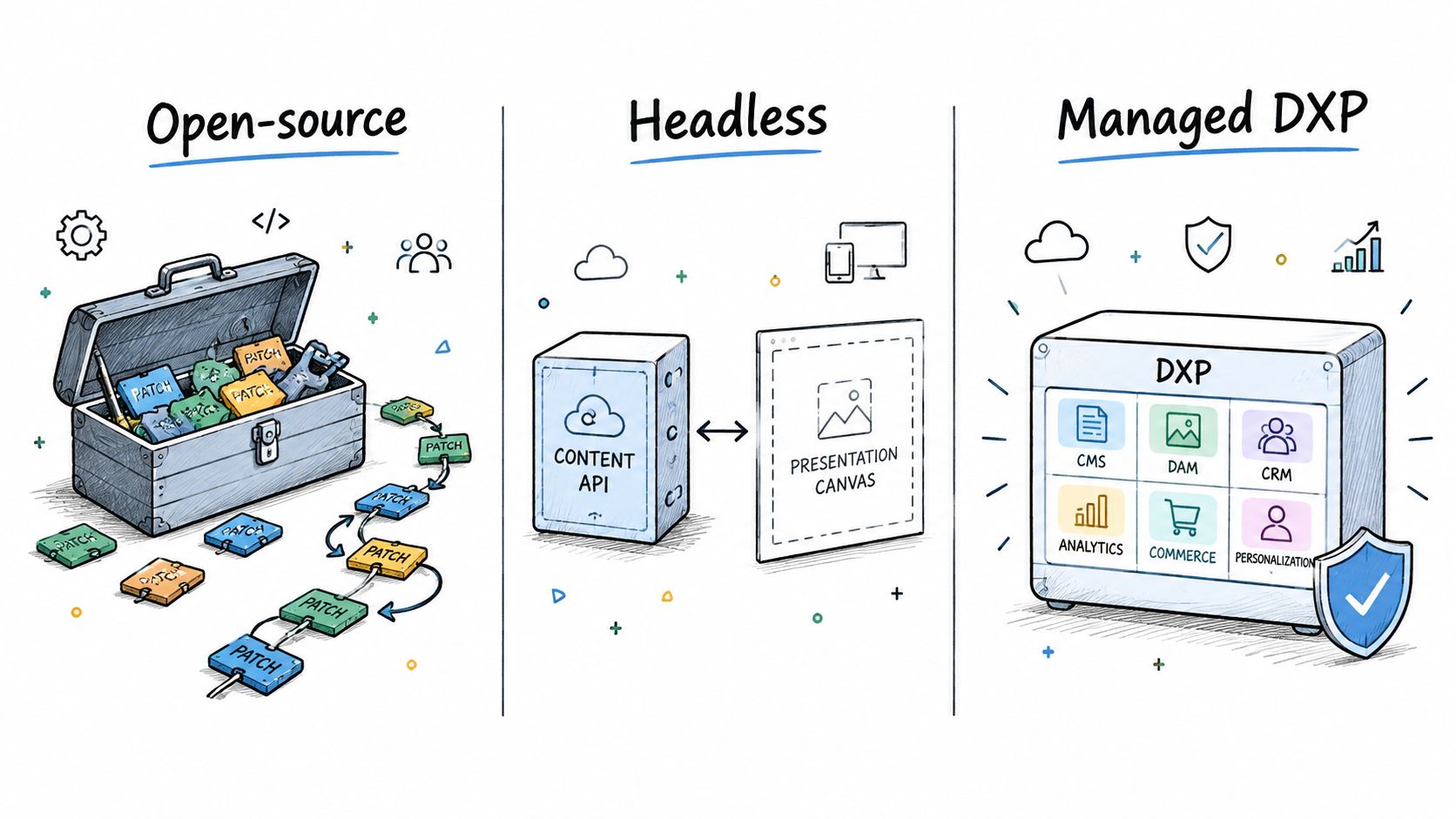
The distinction is easiest to see when the architecture is evaluated by liability rather than capability. Open-source systems can be extensively customized, yet the team commonly owns the patch chain, extension compatibility, hosting, backups, and incident response. A pure headless implementation separates content from presentation, but it also leaves the team responsible for every frontend experience and the workflows around it.
| Architecture Model | Frontend Flexibility | Maintenance Liability | Multi-Site Governance |
|---|---|---|---|
| Traditional open-source | High within the platform and its extensions | Team carries hosting, security updates, extension compatibility, and recovery design | Often varies by deployment and extension choices |
| Pure headless | Very high, with presentation built independently | Team owns frontends, previews, integrations, rendering, caching, and release coordination | Requires deliberate governance across repositories, channels, and environments |
| Managed DXP | High through templates, modules, APIs, and headless delivery | Provider handles core platform operations while the delivery team owns scoped custom work | Centralized controls can standardize sites, users, content, and operational policies |
Open-source flexibility carries a patch chain
The base software isn't the whole system. Extensions, custom modules, themes, infrastructure, databases, search, forms, identity, and monitoring create the production surface that developers must maintain. A managed host can remove some infrastructure tasks, but it doesn't automatically remove extension conflicts, custom-code regressions, or application-level governance.
That burden becomes expensive across a portfolio. A small amount of recurring work per site can become a material operational program when the agency manages many client deployments. The correct comparison is therefore total engineering burden, not license cost or the apparent simplicity of the initial build.
Headless freedom requires a delivery operating model
Headless works well when multiple channels need independent presentation layers, when frontend release cycles must be separated, or when the presentation technology is specialized. It becomes a poor default when a standard web property needs dependable previews, forms, search, commerce, analytics, permissions, and recovery without a large permanent maintenance program.
A practical overview of broader website-builder and CMS considerations is available in RapidNative's platform comparison guide. For teams deciding between architectures, the related headless CMS versus traditional CMS discussion is useful only when paired with an ownership assessment. The central question isn't which model offers the most freedom. It's which model leaves the right responsibilities with the right party.
The Case for Consolidated Digital Experience Platforms
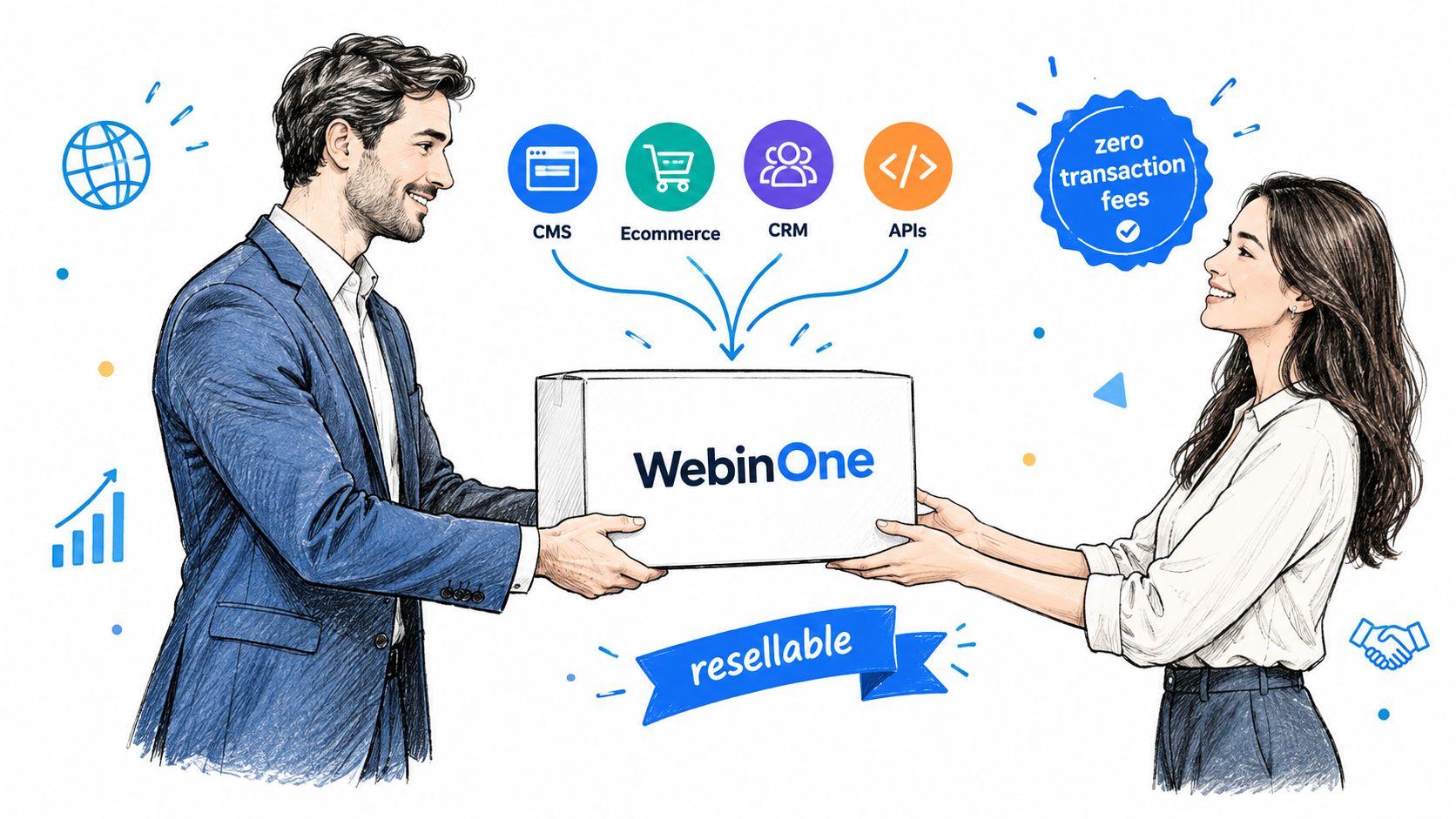
WebinOne gives agencies and systems integrators a managed DXP option that brings CMS, ecommerce, CRM, email marketing, multi-site management, and headless delivery into one system. The value is operational rather than cosmetic. Fewer separately maintained systems mean fewer compatibility decisions, handoffs, and ownership gaps after launch. For a broader evaluation framework, see our guide to the best digital experience platform.
Fragmented stacks create engineering work that clients rarely see on a project plan. The team coordinates hosting, commerce, search, identity, analytics, and custom integrations across separate services. Each release adds another dependency boundary. A request for a new workflow can become an ownership investigation before any code is written: which system holds the data, which integration changes it, and who is responsible when the change fails?
Native capability protects delivery margin
The practical test is not how many features appear in a product list. It is whether the platform covers enough of the common operating model to reduce connector code and extension maintenance. WebinOne documents APIs alongside Liquid templating, custom modules, SEO tools, forms, search, snippets, member areas, ecommerce, CRM functions, email marketing, webhooks, reusable templates, and multi-site administration.
That coverage matters when an agency supports a portfolio. A team can standardize recurring requirements, reuse templates, and keep site administration in a shared operating model instead of maintaining a different integration pattern for every client. Headless delivery remains available for cases that require a separate presentation layer, while routine sites can avoid unnecessary architectural separation.
Ecommerce carries zero transaction fees, subject to the platform's plan terms. Bespoke ecommerce work is scoped as a TeamOne project, so a complex requirement receives an explicit delivery estimate rather than being treated as an automatic platform feature.
White-label operations change the agency equation
White-label login and administration branding let an agency manage sites, staff, billing, support tickets, and templates under its own identity. It can also resell the platform through the WebinOne reseller program. That model gives ongoing platform administration a defined commercial role instead of leaving support work hidden inside implementation retainers.
Published pricing starts at $10 per month per site, and paid partner support is available when delivery teams need help beyond standard operations. The relevant evaluation is not partner count. It is whether support, governance, and reusable delivery practices allow an agency to serve more clients without reproducing the same maintenance burden for every account.
A consolidated platform does not remove architectural judgment. It reduces the number of dependencies an agency must coordinate, document, patch, and explain. That is the operating advantage a managed DXP must demonstrate.
Evaluating Infrastructure Resilience and Performance Baselines
WebinOne treats infrastructure resilience and performance as platform responsibilities that still require technical verification. A cloud label isn't evidence of high availability, and a fast development environment doesn't guarantee strong real-user performance in production.
AWS documents a 99.99% regional availability target for included services when instances or tasks run concurrently across at least two Availability Zones in the same region, or across at least two regions where a region has only one Availability Zone. The AWS historical service-level documentation also distinguishes Amazon S3's 99.999999999% annual durability design from its 99.9% published service-level availability commitment. Availability, durability, backup recovery, and application resilience are separate questions.
Verify the topology, not the label
Before signing a platform agreement, technical leads should ask for clear answers to these questions:
- Failure domains: Does the application run redundantly across Availability Zones or equivalent failure domains?
- Recovery ownership: Who restores data, who initiates rollback, and how are recovery procedures tested?
- Availability commitment: What does the published SLA cover, and how does it differ from observed uptime?
- Storage separation: Are application availability and asset durability measured independently?
- Operational visibility: Is there a public status page, incident process, and audit trail for changes?
- Data residency: Can the deployment use an appropriate AWS region or a custom data center by agreement?
WebinOne runs on AWS across 6 AWS regions, reports 99.99% uptime over the last 12 months, and provides a 99.95% availability commitment in its published SLA. Those are useful reference points, but buyers should still examine deployment topology, recovery procedures, and contractual scope rather than treating a headline figure as a complete resilience strategy.
Connect CMS decisions to user experience
Google's Core Web Vitals define a good experience at the 75th percentile as LCP no more than 2.5 seconds, INP below 200 milliseconds, and CLS below 0.1, according to Google's Core Web Vitals guidance. Google evaluates these metrics using real-user data, so synthetic tests alone don't establish that a portfolio performs well for visitors.
The CMS should support efficient rendering, predictable asset delivery, caching, image handling, and measurement across deployed sites. HTTP Archive's 2025 Web Almanac reports that CMS-driven sites represented more than 54% of observed websites, while only 54% achieved a good LCP result, as summarized in the verified web performance data. That gap shows why platform architecture and implementation discipline must be evaluated together.
Accessibility belongs in the same operational checklist. The EU Web Accessibility Directive covered public-sector websites first published after 23 September 2018 from 23 September 2019, other public-sector websites from 23 September 2020, and public-sector mobile applications from 23 June 2021, as outlined by the European Commission's accessibility documentation. Reusable semantic components, alternative-text workflows, keyboard-accessible templates, document governance, and centralized correction processes should be tested before deployment.
Matching the Right Architecture to the Delivery Scenario
WebinOne fits scenarios where a managed, template-capable CMS with solid APIs can meet the experience requirements without making the delivery team own every platform service. A pure headless design remains justified when independent channels and specialized presentation layers are central to the product, but it shouldn't be selected by reflex.
Consider an agency managing a multi-brand estate. The client needs shared templates, local content ownership, consistent redirects, common permissions, ecommerce, CRM data, and a controlled release process. A platform that centralizes those functions can let developers build differentiated experiences without repeating the same governance model for every brand.
Standard web estates need operational consistency
For corporate sites, campaign properties, client portals, member areas, and regional estates, the delivery risk often comes from variance rather than lack of frontend freedom. A managed DXP can provide reusable templates, custom modules, Liquid access, headless APIs, forms, search, backups, SSL, redirects, and centralized administration. Developers still customize the experience, but they don't need to recreate the full operating layer for each deployment.
Migration planning should start with the estate, not the target template. TeamOne stages migration, tests before and after cutover, and supports zero-downtime delivery. WebinOne has migrated thousands of sites, including large platform end-of-life programs and complex custom builds, which gives agencies and SIs a basis for discussing repeatable migration patterns without assuming that every site can be moved through the same script.
Specialized applications deserve a deliberate exception
A highly specialized omnichannel application may justify separate frontend services, independent release trains, or content delivery to multiple application surfaces. In that scenario, the team should budget for preview infrastructure, authentication, search, forms, analytics, deployment automation, accessibility, observability, and recovery as explicit workstreams.
AWS partners and systems integrators have another deployment path. WebinOne is an AWS Partner, has passed the AWS Foundational Technical Review, holds the AWS Qualified Software designation, is enrolled in the AWS Software and Services Paths, and is available on AWS Marketplace. For qualifying SIs, a licensed version can run in the SI's or customer's own AWS account by agreement, including AWS GovCloud. Custom data centers can also be set up for clients by agreement.
WebinOne delivers FedRAMP and GovCloud projects with SI partners and licensed deployments. Authorization status must be assessed within the specific project and contracting context, so the next step is a technical conversation about deployment boundaries, controls, data residency, and responsibility allocation.
US and Australian government clients already form part of WebinOne's delivery experience. That doesn't remove procurement or compliance work. It does mean government teams and their partners can discuss a managed platform against concrete operational and deployment requirements rather than starting from a generic hosting claim.
Moving from Platform Maintenance to Client Outcomes
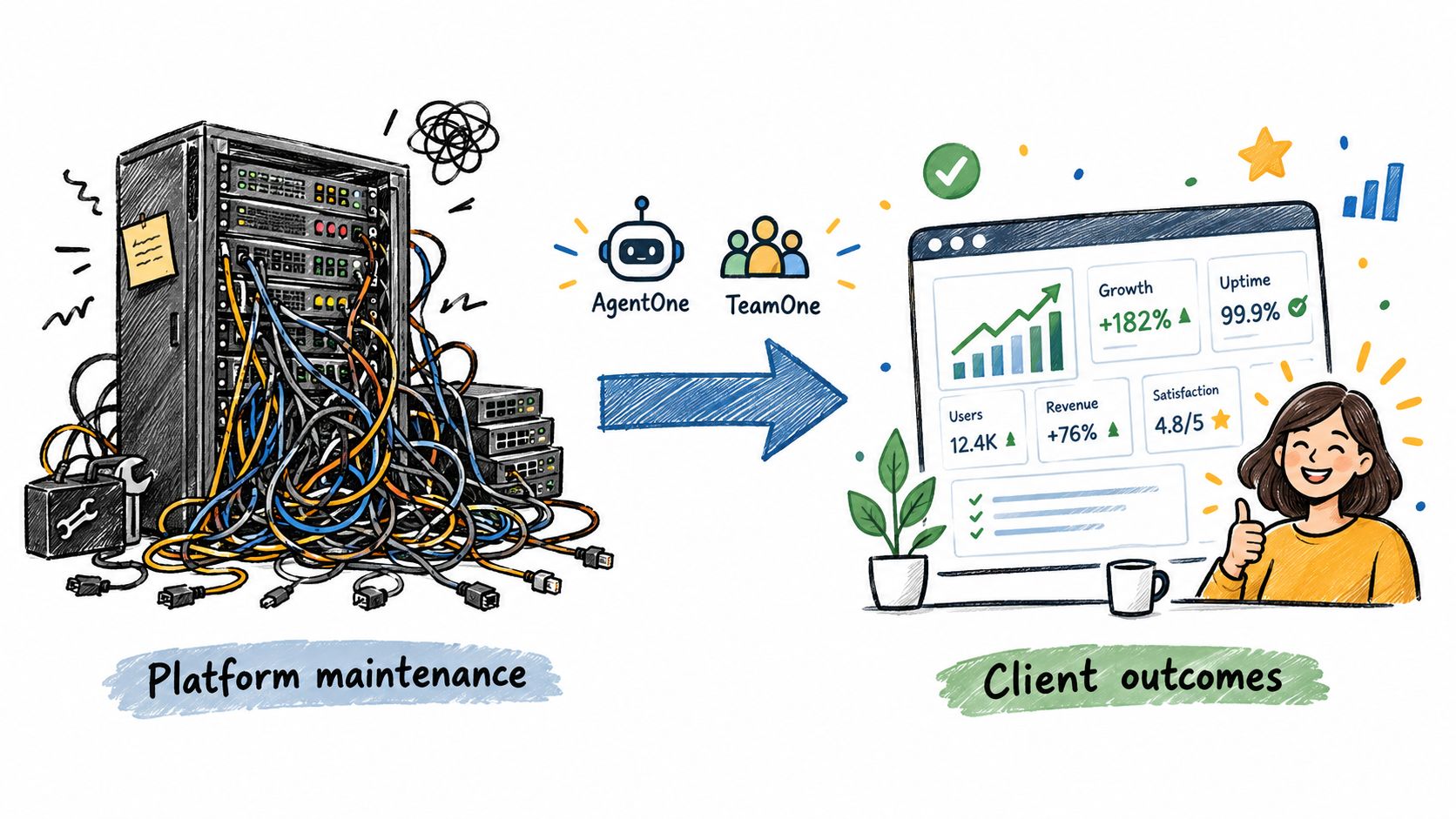
WebinOne shifts the developer question from “How much can the team build?” to “How much platform code must the team continue to operate?” That change matters most for agencies and SIs whose margins depend on repeatable delivery, predictable support, and the ability to move clients into larger engagements without multiplying maintenance work.
The answer isn't to remove developers from the architecture. Developers should still control templates, modules, integrations, APIs, performance decisions, accessibility implementation, and release quality. The better operating model removes repetitive platform ownership that doesn't create client differentiation.
Replace recurring maintenance with governed delivery
AgentOne, WebinOne's Managed Vibe Coding system, builds and operates sites inside the managed platform. It can handle development, content updates, optimizations, and automations within scoped permissions and audit logs. Generated code remains transparent, reviewable, and reversible before production changes are applied, so AI-assisted delivery doesn't have to mean ungoverned output.
That model is useful when the agency needs to increase delivery capacity without turning every content request into bespoke engineering. It doesn't replace architectural review or release discipline. It gives the team a controlled way to automate approved work while preserving visibility into changes.
Make migration a business capability
TeamOne handles complex migrations, portfolio moves, re-platforming, and ongoing managed operations. The delivery pattern is staged and tested before and after cutover, which allows teams to address redirects, structured content, custom modules, integrations, permissions, and performance before the client estate changes production systems.
The result agencies should pursue isn't merely a successful CMS migration. It's a cleaner service model with reusable templates, centralized governance, clearer support boundaries, and a commercial structure that protects margin. SIs should look for the same outcome in a different form, a platform partnership that lets them deliver on AWS while reducing the amount of open-source maintenance they carry for each customer.
The best CMS for developers is therefore the one that minimizes permanent platform liability without restricting the work that differentiates the delivery partner. API flexibility still matters. Frontend freedom still matters. Neither should outrank recovery, governance, native capability, supportability, and total operating cost.
WebinOne offers agencies a white-label managed DXP with CMS, ecommerce, CRM, email marketing, multi-site management, APIs, and AWS-backed operations, while TeamOne supports staged migrations and complex delivery programs. Agencies can explore the WebinOne reseller program, and systems integrators or enterprise teams can start a migration or partnership conversation through the WebinOne enterprise team.