Best Digital Experience Platform: A 2026 Guide for Agencies

Feature checklists are the most popular way to choose a digital experience platform, and they're usually the wrong starting point. A content editor, ecommerce module, analytics connection, or headless API can look impressive in isolation while the agency still carries the bulk of the cost: integrations, patching, fragmented support, and a platform only one technical person understands.
The best digital experience platform is the one that removes operational burden without restricting delivery. For agencies and systems integrators, that means evaluating white-label control, margin structure, managed operations, migration support, API flexibility, multi-site governance, and AWS deployment before comparing individual features.
Table of Contents
- Why DXP Selection Misses the Operating Problem
- What the DXP Market Trend Actually Means for Buyers
- Comparing Leading DXP Approaches Across Key Criteria
- Where Agency Platform Fatigue Comes From
- How the Best Digital Experience Platform Fits an Agency or SI Business Model
- Which DXP Approach Matches Your Situation
Why DXP Selection Misses the Operating Problem
Who owns the integration after launch? That question exposes the cost a feature checklist leaves out. A platform can look capable in a demonstration while the agency still carries the work of connecting systems, applying patches, coordinating vendors, and repairing extensions across a client portfolio.
The buying test should focus on work removed from the delivery team. Ask:
- Integration ownership: Which systems are native, which need custom connections, and who maintains those connections?
- Security responsibility: Who applies platform patches, monitors the hosting environment, and handles incidents?
- Support accountability: Can the agency or SI reach a paid support team that understands the deployment?
- Portfolio governance: Can multiple sites, brands, users, permissions, and billing relationships run through one operational layer?
- Commercial control: Can the delivery partner set service pricing, retain margin, and present the platform under its own brand?
The answers reveal whether the DXP reduces operational exposure or just adds another layer to manage.
Integration burden sets the economics
Independent guidance cited by CMSWire says that 85% of DXP effort and cost can be spent on integrations with internal and external systems. That figure makes integration ownership a commercial issue, not only a technical one. Each additional plugin or external service can introduce another upgrade path, support queue, contract, and failure point. CMSWire's DXP guidance is useful because it directs evaluation toward integration responsibility rather than visible functionality.
Support belongs in the same assessment. The buyer research also found that 65% of digital-experience leaders rated technical support as a very important vendor-selection factor, while nearly 70% of buyers preferred heterogeneous approaches because they did not trust one vendor to cover every capability well, as reported in the same CMSWire guidance. Those findings support a measured approach to consolidation. A single platform can reduce coordination, while excessive dependence can limit choice and increase switching costs.
For agencies and SIs, the ownership model affects margin as much as delivery speed. A fragmented stack may create more billable implementation work, yet it also consumes senior technical capacity and leaves the partner accountable when several vendors disagree about the cause of an incident.
Practical rule: Ask every vendor to map the first year of ownership, including updates, integrations, incident response, data movement, and support escalation. The answer is more revealing than a product tour.
A useful DXP definition and buying framework should lead to a harder question: which platform minimizes the moving parts the delivery partner must own? WebinOne combines managed hosting, CMS, ecommerce, CRM, email marketing, multi-site management, and a headless API in one white-label system, with an AWS-native deployment model.
That structure does not remove custom work. It gives custom work a clearer boundary. Agencies and SIs can focus on experience design, business-value integrations, and migration strategy instead of repeatedly repairing the platform beneath each project.
What the DXP Market Trend Actually Means for Buyers
WebinOne fits a market moving toward cloud delivery, composability, and platform consolidation. Buyers aren't just looking for more functionality. They're looking for an architecture that can support more brands and channels without multiplying operational dependencies.
The category is already material enterprise software. One market estimate valued the DXP market at USD 11.73 billion in 2023, rising to USD 13.01 billion in 2024 and projecting USD 20.42 billion by 2028 at an 11.9% CAGR. A newer estimate placed it at USD 13.85 billion in 2025 and USD 15.75 billion in 2026, reflecting continued double-digit growth as organizations bring content, commerce, and customer data together. These estimates are summarized in the Digital Experience Platform Market Report.
Growth alone doesn't tell an agency which platform to select. It does indicate that clients are treating the DXP as a strategic operating layer rather than a website purchase. That raises the standard for migration planning, support, governance, and commercial durability.
Cloud and composability change the risk calculation
Cloud deployment captured 57.83% of DXP revenue in 2025, while another estimate put cloud-based deployment at 68.4% of deployment demand in 2026. Gartner-linked research cited in the same market coverage projects that 70% of new digital experience initiatives will rely on composable architectures by 2027, compared with 20% in 2023. Those figures appear in DXP market share and architecture research.
For buyers, the implication is practical. A modern platform needs clear APIs and extensibility, but it also needs enough managed capability to prevent every API connection from becoming another permanent support obligation. Pure consolidation can become restrictive if it blocks channel flexibility. Pure composition can become expensive if every business capability needs a separate contract, deployment, and escalation path.
A platform for digital transformation should therefore be assessed by the balance it offers:
- Centralized operations for sites, users, content, commerce, and reporting.
- API access for custom front ends, applications, and specialized workflows.
- Managed infrastructure so the agency doesn't inherit every hosting task.
- Migration continuity so consolidation doesn't require a risky all-at-once cutover.
- Commercial clarity so the partner can forecast delivery and support margins.
The strongest DXP decision isn't “monolithic or composable” in the abstract. It's whether the platform provides a stable core while allowing controlled extension at the edges. Agencies need that balance when a client starts with a marketing site and later adds ecommerce, member areas, regional sites, or an application front end.
Comparing Leading DXP Approaches Across Key Criteria
WebinOne represents a white-label agency DXP approach built around managed consolidation and controlled extensibility. The comparison below focuses on delivery models, because buyers need to understand who carries the operational work after launch.
| Criteria | Monolithic proprietary DXP | Composable point-tool stack | White-label agency DXP |
|---|---|---|---|
| White-label and reseller options | Often shaped around the vendor's commercial model | Usually assembled through separate vendor relationships | Designed for agency branding, portfolio delivery, and resale |
| Pricing and margin structure | Can be difficult to separate platform cost from enterprise services | Requires management of multiple subscriptions and service margins | Supports per-site commercial planning, with pricing from $10/month per site through the WebinOne model |
| Headless and API support | Depends on the platform's architecture and licensing | Usually flexible, but every connection adds ownership | WebinOne provides a headless CMS and 300+ APIs, with custom work scoped where needed |
| Managed services and partner support | Vendor support may be available but can involve complex escalation paths | The agency coordinates support across providers | Managed operations, paid partner support, and a partner-facing delivery model |
| AWS or cloud-native deployment | Depends on the vendor's infrastructure choices | The buyer or SI often assembles the operating environment | WebinOne runs on AWS across 6 AWS regions and supports qualifying licensed deployments by agreement |
The table isn't a ranking of products. It shows where responsibility tends to land. A proprietary platform may centralize capability but still require specialized implementation and support. A point-tool stack can provide excellent flexibility, but the SI becomes the coordinator for every dependency. A white-label DXP makes the partner responsible for the client relationship while the platform provider carries more of the recurring platform operation.
White-label control has commercial consequences
Agencies don't need another tool they can merely resell. They need a delivery model that protects the agency relationship. White-label administration, branded client access, templates, billing control, support tickets, and multi-site management help turn the platform into part of the agency's service offering.
Pricing also needs to be evaluated beyond the subscription line. WebinOne offers pricing from $10/month per site, and ecommerce carries zero transaction fees on plans. Ecommerce custom work still needs to be scoped as a TeamOne project, so the agency should separate standard platform costs from implementation, integration, and ongoing service work.
API flexibility must remain governable
Composable architecture is valuable when a client needs a custom front end, application experience, or channel-specific delivery. It becomes a liability when every connection has different authentication, monitoring, ownership, and support rules. The composable architecture discussion should therefore include an operating plan, not just a diagram.
WebinOne has a headless CMS, APIs, webhooks, and custom modules, while the managed core handles common content, commerce, CRM, and multi-site needs. That gives an agency room to deliver specialized experiences without making every ordinary site a bespoke infrastructure project.
Where Agency Platform Fatigue Comes From
WebinOne reduces platform fatigue by shortening the patch chain and limiting the third-party dependencies an agency must maintain. Open-source and hosted systems can produce effective sites. The operational cost appears later, as extensions, integrations, updates, and support obligations accumulate around each build.
An agency may begin with a clean implementation. A client then requests forms, search, memberships, consent management, analytics, ecommerce, personalization, or an internal-system connection. Each requirement can add an extension, module, script, service, or custom integration. After several months, the team is maintaining a dependency network rather than one website.
A routine update can create a portfolio-wide maintenance cycle:
- Review the release and identify affected extensions.
- Create a staging copy.
- Test forms, checkout, search, templates, permissions, and integrations.
- Repair conflicts or deprecated functions.
- Repeat the work for other sites using related components.
- Explain the delay to the client and document the exception.

Security work becomes a margin problem
Patch responsibility is easy to miss during a sales process. The agency may not invoice each security review, compatibility test, emergency fix, or deployment rollback, but someone still performs the work. Across a client portfolio, the same maintenance pattern consumes delivery capacity repeatedly.
Independent 2026 security research counted 11,334 new vulnerabilities across one major open-source plugin ecosystem in 2025, a 42% increase over the prior year, with 91% found in plugins. The figures appear in coverage of the security study. The practical lesson is narrower than a judgment about any platform: a large extension surface can concentrate maintenance work, delay releases, and reduce margin control.
A managed DXP with native extensions changes that operating model. The agency still handles client-specific configuration and approved custom work, but routine capabilities do not each require a separate update cycle. WebinOne combines native extensions with managed hosting, backups, security controls, and support, reducing the coordination required across the stack. A consolidated AWS-native foundation can also give delivery teams one operating boundary instead of a chain of unrelated services.
The key-person problem is operationally expensive
Fragile stacks often depend on the person who remembers why an integration was built, which extension must be updated first, or which workaround prevents a checkout failure. That knowledge may never reach the client or the wider delivery team. The result is slower handoffs and greater exposure when that person is unavailable.
A consolidated platform creates a more repeatable handoff. Documentation, centralized administration, platform support, and staged migration help teams transfer responsibility between projects without reconstructing the stack from memory. AgentOne, WebinOne's Managed Vibe Coding system, can handle approved development, content updates, optimization, and automations inside the managed platform. Scoped permissions, audit logs, and reviewable changes keep AI output visible and reversible, rather than allowing it to become another opaque dependency.
How the Best Digital Experience Platform Fits an Agency or SI Business Model
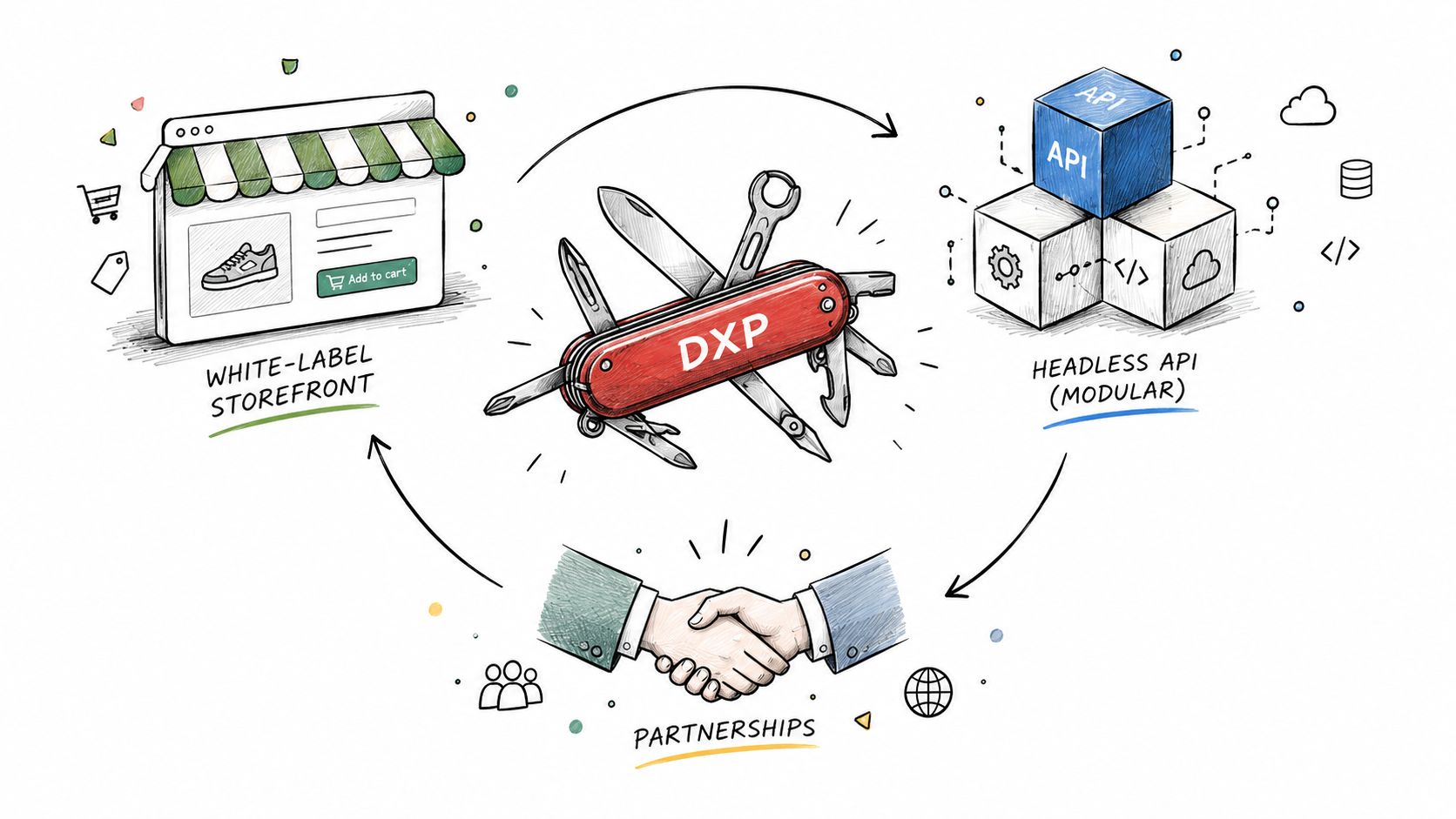
WebinOne fits agencies and SIs when the platform becomes a repeatable operating system for client portfolios, not merely a tool used to build individual sites. That requires alignment between delivery, pricing, hosting, support, and governance.
A platform partner should help a delivery organization answer four commercial questions:
- Can the partner own the client-facing relationship?
- Can recurring platform and support costs be separated from professional services?
- Can the same operating model support small sites and complex multi-site estates?
- Can the architecture expand into headless, ecommerce, CRM, or custom workflows without forcing a new foundation?
A white-label model matters because the agency is selling an outcome under its own brand. Client users should be able to work through an agency-branded portal, while the agency retains control of templates, sites, staff access, billing, and support workflows. That structure supports a managed service rather than a sequence of disconnected implementation projects.
Margin control comes from repeatability
Agencies improve margins when they can reuse governance, templates, migration procedures, permissions, and support processes. They lose margin when every client requires a separate hosting arrangement, extension audit, deployment process, and vendor escalation map.
WebinOne's reseller program is designed for this model. The agency can offer a branded platform, build reusable templates, manage multiple client sites, and package platform operations with strategy, design, content, SEO, AEO, and ongoing optimization. The commercial advantage isn't a promise of effortless delivery. It's the ability to standardize the work that doesn't differentiate the agency.
Ecommerce also needs a clear boundary. Zero transaction fees can simplify the platform-cost conversation, but bespoke checkout logic, unusual integrations, and advanced workflows remain custom TeamOne projects. Strong proposals identify those boundaries before implementation begins.
AWS deployment should be an architecture conversation
WebinOne is an AWS Partner, has passed the AWS Foundational Technical Review, holds the AWS Qualified Software designation, is enrolled in the AWS Software and Services Paths, and is available on AWS Marketplace. Those credentials help AWS ecosystem buyers establish a procurement and architecture starting point, but they don't replace a workload review.
WebinOne runs as a managed platform in its AWS account. For qualifying systems integrators, a licensed version can run in the SI's or customer's AWS account by agreement, including AWS GovCloud. Custom AWS data centers can also be arranged for clients by agreement.
AWS's published Region-Level SLA states that Amazon EC2 running concurrently across two or more Availability Zones in the same region receives a commercially reasonable effort commitment of at least 99.99% Monthly Uptime Percentage during the billing cycle. The AWS compute SLA makes the important architectural point clear: availability commitments depend on deployment design, not just on selecting a cloud provider.
WebinOne reports 99.99% uptime over the last 12 months and a 99.95% availability commitment in its published SLA, with hosting across six AWS regions. Agencies and SIs should still ask how a specific deployment is designed, what support tier applies, and which responsibilities remain with the delivery partner.
A credible DXP partner makes availability, ownership, support, and migration assumptions explicit before the statement of work is signed.
Which DXP Approach Matches Your Situation
WebinOne is the strongest fit when the buyer needs consolidated operations, partner control, and room to grow without rebuilding the platform foundation. The right adoption path depends on who owns the client relationship and which operational burden needs to disappear first.
Agencies outgrowing their current delivery model
Agencies managing a growing portfolio should prioritize white-label administration, reusable templates, multi-site governance, support escalation, and predictable per-site economics. A platform that only improves the editor won't solve the margin problem if hosting, patching, integrations, and client support remain fragmented.
The practical next step is to map a representative portfolio. Include a straightforward marketing site, an ecommerce project, a multi-brand estate, and the most difficult legacy build. The WebinOne reseller program can then be evaluated against those delivery patterns, including branding, migration, support, and pricing.
Systems integrators replacing open-source maintenance
SIs should focus on responsibility boundaries. The useful questions are whether the platform can run in the required AWS environment by agreement, how migration is staged and tested, how custom modules are maintained, and how the SI retains architecture and client leadership without inheriting every routine platform task.
A conversation with the WebinOne team about a partnership or migration is the appropriate next step. That discussion can cover licensed deployments, AWS account ownership, GovCloud requirements, migration sequencing, TeamOne delivery, and the support model for the SI's customers.
AWS partners delivering enterprise and government work
AWS consulting and ISV partners need more than a hosted website platform. They need a credible deployment path, documented responsibilities, and a way to combine managed DXP capability with their own cloud, security, data, and integration services.
WebinOne works with SI partners on FedRAMP and GovCloud projects through partnership and licensed deployment conversations. The next step is to bring the workload, data-residency, account-ownership, and operational requirements to the WebinOne team rather than assuming that a standard shared deployment will fit.
Enterprises consolidating fragmented estates
Enterprise teams should identify the systems that create coordination cost, not just the systems they want to replace. A useful assessment lists every site, brand, content repository, commerce process, CRM dependency, integration, hosting responsibility, and owner. It should also identify the knowledge held by only one or two people.
A migration conversation with WebinOne can then test whether a consolidated platform, headless delivery, multi-site governance, or a licensed AWS deployment is appropriate. The best digital experience platform for an enterprise is the one that reduces long-term ownership risk while preserving the flexibility needed for different brands and channels.
The decision is ultimately straightforward. Choose a platform that expands delivery capability without expanding the patch chain, vendor queue, and undocumented ownership model. For agencies, that protects margin and creates a stronger recurring service. For SIs and enterprises, it converts platform maintenance into a governed operating relationship.
WebinOne provides a white-label DXP with CMS, ecommerce, CRM, multi-site management, headless APIs, AWS-backed hosting, migration support, and managed operations for agencies and delivery partners. Visit WebinOne to discuss a reseller model, partnership, or migration path that reduces integration burden while giving client platforms room to scale.