B2C in E Commerce: A Guide for Agencies and Integrators
On Christmas Day in the 2025 holiday season, smartphones accounted for 66.5% of online transactions, a figure reported by Adobe and compiled alongside Baymard's cart abandonment research. That single fact reframes B2C in e commerce. It's not a desktop storefront with a mobile view attached. It's a transaction system that has to hold product data, customer records, payments, delivery promises and returns together, on a small screen, under peak load, without losing the order.
Table of Contents
- What B2C E-Commerce Means and How Big It Has Become
- How B2C Differs from B2B in Practice
- Business Models Behind a B2C Store
- Where B2C Customers Abandon the Journey
- Platform Needs for Delivery and Cross-Border Selling
- KPIs That Show Whether the Store Works
- What B2C Means for Site Architecture and Marketing
- Confirm Your B2C Platform Plan With the WebinOne Team
What B2C E-Commerce Means and How Big It Has Become
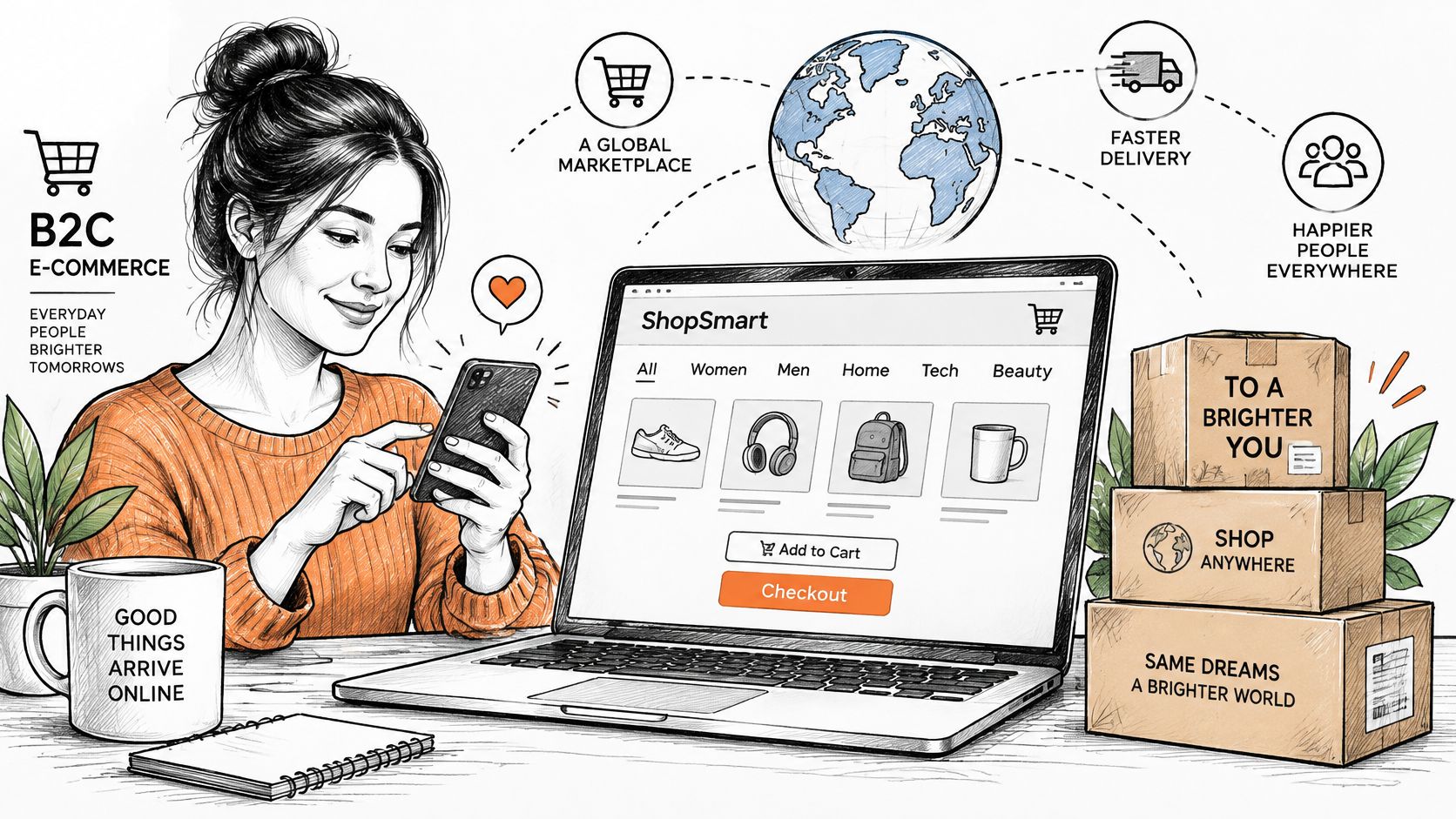
B2C in e commerce is the sale of goods and services online to individual consumers, and WebinOne runs that sale as one system covering catalog, content, customers, payments and orders on a single data model. The buyer purchases for personal use, decides quickly and judges delivery and returns as part of the product itself.
Four characteristics separate a real B2C operation from a website that merely takes payments. The buyer is an individual, not an account with approvers. Purchases are frequent and often impulsive, triggered by search, social feeds or email rather than a procurement cycle. Prices get compared across sellers in seconds, so a stale price or a missing delivery date ends the sale. And the post-purchase experience, from tracking to refunds, decides whether the customer returns.
The Scale of the Channel
The U.S. Census Bureau's quarterly series in its Q4 2025 retail ecommerce release puts seasonally adjusted retail ecommerce sales at approximately $300.2 billion in Q1 2025, about $304.2 billion in Q2, roughly $310.3 billion in Q3 and $316.1 billion in Q4. Across the full year, those quarters imply approximately $1.23 trillion in online retail sales. Ecommerce represented 16.3% of total U.S. retail sales in Q2 2025 and 16.6% in Q4, so roughly one dollar in every six spent through retail moved online. Q4 online sales also rose 5.3% year over year while total retail sales increased 2.7%, which means the online channel keeps taking share rather than holding a fixed slice.
Those are U.S. figures measured against total retail with a consistent methodology, which makes them a clean benchmark. Global totals are harder to compare because countries define and report ecommerce differently, so agencies shouldn't build a business case on a single worldwide headline number.
A B2C store is a shop that never closes, and every customer inside it can compare the offer with every competitor in one tap.
At this scale, the operating implication is direct. A channel carrying a sixth of retail needs integrated product data, customer records, marketing, payments, fulfillment, analytics and multi-site governance, plus the discipline to protect online stores with MANDATE as transaction volume grows. Treating it as an extra storefront bolted onto a brochure site is how product data drifts, orders get stranded between systems and nobody can say why conversion fell.
How B2C Differs from B2B in Practice
WebinOne can serve consumer and business selling from one platform, but only when each journey is configured separately, because B2C is designed to remove steps and B2B is designed to control them. Forcing both audiences through one checkout, one pricing rule and one account model satisfies neither.
| Factor | B2C consumer sale | B2B business sale |
|---|---|---|
| Buyer | Individual consumer | Business account and buying team |
| Purchase decision | One person, often within minutes | Multiple approvers and procurement rules |
| Order size | Small, frequent baskets | Larger, less frequent orders |
| Pricing | Public list prices and promotions | Negotiated, tiered or contract prices |
| Account setup | Guest checkout expected | Approved accounts, credit terms, purchase orders |
| Returns | Consumer rights and free return expectation | Return terms set per contract |
| Catalog | Merchandised for browsing | Structured for reorder by SKU and specification |
The Two Rows That Drive Platform Decisions
Pricing shapes the data model first. A consumer sees one public price per market, with promotions and discount codes applied by rule, so the store needs clean list pricing and visible discount logic. A business buyer sees a negotiated or tiered price tied to an account, which means the same product carries several valid prices at once. Mixing the two without separate rules produces the classic failure where a contract price leaks onto a public page, or a consumer promotion applies to a wholesale order.
Account setup shapes the checkout. Consumers expect to buy as guests and create an account only if there's a reason, such as tracking or loyalty. Business buyers expect the opposite, an approved account with credit terms, purchase order numbers and order history shared across a team. An integrator who copies the B2B pattern into a consumer store adds registration friction at the exact moment the shopper is ready to pay.
Say a shopper buys a jacket in one visit, pays by card and wants a return label if the fit is wrong. Contrast that with a procurement team reordering 200 identical units under a contract, on terms, delivered to three sites.
Configuration rule: shared catalog and inventory underneath, separate pricing, account and checkout journeys on top.
The catalog row follows from the same logic. Consumers browse by category, image and review, so merchandising and search quality carry the sale. Business buyers reorder by SKU and specification, so structured attributes and saved lists matter more than storytelling. One platform can hold both, provided the product record is shared and the presentation, pricing and ordering rules are not.
Business Models Behind a B2C Store
WebinOne holds product and customer data on one model across hybrid B2C setups, which matters because most stores don't run a single pure model for long. A brand store adds subscriptions, then a marketplace channel, then pickup from physical locations, and each addition breaks if the underlying records don't match.
| Model | How It Earns | Platform Need |
|---|---|---|
| Direct-to-consumer brand store | Product margin on its own catalog | Catalog, checkout, CRM and email on one data model |
| Multi-brand store or marketplace | Commission, listing or seller fees | Seller management, split payments, multi-brand governance |
| Subscription commerce | Recurring charges per billing period | Billing cycles, failed-payment recovery, account self-service |
| Dropshipping | Margin between supplier cost and retail price | Supplier feeds, order routing, inventory sync |
| Omnichannel retail | Sales across online and physical stores | Shared inventory, pickup options, unified customer records |
| Social and live commerce | Sales from social feeds or live streams | Feed integrations, fast mobile checkout, performance under spikes |
What Each Model Cannot Work Without
A direct-to-consumer brand store lives on margin and repeat buying, so the customer record has to connect orders, email and support history. Without that link, the store keeps paying to reacquire people who already bought. A marketplace lives on other sellers' catalogs, so seller onboarding, commission tracking and split payments aren't enhancements, they're the revenue mechanism, and governance over who can list what protects the brand running it.
Subscription commerce fails. The storefront can look perfect while failed-payment recovery, dunning emails and self-service plan changes leak revenue every billing cycle, because subscribers rarely complain before they churn; they just let a card expire. Dropshipping fails on data lag. The retailer holds no stock, so the supplier feed is the inventory, and when that feed is stale the store sells products that can't ship, then pays for the refunds and support tickets.
Omnichannel retail depends on one inventory count shared by stores and sites, with pickup treated as a standard fulfillment option rather than a manual workaround. Two counts means the website promises stock the shelf doesn't have. Social and live commerce compresses the whole journey into a feed, so the purchase has to complete in a fast mobile checkout while attention lasts, and the platform has to absorb a traffic spike that arrives in minutes rather than across a campaign week.
Three Questions That Settle the Model
- Who owns the customer record: the brand, the marketplace or the social channel that produced the sale?
- Who holds the inventory: the retailer, a supplier or a network of stores?
- Whose brand appears at checkout: because that name carries the delivery promise and the return.
Answer those three and the platform requirements mostly write themselves. Skip them and the agency ends up rebuilding payment flows and order routing mid-project, which is where margin on a fixed-price build disappears.
Where B2C Customers Abandon the Journey
WebinOne's single data model lets a team see each checkout step against catalog, customer, order and payment events, which is what turns abandonment from a traffic complaint into a diagnosable failure. Most stores don't lose the sale at discovery. They lose it at checkout, after paying to win the visit.
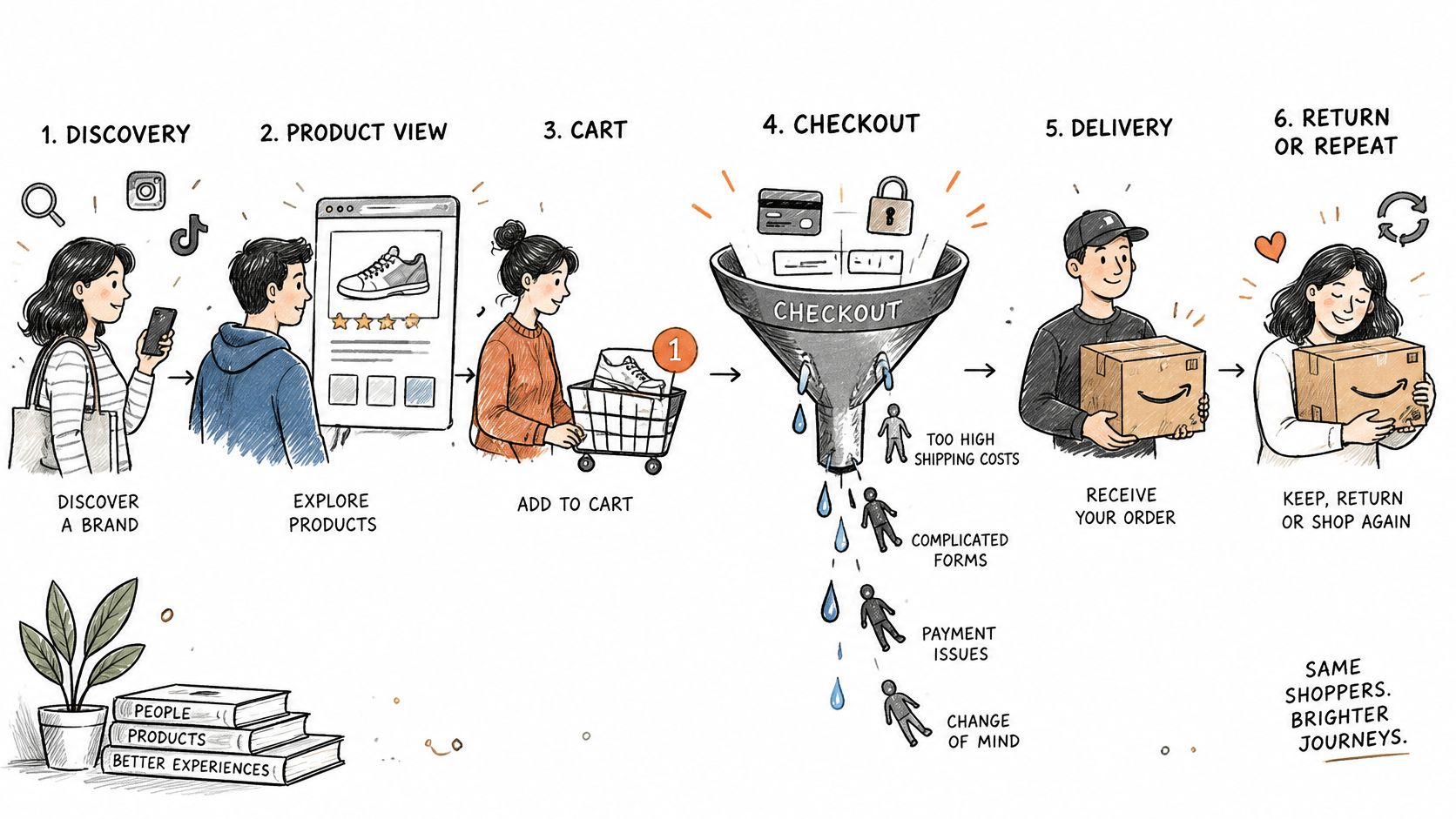
The journey runs through discovery, product view, cart, checkout and delivery, then the return or repeat purchase that follows. Each stage leaks differently. Weak product data loses shoppers at the product view. Surprise costs lose them at the cart. But checkout is where intent is highest and the mechanical friction is worst.
The Checkout Leak in Numbers
Baymard's checkout usability benchmark found that the average U.S. checkout exposes 23.48 form elements by default, while usability testing indicates an optimized flow can be reduced to approximately 12 elements. Baymard's quantitative research reports that 17% of shoppers abandoned an order because the checkout was too long or complicated, 18% because account creation was required, and 40% because extra costs such as shipping, taxes or fees were too high.
Every unnecessary field is interaction cost. It adds cognitive load and creates another chance for a validation error, a formatting rejection or a moment where the shopper decides the purchase isn't worth the effort. Mobile raises the stakes, since Adobe reported 56.4% of online transactions during the 2025 holiday season occurred on smartphones, where typing is slower and networks are less reliable. Delivery expectations set at this stage matter just as much, which is why local references such as Sendaparcel's Melbourne clothing delivery guide are useful when a store promises same-day options in a specific city.
The Fix in Five Steps
- Show the total landed cost before payment, including shipping, taxes and fees, so price shock happens at the cart rather than at the card step.
- Allow guest purchase and offer account creation after the order, using details already entered.
- Reduce fields with address autocomplete and inferred billing details, and drop any field the order doesn't need.
- Preserve the cart and entered data after a validation error, so one rejected field never wipes the form.
- Record abandonment by step and error code, segmented by device, browser and payment method.
Step five is the one teams skip, and it's the one that pays. An aggregate conversion rate can't distinguish price resistance from a broken postcode field, so teams end up discounting to fix a technical fault. Payment choice belongs in the same analysis, since Baymard identifies preferred-payment absence as a cause of abandonment for 9% of shoppers, and the design patterns that support all of this are covered in WebinOne's guidance on ecommerce web design.
Platform Needs for Delivery and Cross-Border Selling
WebinOne treats delivery options as checkout data rather than a warehouse afterthought, because the delivery promise is made at the moment of purchase and judged from that moment on. A store that reveals its real delivery terms after payment has already spent its credibility.
DHL's 2025 Online Shopper Survey, covering 24,000 shoppers across 24 countries, found that 81% of global consumers abandon a purchase when their preferred delivery option is unavailable. Slow delivery was identified as the leading reason shoppers abandon carts. The mechanical implication is that checkout has to expose realistic delivery methods, costs and dates before payment, and the platform has to support every fulfillment mode the market uses, including home delivery, parcel lockers, parcel shops and other out-of-home locations.
Cross-Border Demand Is Already Mainstream
DHL's 2025 online shopper demographics report reports that 70% of global shoppers purchase from online retailers based outside their home country, while 92% prioritize fast, free delivery and hassle-free returns. Those two figures together define the cross-border problem. Demand is international, but tolerance for friction is not, so a storefront that accepts an overseas order and then surprises the buyer with duties, tax or a three-week delivery window loses a sale that product demand had already won. Wiring the carriers, tax services and order systems together is the work described in WebinOne's overview of ecommerce integration services.
The Requirements Checklist
- Localized pricing and content per market, so currency, sizing and product claims match local expectations.
- Landed cost calculation with duties and tax included before payment, not estimated in a footnote.
- Returns routing per market, with a local drop point or label process the customer can use.
- Payment methods by country, since a card-only checkout excludes buyers in markets where wallets or bank transfer dominate.
- A support path for each market, so a delivery question doesn't land with a team that can't see the order.
Returns policy deserves the same discipline. Setting one global free-return rule because a competitor offers it ignores the economics underneath. A free return on apparel can protect conversion and still hold margin, since the item is light and resalable. The identical rule on heavy goods can erase the margin on every returned order. Policy should be set by market and product category, modeled against basket size and repeat purchase value, and configured in the platform rather than promised in marketing copy the warehouse can't honor. Teams scoping that rebuild can start with a conversation through WebinOne for enterprise.
KPIs That Show Whether the Store Works
WebinOne reports over carts, orders and CRM records in one place, so the numbers below can be read as a connected stack rather than as exports from separate tools that never reconcile. A store doesn't need forty metrics. It needs these eight, defined once and segmented properly.
| KPI | Formula | What It Reveals |
|---|---|---|
| Conversion rate | Orders divided by sessions | Whether traffic turns into purchases |
| Average order value | Revenue divided by orders | Basket size and upsell effect |
| Cart abandonment rate | 1 minus completed orders divided by carts created | Checkout friction and price shock |
| Customer acquisition cost | Marketing spend divided by new customers | Cost to win a first purchase |
| Repeat purchase rate | Customers with two or more orders divided by all customers | Retention strength |
| Customer lifetime value | Average order value times purchase frequency times retention period | How much a buyer is worth over time |
| Return rate | Returned orders divided by total orders | Margin lost to fit, product and policy |
| Refund and dispute rate | Refunds and disputes divided by total orders | Quality of post-purchase execution |
The Order to Read Them In
Start with conversion rate and cart abandonment rate, which show whether the funnel works at all. Move to average order value for basket behavior, then repeat purchase rate and customer lifetime value, which show whether the store is building a base or renting traffic forever. Customer acquisition cost only means something against lifetime value, since an expensive first order is fine when the buyer returns and ruinous when they don't. Teams building a reporting baseline can compare their definitions against NanoPIM's reference on measuring ecommerce performance in 2026.
The two metrics many teams track too late are return rate and refund and dispute rate. Both measure post-purchase execution rather than marketing skill. A rising return rate by product points at sizing data, imagery or product quality. A rising dispute rate points at delivery failures and slow refunds, problems no campaign can offset.
A healthy blended conversion rate can hide a mobile checkout that loses most of its buyers.
That's the central reporting trap. Say desktop converts strongly while mobile shoppers hit a payment error on one browser. The aggregate number looks acceptable, the team buys more traffic, and the leak gets more expensive. Segment every KPI by device, geography, browser and payment method, and the failure becomes visible in one report. Instrument four events first, cart creation, checkout step entry, payment success and refund, all against the same customer record, and the automation options in WebinOne's guide to e-commerce marketing automation can then act on real behavior rather than on guesses.
What B2C Means for Site Architecture and Marketing
WebinOne puts content, commerce and CRM in one layer, so site architecture can follow the catalog and customer data model instead of the design brief. That ordering sounds abstract until a redesign ships with beautiful category pages that don't match how the products are structured.
Architecture Follows the Catalog
Category structure should be built from the product attributes shoppers filter by, such as size, material, compatibility or use case. If customers filter by it, it belongs in the data model as a structured attribute, not buried in description copy. Faceted navigation then becomes a query over clean data, and it stays fast on mobile because the platform isn't parsing text to build filters at request time.
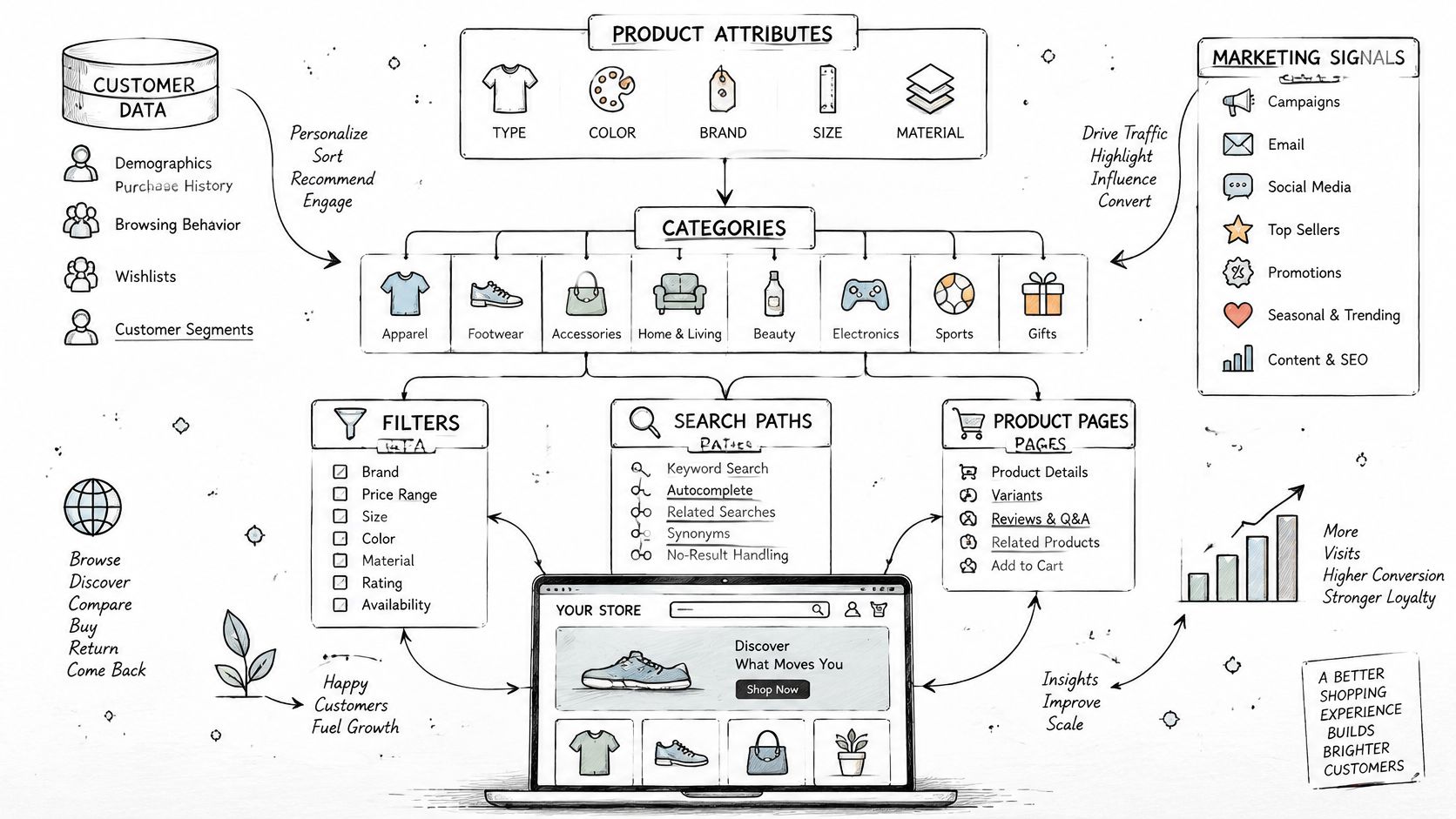
Product data also has to stay consistent across markets. Say a retailer runs a separate site per market and each team edits its own copy of the catalog. Within a year there are three conflicting versions of the same product, with different specifications, different images and prices that no longer reconcile. Shared product data with market-level overrides for price, language and compliance copy prevents that drift, and it's a governance decision, not a design decision. Multi-brand operators need the same rules stated plainly, covering which brand owns which category, which markets carry their own pricing and content, and who can publish where.
Editorial pages, buying guides and category stories belong in the same system as the catalog. When content and commerce share one structure, internal links point at live products, category copy and product pages reinforce the same search intent, and a discontinued item doesn't leave orphaned guide pages ranking for products nobody can buy. Where a separate front end or app is justified, a headless API serves the same content and commerce data to it, so the channel multiplies without the data forking.
Marketing Follows the Customer Record
Segmentation should run on purchase history and frequency, not on demographics alone. A customer who buys every quarter needs a replenishment prompt timed to that cycle. A one-time buyer from a discount campaign needs a different offer, or none. Email triggers built on cart and browse events work because they respond to behavior the platform recorded, and campaigns should be judged against repeat purchase rate rather than opens, since an opened email that never produces a second order is activity without revenue. Architecture, data and marketing aren't three projects. In a B2C store they're one system described three ways.
Confirm Your B2C Platform Plan With the WebinOne Team
WebinOne's position is that the commerce layer belongs in the same system as content and customer data, and the next step is a conversation with the WebinOne team about a partnership or migration through WebinOne for enterprise and integrators. Bring three checks to that conversation.
- The revenue model: which rows of the business model table apply now, and which arrive within two years. This settles required capabilities such as subscriptions, seller management or shared inventory.
- The KPI baseline: current conversion, abandonment, return and dispute rates by device and market. This settles whether checkout can run and be measured on one data model.
- Fulfillment modes and returns rules per market: delivery options, landed cost handling and return terms by category. This settles which markets need separate configuration.
The proof points enterprise and integrator readers usually ask about are on record. WebinOne has thousands of sites migrated, 99.99% uptime with a 99.95% availability commitment in its published SLA, AWS Partner status with the AWS Foundational Technical Review passed, and availability on AWS Marketplace. WebinOne charges zero transaction fees on ecommerce stores, catalogs, payments and marketplaces built on WebinOne.
The decision underneath every section of this guide is singular. Either the commerce layer lives with content and customer data from the start, or the agency pays to rebuild it there later.