AWS GovCloud Explained: Scope, Compliance and Assessment
The usual advice is to pick AWS GovCloud and treat the compliance question as closed. That advice fails the first time a control-plane call, a model activation, or a support tool reaches outside the partition. A region choice sets the floor. It does not describe the stack.
AWS GovCloud is an isolated AWS environment for U.S. government agencies, contractors, and other organizations with sensitive workloads. WebinOne delivers those projects with systems integrator partners, including licensed deployments that can run in an integrator's or a customer's own AWS account by agreement. Before design starts, the work is a dependency and data-flow matrix: which services stay inside, which administrative paths leave, who can touch each path, and which evidence the security owner will accept.
Table of Contents
- GovCloud Regions and What Isolation Changes Your Architecture
- Compliance Frameworks and What Each One Covers
- Where the Compliance Boundary Leaks
- How to Classify Each Dependency Before You Commit
- Who Controls What Under the Shared Model
- Confirm Your GovCloud Scope With Our Team
GovCloud Regions and What Isolation Changes Your Architecture
AWS GovCloud (US) is an isolated AWS environment for U.S. government agencies, contractors, and regulated organizations with sensitive workloads, and WebinOne delivers projects on it with systems integrator partners. Access is limited to eligible U.S. entities and screened root-account holders, so a commercial AWS account is not a substitute login.
The AWS Public Sector account of the program's history records that AWS GovCloud (US-West) launched on August 16, 2011, and that AWS GovCloud (US-East) arrived in 2018 to add geographic separation for resiliency and disaster recovery. The same account describes the environment as addressing federal, state, and local government customers, plus contractors, educational institutions, and other organizations running sensitive workloads. GovCloud stays limited to the United States and sits apart from standard commercial regions.
AWS GovCloud (US) describes the two regions as physically and logically isolated sovereign regions, separate from standard AWS Regions at both the infrastructure and network levels. Each region provides three Availability Zones, built from multiple geographically distributed data centers. AWS GovCloud (US) FAQs state that the regions are operated by U.S. citizens on U.S. soil, with personnel access restricted to vetted U.S. citizens and kept distinct from other AWS Regions.
| Attribute | AWS GovCloud (US-West) | AWS GovCloud (US-East) |
|---|---|---|
| Launch date | 16 August 2011 | 2018 |
| Availability Zones | Three | Three |
| Isolation | Physically and logically isolated from standard AWS Regions | Physically and logically isolated from standard AWS Regions |
| Operating staff | U.S. citizens on U.S. soil | U.S. citizens on U.S. soil |
What the isolation forces you to design
Isolation is a control and a constraint at the same time. It reduces accidental movement of data into a commercial region. It also means you cannot assume the connectivity, credentials, or consoles you use everywhere else.
Local failure and regional failure are different designs. Run the workload multi-AZ inside one GovCloud region so a single Availability Zone failure does not take the site down. When the recovery target includes a regional outage, replicate encrypted backups or application state to the other GovCloud region. That second copy is a scheduled, explicit transfer. It is not something the partition does for you.
Credentials and endpoints are separate. Cross-region designs inside GovCloud need their own data-transfer or replication mechanisms. Service lists also differ, so a pattern that works in one GovCloud region can be missing, console-less, or API-only in the other. Plan CI/CD, observability, and identity federation against the endpoints you will call.
Identity is split, not mirrored. Amazon EC2 on-demand pricing documentation for the GovCloud partition is the wrong page to learn price from, but AWS's own GovCloud IAM description is unambiguous on structure: there is one IAM control plane for all GovCloud regions, located in US-West, while each region has a completely independent IAM data plane. Central policy lives in one place. Regional authentication and authorization behavior does not. A policy change is not the same event as a regional data-plane outage, and a runbook that treats them as one failure mode will send people to the wrong console.
Practical rule: A commercial region is not a fallback. Traffic does not move freely between the GovCloud partition and standard AWS Regions, so "we'll fail over to Virginia commercial" is an export of the workload, not a recovery plan.
A citizen portal that stays inside the boundary
Say a state agency is replacing a citizen portal. The application tier and the database run multi-AZ in US-West. Encrypted backups replicate to US-East on a fixed schedule, with a tested restore, not a folder that nobody has opened. The build runners, artifact store, log destination, and on-call dashboards are rebuilt on GovCloud endpoints. Federation into the portal uses roles whose trust policy points at identities the agency already screens. Nobody adds a commercial-region log shipper "just for the pilot."
Before that portal is funded, hold this checklist for each workload:
- Recovery targets: The recovery time and recovery point, and which of the two GovCloud regions is primary.
- Replication path: The mechanism, schedule, encryption, and the person who runs a restore test.
- Identity scope: Which policies are administered through the US-West control plane, and which regional data plane each application calls.
- Tooling rebuilt inside GovCloud: CI/CD, observability, DNS changes that touch the app, and any admin workflow that would otherwise leave the partition.
Compliance Frameworks and What Each One Covers
GovCloud carries authorizations for several frameworks, but coverage is service-specific rather than a blanket label, and WebinOne confirms scope for each project rather than assuming a badge covers the stack.
AWS's FedRAMP compliance page states that GovCloud holds FedRAMP Class D certification, the designation formerly known as the FedRAMP High baseline, and that its regions support Department of Defense Cloud Computing Security Requirements Guide Impact Levels 2, 4, and 5. On that scale, Impact Level 4 covers controlled unclassified information, and Impact Level 5 addresses more sensitive unclassified workloads that need stronger controls and dedicated or restricted environments. The same page identifies support for ITAR, CJIS, FISMA High, and HIPAA, with the exact services covered varying by program and region. AWS also reports two FedRAMP Joint Authorization Board provisional authorizations, one for the GovCloud regions and one for the standard U.S. East and West regions. A name on that list is a scope line. It is not approval of every API you might turn on. For how inheritance and hosting choices interact on federal work, see WebinOne's note on FedRAMP hosting.
| Framework or Standard | Workloads It Covers | What to Verify |
|---|---|---|
| FedRAMP High (Class D) | Federal cloud workloads at the high baseline | Each intended service appears in the authorized scope |
| DoD SRG Impact Level 2 | Lower-sensitivity unclassified workloads | Service list and region match the IL2 scope |
| DoD SRG Impact Level 4 | Controlled unclassified information | Data flows and access roles meet IL4 controls |
| DoD SRG Impact Level 5 | More sensitive unclassified workloads | Dedicated or restricted environment requirements are met |
| ITAR | Export-controlled technical data | Personnel access and data location are documented |
| CJIS | Criminal justice information | Access controls and logging meet CJIS requirements |
| FISMA High | High-impact federal information systems | Control inheritance and system boundary are documented |
| HIPAA | Protected health information | Scope confirmed for each intended service |
Read each row as a different obligation
FedRAMP High (Class D) is about the federal high baseline and the services inside that authorization. Confirm each intended service appears in scope before anyone draws it on an architecture diagram.
Impact Levels 2, 4, and 5 are not a ladder you climb by picking a bigger instance. IL2 is the lower-sensitivity unclassified case. IL4 is where controlled unclassified information, data flows, and access roles have to match the control set. IL5 is where dedicated or restricted environment requirements show up, and a shared commercial pattern copied into the account will not satisfy them.
ITAR pulls personnel access and data location into the evidence pack. CJIS pulls access control and logging for criminal justice information. FISMA High asks for a documented system boundary and a clear story of which controls you inherit. HIPAA still requires a per-service scope check for protected health information, even when the region is already in use for other programs.
A framework name on a slide is not approval of the workload. The approvable object is the service list, the data flows, and the people who can reach them.
The practical step is short. List every intended service. Check that list against the frameworks this program must meet. Send the list to the integrator before design begins, while changing a service is still cheap.
Where the Compliance Boundary Leaks
A GovCloud region does not make the whole stack compliant, so WebinOne separates the platform running in GovCloud from the integrations and tooling around it, and maps each one.
The popular shortcut, "the data is in GovCloud, so the system is inside the boundary," breaks on activation mechanics. The AWS GovCloud (US) newsletter describes a recent case in which access to a frontier model required accepting the end-user license agreement in a paired commercial AWS account before the model could be enabled in GovCloud, with permissions spanning GovCloud and commercial destinations. That is the pattern. A high-value feature can be "available in GovCloud" and still depend on a commercial-account click, a commercial permission, or an administrative workflow that never touches the application database.
What commonly leaves, and the evidence to collect
Treat the following as a review checklist, not a rumor list. For each row, the security owner should be able to point at a document, not a verbal assurance. The same review is where data sovereignty and data residency stop being slogans and become a map of endpoints.
| Dependency | Where It Can Leave GovCloud | Evidence to Collect |
|---|---|---|
| Model activation | License acceptance or permissions in a paired commercial account | Activation record and permission map |
| Control-plane actions | Administrative APIs or workflows that reach other partitions | Action log for each administrative path |
| DNS | Public zones hosted outside the boundary | Zone ownership and record list |
| CI/CD pipeline | Build runners or artifact stores outside the boundary | Pipeline configuration and runner locations |
| Observability | Metrics and logs shipped to commercial tools | Destination endpoints and retention settings |
| Email provider | Transactional email sent through a commercial service | Provider data processing terms and region |
| Payment service | Payment metadata sent to a processor | Processor data map |
| CRM and third-party integrations | Synced records sent to external SaaS | Field-level data-flow list |
| Support tooling | Tickets containing controlled data in external systems | Ticket handling policy and access list |
Model activation is the loud example, but control-plane actions can also fail. An administrative API, a billing lookup, or an account-bootstrap workflow can reach another partition while the application data never moves. DNS often lives in a registrar or a commercial zone that nobody put inside the authorization boundary. CI/CD fails the same way when the runners sit in a commercial account "because that is where the agency's other pipelines are."
Observability, email, payments, CRM, and support are where a citizen portal leaks after the compute decision looks clean. Metrics and logs shipped to a commercial tool are a data flow. Transactional email is a data flow. Payment metadata is a data flow. A CRM sync that copies case notes is a data flow. A ticket that pastes a screenshot of production is a data flow. None of those are fixed by selecting US-East or US-West.
A platform can keep application data in GovCloud while the deployment pipeline, analytics, or support desk sits somewhere else. That split can be acceptable. It is only defensible when the data-flow and operator-access matrix says so, names the destination, and names who may use it. When that matrix is ready to review, bring it to a conversation with the WebinOne team. New GovCloud capabilities keep arriving, and their activation mechanics are not uniform across regions or partitions, so the matrix has to be rebuilt when the service list changes.
How to Classify Each Dependency Before You Commit
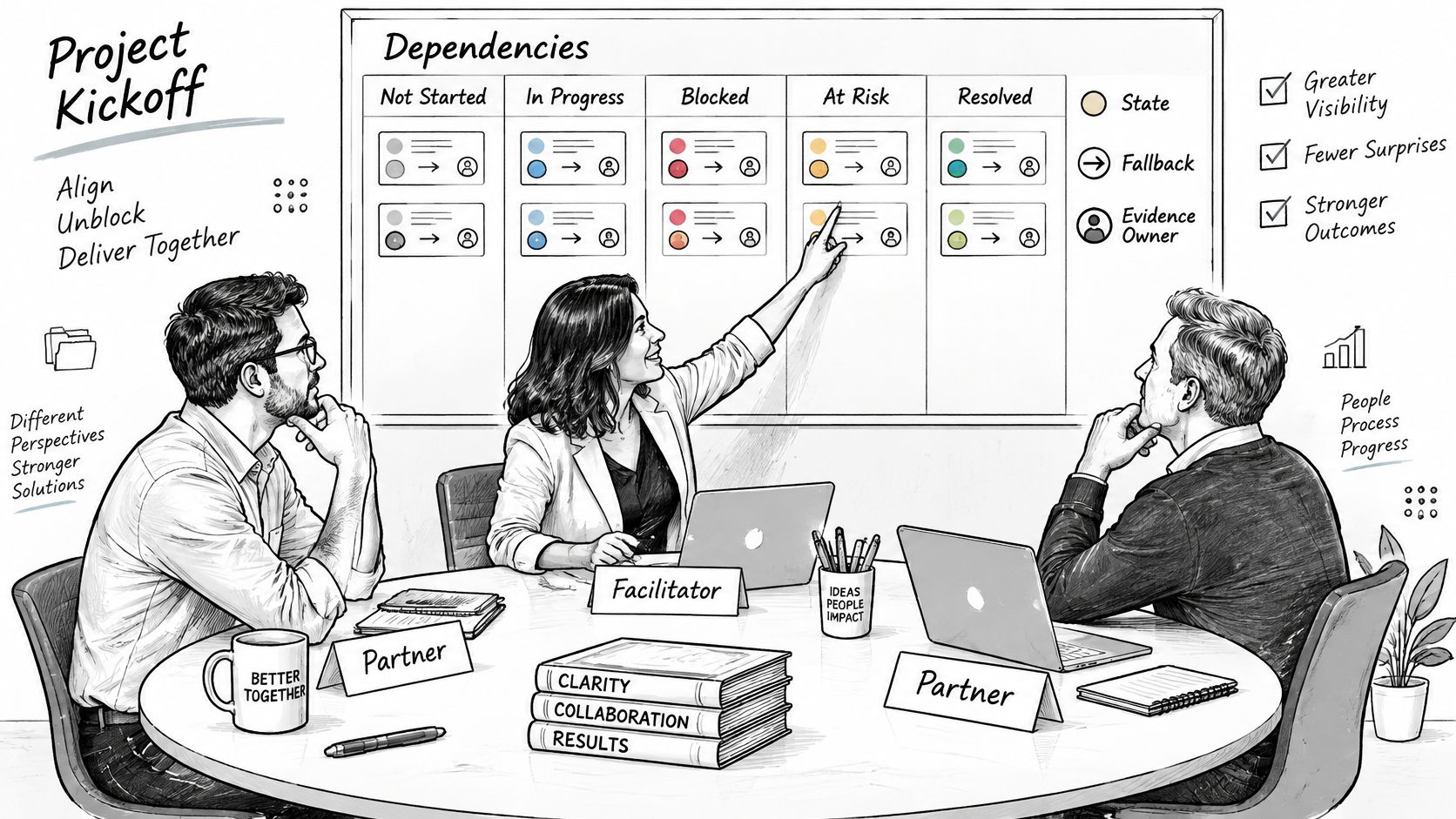
WebinOne runs this classification with partners at project kickoff, and the output is a list where every dependency has a state, a fallback, and an evidence owner before build starts.
The AWS GovCloud (US) service newsletter shows why a supported-services webpage is not an operating plan. MWAA Serverless became available in both GovCloud regions, but its console was not available there, so teams had to operate it through the CLI, REST API, or SDK. The same service history lists continuing exclusions, including Amazon Inspector managed code-repository scanning in GovCloud. Capability is also expanding. AWS has announced GovCloud support for services such as AWS Transform and additional Bedrock tools. One Army-related example in that coverage claimed a reduction in authorization-cycle time from 12 months to 3 months for an agentic-engineering MVP. GovCloud is not slower AWS. It rewards teams that engineer around missing consoles, delayed feature parity, and authorization evidence, and it punishes teams that assume commercial parity.
For a multi-site platform, CMS, commerce, CRM, email, monitoring, backups, and headless integrations can each land in a different state. A headless CMS on AWS still has to be classified service by service when the target is GovCloud. Operational completeness is the buying question, not whether the compute service exists.
Seven outputs, in order
Write the inventory before you classify anything. List every service, API, third-party integration, and administrative path the workload touches, including DNS, email, and the ticket system. The output is one list the room can hold, not a diagram with unnamed clouds.
Assign one of five states. Mark each item available, API-only, delayed, unsupported, or needing a commercial-region bridge. The output is the same list with a state on every row and no blank cells.
Turn API-only items into a runbook. If the console is missing, as with MWAA Serverless in both GovCloud regions, write the CLI, REST API, or SDK steps, including who may run them. The output is a runbook a new operator can follow without the commercial console.
Give delayed and unsupported items one shared fallback. Do not invent a second deployment path for the "GovCloud version" of the site. Keep one path for every environment, and drop the feature that cannot travel with it. The output is a fallback that does not create a two-speed platform.
Name an evidence owner and the document. For each dependency, one person produces one artifact: a service-scope screenshot, a data-flow row, a permission map, or a restore test record. The output is a name and a document title, not a team alias.
Put a review date on the list. Feature parity moves. Announced support for AWS Transform and additional Bedrock tools can land while Inspector managed code-repository scanning stays excluded, so the gap you accepted this quarter may not be the gap next quarter. The output is a dated review, owned by the same person who owns the inventory.
Make the go or no-go decision in writing. Any commercial-region bridge needs security-owner sign-off before it enters the build. If that sign-off is missing, the item stays unsupported and the design changes. The output is a signed decision, not a Slack thread.
GovCloud pays off for approved mission workloads when the missing console, the delayed feature, and the evidence owner are designed in. It does not pay off as a region checkbox on an otherwise commercial pipeline.
Who Controls What Under the Shared Model
AWS restricts its own administrative access to vetted U.S. citizens, but you control who can reach your content and what each user can do, and WebinOne runs the managed platform layer while your partner carries the account design, the roles, and the evidence.
AWS's side is narrow on purpose. Personnel who support the partition are restricted, and that restriction is not something your project configures. Your concern is the identities you create, the roles you attach, and the paths those roles can take into production, staging, backups, and logs.
Your side is the access program. Design least-privilege roles. Separate duties so the person who builds a change is not the person who approves it into production. Log administrative actions and keep those logs inside the boundary you already classified. Where export-controlled data is in the account, use IAM roles as part of the export-control program, and treat correct use of those roles as the customer's responsibility. AWS restricting its own administrators does not restrict yours.
Say a contractor is building the citizen portal. The developer role can deploy to staging and cannot read production data or production backups. A separate approver, inside the agency, publishes the change. The contractor's ticket tool is the one already on the matrix, so a production screenshot never lands in an external desk. That split is boring. It is also the control an assessor can test.
A regional AWS event is still your recovery problem. WebinOne is not responsible for outages caused by problems with Amazon Web Services availability. Recovery has to be in the workload design, using the two GovCloud regions, the replication path, and the restore test you already named. The managed platform layer does not absorb an AWS regional failure, and a contract clause will not rebuild a pipeline that only existed in one region.
Before build starts, write the split down:
- Identity: who creates roles, who approves them, and which control plane those roles live in.
- Logging: where admin actions and application logs go, and who can read them.
- Recovery: who runs the restore, against which region, and how often it is tested.
- Export-control evidence: which roles are in the program, and who confirms they are used as designed.
Confirm that page in writing. If a row has no name, the workload is not ready to build.
Confirm Your GovCloud Scope With Our Team
The next step is a conversation with the WebinOne team about a partnership, a migration, or a licensed deployment.
Bring four inputs, and the meeting can stay on scope instead of on orientation.
- The classified service inventory. Every dependency has a state, a fallback, and an evidence owner.
- The data-flow diagram. It shows where application data, logs, backups, and email travel, including any commercial-region bridge.
- The operator-access matrix. It names who can reach each environment, including contractors and support paths.
- The frameworks and the recovery targets. List what the program must satisfy, and the recovery time and recovery point for each site.
Systems integrators use WebinOne as the platform layer in enterprise and government projects. WebinOne works with those partners on government projects. For qualifying systems integrators, a licensed version can run in the integrator's or the customer's own AWS account, including AWS GovCloud, by agreement. WebinOne is an AWS Partner, has passed the AWS Foundational Technical Review, holds the AWS Qualified Software designation, and is enrolled in the AWS Software and Services Paths. U.S. and Australian government clients already use the platform for secure, compliant web presence. Scope for a given engagement is confirmed against the frameworks and the services on your list. That confirmation is per project, and it is not something a region name can stand in for.
Book the conversation and bring the four inputs. If the inventory or the data-flow diagram is still a draft, send the draft. A gap found before design is a scheduling problem. The same gap found after a commercial pipeline is wired in is a redesign.
Bring your service inventory, data-flow diagram, operator-access matrix, and recovery targets to a partnership or migration conversation with the WebinOne team. We will confirm what can run inside AWS GovCloud with your systems integrator, including a licensed deployment in the integrator's or the customer's own account where that agreement fits the project.