Headless CMS on AWS
A headless CMS on AWS is no longer an experimental architecture. One market estimate puts the category at USD 1.30 billion in 2024, rising to USD 1.51 billion in 2025 and projected to reach USD 3.04 billion by 2030, a forecasted 15.08% CAGR. The figures show why agencies, systems integrators, and enterprise teams now need to evaluate headless delivery as an operational decision, not just a frontend preference. (Market estimate for headless CMS software)
For delivery teams, the important question isn't whether APIs can serve content. They can. The question is who owns downtime, patching, incident response, cache invalidation, database tuning, and the support queue after launch. A managed DXP on AWS gives agencies and SIs a way to move clients toward decoupled delivery without turning every client site into another infrastructure product they must operate.
Table of Contents
- Why Headless CMS on AWS Matters Now
- Managed DXP vs Self-Hosted on EC2, EKS, and Fargate
- Building a Serverless Headless Architecture on AWS
- Scaling, Availability, Security, and Data Residency
- Why Agencies and SIs Should Consider a Managed White-Label DXP
- Migration Checklist and Reference Architecture for Agencies
Why Headless CMS on AWS Matters Now
WebinOne treats headless delivery as an operational foundation, not a fashionable frontend pattern. The platform has a headless CMS, APIs, and managed hosting on AWS, allowing agencies and SIs to separate content delivery from presentation while keeping day-to-day platform risk under control.
The category's growth reflects a broader architectural shift. Headless CMS developed alongside cloud adoption, omnichannel delivery, and microservices-based systems. Contentful's launch in 2013 is often cited as an early commercial milestone, while independent commentary places wider API-first adoption around 2016. AWS now publishes a dedicated explanation of headless CMS architecture and positions it as a cloud pattern for secure, scalable content delivery. (Historical development of headless CMS)

The business impact is operational
A decoupled frontend can consume the same structured content for websites, applications, portals, and other channels. That reduces the need to duplicate content and gives technical teams more control over rendering, caching, and delivery. It also changes the incident profile. The frontend may remain available while an editorial workflow, origin API, search layer, or cache invalidation process causes the failure.
AWS highlights CloudFront as the edge delivery layer for headless architectures. That means performance depends less on traditional CMS page rendering and more on cache hit ratio, origin API efficiency, payload design, and invalidation discipline. A fast frontend can't compensate for an origin that is poorly modeled or an API that returns too much data. (AWS guidance on headless CMS architecture)
For an agency, that distinction affects margin. A client doesn't usually care whether an outage began in a database query or an edge rule. The agency still receives the escalation, coordinates the diagnosis, and carries the relationship cost. A platform choice that shifts routine operations away from the delivery team can therefore be more valuable than another frontend feature.
AWS maturity changes the buying conversation
AWS support for headless CMS architectures signals that the model belongs in enterprise cloud planning. The relevant evaluation points are now practical:
- Workload ownership: Determine which party handles upgrades, backups, security controls, observability, and incident response.
- Channel reuse: Confirm that content can serve the required web, app, commerce, and portal experiences without duplicating editorial work.
- Residency and governance: Establish where content runs, who can access it, and how a multi-site estate is administered.
- Commercial control: Include support effort, migration work, and post-launch incidents in the platform cost.
WebinOne's AWS Partner status and completed AWS Foundational Technical Review are relevant to this conversation because agencies and SIs need more than a diagram. They need a platform and operating model that can survive production ownership. (WebinOne's AWS Partner and FTR announcement)
Managed DXP vs Self-Hosted on EC2, EKS, and Fargate
WebinOne provides the managed path, while self-hosting on EC2, EKS, or Fargate leaves the partner responsible for the platform's operational lifecycle. Both paths can use AWS services, but they don't create the same workload for an agency or SI.
A self-hosted headless CMS often begins with a reasonable goal: keep control of infrastructure and pay only for what the workload uses. The hidden cost appears after the first deployment. Someone must manage image updates, scaling policies, database capacity, secrets, logging, backups, deployment failures, and emergency remediation. If the team sells a portfolio of sites, those duties multiply across environments and client requirements.
A managed DXP consolidates the application layer instead. WebinOne combines CMS, ecommerce, CRM, email marketing, multi-site management, and a headless API in one managed system. It runs on AWS across six global regions, while a qualifying SI can use a licensed deployment in its own or its customer's AWS account by agreement, including AWS GovCloud.
The risk belongs somewhere
| Hosting path | Who manages the platform | Typical partner workload |
|---|---|---|
| Managed DXP on AWS | The platform provider manages core operations, while the partner manages client delivery and governance | Model content, build experiences, manage client relationships, and escalate platform issues through support |
| Self-hosted CMS on EC2 | The agency, SI, or customer manages the application and infrastructure stack | Patch images, tune databases, maintain backups, handle scaling, secure secrets, monitor incidents, and coordinate releases |
| Self-hosted CMS on EKS | The agency, SI, or customer manages the CMS plus the container and cluster layers | Maintain cluster configuration, deployments, policies, observability, application updates, and recovery procedures |
| Self-hosted CMS on Fargate | The agency, SI, or customer manages the application, task definitions, data services, and delivery controls | Tune tasks, APIs, storage, caching, releases, secrets, and incident response |
The managed route doesn't eliminate technical responsibility. It changes where that responsibility sits. The agency still owns information architecture, frontend behavior, integrations, content quality, SEO, and client governance. It doesn't need to become the permanent owner of every CMS patch and infrastructure alert.
Practical rule: If the same team sells strategy, design, development, hosting, and support, count every recurring operational task against delivery margin before choosing self-hosting.
Operational monitoring also needs clear definitions. Digital experience monitoring measures whether users can complete journeys and interact with the experience. Real user monitoring measures what browsers and users experienced. The distinction is useful when designing escalation policies, and this guide to how DEM differs from RUM gives teams a focused explanation of the two approaches.
WebinOne's managed AWS hosting approach fits agencies that want AWS-backed delivery without assembling a separate operations practice for every client. Self-hosting remains appropriate when the customer explicitly requires direct infrastructure ownership and has the people, process, and budget to operate it continuously. It shouldn't be selected merely because the initial deployment looks straightforward.
Building a Serverless Headless Architecture on AWS
WebinOne can support headless delivery without forcing an agency to own every underlying service. For teams designing a serverless architecture directly, the useful sequence is content storage, media storage, API execution, edge delivery, and controlled invalidation.
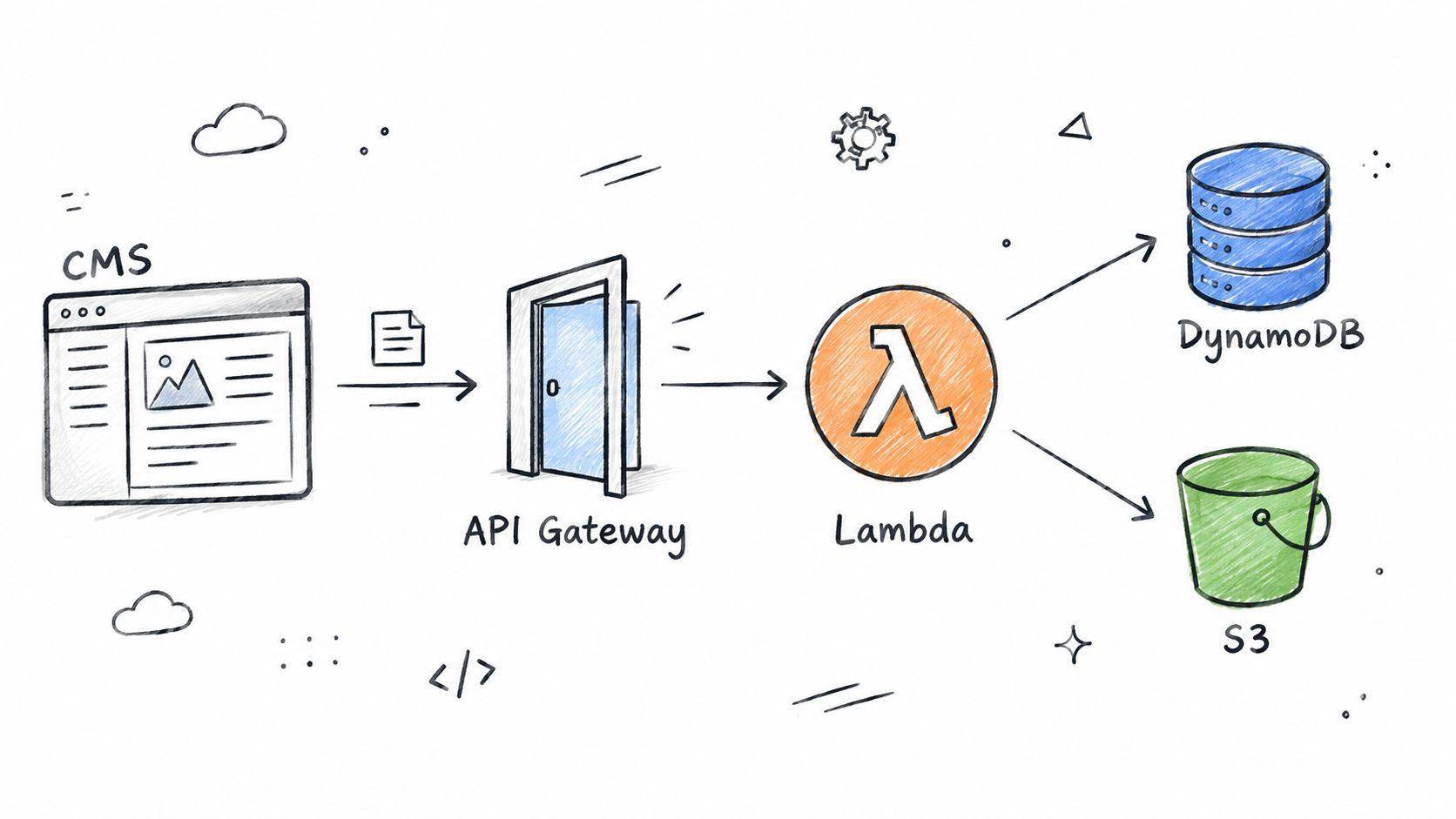
A common AWS pattern uses DynamoDB for content, S3 for media, API Gateway and Lambda for API execution, and CloudFront at the edge. The arrangement separates storage and execution from delivery, which lets teams tune each layer for its actual workload instead of scaling a monolithic application as one unit.
Design the request path deliberately
A practical request path looks like this:
- The client requests content through the edge. CloudFront serves cacheable responses where the request and freshness policy allow it. Static assets and media should avoid unnecessary origin calls.
- The edge forwards misses to the API layer. API Gateway provides the public boundary, while authentication, rate controls, and request validation protect the application path.
- Lambda executes the content operation. Functions should retrieve only the fields required by the frontend. Broad queries create avoidable latency and increase pressure on downstream services.
- DynamoDB returns structured content. Access patterns need to be modeled before launch. A schema that works for editorial writes may perform poorly for high-volume reads.
- S3 handles media separately. Images and files should use an asset path suited to caching and transformation rather than passing large payloads through the content API.
A published benchmarked architecture recorded response times between 88 and 782 milliseconds under load reaching 10,000 concurrent users, with error rates below 2%. The result is useful because it points to the actual engineering problem: cross-service tuning between the database, search layer, cache strategy, and origin API, rather than frontend rendering alone. (Benchmarked serverless headless architecture)
Tune freshness without flooding the origin
Cache invalidation needs a content policy, not a last-minute configuration. Editorial content can tolerate one approach, while stock, account, or transactional data may require another. Teams should define which content is cacheable, how long it remains fresh, what event purges it, and what happens if invalidation fails.
Search deserves separate treatment. A page can load quickly while search remains slow because indexing, filtering, and relationship resolution use a different path. The delivery team should test cold-cache and warm-cache behavior, inspect origin API efficiency, and verify that a content publish event invalidates the correct objects.
The headless architecture guidance from WebinOne is relevant for agencies deciding which content belongs in the API layer and which logic belongs in the presentation layer. The cleanest implementation isn't the one with the most services. It's the one with clear boundaries, predictable failure modes, and an owner for every operational dependency.
Scaling, Availability, Security, and Data Residency
WebinOne gives agencies and SIs a managed availability baseline, with 99.99% uptime over the last 12 months and a 99.95% availability commitment in its published SLA. The platform runs on AWS across six global regions, giving delivery teams a defined hosting foundation without requiring them to assemble regional operations for every deployment.
Scaling a headless system means scaling more than the frontend. Edge caching absorbs repeat requests, horizontal application capacity handles uncached traffic, and data access patterns determine whether the backend remains responsive. A team that only tests the presentation layer can miss the database or search bottleneck that appears under real editorial and user activity.
Availability is a design and ownership decision
A multi-region option can improve resilience, but it also creates replication, failover, data consistency, and operational testing requirements. Agencies shouldn't promise regional redundancy without defining who maintains the runbook and who makes the failover decision. A second region that has never been tested is a document, not a recovery strategy.
The same applies to deployment. CI/CD should separate content changes from application changes where possible, protect production with approvals, and preserve a rollback path. Cache rules must account for release behavior, because a successful deployment can still serve stale or incompatible content if the edge and origin disagree.
A reliable platform is not simply one that stays online. It is one with a clear answer for who detects, diagnoses, communicates, and repairs a failure.
Security moves to the control plane
Headless architecture changes the security workload. The team has fewer presentation concerns tied to the content backend, but it must protect identities, API tokens, secrets, network boundaries, administrative roles, and publishing workflows.
A practical review should cover:
- Identity: Restrict administrative access and separate publishing permissions from development permissions.
- Secrets: Keep credentials out of source code and rotate them through controlled processes.
- API exposure: Validate inputs, limit unnecessary endpoints, and monitor unusual access patterns.
- Content governance: Record who can draft, approve, publish, and revert material across sites and brands.
- Recovery: Test backups and restoration, not just backup completion.
Data residency needs the same specificity. WebinOne supports selectable AWS regional hosting, and a custom data center can be arranged for a client by agreement. For qualifying systems integrators, licensed deployments can run in the SI's or customer's own AWS account, including AWS GovCloud, which supports projects with demanding government or residency requirements. WebinOne delivers FedRAMP and GovCloud projects with SI partners and licensed deployments, with authorization questions handled in the partnership and project assessment.
AWS's Foundational Technical Review is a self-service review for SaaS or customer-deployed solutions. AWS says it helps identify and remediate risks against Well-Architected best practices, can be completed at no cost, and returns a result within minutes. (AWS Foundational Technical Review) Marketplace-listed software solutions can submit FTR validation using either a SOC 2 Type II report or a Well-Architected Framework Review report, and the review must cover the primary AWS-hosted workload. (AWS FTR validation requirements)
Why Agencies and SIs Should Consider a Managed White-Label DXP
WebinOne gives agencies a white-label DXP and gives SIs a managed platform option for AWS delivery. The argument is straightforward: partners should spend their scarce operational capacity on client outcomes, not on rebuilding the same patching, monitoring, and recovery process for every site.
A white-label platform matters because the client relationship remains with the agency. Client portals, branding, billing, support tickets, templates, sites, and staff administration can operate under the agency's identity. The agency can also manage multiple sites from a central console rather than treating every installation as an isolated technical estate.
That changes the economics of platform work. Agencies can package migration, governance, SEO, content operations, and ongoing support as a managed service instead of absorbing infrastructure work as unbilled maintenance. SIs can define a clearer boundary between their solution architecture and the platform's routine operations.
Consolidation is useful when it removes coordination
The managed DXP combines CMS, ecommerce, CRM, email marketing, multi-site management, and a headless API. It also provides 300+ APIs and webhooks for integrations and headless delivery. That doesn't mean every client needs every capability. It means the delivery team can establish one governed foundation and activate the parts required by each project.
The platform includes native extensions rather than relying on a growing collection of third-party plugins. That matters operationally because every external dependency introduces another update cycle, compatibility question, and support boundary. A managed platform doesn't remove customization, but it makes the customization boundary more deliberate.
- For agencies: White-label administration supports reseller delivery, while templates and reusable patterns reduce repeated setup.
- For SIs: A licensed deployment in a qualifying customer's AWS account can preserve account ownership requirements without making the SI responsible for developing the entire CMS platform.
- For enterprise teams: Multi-site governance, API access, regional deployment choices, and managed support provide a common operating model for a distributed estate.
WebinOne is an AWS Partner, has passed the AWS Foundational Technical Review, holds the AWS Qualified Software designation, is enrolled in the AWS Software and Services Paths, and is available on AWS Marketplace. These facts don't replace a workload review. They give procurement and architecture teams concrete checkpoints before discussing migration scope.
Agencies evaluating broader alternatives to conventional agency delivery can also review Vision as an agency alternative for a different perspective on how delivery models are changing. The key decision remains operational: whether the proposed model leaves the agency carrying production risk after the project closes.
Ecommerce is available with zero transaction fees on all plans. Custom ecommerce work is scoped as a TeamOne project, so complex requirements still need explicit discovery, acceptance criteria, and delivery boundaries. Pricing starts from $10 per month per site, and paid partner support is available for agencies that need a defined escalation path.
Migration Checklist and Reference Architecture for Agencies
WebinOne uses a staged migration process because a headless move exposes content, integration, and governance gaps quickly. Thousands of sites have been migrated, including complex live-site programs and large platform transitions, so the practical priority is controlled execution rather than a risky one-time rewrite.
A sound migration has four workstreams:
- Inventory and model: Identify content types, relationships, redirects, media, forms, users, integrations, and publishing rules. Separate reusable structured content from presentation-specific markup.
- Build and map: Create the target content model, map APIs, rehost media, and connect external services. Define ownership for every integration before testing begins.
- Stage and validate: Run content imports in a staging environment, test editorial permissions, check SEO fields and redirects, verify forms and commerce flows, and compare critical journeys.
- Cut over and observe: Plan DNS and cache transitions, preserve rollback conditions, monitor the live experience, and keep an audit trail of changes before and after launch.
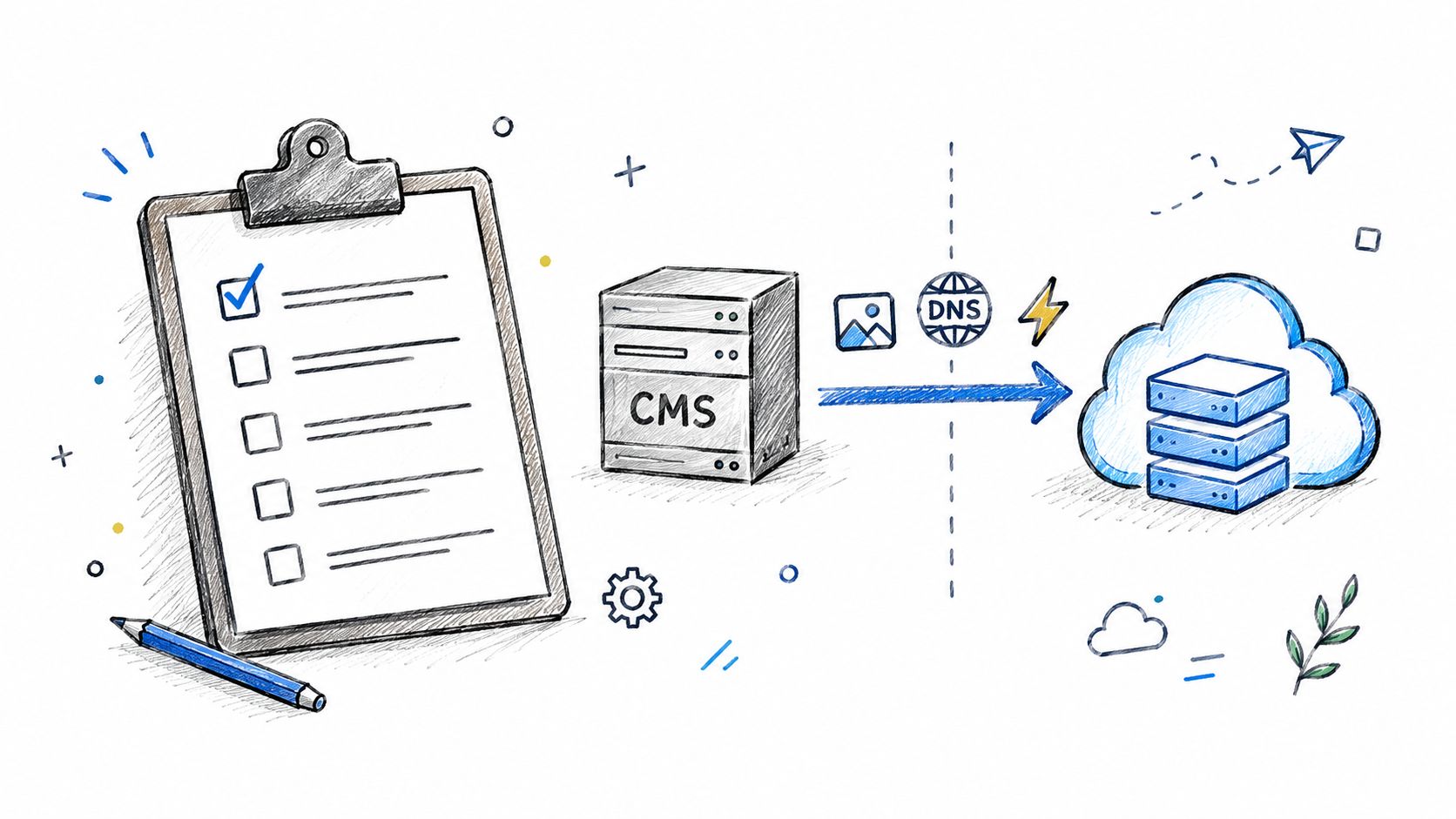
The reference architecture should assign a clear owner to the CMS, API, media path, frontend, edge cache, identity layer, analytics, and incident process. Zero-downtime cutover is achievable when staging, rollback, cache behavior, and content freeze rules are designed before launch, not improvised during it.
Agencies should review the WebinOne reseller program for white-label delivery, partner support, and portfolio governance. SIs, AWS partners, and enterprise teams should request a migration or partnership conversation for complex rescues, bulk estates, licensed AWS deployments, and GovCloud or FedRAMP-related work.
WebinOne provides a managed, white-label DXP with headless CMS delivery, multi-site governance, AWS hosting, APIs, ecommerce, CRM, and operational support for agencies, SIs, and enterprise teams. Visit WebinOne to discuss a migration plan that moves client platforms toward AWS headless delivery without leaving patching, downtime response, and platform ownership on the delivery team.