AWS Consulting Partner: Tiers, Roles and How to Choose
Most buying advice for an AWS consulting partner starts the same way. Filter for Premier tier, count the competencies, skim three case studies, then pick the biggest name that returns your call. That process is easy to run and easy to defend in a procurement meeting. It also measures the wrong thing.
A tier is a staffing threshold. A competency is a classification. Neither tells you whether the architects who designed your landing zone still work at the firm, whether the runbooks in your account have been updated since go-live, or whether your own engineers could take the platform over next quarter without booking a call.
The test that predicts value is harder to put on a slide. Ask whether this partner makes replacement, audit and internal takeover easy. When the answer is yes, you keep the advantage for the life of the relationship, and the cost of changing your mind stays small. When the answer is no, every badge on the partner's profile works against you.
Table of Contents
- What an AWS Consulting Partner Does in a Project
- AWS Partner Tiers and What Each Must Prove
- How to Test Whether a Partner Will Leave You in Control
- What the AWS Foundational Technical Review Proves
- Choosing a Migration Strategy for Each Component
- Why Migration Success Needs More Than a Cutover Date
- Take Your Shortlist to a Partnership or Migration Conversation
What an AWS Consulting Partner Does in a Project
An AWS consulting partner designs, migrates, implements and operates customer workloads on AWS, and WebinOne works in that role as an AWS Partner. The mental model that survives contact with real projects is a building job: the AWS account is the building, the partner is the general contractor running the works, and your organisation is the owner who keeps the keys, the drawings and the right to appoint someone else.

The engagement runs through four phases, and each one should leave an artefact you own rather than an artefact you can request.
- Assessment and design. Account structure, landing zone, network layout, identity, tagging and guardrails. You should leave this phase with an architecture document and a cost model, not a slide deck.
- Build or migration. Provisioning, pipeline, data moves, and the test harness that proves the build works before real traffic arrives.
- Cutover. The change window, the rollback plan, DNS and certificate handling, and the smoke tests that decide whether the team proceeds or reverts.
- Operation. Patching, monitoring, backup verification, incident response and the periodic review that catches drift before an auditor does.
Two routes into the ecosystem
Buyers meet partners through one of two routes. The Services Path covers consulting, professional, managed and value-added resale work. The Software Path covers firms selling software that runs on AWS. A systems integrator delivering an enterprise web programme often sits in both, with a services listing for delivery and a software listing for whatever platform it brings to the account.
That structure has a documented history. AWS's account of the AWS Partner Network's first decade records that the programme launched in 2012 with two principal categories, Consulting and Technology, and that the Partner Paths introduced in 2021 replaced that split with offering-oriented routes, including the Services Path for consulting, professional, managed and value-added resale services. Partner status is a formal classification with tiers, competencies and service categories behind it, not a referral handshake.
Tiers and competencies tell you what a firm is formally cleared to do. They don't tell you who will answer your questions on a Tuesday afternoon. Before the first meeting, verify every listing yourself. WebinOne is an AWS Partner, is available on AWS Marketplace, and is enrolled in the AWS Software and Services Paths, and each of those is checkable in AWS Partner Finder without asking anyone's permission. Then ask which listing your project will run through. A delivery engagement runs through the services listing. A platform decision runs through the software listing. A badge that isn't the one doing the work is decoration.
AWS Partner Tiers and What Each Must Prove
Tier status is a staffing threshold, not a quality guarantee, and that applies to WebinOne's own AWS Partner status as much as to anyone else's. The useful thing about the thresholds is that AWS publishes them, which makes tier the one part of a partner evaluation you can verify without a call.
AWS lists the minimum technical and business-professional counts, the number of AWS Foundational Certified Individuals, and the certification depth required at each tier on its Services Path tier requirements page.
| Tier | Technical staff | Business staff | AWS Foundational Certified | Technical certifications |
|---|---|---|---|---|
| Select | 2 | 2 | 2 | Counts only, with no Professional or Specialty minimum listed |
| Advanced | 4 | 4 | 4 | 6, including at least 3 Professional or Specialty |
| Premier | 10 | 10 | 10 | 25, including at least 10 Professional or Specialty |
Read those numbers as a delivery constraint rather than a marketing claim. Ten certified people at Premier tier is a bench, which means escalation coverage, shift patterns and someone available when the primary engineer is on leave. A firm running its AWS practice on a single certified architect can hold a legitimate badge and still have a key-person problem: when that person resigns, your escalation path resigns with them.
Three questions the tier table cannot answer
- Who holds each certification? Ask for names and roles mapped to architecture, security, migration and operations, not a headcount. A roster without roles tells you nothing about coverage.
- Are those people still on accounts like yours? Certified staff get pulled into pre-sales and escalations. Ask what share of their week is delivery work.
- Which of them will touch your environment? The roster that satisfies AWS is usually wider than the team assigned to your project, and the gap is where surprises live.
Match tier to project size. A single site migration rarely needs Premier depth, and paying for it is a choice, not a requirement. A multi-region estate with identity, data and compliance dependencies should show Advanced or Premier staffing on paper and in named roles, because the escalation path has to exist before the incident. The tier gets a firm onto the shortlist. The named people decide whether it stays.
How to Test Whether a Partner Will Leave You in Control
WebinOne's delivery model is built so the client keeps ownership and can take over, and TeamOne complements a partner's own team rather than replacing it, with the partner keeping full client ownership. That is the design principle to demand from any AWS consulting partner, because a firm can hold every tier and still leave undocumented decisions scattered across your account.
Continuity risk is invisible in credentials. An architecture diagram that lives in the partner's wiki. An IAM role nobody has reviewed since onboarding. A cost optimisation script with no owner and no schedule. None of that shows up in a case study, and all of it shows up the week you try to change supplier.
The assessment market is shifting the same way. ISG's 2025 assessment of AWS ecosystem partners scores partners on customer experience rather than provider claims, which is the right instinct applied with more rigour than a reference call.
| Criterion | Question to ask | Evidence to request |
|---|---|---|
| Named delivery staff | Who runs our account after go-live? | Named roles, tenure and a named backup for each |
| Architecture and runbooks | Where are they documented and who updates them? | Current diagrams and runbooks in the client's repository |
| Least-privilege access | Which accounts and roles does the partner hold? | Access matrix and a reviewed role list |
| Measurable service levels | What are the uptime, response and recovery targets? | Written service-level objectives with a reporting cadence |
| Knowledge transfer | How do our staff take over operation? | Training plan and shadowed runbook exercises |
| Change control | Who approves production changes? | Written change process and approval records |
| Exit plan | How do we leave or bring the work in-house? | Contractual exit terms and a tested data export |
Score the partner before the contract
Run the test as a paid discovery or pilot with a fixed scope, a fixed fee and a pass mark agreed before work starts. Two to three weeks on a small workload is enough to see how a team documents, how it hands over access, and whether its service-level reporting exists or gets invented for the occasion. Score each row, publish the scores, and let the result feed the main contract rather than sitting in a file.
A partner that resists a scored pilot is telling you something useful about how it will behave when the schedule slips.
The strongest partner on your shortlist is often not the largest or the most decorated. It is the one whose departure would cost you the least.
For the operating detail behind that test, including access reviews, backup verification and the artefacts a managed environment should hand back, the guide to managed AWS hosting covers what good looks like month to month.
What the AWS Foundational Technical Review Proves
The Foundational Technical Review checks a customer-facing solution against Well-Architected practice, and WebinOne has passed it. That makes it an architecture-and-operations control you can audit, not a logo to paste onto a slide.
AWS uses the review to identify and remediate risks in customer-facing solutions. Validation runs through one of two routes: a third-party SOC 2 Type II report covering the AWS-hosted workload, or a Well-Architected Framework Review, as set out on the Foundational Technical Review page. Both routes produce evidence you can read. Neither is a formality.
What the six pillars actually test
- Operational excellence covers how the workload is run, monitored and improved, including runbooks and post-incident review.
- Security covers identity, least privilege, data protection and detection.
- Reliability covers failure handling, backup and the recovery objectives behind them.
- Performance efficiency covers sizing, scaling and the choice of services.
- Cost optimisation covers spend visibility, right-sizing and the removal of waste.
- Sustainability covers the environmental footprint of the workload and its region choices.
Ask for the control mapping to each pillar for the specific workload you are buying, not a general statement about the platform. Then check the clock. AWS states that FTR approval is valid for two years, so request the review date and ask whether a periodic architecture and operations review has happened since. Those reviews are what catch drift, and drift is normal in any environment that changes weekly.
The limit matters as much as the pass. Approval does not prove how your application performs after migration, and it says nothing about your traffic profile, your integrations or your content model. It complements cutover testing, it doesn't replace it.
WebinOne hosts on AWS across six AWS regions, with 99.99% uptime and a 99.95% availability commitment in the published SLA. Those are operating commitments, and they still sit alongside your own acceptance tests rather than above them.
Four things to put in writing before you accept an FTR claim: the review date, the route used (SOC 2 Type II or Well-Architected), the workload covered, and the pillar mapping for that workload. Anything less is a screenshot.
Choosing a Migration Strategy for Each Component
WebinOne plans migration one component at a time and moves sites onto the platform in staged waves rather than a single cutover night. AWS's six-strategy model gives that discipline a shared vocabulary, and it's the difference between a hosting move and a genuine platform replacement.
AWS defines six standard strategies and recommends assigning exactly one to every application and its associated infrastructure components, as its portfolio assessment guidance on the 6 Rs sets out. Teams new to the terminology often start with a general overview of five core cloud migration strategies and then apply the thinking component by component, which is the sequence that works.
| Strategy | What changes | Typical web-estate case |
|---|---|---|
| Rehost | Moves to AWS with no application changes | Stable components with low change needs |
| Replatform | Limited optimizations; core architecture unchanged | Services that gain managed capabilities without redesign |
| Repurchase | Replaces the existing product | Moving to a different platform for the same function |
| Refactor or re-architect | Redesigns around cloud-native capabilities | Custom code or components that block scale or performance |
| Retire | Removes an unnecessary application | Dead microsites and unused tools with no business case |
| Retain | Leaves the component in place for later review | Components with unresolved dependencies or timing constraints |
A legacy estate, mapped
Take a typical estate: a marketing site, a commerce store, a search service, a media store and a scheduled-jobs server. The mapping isn't uniform, and that's the point. Rehost the stable media store because it works and nobody wants to touch it. Replatform the database and search into managed services so backups and failover stop being a DIY project. Retire the dead campaign microsites that still bill for hosting. Retain the reporting tool until its licence review, because moving it now buys nothing. Re-architect the custom code that blocks scale, since rehosting it just relocates the problem.
One estate, five different answers. Teams that treat every workload as a lift-and-shift end up paying for infrastructure they should have deleted and rebuilding a bottleneck in a new region.
Build the component inventory before you pick a strategy, because the right strategy depends on what each piece connects to. AWS's application portfolio assessment guide treats discovery as the stage where interdependencies are mapped and workloads are classified as easy or hard to move. In practice that means an afternoon with a dependency map beats a week with a migration tool. The mechanics of the move itself, from content parity to redirects, are covered in this walkthrough of website migration to AWS.
Why Migration Success Needs More Than a Cutover Date
Migration success is a stable platform three months after cutover, not a green build on the night, and WebinOne's record includes thousands of sites migrated through exactly those conditions. A cutover date measures the partner's schedule. It says nothing about yours.
The evidence on speed is unkind. The 2025 Caylent survey reported that only 6% of challenging database migrations were completed on time, which is the clearest argument available that a technically complete move can still fail operationally.
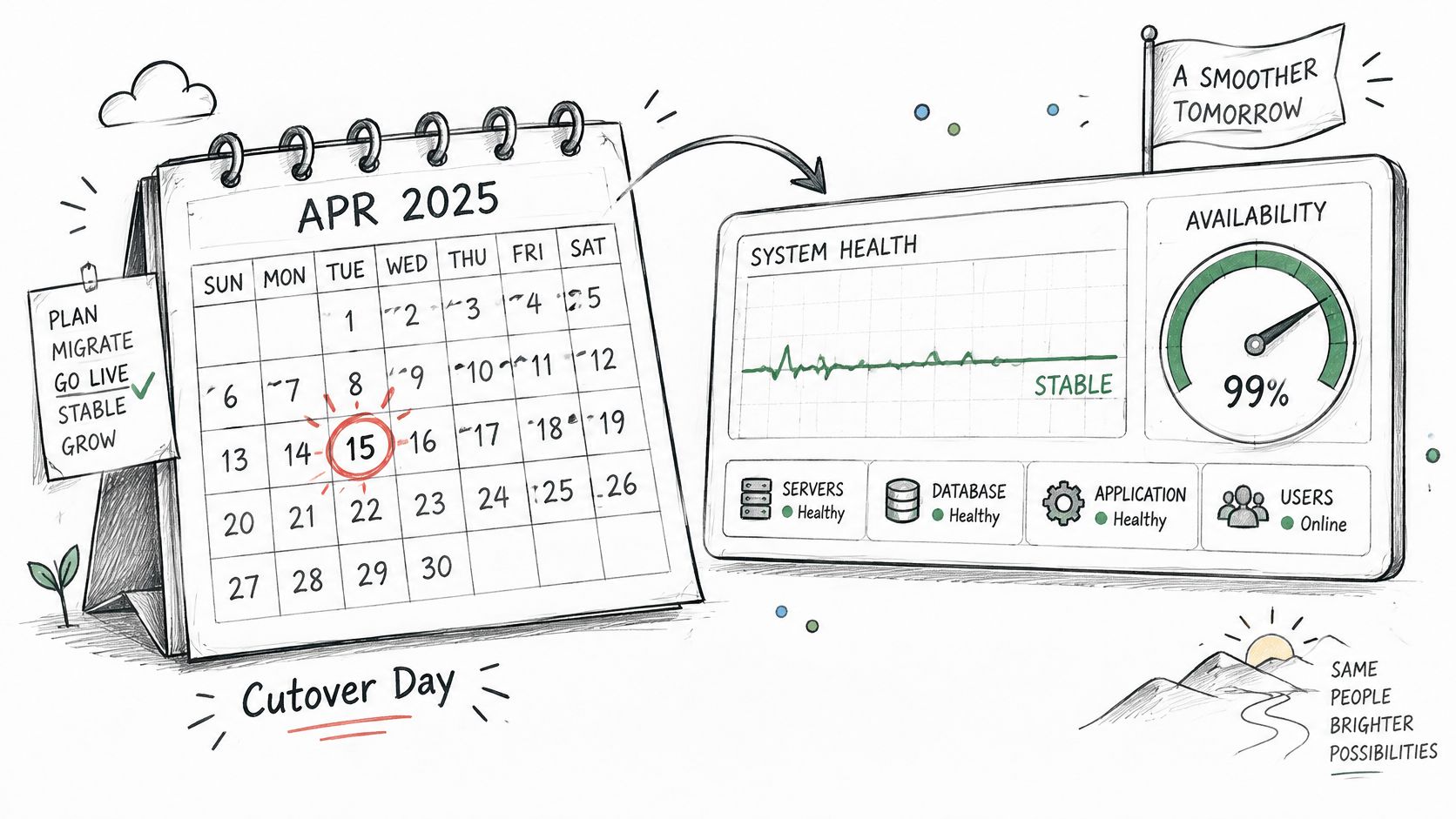
Migration-partner recognition tends to be described in terms of volume, value and on-time delivery. None of those reveal post-cutover stability, data integrity, security posture or total cost of ownership. A firm can be decorated for finishing and still leave you with a platform that needs remediation for six months.
Four questions that belong in the contract
- Is success measured at cutover or 30 to 90 days after? If the answer is cutover, the incentive ends before your risk does.
- Who pays for rollback? Ask before the change window, not during it.
- Are performance baselines and business-continuity tests included? Baselines captured after migration are not baselines.
- Can the partner prove cost forecasts against actual AWS bills? A forecast without a reconciliation date is a guess with a chart attached.
Contract in phases: discovery, rehearsal, cutover, hypercare and optimisation. Give each phase acceptance criteria for uptime, latency, security findings, data completeness and spend variance. Write the hypercare window and the acceptable spend-variance band into the statement of work before cutover, because after cutover you're negotiating from a weaker position with a live platform on the line.
If a partner can't put uptime, latency, data completeness and spend variance into the statement of work, the migration isn't scoped yet.
A fixed deadline on its own misaligns incentives. The partner is paid for finishing; you're exposed for as long as the platform runs. "Zero downtime" claims are where this shows up most often, because the claim tends to cover extensive manual validation and post-launch remediation that nobody costed. Phased acceptance criteria align both sides around the same evidence, and they give you something a deadline never does: proof that the outcome held.
Take Your Shortlist to a Partnership or Migration Conversation
Bring the scorecard, the component inventory and the draft acceptance criteria to a conversation with the WebinOne team, because those three artefacts turn a platform discussion into a scoped delivery plan. WebinOne serves as the platform layer in enterprise and government projects, and qualifying systems integrators can run a licensed version in their own or their customer's AWS account, including AWS GovCloud, by agreement. US and Australian government clients already use the platform for secure, compliant web presence, and FedRAMP and GovCloud projects are delivered with SI partners and licensed deployments, so the next step is a conversation to scope the path rather than an assumption about authorisation.
Four steps to run before that call.
- Score each shortlisted partner against the independence scorecard and keep the scores in the file.
- Attach the component inventory with dependencies and the strategy assigned to each piece.
- Write the acceptance criteria into the draft statement of work, including the hypercare window.
- Book the conversation at webinone.com/enterprise with all three documents in hand.
If procurement runs through AWS, ask whether the purchase can be structured as a Marketplace private offer, which lets seller and buyer negotiate custom pricing and end-user licence terms for one defined customer, as described on AWS Marketplace private offers. Confirm the licensed scope, the negotiated price and the EULA provisions before the statement of work is signed. The buying mechanics for software purchased this way are set out in this guide to SaaS on AWS Marketplace.
The shortlist decision comes down to one question a badge can't answer: if this partner disappeared next quarter, how much of your platform would disappear with them? Start the conversation about a partnership or migration at webinone.com/enterprise, and bring that question with you.