AWS Marketplace SaaS: A Vendor and Integrator Guide
The popular advice on AWS Marketplace SaaS is simple. List the product, let buyers find it, let AWS handle billing. That advice is wrong in the ways that cost money.
A listing doesn't create demand, metering doesn't run itself, and a Marketplace purchase doesn't place customer data in the buyer's preferred AWS Region. Vendors still count usage, check entitlements, reconcile bills, and govern renewals. Buyers still own approvals, residency checks, and exit terms.
The channel works when it's treated as commercial infrastructure with engineering attached. The sections below separate the three buying models, price only what the application can count hourly, build the entitlement and metering calls before launch, and govern the contract after checkout.
Table of Contents
- Why Buyers and Vendors Use AWS Marketplace for SaaS
- SaaS Subscriptions, SaaS Contracts and Private Offers Compared
- Pricing Dimensions and Contract Terms Buyers Accept
- How to List a SaaS Product in Partner Central
- Metering and Entitlement Calls Your Integration Must Make
- Post-Purchase Governance for Renewals, Commits and Exit
- What Marketplace Availability Does Not Guarantee
- Talk Through a Marketplace Partnership With WebinOne
Why Buyers and Vendors Use AWS Marketplace for SaaS
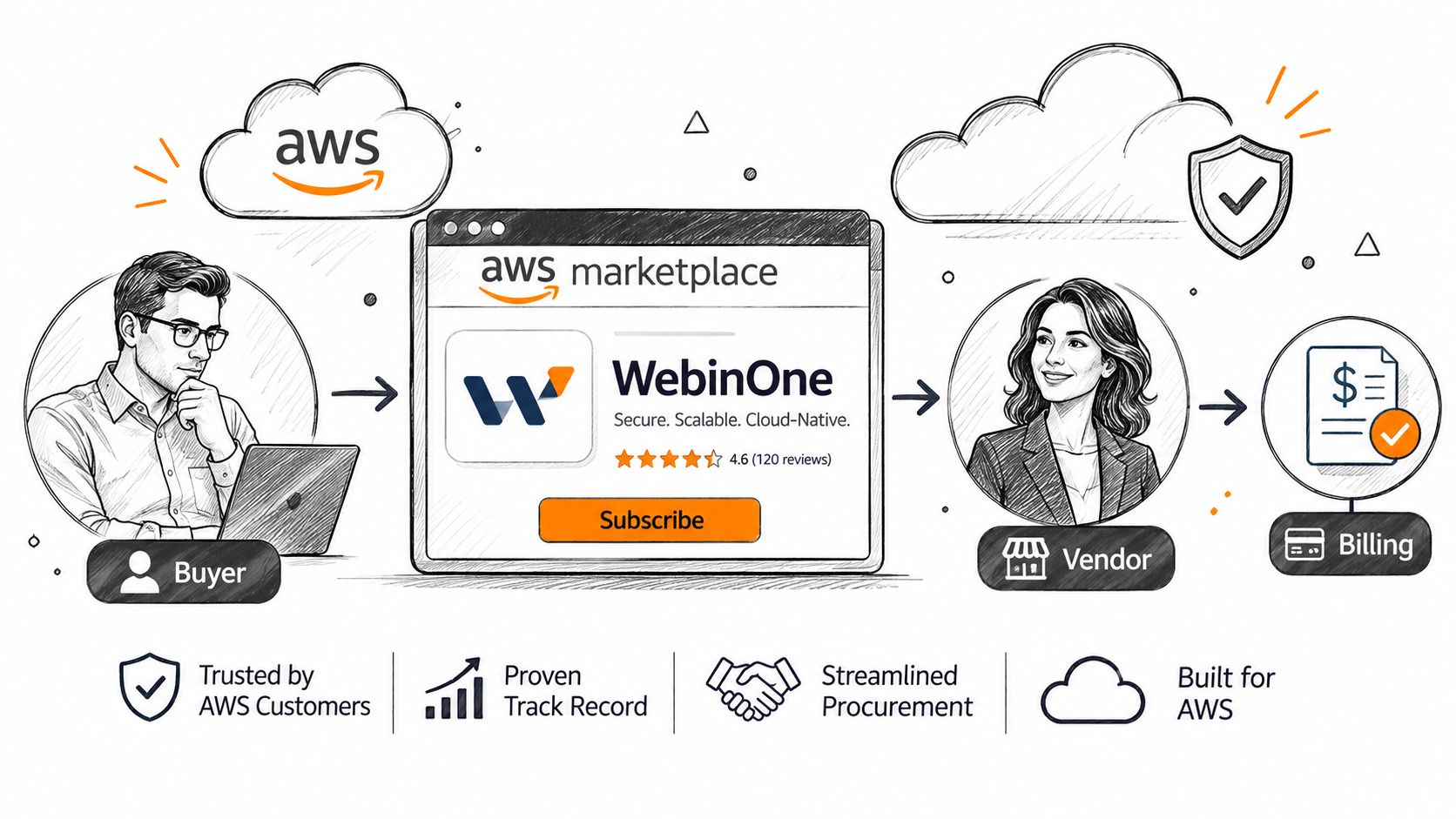
A buyer with committed AWS spend may prefer to purchase SaaS through the procurement, billing, and approval workflows already in place. For vendors, Marketplace can support sales and payment processes, but it does not create demand by itself.
The IDC 2025 survey of 287 AWS Marketplace sellers found that 55% of software and services portfolios were listed in the marketplace and 23% of revenue was generated there. In the same survey, 45% of partners said Marketplace shortened sales cycles, 48% cited reliable payment collection and disbursement, and 33% reported superior renewal rates.
Where demand actually comes from
Self-service discovery accounts for a smaller share of transactions than seller-led channels. The IDC survey findings on transaction sources report 44.8% originating through sellers' internal sales teams, 16.7% through joint selling with AWS sales teams, 15.0% through AWS Partner Network resellers, managed-service providers, or distributors, and 13.3% through customer self-service or organic search. More than half of transactions occurred through Private Offers.
The practical implication is that sellers need a route to buyers before a listing can help. Sales teams bring opportunities, partners extend distribution, and Marketplace can reduce procurement friction for a deal already in motion. Agencies considering a white-label SaaS platform for client delivery should assess how its channel supports their existing client relationships. Channel fit depends on distribution and margin; a catalog page alone rarely moves revenue.
Practical rule: List where the buyer already buys. Treat the listing as part of the sales process, not a replacement for it.
For buyers, the test is whether committed AWS spend and existing procurement workflows make a Marketplace purchase easier than onboarding a new vendor. When they do, the channel can remove friction from a purchase the organization already wants. When they do not, the vendor and buyer take on integration and governance work without a clear procurement benefit.
SaaS Subscriptions, SaaS Contracts and Private Offers Compared
Buyers comparing WebinOne or any other AWS Marketplace SaaS product should choose a subscription when usage varies, a contract when capacity is committed in advance, and a Private Offer when negotiated terms differ from the public listing. Mixing those routes up creates billing disputes later.
A SaaS subscription meters everything. The seller records all customer usage, sends the records to AWS, and AWS calculates the bill from those records and the listing prices. The model suits usage that can't be forecast reliably, such as API volume that follows integrations or traffic that shifts by campaign. Its weakness is exposure. Neither side gets cost certainty, and every disputed bill turns into a telemetry argument.
A SaaS contract works in the opposite direction. In the AWS Marketplace guide to SaaS contracts, the buyer receives a defined entitlement, such as a specified quantity of users, requests, hosts, bandwidth, or data, for a negotiated contract period. The application verifies the entitlement through the AWS Marketplace Entitlement Service. It doesn't submit ordinary usage records for the contracted amount. If the customer exceeds the entitlement, the seller can report additional usage through the AWS Marketplace Metering Service for separate billing.
The private offer route
A Private Offer isn't a third pricing engine. It's a negotiated version of the underlying subscription or contract. The seller creates it in AWS Partner Central, sets custom terms, generates a unique offer ID and URL, and extends it to specific buyer AWS accounts. That route fits enterprise legal terms, volume pricing, custom currency, longer or shorter durations, and scheduled payments that the public page can't express.
| Model | What the buyer is charged for | Who meters usage | Best fit |
|---|---|---|---|
| SaaS subscription | All metered usage at listing prices | Seller meters all customer usage | Variable consumption with no fixed commitment |
| SaaS contract | A defined entitlement for the contract period | Seller meters only usage above the entitlement | Predictable committed capacity with controlled overage |
| Private offer | Custom terms agreed in AWS Partner Central | Follows the underlying contract or subscription | Negotiated enterprise deals with custom EULA and payment schedule |
Read the table by risk, not by label. Subscriptions put reconciliation risk on every hour of usage. Contracts put forecasting risk on the commitment, then narrow metering to overage only. Private Offers put drafting risk on the negotiated terms, because a custom EULA or payment schedule that's vague at signing stays vague at renewal.
Consider a multi-site platform sale. A buyer with a stable portfolio suits a contract for a set number of sites, with overage for extra sites or API use. A buyer running a short pilot with unknown traffic suits a subscription. A buyer demanding custom legal terms and staged payments needs a Private Offer wrapped around either model.
The decision rule stays consistent. Variable consumption points to a subscription. Predictable capacity with controlled overage points to a contract. Any term that differs from the public listing points to a Private Offer.
Pricing Dimensions and Contract Terms Buyers Accept
A platform vendor such as WebinOne should pick a pricing unit the application can measure from its own telemetry every hour, then defend that count to a buyer's finance team. Anything else becomes a monthly argument.
Sellers define dimensions at listing time, and those choices shape comparison long before a sales conversation starts. The AWS Marketplace storefront guide on listings names pricing dimensions including users, API requests, hosts, gigabytes, megabytes, terabytes, and bandwidth, with standard contract durations of one month, one year, two years, or three years. The seller selects the dimensions and contract length when configuring the listing.
| Pricing dimension | Example unit | Fits best when | Metering risk |
|---|---|---|---|
| Users | Named or active users | Access scales with headcount | Seat counts must reconcile with the buyer's user records |
| API requests | Requests per period | Consumption follows integrations | Late or duplicate events shift the bill |
| Hosts | Hosts or instances managed | Tooling is priced per managed host | Host counts change during the hour |
| Storage | Gigabytes, megabytes or terabytes | Content and media volume drives cost | Measurement point must be fixed |
| Bandwidth | Gigabytes transferred | Traffic-heavy delivery | Definition of transfer must be written down |
| Custom unit | Sites or workspaces, if the application can count them | Multi-site platforms | Needs a reliable count the application can report |
Reading the trade-offs
Users are easy for buyers to read and hard to reconcile. A buyer's directory includes leavers, service accounts, and dormant logins. The application counts active users differently. Agreement on the definition, named or active, and on the snapshot time prevents the first invoice dispute. Teams comparing service economics can also compare per-user MSP costs to sanity-check how per-seat pricing lands in a managed service budget.
API requests match integration-heavy products, but late events and retries distort totals. Hosts move during the hour as instances scale, so the count needs a rule, such as peak or hourly average, written into the offer. Storage and bandwidth look objective until someone asks what's counted. Replicated copies, backups, cached delivery, and internal transfers each change the number.
A hypothetical multi-site offer shows the hybrid clearly. The base entitlement covers a set of sites, counted by the application at a fixed point each hour. API overage runs on the requests dimension. Sites aren't on the standard named list, so the vendor must expose a site count it can report reliably and show the buyer the same count in its own console.
Choose the unit that can be counted consistently and explained to a finance team in one sentence.
Contract length carries the same discipline. Short terms suit pilots and uncertain volumes. Annual and multi-year terms suit committed capacity where the buyer wants price certainty. A dimension the vendor can't meter cleanly shouldn't be sold on any term.
How to List a SaaS Product in Partner Central
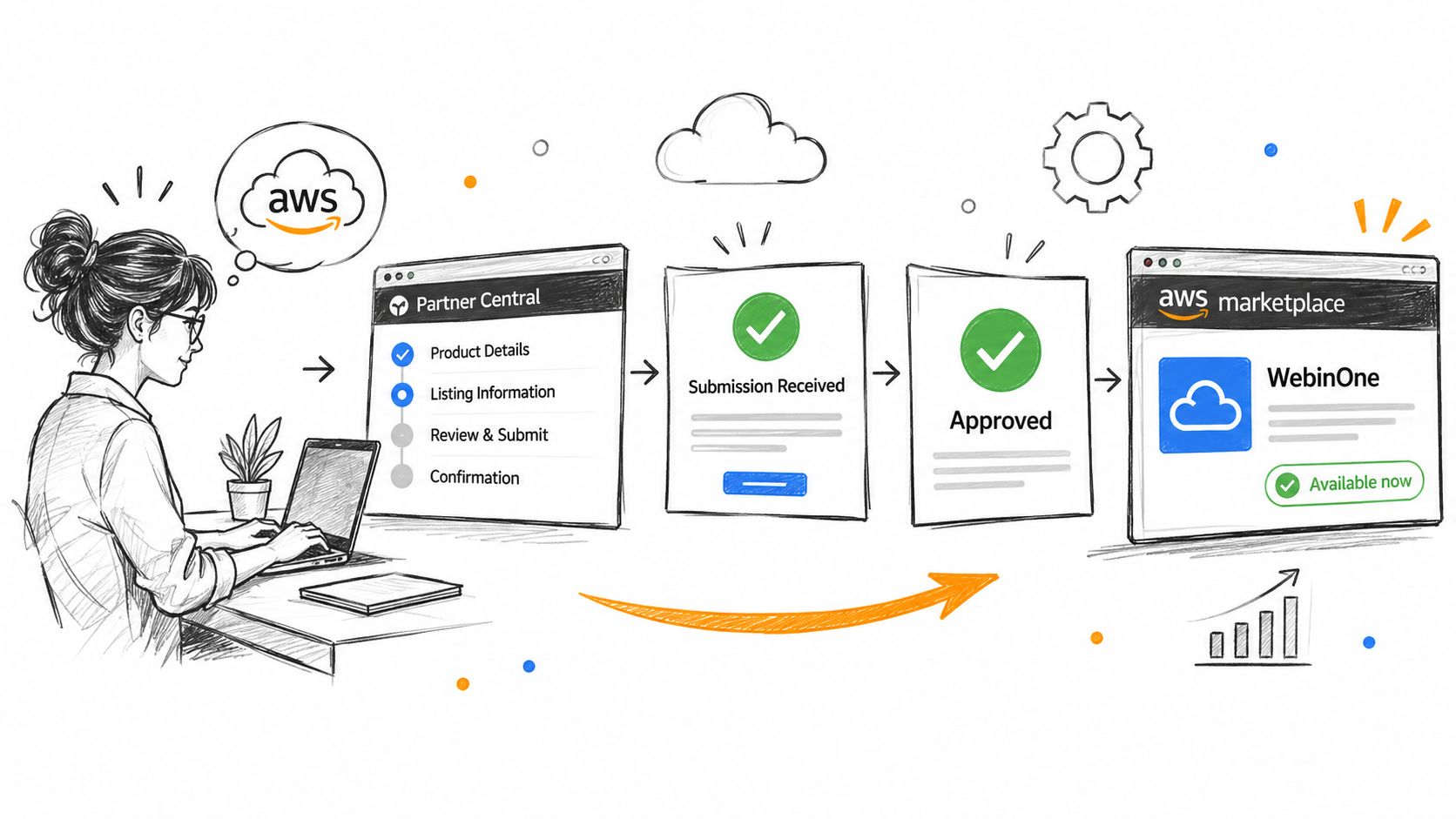
A listing can stall before review begins if the seller profile, pricing model, and product integration do not agree. Treat registration, commercial configuration, engineering, testing, and review as one sequence. Each step sets conditions for the next.
Register the seller account. Complete the profile, legal entity details, tax information, and payout setup in AWS Partner Central. These records support later offers, agreements, and disbursements. Delaying legal or banking details can hold up a deal when a buyer is ready.
Choose the commercial model. Decide whether to sell as a subscription, a contract, or both. The choice determines whether the product needs usage metering, entitlement checks, or a combination. Changing models after implementation can mean rebuilding the integration.
Define pricing dimensions. Match each dimension to a unit the application can count consistently. If telemetry cannot produce the number hourly, the dimension is not ready. A label such as “engaged users” needs a reproducible definition grounded in application events.
Set durations and public prices. Configure contract lengths and prices for each dimension. Leave room for negotiated Private Offers while keeping the public listing clear about the standard terms.
Write the listing content. Prepare the product description, support contacts, refund and cancellation handling, and end-user license agreement. Buyers and reviewers need terms that explain how support and cancellations work, not generic language that leaves key responsibilities unclear.
Build, test, and publish
Build the integration. Implement the required Marketplace integration for the chosen commercial model. See the metering section below for the call pattern and usage-reporting details.
Test the full purchase path. Use a test buyer account to subscribe, provision a tenant, consume usage, submit records, and reconcile Marketplace totals with internal reports. Test cancellation and final usage submission too. Signup alone does not show whether provisioning, billing records, and account mapping work together.
Submit, publish, and prepare Private Offers. Submit the listing and integration for review against Marketplace requirements. Before publication, ensure the product description and configured terms agree. Prepare Private Offer templates for terms sales teams expect to negotiate, including custom EULAs, volume pricing, and payment schedules.
Keep the order deliberate: commercial choices shape the engineering work, and working integration evidence supports publication. Drafting listing copy before pricing dimensions are settled can leave both the listing and implementation needing revision.
Metering and Entitlement Calls Your Integration Must Make
A site can exceed its contracted allowance without anyone noticing if provisioning and usage reporting do not share a reliable customer identity. Marketplace integration depends on two coordinated controls: checking what a buyer is entitled to use, and reporting billable activity against the right account and pricing dimension.
For contract products, entitlement checks establish the purchased dimensions, quantities, and relevant expiration. The AWS Marketplace guide to checking entitlements documents GetEntitlements, including paginated responses and an ExpirationDate that can represent the next automatic-renewal date. Check entitlements when setting up a tenant and again at product control points, such as user creation, workspace provisioning, site-count expansion, or premium-feature activation. If the allowance is exhausted or expired, stop provisioning or direct the customer to an upgrade path.
Usage reporting requires a separate accounting discipline. The AWS Marketplace integration checklist calls for hourly submission through BatchMeterUsage, with usage accumulated for the relevant hour and requests de-duplicated hourly. AWS recommends submitting a zero-usage record for an hour with no billable activity. The integration also needs to handle the unsubscribe-pending event and submit final usage within one hour.
| Integration task | AWS API or event | When it runs | What breaks if missed |
|---|---|---|---|
| Onboarding entitlement check | GetEntitlements | At subscription and onboarding | Users are provisioned without a valid purchase |
| Control-point entitlement check | GetEntitlements | At user creation, site expansion or premium-feature activation | Access runs past the contracted quantity |
| Hourly usage submission | BatchMeterUsage | Every hour, cumulative for that hour | Missing hours leave gaps in the bill |
| Zero-usage record | BatchMeterUsage | Hours with no billable activity | Ambiguity during ingestion gaps |
| Final usage on unsubscribe | BatchMeterUsage | Within one hour of unsubscribe-pending | Usage after cancellation goes unbilled |
| Hybrid overage reporting | BatchMeterUsage | Hourly, excess above entitlement only | Overage billed late or not at all |
Architecture that survives reconciliation
Keep metering out of request-serving paths. Capture usage events in a durable store or queue, aggregate them by customer and pricing dimension, then send them through a scheduled hourly worker. Monitor delivery through CloudTrail and alert on missing hours, not only failed calls. A successful request can still leave one customer's usage unreported.
In a hybrid model, GetEntitlements checks the contracted allowance while BatchMeterUsage reports only usage above that allowance. This fits products with pre-committed site allowances and overage for additional sites, API volume, or managed services. The WebinOne AWS architecture guide for integrators provides related implementation context.
The operational risks are customer identity resolution, idempotent aggregation, late events arriving after an hour closes, retries that double-count usage, and alerts that fail to identify gaps. Resolve the Marketplace customer to an internal account before reporting, retain enough event detail to reconcile each pricing dimension, and make retries safe to repeat. These controls make usage explainable when the Marketplace total and the application's records differ.
Post-Purchase Governance for Renewals, Commits and Exit
A WebinOne purchase through AWS Marketplace starts governance rather than ending it, and the same holds for any enterprise SaaS contract bought there. Checkout is fast. Ownership, renewals, and exit still need named humans.
The workload follows the contract shape. The AWS Marketplace buyer guide on private offer types covers flexible SaaS contracts lasting one month to three years or custom durations up to 144 months, with upfront or scheduled payments and pay-as-you-go charges above contracted usage. Convenience at purchase can still produce long commitments, renewal surprises, and unclear accountability between the AWS bill and the SaaS agreement. Returns don't remove that work either. A 2025 Forrester Consulting study commissioned by AWS reported 377% return on investment with payback within six months for organisations using AWS Marketplace, and commissioned findings still need local governance to hold up.
| Stage | Control | Evidence to keep |
|---|---|---|
| Pre-purchase | Approval, scope and private-offer validation | Signed approval and offer terms |
| Account setup | Account and budget ownership, tagging and chargeback | Tag map and cost-center assignment |
| Operating period | Usage monitored against commitment | Monthly usage reports against the contracted amount |
| Renewal | Renewal checkpoint before the expiration date | Renewal decision record |
| Exit | Data export and termination assistance | Export logs and termination confirmation |
| Ongoing | Evidence retention across the contract | Retained contract, usage and access records |
Each stage requires one owner and one artefact. Finance manages committed spend against actual usage. The platform team is responsible for tagging and account placement. Procurement oversees the renewal checkpoint, scheduled before the expiration date appears in entitlement data. Exit terms, export format, and termination assistance are agreed upon at signing, when opportunity exists, not during a cancellation.
What Marketplace Availability Does Not Guarantee
AWS Marketplace availability addresses procurement and purchasing. Compliance obligations and regional data residency require separate checks against the seller's controls, contract terms, and deployment model.
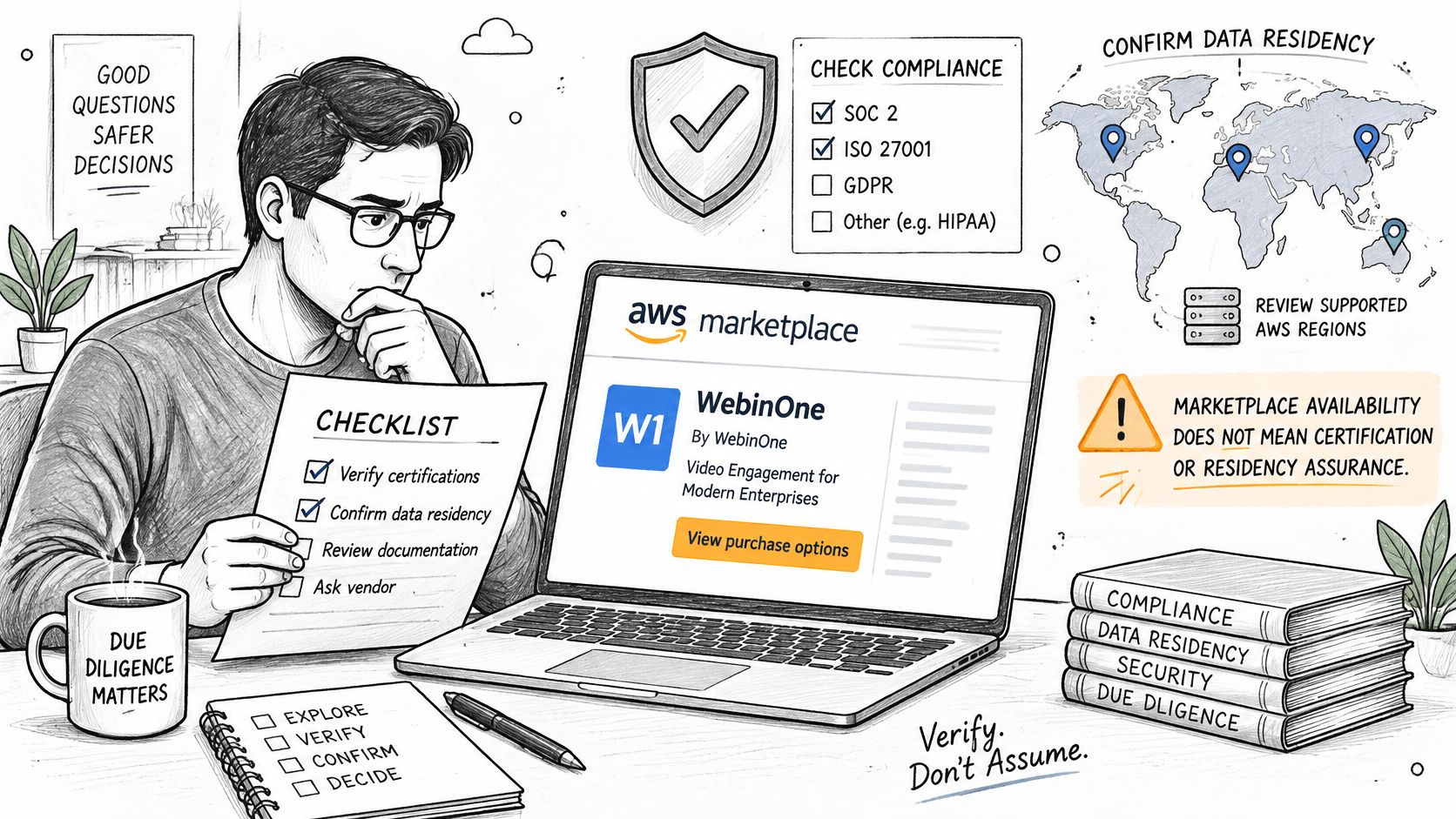
The AWS Marketplace blog on centralized procurement visibility says AWS expanded its SaaS Marketplace policy effective May 1, 2025 to include SaaS products regardless of deployment location. Sellers still have substantive obligations: disclose data collection, storage, usage, sharing, retention, backup, and deletion; protect data in transit and at rest; maintain tenant isolation and customer authentication; notify customers of incidents; and retain tamper-resistant security logs for at least one year.
Use five checks to assess the gap between listing and operating controls:
- Processing locations: Identify where application data, backups, and logs are stored.
- Contractual residency: Specify residency in the agreement rather than relying on listing copy.
- Audit evidence: Match evidence to each seller obligation.
- Control layers: Establish which controls belong to AWS and which to the seller.
- Deletion and incident handling: Confirm procedures through operational review, not documentation alone.
For WebinOne, all websites are physically hosted on AWS servers, and buyers can select data residency. US and Australian government clients use the platform for secure, compliant web presence. A custom data center can be arranged for a client by agreement. For qualifying systems integrators, a licensed version can run in the SI's or customer's AWS account by agreement, including AWS GovCloud. Buyers can review the managed AWS hosting options and WebinOne enterprise information when assessing deployment and residency requirements.
Talk Through a Marketplace Partnership With WebinOne
For WebinOne, a Marketplace partnership discussion should settle three decisions first: the commercial model, metering design, and residency requirement. These choices shape the integration and delivery scope.
WebinOne is an AWS Partner, holds the AWS Qualified Software designation, and is available on AWS Marketplace. Its platform reports 99.99% uptime, and its published SLA includes a 99.95% availability commitment. These details help buyers assess the service, while the SLA clarifies the stated availability commitment.
Two deployment options frame the discussion. The managed platform runs in WebinOne's AWS account. Qualifying systems integrators can use a licensed version in their own or their customer's AWS account by agreement, including AWS GovCloud. Agencies building security services may also consider white-label security reseller partnerships when deciding how to package monitoring alongside a platform engagement.
Before the discussion, identify the target commercial model, metering approach, residency requirement, migration scope, and team responsible for the integration after launch. The conversation should settle who owns each decision, how usage will be reconciled, and what delivery scope the partnership covers.