WordPress Multisite Alternative: Agency Platform Guide 2026
The most popular advice about WordPress Multisite is also the least complete: centralize everything, reduce duplicated maintenance, and assume the network will remain uniform. That model can work until one brand needs a different release cycle, one client needs to leave, or one compromised account and shared resource turns a local incident into a portfolio problem.
A credible WordPress Multisite alternative shouldn't be selected by counting dashboards or matching publishing features. Agencies and systems integrators need to assess blast-radius governance, independent recovery, extraction effort, permission boundaries, and the maintenance tax created by extensions. Centralized administration matters, but controlled separation matters just as much.
Table of Contents
- Why WordPress Multisite Is Still the Default Reference Point
- Categorizing WordPress Multisite Alternatives by Governance Model
- The Blast-Radius Governance Risk in Centralized Systems
- The Hidden Cost of Extraction and Migration Exit-Readiness
- Evaluation Checklist for Agencies and Systems Integrators
- When to Choose a Managed White-Label DXP Like WebinOne
Why WordPress Multisite Is Still the Default Reference Point
WordPress remains the reference point because agencies inherit it, clients recognize it, and its network model establishes a familiar baseline for centralized site operations. Adoption alone does not show whether a portfolio is safe to run, easy to separate, or economical to maintain as client requirements diverge. Those questions determine whether an alternative reduces operational work or just relocates it.
Independent usage data reports that WordPress was used by 42.5% of all websites in April 2026 and represented 59.8% of websites with an identifiable content-management system (W3Techs WordPress usage data). The figures describe broad web usage, not the number of installations or organizations. They do explain why agencies regularly inherit WordPress portfolios and why buyers expect an alternative to support centralized publishing, permissions, templates, and operational control.
Since the 2010 merger that enabled multiple sites from one installation, the operational question has been what is shared, what can be isolated, and what can be recovered independently. That question matters more than the platform's history.
Popularity is not a governance specification
The shared installation remains the important architectural detail. It can simplify site creation and network administration, while requiring the agency to understand which resources are inherited, which changes affect multiple properties, and which controls apply at site level.
A portfolio operator should ask:
| Operational question | What a serious alternative must demonstrate |
|---|---|
| Can sites use different templates? | Reusable templates with controlled site-level variation |
| Can teams have different permissions? | Scoped roles, credentials, and approval paths |
| Can one site be restored independently? | Per-site backup and recovery procedures |
| Can a client leave cleanly? | Exportable content, media, settings, and configuration |
| Can one site absorb traffic without affecting others? | Resource isolation and measurable performance controls |
These questions expose the gap between feature parity and operational readiness. A widely adopted system can still create a large blast radius if an extension, permission error, resource constraint, or deployment decision crosses site boundaries. It can also make a client departure expensive if content, media, configuration, and hosting assumptions are tightly connected.
That is why a 59.8% CMS share is not a buying argument by itself. It shows that WordPress is widespread, but an agency choosing a WordPress Multisite alternative is solving a portfolio-operations problem. The replacement must reduce duplicated infrastructure and maintenance without creating a new dependency that becomes difficult to unwind. Exit-readiness belongs in the initial selection criteria, not in the recovery plan after a dispute or failed migration.
Multi-tenant design provides a useful comparison because it separates shared platform services from tenant-level boundaries. The overview of how Querio uses multi-tenant design gives teams context for deciding what should be centralized and what should remain isolated. The same distinction should guide a multi-site DXP assessment.
The benchmark is operational, not ideological
WebinOne's managed approach centers multi-site administration, templates, permissions, support, billing, DNS, and branding within a partner environment. The practical value is controlled standardization at the platform layer while each client property retains its own domain, content, design system, configuration, and release needs.
That operating model changes the migration decision. Agencies can compare the cost of continuing to own extension compatibility, shared-network behavior, recovery boundaries, and extraction work with the cost of adopting a managed platform whose responsibilities and exit conditions are defined. The strongest reference point is therefore not popularity. It is the ability to run a portfolio safely today and separate a site cleanly when tomorrow's business requirement demands it.
Categorizing WordPress Multisite Alternatives by Governance Model
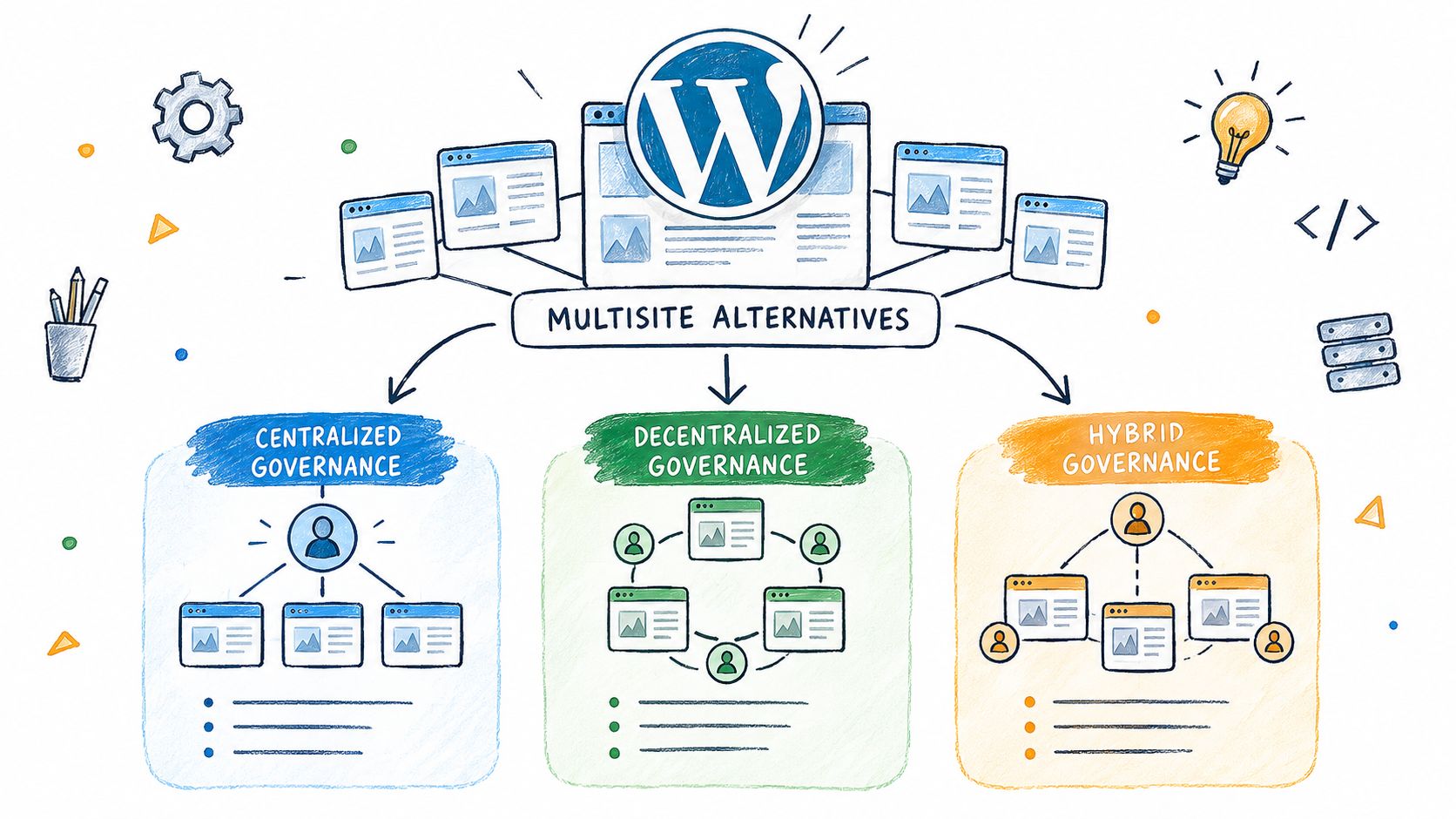
WebinOne fits the managed white-label DXP category, where agencies centralize operations without forcing every client site into the same technical dependency chain. The useful comparison is not a feature checklist. It is how each model distributes authority, failure, customization, and ongoing work.
Agencies usually encounter three broad categories. Enterprise DXPs can provide formal governance and extensive integration capacity, but implementation may demand substantial architecture, administration, and specialist oversight. Managed headless CMS platforms can give teams API-first flexibility, although the agency may still need to assemble front ends, commerce, search, identity, analytics, and operational tooling. White-label agency DXPs focus more directly on repeatable delivery, client management, reseller economics, and multi-site administration.
The categories are not interchangeable. A platform that is powerful for a global transformation program may be unnecessarily heavy for an agency managing varied client portfolios. A flexible headless layer may suit a systems integrator with an established delivery practice, but it can transfer more integration and support responsibility to the agency.
Compare operating models, not marketing labels
| Platform Type | Governance Approach | Scalability Limit | Operational Overhead |
|---|---|---|---|
| Enterprise DXP | Formal governance, centralized standards, controlled publishing | Complexity can increase implementation and administration demands | High during architecture, integration, and change management |
| Managed headless CMS | Central content and API services with independently delivered experiences | Integration capacity and front-end ownership become decisive | Medium to high, depending on the delivery stack |
| White-label agency DXP | Centralized portfolio controls, reusable templates, client-level administration, reseller workflows | Fit depends on customization, integration, and isolation requirements | Lower when native services replace separate tools and extensions |
A useful multi-level governance model helps teams distinguish platform administration from agency administration, client administration, and site-level publishing. Without those layers, “centralized management” often means that a small number of super-admins carry too much authority.
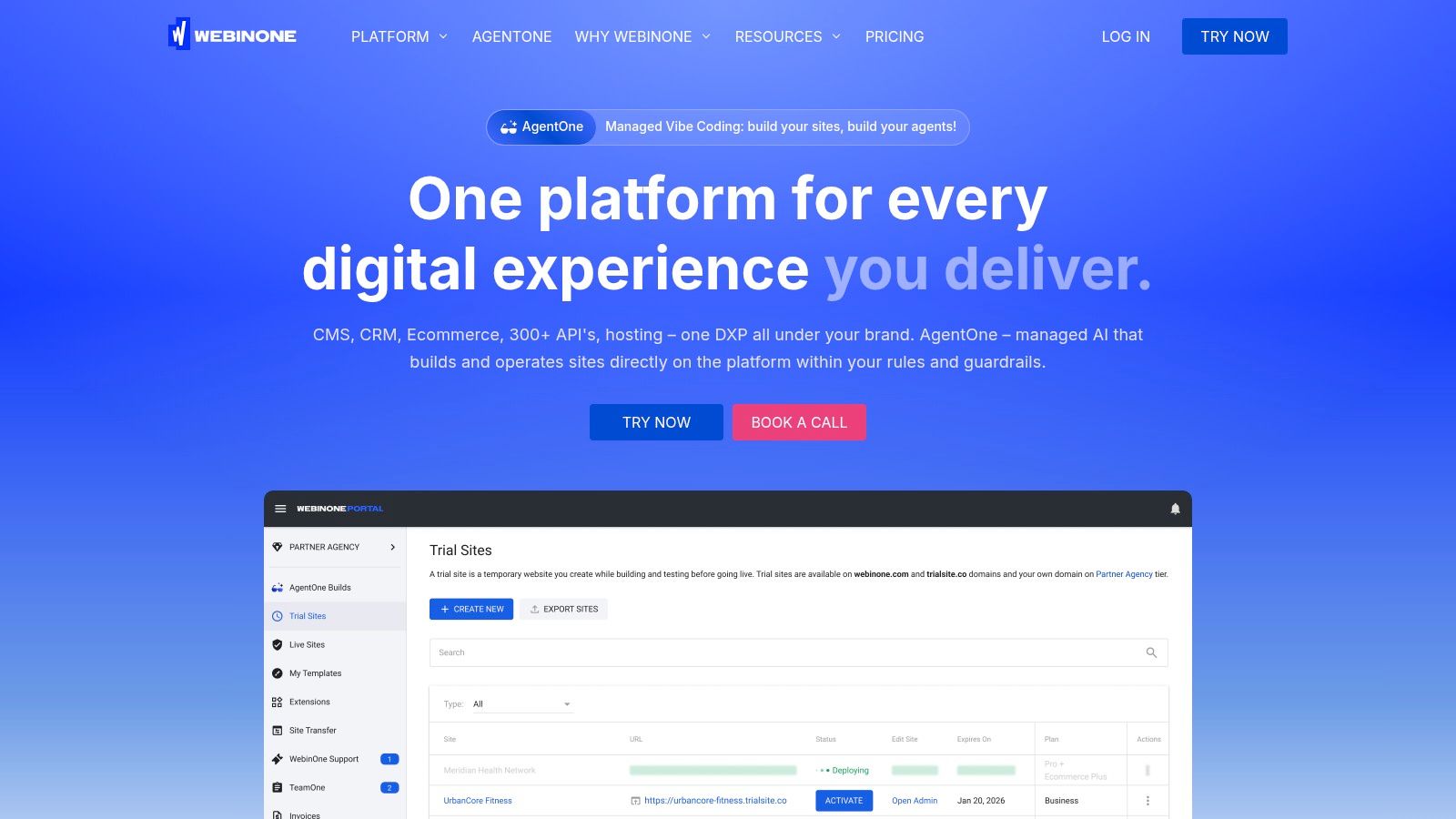
WebinOne combines CMS, ecommerce, CRM, email marketing, multi-site management, and a headless API in one managed system. Its white-label portal can place site access, permissions, billing, support, branding, and operational controls under an agency's own delivery model. That matters for agencies that want to sell an ongoing platform service rather than deliver a site and then coordinate separate hosting, security, analytics, and maintenance products.
The right model depends on who owns the work
A systems integrator may prefer a licensed deployment in its own or its customer's AWS account by agreement, including AWS GovCloud for qualifying projects. An agency may instead prefer a managed environment operated through a reseller relationship. Both models can work, but the contract and operating boundary must be clear before migration begins.
The weakest alternative is the one that looks centralized in the sales process but leaves the agency responsible for stitching together deployment, backups, permissions, extension updates, reporting, and client support. A modern model should make those responsibilities explicit. It should also document what happens when a site becomes materially different from the rest of the portfolio.
The Blast-Radius Governance Risk in Centralized Systems
Centralized administration can improve consistency while widening the consequences of a single mistake. WebinOne addresses that tension by combining portfolio visibility with site-level controls. A shared management layer should reduce duplicated patching and monitoring without making credentials, releases, backups, logs, and resource pressure inseparable.
A faulty extension release shows the risk clearly. If the same component runs across a network, testing and deployment become portfolio-level decisions. A compromised administrator account creates a separate exposure. One account might reach unrelated brands, client data, billing settings, or production operations.
Performance creates the same governance problem. Industry guidance emphasizes resource isolation because a traffic spike on one property can affect other sites sharing infrastructure (guidance on WordPress agency infrastructure and resource isolation). An agency should not treat “one dashboard” as proof that one site cannot consume shared capacity or interfere with another site's recovery plan.
Central visibility needs independent controls
The practical test is whether the platform separates observation from authority. A portfolio administrator may need visibility across every site, while a client editor should access only an assigned property. A release manager may approve a template change without receiving unrestricted billing or identity permissions.
A defensible governance design includes:
- Scoped credentials: Roles should limit access by site, function, environment, and approval responsibility.
- Independent backups: A single site should be recoverable without restoring the full portfolio.
- Release rings: New templates, modules, or platform changes should be tested on representative properties before broad deployment.
- Separate logs: Audit trails should identify who changed what, where, and when.
- Resource boundaries: Traffic or processing demand on one property should not automatically consume capacity required by others.
- Rollback scope: A failed release should be reversible at the smallest practical unit.
Practical rule: Centralize reporting and standards, but isolate credentials, recovery, releases, and incident response.
Government, regulated, and multi-brand organizations face higher consequences when these boundaries are unclear. Separation of duties can be a contractual or operational requirement. A shared administrative plane may still fit, but the organization needs evidence that centralized governance does not force every recovery objective into one network-wide procedure.
The same evidence should influence migration planning. If a site cannot be independently audited, restored, permissioned, or released, extracting it later will likely require more coordination and create more opportunity for downtime or data gaps. Exit-readiness is therefore part of blast-radius control, not a separate procurement exercise.
Extension reduction is not the same as risk elimination
Patchstack reported 7,966 newly disclosed vulnerabilities across the WordPress ecosystem in 2024, with 96% in plugins, 4% in themes, and only seven affecting WordPress core (Patchstack State of WordPress Security in 2025). The operational lesson is not that every extension is unsafe. Centralized installations still require an extension inventory, compatibility testing, patch prioritization, deployment scheduling, and post-update verification.
A managed platform can reduce that workload when native functionality replaces independently maintained extensions. It cannot remove governance requirements. Buyers should request the platform's security overview, support boundaries, audit capabilities, backup model, and incident process before treating managed hosting as a complete answer.
A strong WordPress Multisite alternative shows how risk is scoped across sites, teams, releases, and recovery procedures. That evidence matters more than a larger feature list because it determines whether centralization lowers maintenance work without creating a portfolio-wide failure point.
The Hidden Cost of Extraction and Migration Exit-Readiness
WebinOne makes exit-readiness a design criterion instead of an afterthought. Every site in a multi-site portfolio should be exportable, auditable, and recoverable on its own, because client ownership, brand strategy, acquisitions, and agency relationships can change.
Shared users, network-enabled extensions, inherited themes, domain mappings, media dependencies, and cross-site content can make a subsite extraction materially harder than a normal migration. Available industry estimates place multisite migrations at 40% to 60% more expensive than single-site migrations, while another estimate puts extraction labor at roughly three to six hours per site before hosting migration or client communication (industry migration cost analysis). These are estimates, not universal project rates, so they should be used as risk indicators rather than quoted budgets.
The mistake is to calculate only the cost of operating the network while every site remains similar. The correct calculation also includes the cost of separating one property when its ownership, security boundary, technology requirements, or commercial relationship changes.
Apply an exit-readiness test before signing
A migration assessment should answer these questions in writing:
- Data ownership: Can content, media, users, forms, commerce records, and custom data be identified by site?
- Configuration ownership: Can templates, modules, redirects, SEO settings, integrations, and permissions be audited without interpreting hidden network behavior?
- Dependency mapping: Which services are shared, and what must be rebuilt if one site leaves?
- Recovery proof: Has the team restored one site independently in a test environment?
- Contractual portability: Does the agreement define how data, code, assets, and operational records are returned?
- Cutover procedure: Can the extracted site be tested before its domain and traffic move?
Agencies should document the result as part of the proposal, not leave it to an emergency migration later. A clear platform migration strategy should include ownership, inventory, redirects, content validation, analytics continuity, acceptance criteria, and rollback decisions.
Documentation is part of portability
Extraction work becomes more expensive when the original team has to rediscover why a shared template, custom field, or integration behaves a certain way. Documentation software such as Documentation software can help teams capture procedures, decisions, and operational context, but documentation doesn't replace export testing. The platform still needs to expose the data and configuration needed for an independent restore.
WebinOne's migration process uses staged delivery and testing before and after cutover. The relevant question for a buyer is not whether a vendor claims migration experience. It is whether the vendor can produce a site inventory, dependency map, validation plan, and independently recoverable result for the specific portfolio.
A portfolio is not portable because content can be exported. It is portable when a site can leave without reconstructing undocumented network behavior.
That standard changes platform selection. The alternative that saves a small amount of administration today may create a large extraction liability later. Exit-readiness is the safeguard against that form of vendor lock-in.
Evaluation Checklist for Agencies and Systems Integrators
WebinOne gives agencies and systems integrators a practical benchmark for evaluating a platform and its operating service together. The test should cover extension dependency, governance boundaries, recovery, representative performance, migration readiness, and commercial fit. A polished demo is not enough. The platform must reduce the patching and coordination work that consumes delivery margin.
Start with the workload creating the most friction today. If an agency spends margin on plugin triage, emergency fixes, staging coordination, hosting escalation, and cross-site troubleshooting, a different dashboard will not solve the underlying commercial problem.
Test the operational core
Native capability versus extension sprawl. List the functions currently delivered through plugins, modules, scripts, and external services. Ask which capabilities are native, who maintains them, how changes are tested, and whether an individual client can disable or replace a function without affecting other sites. The answer should also identify what happens when a client leaves the shared environment.
Permission boundaries. Build a role matrix for agency staff, client users, developers, support personnel, and auditors. Test access by site, function, environment, and data type. A user should see only the sites and controls assigned to that role, with administrative actions recorded for later review.
Recovery. Request a per-site backup and restore demonstration. Include media, redirects, forms, integrations, SEO settings, and any commerce or CRM data relevant to the project. Test whether one site's recovery can occur without restoring unrelated sites or recreating shared configuration manually.
Migration validation. Require a sample migration before making a portfolio-wide commitment. Check URL coverage, metadata, structured content, media references, search behavior, forms, analytics, and editorial workflows. Record the failures, remediation steps, and acceptance criteria. This exposes extraction work that a sales demonstration will usually hide.
Measure what users experience
Recent large-scale web performance benchmarks report that only 54% achieved a good Largest Contentful Paint result across CMS-driven sites. The benchmark also shows significant performance variation, reinforcing the need to test representative pages under cold-cache and uncached conditions rather than rely on platform averages.
A buying team should measure:
- Largest Contentful Paint and Interaction to Next Paint
- Cumulative Layout Shift
- Origin response time and cache-hit behavior
- Mobile performance across relevant regions
- Deployment and rollback time
- Performance under realistic content and traffic conditions
Avoid treating a single Lighthouse screenshot as proof. A fast demonstration page says little about a portfolio with custom modules, search, forms, commerce, personalized content, and large media libraries. Test the templates and content patterns that create the highest operational risk.
Check the commercial and delivery model
Pricing should let an agency model margin by site, service tier, support requirement, and implementation effort. WebinOne pricing starts from $10 per month per site, and ecommerce plans carry zero transaction fees. Custom ecommerce work remains scoped as a TeamOne project, so separate platform charges from design, integration, migration, and custom delivery work.
The delivery review should cover dedicated server options, selectable data residency, support escalation, status visibility, security documentation, and ownership of the cloud environment. A platform may run as a managed service in the provider's account or support a licensed deployment in an SI's or customer's account by agreement. These operating models have different procurement, compliance, recovery, and exit implications. Document the chosen model before migration approval.
When to Choose a Managed White-Label DXP Like WebinOne
WebinOne is the right type of WordPress Multisite alternative for agencies and SIs that want to move beyond open-source maintenance while preserving control over templates, integrations, client operations, and multi-site governance. It combines managed infrastructure with a white-label delivery model, so the agency can sell a platform service instead of passing patching and infrastructure work through to every client.
The case is strongest when the agency has outgrown its current delivery model. That doesn't require a specific site count or a single CMS. The warning signs are operational: margin disappears into plugin and module maintenance, senior staff handle recurring upgrades, client sites share undocumented dependencies, support requests cut across multiple vendors, and every new project adds another variation to the hosting and reporting stack.
Replace the maintenance tax with a managed operating model
WebinOne consolidates CMS, ecommerce, CRM, email marketing, multi-site management, and a headless CMS into one managed system. The platform includes Liquid templating, custom modules, SEO controls, forms, snippets, search, member areas, catalog and order tools, CRM records, email marketing, APIs, webhooks, redirects, backups, SSL, and security headers.
That breadth matters because agencies often create operational risk by connecting separate products that each have their own permissions, update cycles, billing, support routes, and data model. A unified system doesn't eliminate integration work, but it can reduce the number of independently maintained components that a delivery team must monitor.
The platform also supports AgentOne Managed Vibe Coding, which builds and operates sites inside the managed environment. It can handle development, content updates, optimizations, and automations within approved scopes, with scoped permissions, audit logs, visible changes, and reversible production workflows. For agencies, the value is not disposable generated output. It is a controlled way to accelerate recurring work while keeping changes reviewable and maintainable.
White-label delivery requires more than a logo on a login screen. Teams evaluating white label website creation should check whether the platform supports agency branding, templates, staff access, billing, support tickets, client permissions, and a clear division of responsibility. WebinOne's reseller program provides a white-label portal and agency administration model designed for those workflows.
Use AWS as a delivery foundation
WebinOne is an AWS Partner, has passed the AWS Foundational Technical Review, holds the AWS Qualified Software designation, is enrolled in the AWS Software and Services Paths, and is available on AWS Marketplace. It offers hosting across six global AWS regions with a 99.99% uptime commitment, alongside a 99.95% availability commitment in its published SLA.
Those credentials and infrastructure choices don't replace a buyer's own security and compliance review. They do give AWS consulting partners and systems integrators a defined foundation for conversations about hosting, data residency, dedicated environments, and client-specific operating models.
For qualifying SIs, a licensed version can run in the SI's or customer's own AWS account by agreement, including AWS GovCloud. WebinOne delivers FedRAMP and GovCloud projects with SI partners and licensed deployments, without presenting an authorization status that has not been established. A custom AWS environment can also be arranged for a client by agreement.
Make migration an operating decision
A successful re-platforming program doesn't begin with a page rebuild. It begins with inventory and separation. TeamOne can stage migrations, test before and after cutover, validate live behavior, and operate the platform after launch. WebinOne has migrated thousands of sites, including complex portfolio work and large-scale platform transitions under strict deadlines.
For agencies, the commercial result is a more repeatable delivery engine. Templates can be standardized without forcing every client into identical branding. Client access can be separated from agency administration. Billing and support can sit within the reseller workflow. SEO and content operations can become a managed service rather than a collection of project-specific tasks.
For systems integrators, the decision is often about ownership. A licensed deployment, AWS-aligned delivery, headless API, 300+ APIs, webhooks, and managed platform operations can support client architectures that need more than a conventional page editor. The SI retains a delivery and integration role without carrying every upgrade, security patch, extension conflict, and scaling incident indefinitely.
The selection test remains exit-readiness. WebinOne should be evaluated by asking how each site, dataset, configuration, permission structure, and integration is documented and recovered. A managed platform earns trust by making the operating boundary clear, not by hiding it behind a single dashboard.
Agencies ready to turn multi-site delivery into a white-label service should review the WebinOne reseller program. Systems integrators, AWS partners, and enterprise teams should use the white-label agency platform overview as a starting point for a partnership or migration discussion, then validate the model against a representative portfolio and its exit requirements.
WebinOne provides a managed, white-label DXP for agencies and SIs that need centralized multi-site governance without carrying the full patching and infrastructure burden of an open-source network. Visit WebinOne to discuss a reseller model, AWS partnership, or migration plan built around independent recovery and controlled blast radius.