Website Builder for Agencies: Reseller vs Platform
A strong website builder for agencies should consolidate white-label delivery, multi-site governance, and native extensions in one managed layer. WebinOne's reseller program starts at $10 per month per site, while its platform is designed to reduce the third-party dependencies that turn client work into ongoing technical debt.
Why do conventional comparisons still treat an agency platform like a design tool? Templates and visual editing matter, but they don't answer the questions that affect margin after launch: who can change a client site, which changes are recorded, how quickly a team can reverse an error, and who owns the security workload when the stack grows.
The agency's real product isn't a collection of pages. It's a repeatable operating model for building, launching, governing, and improving a portfolio of digital experiences. The right platform should help an agency move clients into larger engagements without multiplying the systems required to support them.
Table of Contents
- The Real Question Agencies Miss When Choosing a Platform
- Reseller Programs Versus Managed Platform Operations
- Why Multi-Site Governance Breaks Basic Builders
- Evaluating Control-Plane Maturity and Auditability
- Managed Automation and the Risk of Opaque AI
- The Financial Case for Consolidating Your Digital Stack
- Next Steps for Agencies Ready to Scale
The Real Question Agencies Miss When Choosing a Platform
WebinOne treats a website builder for agencies as an operational control plane, not only a visual production tool. The decisive question is whether the platform can govern client estates consistently as delivery expands.
Most buying evaluations still begin with templates, page speed, and pricing tiers. Those criteria are useful for a single project, but they become incomplete once an agency manages several brands, contributors, approval paths, integrations, and post-launch service commitments. A platform can produce an attractive page and still create an unprofitable operating model.
From page production to portfolio control
A mature evaluation asks whether the platform can:
- Separate client access: Scope permissions so clients, agency staff, and external contributors see only the sites and functions assigned to them.
- Record operational history: Attribute content, configuration, and deployment changes to a person or process.
- Support reversibility: Provide dependable backups, staged releases, and rollback procedures when a change creates a defect.
- Centralize routine work: Bring site administration, content operations, support, billing, and related digital functions into one governed environment.
- Preserve customization: Let technical teams extend templates, structured content, integrations, and front ends without returning to a disconnected stack.
Platform choice changes the economics of agency work. Every additional login, plugin, hosting account, update queue, and undocumented workaround creates another place where a routine task can stall or a client issue can become an emergency.
Evidence of a persistent digital workload
The need is broader than website launches. Eurostat reports that 60.9% of EU enterprises used at least one form of social media in 2023, compared with 36.8% in 2015. Social networks were used by 58.9% of enterprises, while content-sharing websites reached 31.5% and corporate blogs 10.2%. Large enterprises reported social-media use at 86%, compared with 58% among small enterprises.
Those figures point to a connected marketing and publishing environment, not a brochure-site market. Agencies now support websites alongside content distribution, customer engagement, analytics, ecommerce, and ongoing optimization. A builder that governs only page layout leaves the agency managing the rest through fragmented tools.
Practical rule: Evaluate the platform by the number of routine decisions it makes visible, controlled, and reversible.
Reseller Programs Versus Managed Platform Operations
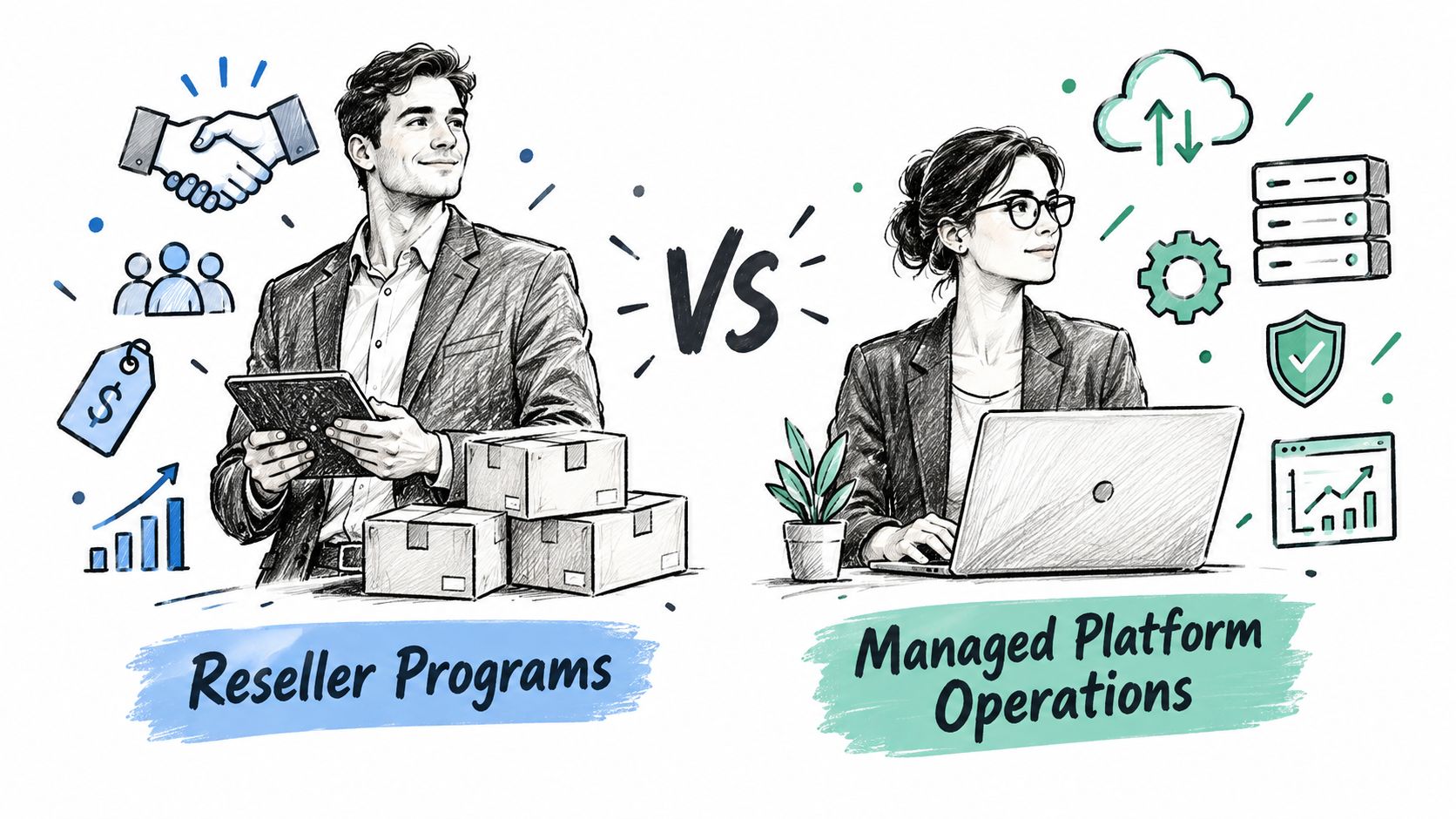
WebinOne combines a white-label reseller route with managed platform operations, allowing agencies to retain the client relationship while reducing responsibility for the underlying hosting and infrastructure layer. The useful comparison isn't just margin versus convenience. It's client ownership versus technical risk, and each agency must decide where that risk belongs.
A traditional reseller model gives an agency a branded commercial wrapper around platform capacity. The agency can package the service, set its own delivery model, and make the platform part of a broader retainer. That structure can support margin, but it may still leave the agency responsible for hosting coordination, patching decisions, incident response, and the documentation needed to keep the estate understandable.
A managed platform partnership changes the boundary. The agency remains responsible for strategy, design, content, integrations, and client outcomes, while the platform operator manages the core service. The agency still needs technical discipline, but it isn't forced to treat every client site as an independent infrastructure project.
The commercial distinction
WebinOne offers a reseller program with white-label login and admin branding, with pricing starting from $10 per month per site. Agencies can present the service under their own brand while deciding how to package implementation, support, optimization, and ongoing operations.
The commercial model works best when the agency defines the service around outcomes rather than reselling access alone. A recurring offer can include governance, SEO maintenance, content production, analytics review, conversion improvements, and support. The platform becomes the delivery layer, while the agency sells expertise and accountability.
| Operating question | Capacity resale | Managed platform partnership |
|---|---|---|
| Client relationship | Usually owned by the agency | Owned by the agency |
| Core hosting responsibility | May remain partly with the agency | Retained by the platform operator |
| White-label presentation | Depends on the program | Available through WebinOne's reseller model |
| Custom development | Agency-led | Agency-led with managed platform services |
| Security maintenance | Shared or agency-managed | Centralized at the platform layer, with application responsibilities remaining |
| Best fit | Agencies wanting commercial control and technical ownership | Agencies prioritizing repeatable delivery and lower operational drag |
The right question is not whether a reseller program or managed operation is universally superior. It is whether the agency wants to build a hosting business or a digital delivery business. A white-label agency model becomes more durable when branding, provisioning, billing, support, and governance work together instead of creating another set of disconnected administration tasks.
Why Multi-Site Governance Breaks Basic Builders
WebinOne provides centralized multi-site management so agencies can govern client estates from one operational layer instead of repeating the same administration across isolated accounts. Basic builders work well for individual sites, but portfolio delivery exposes their limits through permissions, auditability, integrations, and maintenance.
An agency may start with a small collection of projects and still operate efficiently through separate logins and manual checklists. As the portfolio grows, the same approach creates inconsistent roles, duplicated settings, uncertain ownership, and a growing dependence on whoever remembers how each account was configured.
The hidden cost of fragmentation
Security maintenance becomes especially difficult when each site has its own combination of core software, extensions, hosting settings, forms, integrations, and deployment procedures. Verizon's 2025 Data Breach Investigations Report found that vulnerability exploitation represented 20% of breach initial-access vectors, a 34% increase from the previous report. It also found that edge devices and VPNs represented 22% of vulnerability-exploitation targets, up from 3% the previous year.
The figures don't prove that a particular CMS will fail. They do show why agencies should treat maintenance as a continuing business responsibility. A platform that reduces separately administered components can reduce the number of places where an agency must monitor updates, access, configuration, and incident response.
A useful portfolio review maps each client site against the following questions:
- Who approves changes?
- Which staff members can publish?
- Where are backups and deployment records stored?
- Which integrations require separate credentials?
- Who receives security alerts?
- How does the team restore a known-good state?
- What happens when the person who built the original setup leaves?
One console, fewer handoffs
Centralization matters because routine client work rarely stays inside the page editor. A campaign may require a landing page, a form, a CRM update, an email, a content revision, analytics validation, and a support response. If every step moves through a different vendor account, the agency pays for coordination before it delivers any strategic value.
WebinOne brings CMS, ecommerce, CRM, email marketing, multi-site management, and a headless API into one managed system. The platform also includes native extensions maintained by WebinOne, which avoids treating every functional requirement as another third-party dependency.
The practical test is simple. Give the team a representative client request and measure how many systems, permissions, and handoffs it requires. Multi-site management should reduce that operational path, not merely provide a dashboard that links out to separate products.
Evaluating Control-Plane Maturity and Auditability
WebinOne should be evaluated by testing control-plane maturity directly, including permissions, auditability, deployment review, and rollback. Marketing language can't substitute for seeing how the platform handles a real client change from request to production.
A control plane is the layer that governs the work around the website. It determines who can act, what they can access, how the system records the action, and how the agency responds when a release needs correction. Agencies serving public-sector, healthcare, financial, or enterprise clients need these controls as part of delivery, not as optional administration.
Run a representative test
A useful evaluation uses one realistic workflow rather than a polished demo site. Ask the platform team to demonstrate the following sequence:
- Create scoped roles: Give a client editor access to content but not billing, infrastructure, or another client's data.
- Submit a change: Make a content or component update that requires agency review.
- Inspect the record: Confirm that the system identifies the user, action, time, and affected environment.
- Review before release: Show how the agency can inspect the proposed result before publication.
- Reverse the decision: Restore the previous state without rebuilding the entire site.
- Hand off the account: Remove one contributor and verify that the estate remains understandable to the next operator.
If the demonstration depends on a manual spreadsheet, an informal approval message, or a support request to recover a change, the control plane isn't mature enough for a demanding portfolio.
Separate governance from customization
Agencies sometimes assume that control means restricted development. That trade-off isn't necessary. A strong platform can provide structured content, custom modules, Liquid templating, headless delivery, APIs, and webhooks while still controlling access and release procedures.
The evaluation should therefore measure both sides:
| Capability | What to verify |
|---|---|
| Client isolation | Users can't cross into unrelated accounts or sites |
| Role-based permissions | Access reflects job responsibilities, not convenience |
| Audit records | Changes identify both human and automated actors |
| Deployment controls | Releases can be reviewed and approved |
| Rollback | Known-good versions can be restored |
| Documentation | A new operator can understand the estate |
| Data ownership | The agency and client know how content and data are handled |
Web standards reinforce the need for repeatable governance. The history of WCAG runs from early accessibility guidance in January 1995 to WCAG 2.0 as a W3C Recommendation on December 11, 2008, ISO/IEC 40500:2012 in October 2012, and WCAG 2.2 as a W3C Recommendation on October 5, 2023. Accessibility practices must survive template changes, component reuse, forms, media updates, and content edits. A portfolio platform should help an agency apply those standards repeatedly and produce evidence of the work.
Managed Automation and the Risk of Opaque AI
WebinOne's AgentOne uses Managed Vibe Coding to build and operate sites inside a managed platform, with scoped permissions, transparent code, audit logs, and reversible changes. AI becomes useful to an agency when it accelerates delivery without removing the agency's ability to inspect and govern the result.
An automated site that cannot be reviewed creates a new form of technical debt. The agency may launch quickly, but later struggles to explain the implementation, correct a flawed change, or demonstrate who approved an update. That risk matters more when the site handles customer data, payments, regulated content, or a client's public reputation.

Automation needs an operating boundary
AgentOne operates within WebinOne rather than generating a disposable project and leaving the agency to maintain it. Native and custom agents can handle development, content updates, optimizations, and automations within approved scopes. The generated code remains visible and extensible, so a technical team can review it before production.
The distinction is similar to the broader concept explained in what is AI orchestration. Orchestration is valuable when multiple automated actions follow defined objectives, permissions, and dependencies. Without those controls, automation can act faster than the organization can verify.
A sensible agency policy separates low-risk automation from changes requiring human approval:
- Routine content updates: Permit within defined templates and editorial rules.
- SEO recommendations: Generate drafts and proposed changes for review.
- Component creation: Require technical approval before production release.
- Data and integration changes: Restrict to authorized operators and documented workflows.
- Client-facing publication: Keep approval attributable to a named person or approved process.
Review the output, not just the speed
The correct demonstration isn't “build a site in a few prompts.” It is “show the complete audit trail for an automated change.” The agency should see the request, generated output, permission boundary, reviewer decision, deployment record, and rollback path.
That workflow supports faster routine production while preserving accountability. It also gives agencies a more credible way to sell AI-enabled maintenance. Clients aren't buying an opaque machine. They're buying controlled improvements delivered through a platform with an understandable record.
AI-powered content generation becomes commercially defensible when the agency can explain where automation operates, what it can change, and who remains accountable for publication.
The Financial Case for Consolidating Your Digital Stack
WebinOne's consolidation model turns fragmented website operations into a managed platform cost, while leaving the agency free to charge for strategy, implementation, optimization, and accountable support. The financial case rests on avoiding unpredictable maintenance and security exposure, not on counting software subscriptions alone.
A fragmented stack creates direct costs and opportunity costs. Staff spend time checking updates, resolving compatibility problems, tracing credentials, coordinating vendors, rebuilding failed integrations, and explaining inherited configurations. Those hours rarely appear as a separate line item, but they reduce the capacity available for higher-value work.
Price risk into the platform decision
IBM's 2025 breach research analyzed 600 organizations affected between March 2024 and February 2025. It reported a global average breach cost of USD 4.44 million, compared with USD 4.88 million in 2024, while phishing represented 16% of attack vectors and produced an average breach cost of USD 4.8 million. The research also found that organizations using AI and automation extensively reduced average breach costs by USD 1.9 million and shortened breach lifecycles by 80 days compared with organizations that didn't use those capabilities. IBM's published report provides the underlying methodology and figures.
These figures describe organizational breach impact, not an agency's expected loss. They still establish why security, monitoring, access control, automation, and managed operations belong in the commercial model. A low platform fee doesn't create savings if the agency absorbs every incident and maintenance task.
Compare total operating effort
A practical financial review assigns each platform expense to one of four categories:
- Predictable platform cost: Hosting, support, environments, and core capabilities.
- Agency delivery effort: Build, migration, content, integrations, and optimization.
- Maintenance exposure: Updates, patches, plugin or module conflicts, and emergency fixes.
- Commercial capacity: Work the team could sell if routine operations required less manual coordination.
Agencies can also benchmark contractor and staffing assumptions against market references such as Virtustant pricing, while keeping the calculation specific to their own delivery model. The useful result isn't a generic cost estimate. It's a comparison of current support hours, incidents, handoffs, and margin against the proposed managed operating model.
Consolidation doesn't eliminate application-specific security work or thoughtful architecture. It does reduce the number of independently maintained layers and gives the agency a clearer boundary for responsibility. That clarity is often more valuable than a nominally cheaper collection of tools.
Next Steps for Agencies Ready to Scale
WebinOne gives agencies two practical paths: use the reseller program for branded client delivery, or start a partnership and migration conversation when the estate requires deeper technical or AWS alignment. The next decision should be based on operating responsibility, not on which demo has the most visual features.
Agencies can move from evaluation to implementation through a structured review:
Start with the portfolio
Select representative sites rather than the easiest site. Include a content-heavy build, a site with integrations, an ecommerce requirement, a multi-brand scenario, and a project with strict access or compliance expectations. Document the current systems, owners, deployment process, maintenance effort, and unresolved risks.
Test the migration path
Migration quality depends on more than moving page content. The agency should verify redirects, structured content, forms, media, search behavior, integrations, permissions, analytics, accessibility, and post-launch ownership. WebinOne's TeamOne service supports staged, tested, zero-downtime migrations, including complex live-site estates and legacy builds that need their custom code and dependencies untangled.
Choose the commercial route
The reseller path fits agencies that want white-label login, admin branding, client provisioning, billing, support, and a branded delivery experience. WebinOne operates on AWS across six global regions, has reported 99.99% uptime over the last 12 months, and offers a 99.95% availability commitment in its published SLA. It is also an AWS Partner, has passed the AWS Foundational Technical Review, holds the AWS Qualified Software designation, is enrolled in the AWS Software and Services Paths, and is available through AWS Marketplace.
Systems integrators and enterprise teams may need a different arrangement. WebinOne can support qualifying licensed deployments in an SI's or customer's AWS account by agreement, including AWS GovCloud, and delivers FedRAMP and GovCloud projects with SI partners. That path requires a direct technical and commercial conversation about architecture, data residency, operations, and migration scope.
The buying team should leave the evaluation with a written responsibility matrix. It should state who manages infrastructure, application security, content approval, accessibility testing, integrations, support escalation, and rollback. That document turns a platform decision into an operating agreement.
WebinOne provides agencies with a white-label DXP for building, hosting, and governing client sites, plus managed operations, native extensions, ecommerce without transaction fees, CRM, email marketing, multi-site management, and headless APIs. Agencies ready to replace fragmented delivery can review the WebinOne reseller program and choose a partnership or migration path based on the portfolio's governance and operational requirements.