Web Hosting Reseller Program: How Agencies Earn More

Most agencies don't lose money on a web hosting reseller program because the platform is weak. They lose money because they price the wholesale line, then absorb the labor, support, incident handling, and client pressure that sit underneath it.
That's the part worth paying attention to. A reseller program only works when the agency can own the relationship, package recurring services around the platform, and keep operational scope tight enough that margin survives contact with reality. WebinOne sits in that category as a white-label DXP, which changes the conversation from “cheap hosting” to “managed client platform.”
Table of Contents
- What a Web Hosting Reseller Program Actually Does
- How Reseller Margin Really Works After Labor and Risk
- The Evaluation Checklist That Separates Real Programs
- Why White-Label DXP Reselling Changes the Bundle
- Getting Started as a Reseller Without Leaking Margin
- How WebinOne's Reseller Program Compares
- The Next Step for an Agency Ready to Resell
What a Web Hosting Reseller Program Actually Does
A web hosting reseller program is not a discount on server rental. It's a way for an agency to put its own brand on a managed platform, bill clients directly, and keep control of the customer relationship.
That matters because the bundle has three parts: the platform itself, the white-label wrapper, and the agency-side operations that keep the whole thing profitable. If any one of those is missing, the program turns into a thin margin pass-through with your name on it.
The agency owns the wrapper, not just the invoice
WebinOne's reseller program belongs in the white-label DXP category, not the generic hosting bucket. That means the agency can present a broader client platform, not just a login that points to server capacity.
The practical difference shows up in the offer. The agency isn't only reselling space and bandwidth, it's wrapping CMS, ecommerce, CRM, email, multi-site management, and a headless API into a single managed relationship. That changes the sales motion, the support motion, and the margin model.
A good reseller program should let the agency decide how to package the relationship, who handles first-line support, what gets branded, and which clients belong on which tier. If that control isn't there, the program is doing less than it should.
Practical rule: if the reseller offer can't be explained as a recurring client platform, it's too thin to build a business on.
The rest of the decision comes down to whether the economics work after labor, support, and incident ownership, what to check before signing, how to launch without leaking margin, and whether the platform gives the agency enough control to keep growing. That's the path that matters, not the buzzwords.
How Reseller Margin Really Works After Labor and Risk
Headline margin is a trap. The number that matters is contribution margin after the agency accounts for labor, support escalation, billing overhead, backups, security work, churn, and the time spent calming clients down when something breaks.
The agency doesn't get paid for wholesale markup alone. It gets paid for packaging a reliable recurring service, and that only works when the service is attached to something clients already need every month.
Why gross margin can disappear fast
One industry analysis says gross margins above 80% can still collapse once the owner's time, billing administration, monitoring, incident handling, and customer support are counted. It also estimates roughly 10 to 15 minutes of work per account each month, plus fixed overhead for billing and platform issues. The same analysis suggests around 8 to 10 accounts may justify overhead, 25 or more may create a meaningful secondary income stream, and 100 or more may be needed for hosting to become a primary business line. Managed service pricing and contribution margin
That's why agencies without recurring revenue were unprofitable nearly 60% of the time, while that rate fell below 10% once recurring revenue reached 25% of total income, according to a 2026 summary of survey data from 622 agency owners and freelancers. Agency recurring revenue and profitability The signal is obvious, recurring revenue helps, but only when the scope is real.
Bottom line: margin doesn't survive if the agency sells hosting as a standalone commodity and then becomes the default support desk for everything around it.
What belongs in the bundle
The smarter play is to attach hosting to repeatable services the client already values. Migrations reduce switching friction. Care plans reduce breakage. SEO and content operations turn a technical contract into ongoing business impact. Managed updates, reporting, and platform support add predictable monthly revenue without forcing the agency to invent new delivery habits.
A reseller program should therefore be treated as the base layer of a broader recurring offer, not the offer itself. That's the difference between a line item that bleeds time and a platform relationship that compounds.
The Evaluation Checklist That Separates Real Programs
WebinOne should be judged on operational control first, branding second. If the platform can't handle tenant isolation, access scope, and clear incident ownership, the white-label layer just hides risk instead of reducing it.
The first thing to check is whether every request carries a tenant context that's enforced before data, files, caches, queues, or APIs are touched. AWS's SaaS guidance treats tenant isolation as foundational, and that's the right standard for a reseller program too. AWS SaaS design principles
What the agency should demand before signing
A real evaluation should cover these items:
- Tenant isolation: each customer needs clear separation across object keys, database queries, background jobs, logs, backups, and support tooling.
- Scoped roles: the platform should support defined access levels such as operator, reseller administrator, site administrator, editor, and end user.
- Auditability: logs should record actor, tenant, action, resource, timestamp, and result, without exposing sensitive data.
- Support boundaries: it should be obvious who answers what, and what gets escalated.
- Data location and region choice: the agency should know where the platform runs and whether region selection is available for specific customers.
- Backup and recovery rules: the agreement should spell out retention, recovery expectations, and testing responsibility.
- Exit procedures: the client should know how data and sites leave the platform without drama.
White-label convenience can increase liability if those items aren't documented. When the reseller looks like the provider but doesn't control the underlying processes, the agency owns the client conversation without owning the evidence.
The cleanest reseller offer is the one where support, access, and incident handling are boring because the rules were written before the first client moved.
For a sales call, the agency should walk in with a simple checklist, not a wish list. Ask who owns incidents, who can see logs, what gets branded, how backups are tested, what's included in support, and how the exit path works. If those answers are fuzzy, the margin problem will show up later.
Why White-Label DXP Reselling Changes the Bundle
A white-label DXP reseller program changes the deal because the agency is no longer selling a hosting line item. It is selling a client platform that holds content, commerce, CRM records, email workflows, multi-site governance, and API-driven delivery in one place.
That matters commercially because the market is still expanding, and web hosting remains a recurring infrastructure category with room to grow. Analysts at Fortune Business Insights project the Web hosting services market outlook toward a much larger addressable base over the next few years. The exact figure matters less than the direction. Recurring infrastructure revenue is still there, and agencies that treat it like a service layer rather than a commodity line item keep more of the margin.
Specialization beats generic resale
That scale creates room for specialization. Agencies can build offers around multi-site organizations, regulated customers, geographic requirements, or a specific service niche instead of fighting on infrastructure price.
A white-label DXP also replaces a stitched-together stack that the agency has to explain, support, and keep synced, as described in this white-label agency platform overview. One managed system is easier to govern than separate subscriptions and disconnected workflows, especially when the client expects a single relationship and the agency wants a clean margin story.
A useful resource for teams building that market position is white label B2B client acquisition, especially when the agency is trying to frame the offer as a platform relationship instead of a commodity sale.
Why the DXP framing matters
The DXP model changes the resale conversation in three ways. First, it lets the agency package more of the client experience under one brand. Second, it gives the agency a better way to attach managed services, because the platform already contains the operational surface. Third, it cuts the need to stitch together CMS, ecommerce, email, and CRM pieces by hand.
That is the advantage. A web hosting reseller program only works when it becomes the base of a broader managed relationship, not a badge on a thin infrastructure offer.
Getting Started as a Reseller Without Leaking Margin
The first move is portfolio triage. Not every client should move at once, and some should stay where they are until the agency knows what the support load looks like.
The right sequence starts with the easiest recurring wins, not the noisiest accounts. High-maintenance clients, unclear scopes, and low-value sites can drain attention before the program proves itself.
Launch in the order the margin can survive
A practical rollout usually follows this order:
- Pick the first sites carefully. Move clients with clear content ownership, predictable support needs, and a real chance of recurring service expansion.
- Price the whole bundle. Set the retail price around hosted cost, labor, support escalation, and a margin floor. Don't just mark up the wholesale line.
- Plan the migration path. Cut over in stages, test before and after, and keep the transition boring.
- Prepare the operating assets. Branded admin, branded support email, a status page, and an incident runbook should exist before the first client is live.
- Define the 30, 60, 90-day rhythm. The agency should know when check-ins happen, how upsells are introduced, and what gets reported.
That sequence matters because the reseller program is an operating plan, not a feature checklist. If the agency skips the support assets and the pricing discipline, the wholesale discount won't save it.
Operational rule: if the first 90 days are improvisation, the program was launched too early.
The agency should also use the launch window to attach SEO, content operations, and care-plan work. Those services create the recurring layer that hosting alone rarely delivers. A practical way to think about the transition is to move the client from a “site host” relationship to a “site operations” relationship.
For agencies building that offer, white-label hosting reseller guidance is worth reading alongside the rollout plan, because pricing and support design need to match each other from day one.
How WebinOne's Reseller Program Compares
WebinOne should be evaluated on operational surface, not on whether it looks like a standard hosting account. That's the right comparison because the agency's risk lives in governance, uptime, support, and the breadth of what the platform carries.
The platform's published posture is straightforward. WebinOne reports 99.99% uptime over the last 12 months, with a 99.95% availability commitment in its SLA, is hosted on AWS across six AWS regions, and says it has partners in 16 countries, pricing from USD 10/month per site, and zero transaction fees on ecommerce. It also says it is an AWS Partner, has passed the AWS Foundational Technical Review, holds the AWS Qualified Software designation, is enrolled in the AWS Software and Services Paths, and is available on AWS Marketplace. AWS partner program listing That's the kind of posture agencies can sell against.
What matters in the comparison
Compared with generic reseller arrangements, the difference is not just branding. It's whether the agency can run multi-site governance, manage client access cleanly, keep support under control, and package the business around a broader managed platform.
WebinOne also fits the AWS channel model in a way that matters for partners. The platform has supported US and Australian government clients, and for qualifying system integrators, licensed deployments in the SI's or customer's own AWS account are available by agreement, including government-oriented projects. That gives a partner a real path for controlled delivery when the account structure needs to stay closer to the customer.
If the agency needs a reseller offer that includes a broader platform surface, the question isn't whether hosting exists. It's whether the platform can carry the operational burden without forcing the agency to build its own support layer around it.
The Next Step for an Agency Ready to Resell
The next step is a conversation with the WebinOne team about the reseller program or a demo with an existing partner, not a self-serve signup. An agency should bring its current portfolio size, the platforms it's moving clients off, the care services it wants to bundle, and the geographies it serves.
That conversation should also cover how onboarding works, including white-label setup, template help, and migration support through TeamOne where the engagement calls for it. Paid partner support makes sense here, because the support load is part of the commercial model, not a surprise.
For agencies mapping the commercial side of the move, launching an SEO business is a useful companion read because recurring services need a real delivery model, not just a sales promise.
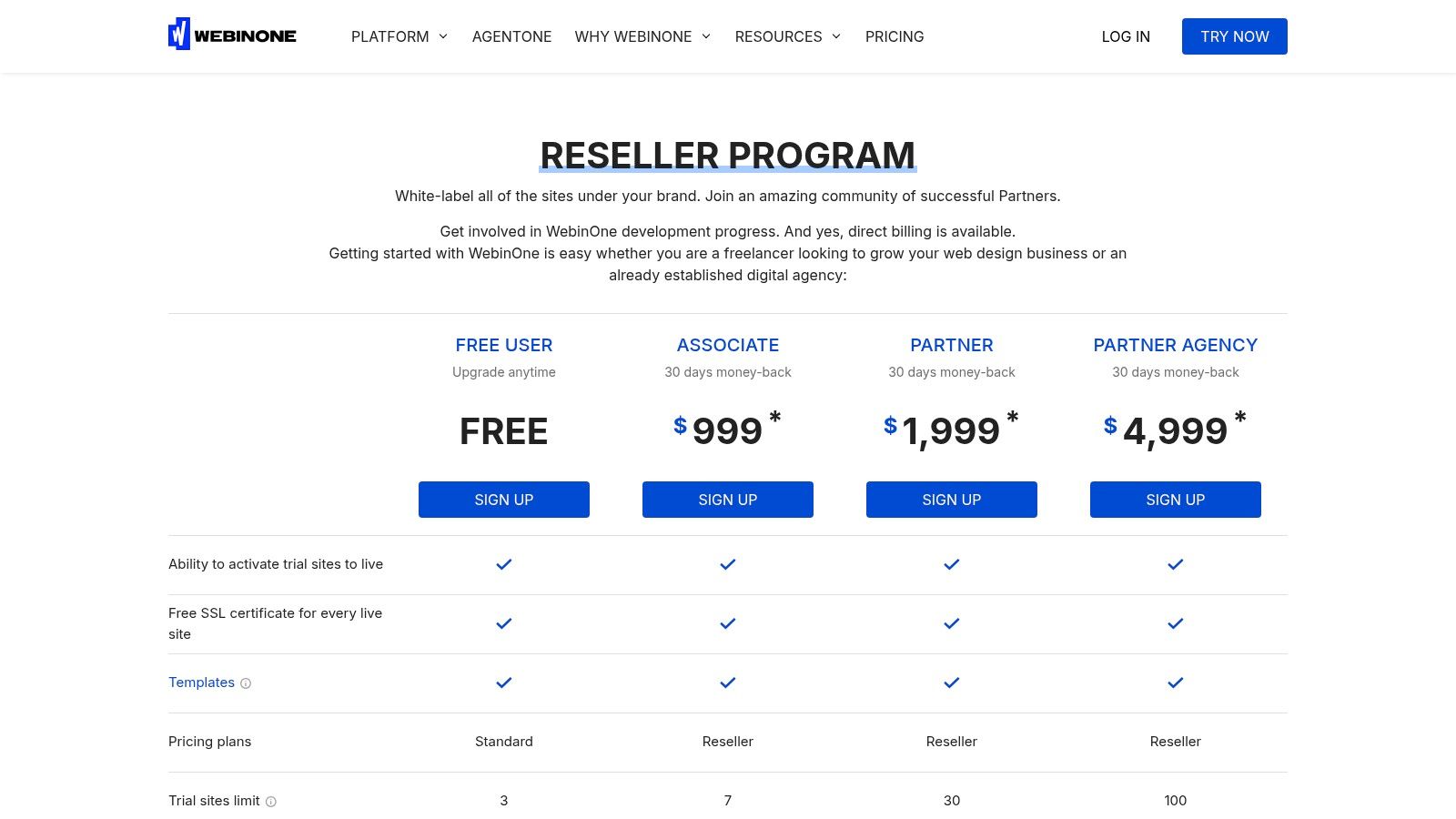
Start the discussion at WebinOne's reseller program. Bring the portfolio, the margin target, and the support scope, and make the next move a real conversation, not a form submission.