White Label Hosting Reseller: The Agency Guide

A client site launches successfully, then the agency inherits everything around it. Security patches arrive, extensions need testing, hosting questions land in the project channel, and a traffic spike turns a simple retainer into an infrastructure incident. The client still expects a single agency-level service, often at a price shaped by low-cost hosting rather than by the operational work involved.
That's the uncomfortable reality of a white label hosting reseller model. The opportunity is real, but the margin doesn't come from buying server capacity cheaply and adding a logo. It comes from controlling support liability, standardizing delivery, and moving clients onto a managed platform that lets the agency sell outcomes instead of exposing the machinery behind them.
Table of Contents
- Where Agency Hosting Margins Break
- Understanding Reseller Economics and Margins
- Evaluating White-Label Platform Requirements
- From Commodity Hosting to Managed Platform Models
- Legal, Data Residency, and Support Structures
- Why WebinOne Solves the Agency Scaling Problem
Where Agency Hosting Margins Break
WebinOne treats white-label delivery as a managed platform partnership, not a rebranded hosting account. That distinction becomes important once an agency carries several client sites and the operational work no longer fits inside an informal hosting add-on.
The margin rarely disappears through one dramatic incident. It erodes through recurring obligations: reviewing updates, answering configuration questions, coordinating recoveries, checking performance, and deciding whether a problem belongs to the site, the infrastructure, or the agency's own process. Each task may appear minor. Together, they consume senior delivery time that the original hosting price often never covered.
An agency can also inherit inconsistent standards across its client base. Sites may use different backup rules, update schedules, access arrangements, and escalation paths. Every variation increases the time required to diagnose a problem and makes it harder for another team member to handle the account without context.
Where the margin disappears
The infrastructure invoice is visible. The operational exposure sits elsewhere:
- Unbounded support: A hosting plan gradually becomes general website support, content editing, emergency fixes, and application troubleshooting.
- Patch ownership: The agency tests updates, investigates conflicts, manages failed deployments, and explains service interruptions to the client.
- Control-panel licensing: Per-account or per-site licensing can compress margin as the portfolio grows, especially when the agency cannot consolidate configurations.
- Portfolio interference: One resource-heavy site can affect neighboring accounts when the environment lacks meaningful isolation.
- Migration friction: Moving a client later may require planning, testing, redirects, validation, and rollback preparation. That work can consume more time than the original recurring revenue justified.
- Commercial ambiguity: “Managed hosting” means little unless the agreement defines whether migrations, security reviews, performance work, recovery, and application changes are included.
Support liability is the cost agencies underestimate most often. Clients do not separate the hosting layer from the website experience. If a form fails, a deployment breaks, or a site slows down, the agency usually receives the first message regardless of where the fault sits.
Industry guidance identifies underpricing, vague support boundaries, and weak backup or security policies as common reseller failure modes (industry guidance on reseller hosting margins and pitfalls).
Operational rule: If the agency cannot define what a hosting ticket includes, it cannot forecast the margin.
The better commercial position
A commodity reseller sells capacity. An agency should package a governed digital service in which hosting is one component. The offer can define platform operations, migration responsibility, security posture, content workflows, SEO and AEO maintenance, reporting, and escalation through named service levels.
WebinOne supports that shift through a white-label DXP and partner environment, allowing the agency to retain the client relationship and commercial positioning while a platform partner operates the managed environment. The agency's role changes from maintaining a collection of server arrangements to managing a consistent service model.
The broader market is large enough to attract serious reseller activity. One industry summary projects the reseller web hosting market to reach $9.8 billion by 2031 at an 8.1% CAGR, while another values the broader reseller web hosting service market at $15.8 billion in 2024 and projects $30.2 billion by 2033 (reseller hosting market overview and projections). Those projections do not establish agency profitability. They reinforce the need to treat support capacity, licensing, and operational ownership as part of the commercial model.
Understanding Reseller Economics and Margins
A hosting account can appear profitable until migration work, support tickets, licensing, and exception handling are charged against it. WebinOne frames the agency's margin as service capacity, not just the gap between wholesale and retail pricing. The commercial model needs a clear support boundary, repeatable delivery process, and upgrade path before the agency sets a price.
Calculate the service before setting the price
A practical pricing model separates four layers:
- Platform cost: The recurring charge for the managed environment, site capacity, control-panel licensing, and account-level services.
- Delivery cost: Provisioning, migration, configuration, quality assurance, and launch support.
- Operating cost: Monitoring, maintenance coordination, reporting, ticket handling, and escalation.
- Commercial risk: Recovery work, exceptional support, client-specific governance, and future migration obligations.
The monthly contribution can then be expressed plainly:
Client fee minus platform cost, delivery cost, operating cost, and commercial-risk allowance equals service contribution.
That calculation exposes costs that a basic reseller price often hides. Control-panel licensing can compress the margin as the portfolio grows. A difficult migration can consume the contribution from several billing cycles. A client who expects unlimited troubleshooting turns a defined hosting plan into an open-ended support commitment.
The agency should document what the client receives at each layer. A standard plan might cover platform operation, routine monitoring, and support for defined hosting-related issues. A higher tier can include content operations, SEO and AEO changes, structured reporting, or priority escalation. New functionality should remain project work. Without these boundaries, specialist intervention becomes unpaid delivery and the original price becomes difficult to defend.
The web development reseller margin framework provides a useful structure for examining delivery effort alongside platform expense. The key question is not, “What does hosting cost?” It is, “How much recurring work does this account consume, and which portion belongs in the hosting plan?”
Protect the portfolio
Resource monitoring is part of margin control. One badly behaved site can consume disproportionate CPU, disk, or bandwidth and affect other client accounts. The contract should define an upgrade path before an incident occurs, including the conditions that trigger a capacity review and the work that becomes chargeable.
Support language should distinguish four types of work:
- Platform incidents, which go to the platform partner.
- Site configuration issues, which belong to the agency or an agreed maintenance tier.
- New functionality, which becomes project work.
- Client-generated changes, which may require diagnosis before responsibility is assigned.
A white-label hosting reseller earns recurring revenue when recurring work remains predictable. Price the operational envelope, record the assumptions behind it, and review usage before the client outgrows the plan. That discipline protects both account margin and the agency's support capacity.
Evaluating White-Label Platform Requirements
A platform can look affordable until the agency absorbs incident triage, account isolation, and client communication. Evaluate those obligations before discussing branding or pricing. Clients see the agency name, so a provider outage, slow site, or unclear escalation path becomes an agency credibility problem.
Start with the service-level agreement. Industry guidance on quality and performance notes both the 99.9% uptime threshold, described as less than 1.5 minutes of downtime per day, and comparative benchmarks showing PHP execution at approximately 0.311 seconds versus 0.105 seconds, MySQL at 0.904 seconds versus 0.162 seconds, and combined PHP and MySQL performance at 1.215 seconds versus 0.266 seconds (white-label hosting quality and performance guidance). Treat those figures as evaluation prompts, not sales claims. Ask how the platform behaves when several sites compete for shared resources.

Test the platform in the order clients experience it
First, inspect the SLA. Confirm the availability commitment, incident notifications, exclusions, maintenance terms, and remedies. The agency should know what it can promise and which failures remain outside its control.
Next, test response behavior. Run representative sites and workloads, then ask how results are monitored over time. A benchmark from one environment does not predict every client experience. It does reveal whether the provider can explain performance, identify contention, and escalate recurring slowdowns without sending the agency into manual diagnosis.
Then, examine isolation. Ask how a traffic spike, inefficient query, or resource-heavy application affects the rest of the portfolio. Vague limits create support liability because the agency must explain an incident without clear evidence. Capacity thresholds, monitoring ownership, and escalation steps should be understandable to the delivery team.
Review the commercial controls at the same time. Control-panel licensing, paid add-ons, migration labor, and support handoffs can compress recurring margin even when the base hosting fee appears low. Confirm which functions are included, which are billed per site or account, and which tasks the agency must perform itself.
Governance is a product feature
A white-label platform needs operational controls that commodity hosting often leaves to the reseller. Look for:
- Portfolio visibility: One place to review site status, usage, incidents, deployments, and ownership.
- Role separation: Client, agency, delivery, and support access must not expose unrelated accounts.
- Repeatable provisioning: New sites should follow templates, not a checklist held by one person.
- Migration support: The provider should define how sites are moved and validated before cutover.
- Recovery controls: Backups, restoration duties, and escalation paths should be documented.
- Brand control: Login, administration, support, and client-facing experiences should remain consistent with the agency service.
Branding alone does not make a platform white label. If provisioning, resource management, licensing decisions, and support triage remain with the agency, the provider's name is hidden while the operational burden stays visible.
Test the arrangement with a real portfolio scenario. Ask how the provider would onboard a site, migrate an existing one, isolate a noisy account, handle a client ticket, and escalate a platform incident. Several disconnected systems usually mean the agency is buying coordination work as well as hosting.
From Commodity Hosting to Managed Platform Models
WebinOne represents the managed platform direction, where the agency sells an operating environment rather than a thin layer of rebranded server capacity. This shift changes the agency's support liability, client experience, and ability to create higher-value recurring work.
Traditional reseller hosting keeps the agency close to server management. Staff configure packages, manage accounts, answer technical questions, and interpret infrastructure behavior for clients. A modern white-label DXP places a branded operating layer around sites, staff access, billing, support, and governance while the upstream provider handles the underlying platform.
The commercial trade-off is operational. A low hosting fee can lose its appeal once the agency absorbs support tickets, incident triage, resource disputes, and control-panel licensing costs. Every platform function that remains with the reseller consumes delivery time or requires a higher service price.
Two models with different exposure
| Operating model | Agency sells | Agency carries |
|---|---|---|
| Commodity reseller | Branded hosting capacity | Infrastructure interpretation, support triage, and resource disputes |
| Managed platform partnership | A governed digital service | Client relationship and service design, with platform operations handled through an agreed partner model |
Commodity resale can suit technically capable teams with tightly limited support. It becomes fragile when the agency promises managed service while lacking controlled provisioning, a defined escalation route, or repeatable release processes. A managed platform partnership gives agencies more room to deliver multi-site governance, migrations, content operations, and ongoing optimization without assigning every infrastructure task to internal staff.
Industry coverage describes the market's movement toward resellers acting more like specialized managed IT partners. It identifies AI for predictive maintenance, zero-trust security, and vertical specialization as differentiators, alongside automated provisioning, real-time resource monitoring, and fully branded client portals (white-label hosting trends and managed operations). These capabilities shift the agency from reactive host to accountable service operator.
Know when to graduate
A managed platform model deserves consideration when:
- Sites span multiple environments and governance is inconsistent.
- Support requests increasingly concern platform behavior rather than the original website project.
- The portfolio needs shared templates, permissions, reporting, and standardized releases.
- The agency sells security, SEO, AEO, analytics, or content operations without a unified delivery layer.
- A migration or re-platforming project is delayed because the destination architecture is difficult to repeat.
- Senior technical staff spend routine maintenance time that could support higher-value client work.
Learn how to package platform operations as managed services and support rather than ad-hoc hosting fixes.
WebinOne consolidates CMS, ecommerce, CRM, email marketing, multi-site management, and a headless API in one managed system. That structure can support a broader agency offer, while commercial discipline remains with the reseller. Define which capabilities are included, which belong in managed service packages, and which require separately scoped delivery.
The practical test is simple: can the agency operate a growing client portfolio without becoming the hidden infrastructure department? If support liability, licensing costs, and escalation work remain unpriced, white-label branding has only concealed the margin problem.
Legal, Data Residency, and Support Structures
WebinOne gives agencies a platform partnership to structure around, but the agency still needs explicit contracts, escalation rules, and data-handling decisions. White-label branding doesn't transfer client liability automatically, and a logo replacement isn't a substitute for governance.
The legal model should answer who sells the service, who provides the platform, who handles personal data, who responds to incidents, and who can authorize changes. Agencies should also distinguish their own service commitments from the platform provider's commitments. A client may have one commercial relationship with the agency, but the delivery chain still contains separate responsibilities.
Use formal channel mechanics
AWS Marketplace provides a useful example of how a reseller relationship can be formalized. AWS Marketplace terms allow a listing owner to authorize resellers, with the authorized reseller becoming the seller of record for paid offerings and each resale creating a contemporaneous sale from the listing owner to the reseller (AWS Marketplace seller terms).
That structure is materially different from informal account sharing. It creates a defined channel relationship, which is especially important when an agency or systems integrator serves regulated, public-sector, or enterprise buyers.
AWS Marketplace channel partners can also create private offers and resell products including AMI-based, container-based, SaaS-based, and professional services products (AWS Marketplace channel partner documentation). For agencies, this reinforces a broader point: the resale model can include implementation and managed services, not just infrastructure access.
Put support boundaries in writing
A sustainable contract should specify:
- Included platform support: Availability incidents, platform-level faults, and defined escalation handling.
- Included site support: The exact maintenance, content, SEO, AEO, and configuration tasks covered by the agency.
- Excluded project work: New features, redesigns, integrations, major migrations, and custom workflows.
- Client responsibilities: Access approvals, content ownership, application changes, and timely incident information.
- Recovery expectations: Backup scope, restoration authority, testing responsibilities, and communication procedures.
- Data residency: The permitted hosting location and the process for clients with regional or government requirements.
Support should flow through one accountable route. If the client can bypass the agency and create conflicting instructions with the upstream provider, the white-label promise breaks and the agency loses operational control.
WebinOne operates on AWS across six regions and supports selectable data residency, while custom data centers can be arranged for clients by agreement. For qualifying systems integrators, a licensed version can run in the SI's or customer's own AWS account, including AWS GovCloud, by agreement. FedRAMP and GovCloud projects are delivered with SI partners and licensed deployments, so the appropriate next step is a technical and commercial conversation rather than an unsupported promise in a sales contract.
Why WebinOne Solves the Agency Scaling Problem
WebinOne gives agencies a white-label DXP for consolidating client delivery, platform operations, and recurring services under the agency's own commercial model. It addresses the central failure of commodity resale, which is asking the agency to own the client liability without giving it a unified system for managing the portfolio.
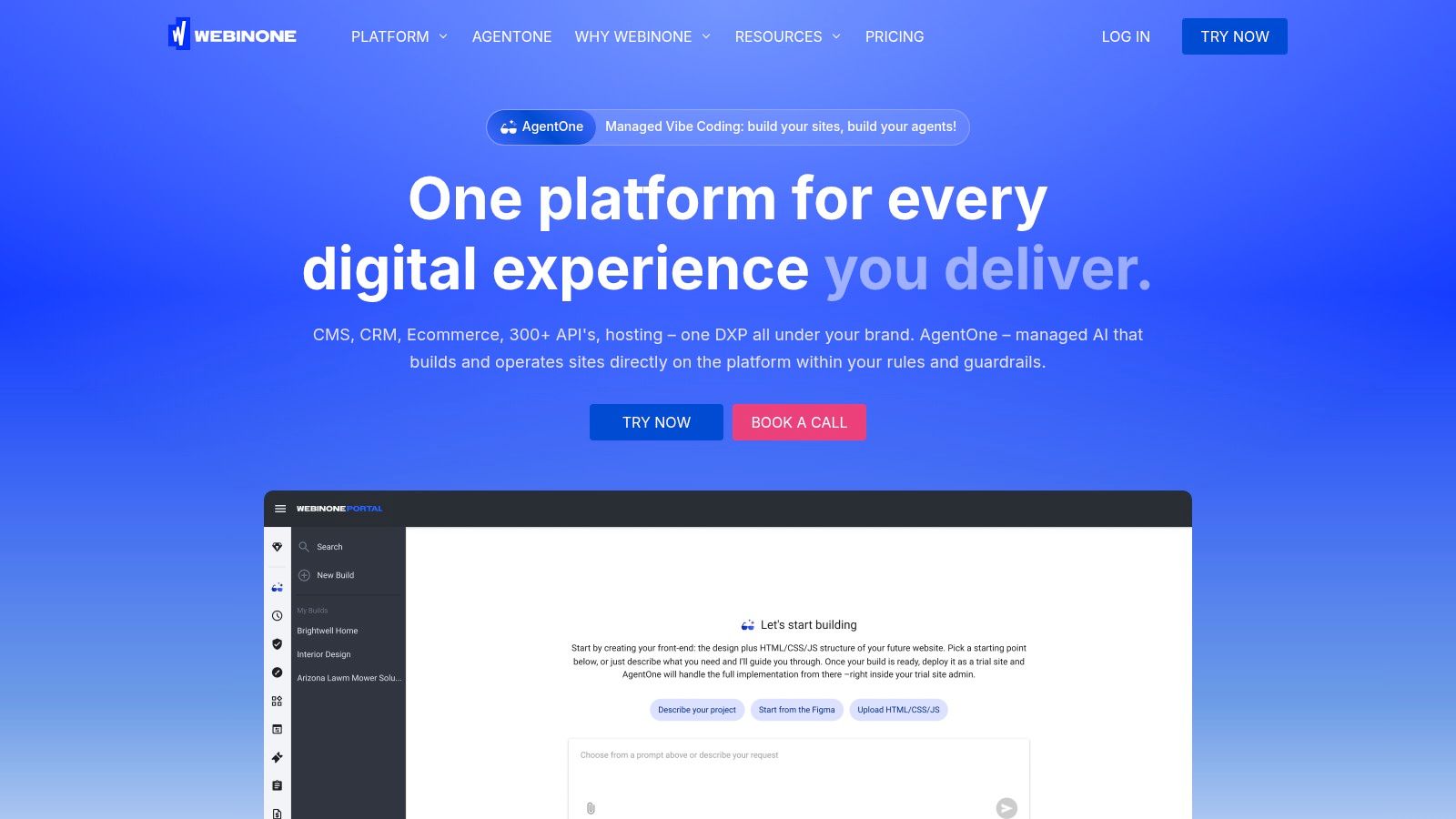
The platform combines CMS, ecommerce, CRM, email marketing, multi-site management, and a headless API. Agencies can use centralized management, unified data, templates, custom modules, and native extensions without building a separate operational layer around every site. That matters for teams moving beyond one-off builds into multi-site programs, migrations, and ongoing SEO or AEO services.
WebinOne delivers 99.99% uptime over the last 12 months, with a 99.95% availability commitment in the published SLA, and has partners in 16 countries with thousands of sites migrated. It runs on AWS across six regions, offers dedicated server options and selectable data residency, and has supported US and Australian government clients.
Turn platform capability into an agency offer
The commercial advantage comes from packaging the platform around client outcomes:
- Portfolio governance: Manage multiple sites, brands, staff permissions, support tickets, and billing through a branded partner environment.
- Migration delivery: Use TeamOne for staged, tested migrations and cutover planning instead of treating every move as an improvised project.
- Managed operations: Use AgentOne for managed vibe coding, content updates, optimizations, and automations inside the platform, with scoped permissions, audit logs, and reviewable changes.
- Commerce economics: Price ecommerce services without transaction fees, while treating custom work as a separately scoped TeamOne project.
- Recurring optimization: Bundle SEO, AEO, content updates, analytics, and governance into a service that has visible operational value.
Pricing starts from $10 per month per site, and ecommerce carries zero transaction fees. Those facts don't establish an agency's retail price. They give the agency a transparent platform baseline from which to calculate support, delivery, governance, and margin.
For agencies building AI-enabled workflows, a resource such as an AI automation agency can help frame the broader service opportunity. The important distinction is operational: AgentOne doesn't generate a site and disappear. It operates within the managed platform, where changes can be reviewed, audited, and reversed before production.
WebinOne is an AWS Partner, has passed the AWS Foundational Technical Review, holds the AWS Qualified Software designation, is enrolled in the AWS Software and Services Paths, and is available on AWS Marketplace. Paid partner support is available, and the WebinOne reseller program gives agencies a defined route to package the platform under their own brand.
Agencies evaluating white-label hosting can use WebinOne to consolidate site delivery, governance, ecommerce, and managed operations without turning every client account into an infrastructure obligation. Visit WebinOne to review the platform model and start a reseller-program conversation focused on portfolio migration, support boundaries, and sustainable agency margin.