Schema Markup for SEO: What Agencies Should Govern
Adding more schema types won't make a client's pages rank higher, and wrapping a site in structured data isn't an AI-search strategy. The useful work is less glamorous: deciding which templates describe which entities, keeping those descriptions aligned with published content, and checking whether search engines still support the intended feature.
For agencies managing client portfolios, schema markup for SEO is a governance responsibility. A copied snippet can pass a syntax test while describing the wrong brand, an expired event, or a price the visitor can't buy at. The operating model matters more than the volume of markup.
Table of Contents
- What Schema Markup Changes in Search
- Schema Types Worth Governing Across Sites
- Build JSON-LD From the Same Content Source
- Connect Entities With Stable Identifiers
- Validate Syntax and Rich Result Eligibility
- Roll Out a Schema Policy Across Client Sites
- Govern Markup on the Platform You Resell
What Schema Markup Changes in Search
WebinOne treats schema markup as a search-appearance and disambiguation layer, not a direct ranking signal. It helps describe the entities on a page and may qualify that page for an enhanced search result.
The pathway is narrow: a publisher supplies accurate structured data, the page meets a supported feature's requirements, and the search engine decides whether to display that feature. An enhanced listing can affect clicks, but markup doesn't move a page up the results by itself.
Milestone Research's analysis of more than 4.5 million queries found that rich results received clicks 58% of the time versus 41% for standard results, a 17-percentage-point difference, according to Search Engine Journal's reporting. That's an observational comparison between result presentations, not proof that adding schema caused the difference.
Measure the feature, not the snippet deployment
An agency's reporting should distinguish implementation success from commercial results. Publishing valid markup proves that a technical task was completed, not that the client gained incremental traffic.
- Segment by eligible type. Keep product pages separate from editorial pages and location pages.
- Establish a comparison. Use a preimplementation baseline or a matched group of unchanged URLs.
- Track impressions, CTR, and clicks together. A higher click-through rate doesn't necessarily mean more visits if impressions fall.
- Record concurrent changes. New titles, redesigned pages, and revised content complicate attribution.
Reporting rule: Promise accurate implementation and monitored eligibility, not a universal schema CTR lift.
For ecommerce teams considering broader discovery work, Next Point Digital's AI search tips for ecommerce brands provides a useful companion resource. Keep that planning separate from the narrower question of whether a URL qualifies for a supported search feature.
The strongest agency deliverable is an auditable relationship between the page, its markup, its eligibility, and its measured performance. A report that merely counts schema types encourages unnecessary implementation work.
Schema Types Worth Governing Across Sites
Most editorial templates need three schema types, not eleven. On a typical client site the governed set starts with Organization, BreadcrumbList, and Article or BlogPosting; on a commerce site the editorial slot gives way to Product and Offer. Across a portfolio, that short list becomes policy: the same types, backed by the same fields, on every site that shares the template.
Schema types to govern and what they can still earn
| Type | Must match on the page | Google feature status | Template priority |
|---|---|---|---|
| Organization | Legal or brand name, logo, URL, sameAs profiles | No guaranteed knowledge panel | High, one canonical entity per brand |
| WebSite | Site name and canonical home URL | Sitelinks search box is not a feature to plan for | Medium, identity only |
| Article or BlogPosting | Headline, dates, author, image as shown | Article search enhancements when applicable requirements match | High on editorial templates |
| Product and Offer | Name, price, currency, availability as shown | Product snippets when requirements are met | High on commerce templates |
| BreadcrumbList | The visible path and real URLs | Breadcrumb trail in search results | High on public templates with a visible hierarchy |
| LocalBusiness | Name, address, phone, hours as shown | May support local appearance, not guaranteed | High only where a location is on the page |
| Event | Name, start date, location, offer if a price is shown | Event rich results while dates stay current | Medium, only on event templates |
| VideoObject | A playable video on that URL plus name and thumbnail | Video rich results when requirements are met | Medium, only if the video is on the page |
| Review or AggregateRating | Ratings that are visible and about the item | Only with a supported parent type, not standalone | Low, attach to Product or another supported type |
| FAQPage | Visible question and answer pairs | Not a general rich result for commercial sites | Don't add for click gains |
| HowTo | Visible steps | HowTo rich results have been retired | Don't add for click gains |
A broad vocabulary, a short working set
The Schema.org vocabulary documentation lists 826 types and 1,540 properties. That breadth supports entity modeling across many applications; an SEO engagement uses only the types a template can support.
A type identifies the kind of entity being described. A property supplies an attribute or relationship. Google's feature documentation determines which combinations qualify for its search enhancements, so a valid graph can still produce no rich result.
That distinction changes prioritization. A service page doesn't become a Product because product snippets look attractive. A brand doesn't become a LocalBusiness unless the page presents a location. The type follows the page job, and the page job follows the template.
Assign types to templates, not sales packages
For commerce, the product detail page establishes the content model before any markup is written. If price, availability, imagery, and product identity aren't dependable in the page record, structured data exposes that weakness to every crawler that reads it.
On WebinOne, the approved set lives in the shared template, so a content editor can't add a type the page can't support. Agentable's guidance to validate schema markup before launch fits the point where a working set becomes a release checklist: validation sits inside template acceptance, alongside the design QA and content checks a page already passes before publication.
A practical policy also names exclusions. Review markup stays off a template merely because a testimonial component exists, and FAQPage stays disabled portfolio-wide rather than running as a traffic tactic. Pick the types the template can support, then stop.
Build JSON-LD From the Same Content Source
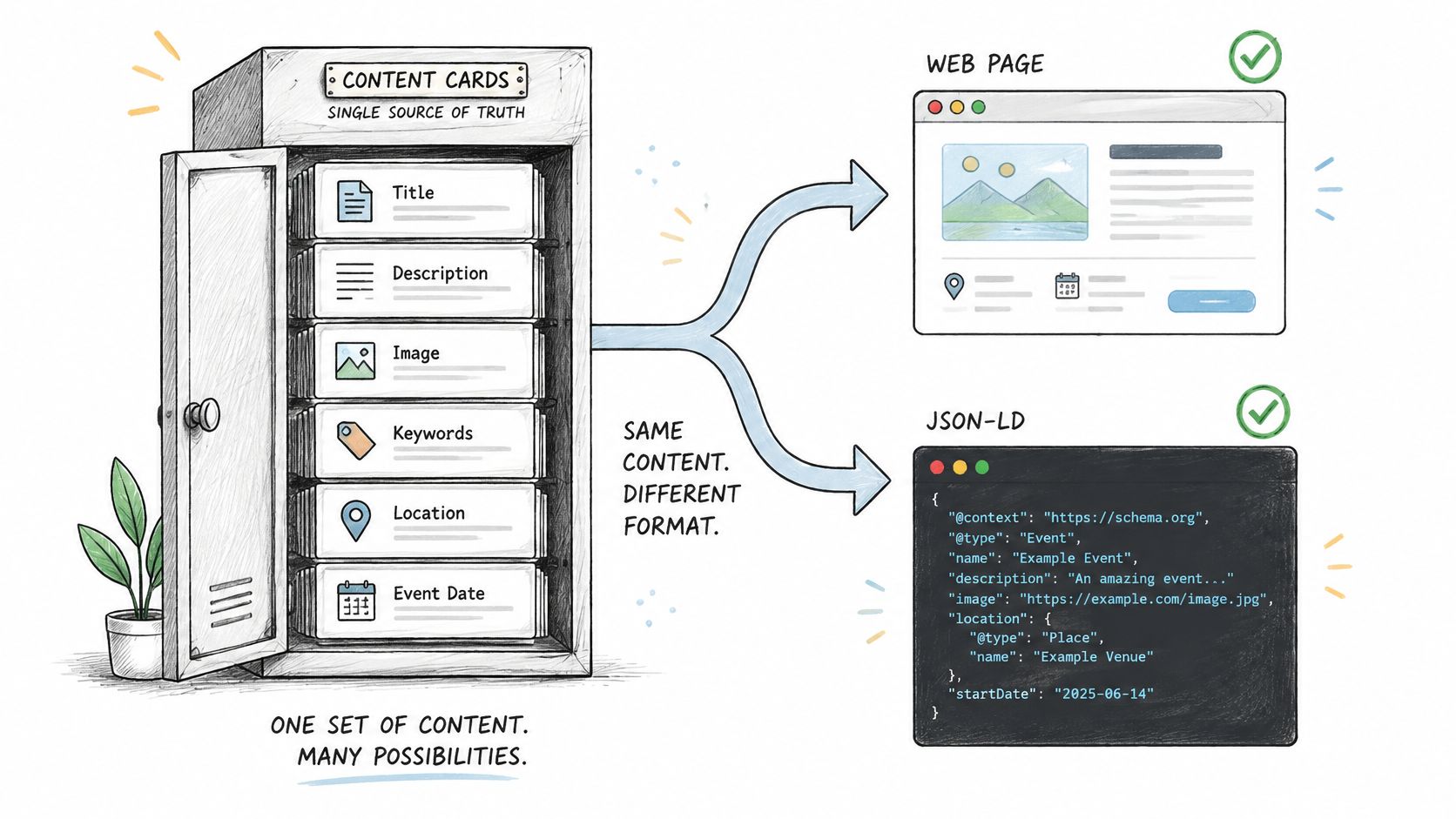
A price that exists in a template field and again inside a hand-edited JSON-LD block will eventually disagree with itself. The durable fix is structural: generate the markup from the same governed fields that render the page, so each URL gets one canonical graph assembled from content records rather than a second copy of the copy.
Google recommends JSON-LD for maintainability, and its structured-data policies require markup to describe relevant page content and meet feature-specific requirements. Hidden, misleading, unrelated, or outdated information can undermine eligibility even when the JSON parses correctly.
Reject any template that lets the same fact be edited in two places.
Map fields before writing the graph
Start with a field map for each approved template. Record the visible component, its source field, the corresponding schema property, and the behavior when that field is empty. The map becomes the artifact reviewers check before a template ships, and it exposes gaps while they are still cheap to fix.
- Use typed source fields. Store dates as dates and amounts as numeric values with separate currency fields.
- Serialize safely. Use a JSON serializer rather than concatenating unescaped titles, descriptions, or author names into a script.
- Define omission behavior. Leave out unsupported optional values instead of publishing empty strings or invented defaults.
- Block incomplete feature output. If a required value is missing, flag the record for correction rather than manufacturing a plausible value.
Say an event's venue changes three weeks before the date. The address component and the Event's PostalAddress should both read the updated venue record on the next publish. A standalone JSON-LD address field gives editors a second place to forget, and stale markup is exactly the kind of policy violation that erodes eligibility.
Keep assembly under template control
A canonical graph does not require flattening every relationship. Nesting earns its place when an Offer belongs to a Product or a PostalAddress belongs to an event location.
The boundary that matters is ownership. Content records provide the facts; the template decides their structured representation. WebinOne gives full code access through Liquid templating, so the graph can be generated inside the same template that renders the page and an editor updating a product description never touches JSON escaping.
The same rule holds for headless CMS SEO: the delivery layer consumes the governed record instead of assembling an independent set of SEO facts for each front end.
A schema-only field is a warning sign when it duplicates information already displayed elsewhere.
Before migration, inventory every existing markup producer: template fragments, injected scripts, and reusable components. A new graph layered over an old block leaves both publishing at once, and conflicting prices or identities are the usual result. Retire or redirect each legacy producer before the new template ships.
The acceptance test stays simple. Change a fact once, publish, and confirm the page and the graph moved together.
Connect Entities With Stable Identifiers
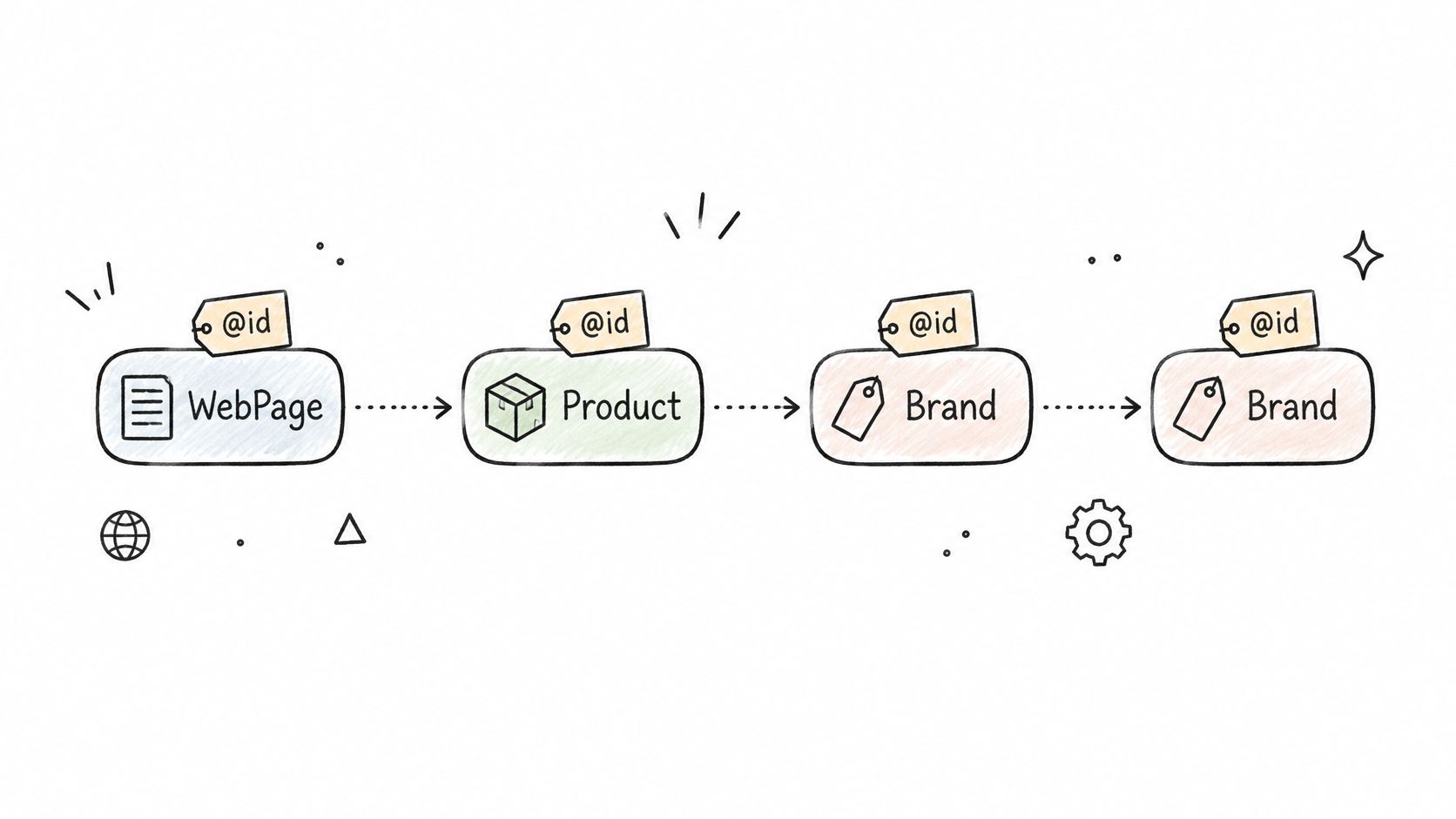
Stable @id values keep an identity attached to the thing it describes, wherever a template publishes it. The entity registry should assign one identifier per brand, site, and item, and every page that mentions that entity should reference the same value.
A product page in a multi-brand portfolio shows why. The WebPage identifies its main entity as a Product, and that Product takes its name, image, and description from the visible product record.
The Product connects to an Offer containing price, priceCurrency, and availability. Its brand relationship references the appropriate Organization identity, while a BreadcrumbList represents the visitor's actual navigation path. Change any of these facts in the record and the markup should follow, because the template reads the same fields the page displays.
Preserve identity without merging unrelated entities
A new regional site does not automatically create a new organization. Equally, shared ownership does not mean distinct brands should all inherit the same name, logo, and public profiles.
The entity registry should distinguish:
- Brand identity. The organization or brand responsible for the offering.
- Site identity. The particular website publishing the page.
- Item identity. The product, article, event, or location being described.
An article follows a different relationship pattern. The Article connects to its author as a Person or Organization, while datePublished reflects the published byline information rather than a deployment timestamp.
WebinOne gives full code access through Liquid templating, so a template can pull the registry field and emit the same @id on every page that references the entity. The registry holds the policy. The template delivers it.
Test the relationships at portfolio boundaries
When a client moves a product range between brands, the Product can keep pointing at the former brand's Organization identifier long after the visible logo has changed. The page looks correct while the graph still tells search engines who used to own it.
Similar problems arise when a location record is copied between clients, an event is duplicated without changing its date, or an author reference survives after the displayed byline changes. Each one is a modeling error.
Maintain identifiers in an entity registry with an owner and a clear reassignment rule. Retire mistaken identities deliberately, and preserve legitimate identifiers through redesigns and migrations. A few accurate relationships are more useful than a long list of disconnected types.
Validate Syntax and Rich Result Eligibility
A passing vocabulary check can still hide a price that the visitor never sees. Syntax validity and feature eligibility are separate questions, and a green result on the first settles nothing about the second.
Google's structured-data validation guidance recommends the Rich Results Test for Google-supported features and the Schema Markup Validator for broader Schema.org validation. Neither result substitutes for inspecting the rendered page.
Use the checks as a release gate
The release gate should capture evidence, not a green status pasted into a ticket. Record the tested URL or candidate markup, the template revision, the detected feature, and any unresolved warnings.
Schema release checks and what each one proves
| Check | Question it answers | Pass condition | Typical failure |
|---|---|---|---|
| Rich Results Test | Which Google features can this URL earn? | A targeted supported feature is detected with no errors | Valid markup for a feature Google no longer shows |
| Schema Markup Validator | Is the graph valid Schema.org? | Errors cleared across the types used | A type or property that isn't in the vocabulary |
| Feature documentation | Are required properties present? | Every required property for that feature is populated | Syntax valid but a required field omitted |
| Rendered-page parity | Does the markup match what visitors see? | Values, dates, prices, and names match the page | Hidden, stale, or copied entity data |
| Crawl check | Can Googlebot see the JSON-LD? | Markup present in the rendered HTML Google fetches | Script blocked, or injected only after a blocked call |
| Search Console watch | Did eligibility survive the release? | No new enhancement errors after processing | Errors appear only after content edits |
Identity markup without a targeted rich-result feature may show no detection in the Rich Results Test, and that alone is not a defect. Acceptance criteria should reflect the intended use rather than require every entity to earn a visual enhancement.
Inspect what the visitor and crawler receive
Test representative records, including incomplete and unusual cases. An article with no image, a product with special characters in its name, and an event with a changed venue expose failures that a fully populated demonstration record hides.
Inspect the rendered HTML as well as the source record. A correct API response proves nothing about the JSON-LD the front end emitted or the facts the page displays.
For stakeholders who need context before approving the release gate, Bruce and Eddy's structured data explainer can support the discussion without replacing feature-specific acceptance criteria.
Release boundary: A passing test establishes technical readiness under the tested conditions. It doesn't guarantee display in search.
After deployment, monitor Search Console enhancement reports and investigate new errors by template and content change. Re-test after changes to price handling, author models, date formatting, or rendering logic.
Warnings deserve review on their own terms. When one appears, the fix is usually a documented omission, a content correction, or removal of an unsupported feature target, never an invented value added to satisfy the tool.
Roll Out a Schema Policy Across Client Sites
For a portfolio with 40 templates, conversion order matters more than client count. Start with the templates that carry the highest-value public facts, such as service pages, articles, events, product pages, and location records. Then move to aging templates whose source fields, rendering logic, or content models are still understood by the team maintaining them. Google's SEO in AI Search guide for marketers states that AI Overviews introduce no additional structured-data requirements beyond normal indexing and snippet eligibility.
That gives the rollout a clear scope: govern the facts already used for search eligibility and disambiguation. Effort goes to stable field mappings, visible-content parity, and entity consistency across the portfolio.
Establish ownership before expanding coverage
A schema policy belongs within the broader content governance framework. The template owner needs to know who approves field mappings, who maintains entity identities, and who can stop a faulty release.
Write the policy per template. Name the permitted types, their intended purpose, and the content fields that supply them. Include explicit exclusions so a new component doesn't introduce unrelated markup.
Ensure visible-content parity. Prices, dates, names, and authors must agree with the rendered page. A record that can't support that agreement needs correction, not an exception hidden inside a script.
Separate shared identity from local facts. Maintain the correct Organization identity for each brand while letting each site supply its own relevant addresses, offers, and authors.
Sequence legacy templates by migration risk. Convert templates whose fields are stable first. Leave templates with unclear ownership, duplicated content models, or hard-coded markup until their source records and rendering behaviour have been mapped.
Use the release gate established earlier for vocabulary checks, feature testing, deployment evidence, and rollback control. The rollout adds the operating sequence: which template goes first, who owns the mapping, and when a legacy template is ready to move from exception to supported coverage.
Roll out by risk, not by client count
Start with a representative site whose templates and source records are understood. Include a difficult record early rather than selecting only clean examples that make the implementation look complete.
Expand only after the agency can explain the source of each emitted value and reproduce the validation results. Record deliberate exceptions, including legacy templates awaiting migration. Each exception should name the blocking issue, the owner, and the condition for removal.
The managed service is concrete: approved mappings, controlled releases, eligibility monitoring, and corrective work. Those deliverables can be inspected, assigned, and renewed as part of an ongoing client retainer.
Govern Markup on the Platform You Resell
A buying team usually reaches this decision after the second or third client site moves onto a new stack. The schema was acceptable at launch, but the Organization record, article authors, product names, and offer details now live in different places. The question is whether the agency can keep a reliable implementation as sites and brands grow.
Schema markup needs a system that survives template changes, staff turnover, and portfolio expansion. A JSON-LD block pasted into a page can be correct for a week. A governed implementation has named content sources, approved mappings, release checks, and a correction path that another technical lead can follow.
Buy for the work that continues after launch
A buying team should test the operating model with a representative migration scenario. Include a shared brand identity, a product or article template, an incomplete record, and a content change that affects structured data.
- Trace the source. Identify where each public fact originates and who may change it.
- Review the handover. Confirm that another technical lead can understand the mapping without reconstructing undocumented snippets.
- Demonstrate correction. Introduce a controlled error, detect it, and establish the recovery procedure.
WebinOne combines CMS, ecommerce, CRM, email marketing, multi-site management, and a headless API in one managed system. That scope matters because schema governance depends on keeping shared identity, page content, and local facts connected across templates. It also gives agencies full code access through Liquid templating, so markup can be generated from the same content model that renders visible page content.
White-label control also belongs in the evaluation. WebinOne puts the reseller's logo and branding on the admin and login pages of each client site, which supports an agency-led delivery model. The platform is an AWS Partner, has passed the AWS Foundational Technical Review, and holds the AWS Qualified Software designation. Those details inform platform due diligence. They do not prove a client's schema is correct, so the agency still needs release evidence and clear content ownership.
Price governance as a service
WebinOne's white-label platform includes content management, templates, multi-site management, and a headless API, with pricing from $10/month per site. Published pricing is designated for web design resellers; site owners and free users are expected to apply at least a 2x markup.
That commercial floor should not become the price of an SEO management service. Field mapping, migration review, validation, monitoring, and exception handling are agency work and should be scoped separately.
The practical buying test is straightforward. Can the platform emit schema from controlled content fields? Can the agency explain every value to a client? Can a template change be reviewed before release and rolled back if it breaks eligibility? If those answers are tied to the delivery system, schema governance becomes a maintainable service rather than a one-time implementation task.