Sanity Headless CMS: Capabilities, Trade-offs and Fit
A headless CMS decision is not finished when the API works. The harder question is who owns publishing failures, integration changes, governance and production costs after launch.
For an agency carrying the support contract, those responsibilities shape whether the work remains manageable and profitable. Choose a platform around the client's channels and content relationships, then document ownership, service levels and the full operating cost before committing to the build.
Table of Contents
- Sanity Capabilities and the Headless Content Model
- Choosing Between Live and Cached API Delivery
- Event-Driven Integrations With Webhooks
- Where Sanity Fits and Where Teams Hit Friction
- Migration, Governance and Who Runs It After Launch
- Sanity Against Other Headless Options by Criteria
- Confirm the Stack Before You Commit a Client
Sanity Capabilities and the Headless Content Model
A headless content model succeeds when it reflects how information is reused across channels. Start by identifying the business entities that need to stay consistent, then define how each destination uses them.
Model the business entities, not the page layout
Define schemas around products, authors, locations and offers. If a product appears on a marketing site, in an application and on a kiosk, model its description as reusable information rather than creating a separate record for each destination.
A location record, for example, might include an address, opening hours, accessibility information and a reference to the current offer. The marketing site can request the full profile; an application can request opening hours and directions; a kiosk can request the offer and its image.
Each frontend should request only the fields it needs. Projections help shape those responses, while references connect related records. The model should also establish validation rules and ownership, so teams know which information they can change and who is responsible for it.
Design for reuse without losing control
A presentation change can often ship independently when the existing fields still support it. Changes to field names, references or validation rules may affect every consumer, so schema updates need clear ownership and a review process.
Editors need understandable field names and helpful validation messages. They also need to distinguish reusable business information from content that belongs to a specific presentation.
A field-based content model does not automatically provide visual editing. Preview must be connected to the frontend, with draft access, authentication and representative layouts tested before editorial acceptance.
Practical rule: Test the editorial task, not just the API response. An editor should be able to change an offer, inspect its intended presentation and understand where it will appear.
During discovery, list the expected channels and map each to the records it needs. Confirm that shared records represent reusable information, rather than unrelated pages grouped together for convenience.
WebinOne includes a headless CMS alongside CMS, ecommerce, CRM and multi-site management. Teams can assess managed page delivery and API-driven delivery against the same client requirements.
Choosing Between Live and Cached API Delivery
A morning build publishes at 8 a.m. An editor corrects a headline at 8:15. Whether readers see the correction immediately depends on when the frontend reads content and how that delivery path handles caching.
Separate two questions: how fresh the data must be at the point of reading, and how much repeated traffic the delivery path must handle. The Sanity API CDN documentation describes distinct options for uncached reads and CDN-distributed delivery.
Typical delivery patterns and when to use them
| Delivery pattern | Caching behaviour | Best use |
|---|---|---|
| Uncached read | Fetches the latest available content at request time | Build jobs or other reads that require current content |
| CDN delivery | Serves repeated reads through a content delivery network | Public frontends with recurring reader requests |
| Query language | Depends on the delivery path, not the language alone | Choose based on the team's skills and the contract it needs |
Turn freshness into an acceptance test
For the morning build, determine whether the build must include the latest published records or can use a recently cached response. Then decide how a correction made after the build reaches readers: through a targeted rebuild, a request-time read or another release mechanism. “Published” and “visible to readers” are separate acceptance criteria.
- Inventory each frontend. Include public pages, applications, previews and internal consumers.
- Identify the read point. Record whether each consumer retrieves content during a build or when a request arrives.
- Set a freshness window. Agree how long a published change may take to appear for each audience.
- Test publication end to end. Change a representative record, then confirm it reaches the intended audience within that window.
Keep query design separate from delivery design. Sanity's GROQ feature documentation describes joins, subqueries, reference dereferencing and custom functions for reusable query logic. A schema-driven query contract is another option.
Choose the approach the delivery team can maintain, then test query behaviour, caching and rendering together. The API choice matters less than whether the agreed freshness window holds after launch.
Event-Driven Integrations With Webhooks
A webhook can fail after a content change but before a downstream system finishes processing it. The site may show the new content while search, a listing or a social channel still holds the old version. Design for that gap: events notify systems that something changed, while an API lets them retrieve the data they need.
- Filter narrowly. Limit events to relevant content types and changes. A metadata correction should not trigger unrelated processing.
- Make consumers idempotent. Use a processing identifier or safe upsert so repeated delivery does not create duplicate records.
- Authenticate endpoints. Reject unauthenticated requests before processing their payloads.
- Plan for retries. Distinguish temporary failures from invalid payloads, and define how failed work can be recovered.
- Record outcomes. Keep enough context to investigate and replay failed work without exposing sensitive content.
Shape the payload around the downstream task
In Sanity, GROQ projections and change-aware functions such as before(), after() and delta:: can help integrations respond to relevant field changes. A changed offer image might trigger image generation; a corrected location address might update a downstream listing. Neither event necessarily justifies rebuilding the entire site.
For channel distribution, the guide to social publishing integrations for developers can help teams define the boundary between content approval and external publication. The distinction between event notification and data retrieval is also covered in WebinOne's guide to webhooks and APIs.
Every consumer adds ongoing work. Include its credentials, payload contract, failure handling and recovery procedure in the support scope, not just the launch checklist.
Where Sanity Fits and Where Teams Hit Friction
Sanity's headless model can suit projects that reuse structured content across several destinations or need custom rendering. The harder question is whether the client can support the operating model after launch: editors need workable tools, integrations need maintenance, and someone must own ongoing platform costs.
Before choosing any vendor, document the requirements that affect day-to-day operations:
- Editorial workflow: Define how editors preview, review, and publish structured content. Test those tasks with the people who will use the system.
- Access and recovery: Confirm the identity, role, backup, and recovery controls the client requires, then check that they fit the proposed setup.
- Production dependencies: Account for frontend hosting, search, preview environments, identity integrations, monitoring, and release management.
- Engineering capacity: Identify who will maintain the content model and integrations, and include that work in the service scope.
A low subscription price alone does not establish a low annual operating cost. Estimate the full operating envelope, including seats, documents, datasets, environments, request volume, compliance requirements, and available engineering time. Assign a commercial assumption to each item.
For example, another dataset may add content synchronisation and deployment work. A security review may require evidence or controls that were not part of the initial estimate. Agencies planning for enterprise requirements can use this guide to enterprise headless CMS planning to frame the wider operating responsibilities.
The proposal should make clear whether the agency is providing ongoing engineering support or a managed platform relationship, and whether its margin covers that commitment. For WebinOne, reported uptime and a contractual availability commitment are distinct measures: the platform reports 99.99% uptime, with a 99.95% availability commitment in its published SLA.
Migration, Governance and Who Runs It After Launch
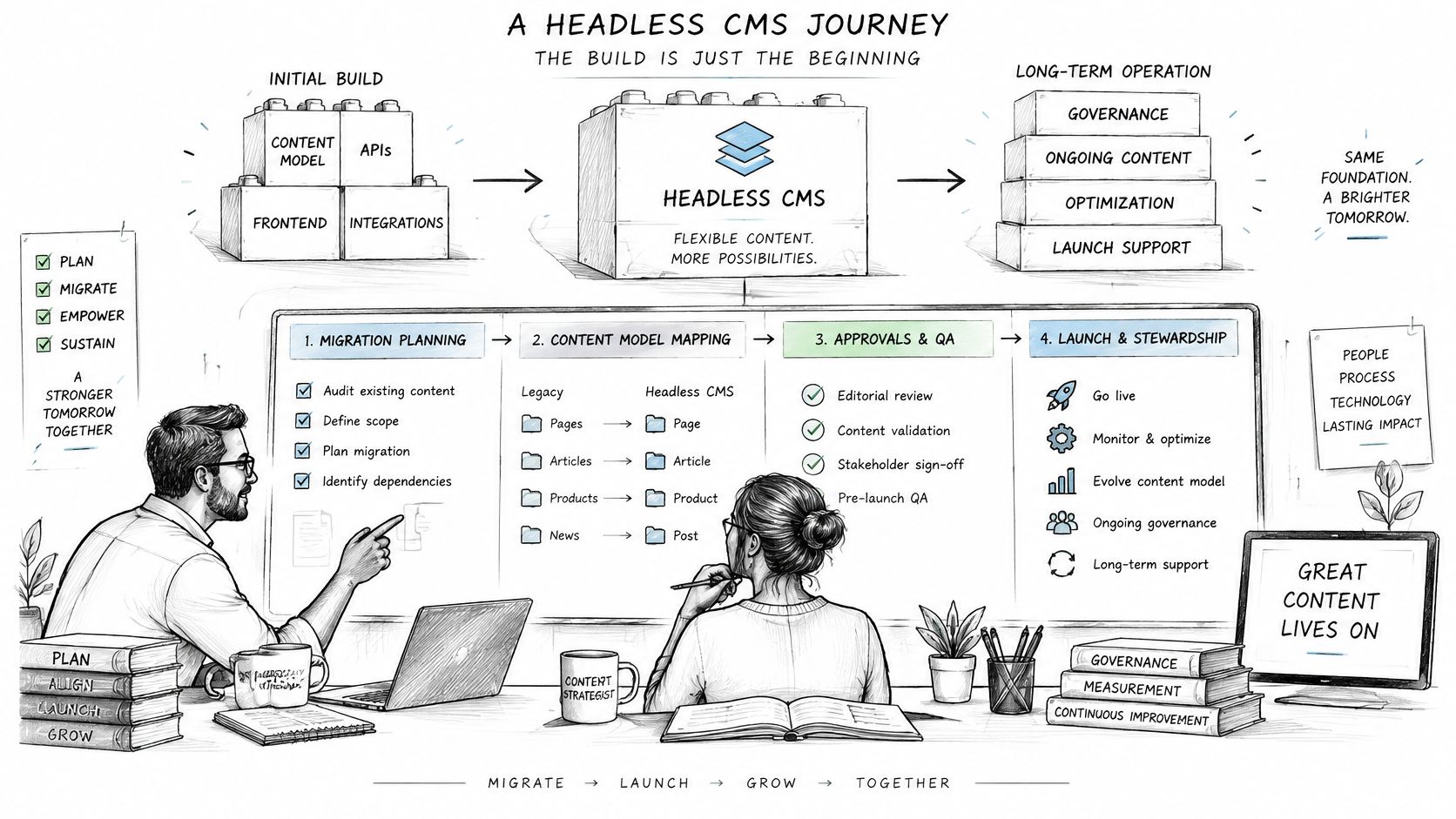
Who fixes a broken webhook at 2 a.m., and who can approve a content-model change the next morning? Set those responsibilities before migration starts. Mapping the content model is only one part of the work.
A migration plan should cover content to retain or archive, URL continuity, editorial training, parallel running and rollback criteria. It should also name who maintains custom integrations after the implementation engagement ends.
Put ownership in the contract
- Content model: Name the approver for schema changes and the person who checks downstream compatibility.
- Migration QA: Assign responsibility for reconciling records, assets, references and rendered output.
- Redirects: Identify who owns URL mapping and monitors errors after cutover.
- Integrations: Specify who manages credentials, failures, external changes and recovery.
- Post-launch operations: Document escalation paths, monitoring, maintenance and handover acceptance.
The Mordor Intelligence headless CMS market analysis cites an estimate of roughly 16 to 24 weeks for core model configuration and integration wiring in a standard monolithic-to-headless migration. The timeline depends on the estate's scope: multiple brands, languages, regulatory requirements or commerce connections can add work.
Make automated changes reviewable
Require human approval before publishing, a traceable change record, reversible actions and explicit permissions. Automation can update valid fields and still publish the wrong commercial message.
WebinOne's content governance framework offers guidance on editorial accountability. Smaller organisations defining infrastructure responsibilities can also consult IT Cloud Global, LLC's cloud governance framework for SMBs.
WebinOne supports staged migration, documented ownership, managed operations and rollback planning. The company says it has migrated thousands of sites. Agencies can review the WebinOne reseller program alongside their delivery responsibilities.
Handover is complete when the receiving team can recover a failed publish or integration using documented procedures, without relying on undocumented knowledge.
Sanity Against Other Headless Options by Criteria
Set the criteria and their relative importance before reviewing proposals. A regulated publishing estate and a bespoke consumer application need different weightings, even when both depend on APIs.
Headless CMS criteria for a client decision
| Criterion | Question to ask any headless vendor |
|---|---|
| Content model | Can structured entities be reused across every channel? |
| Query language | Does the team need typed contracts or precise filtering? |
| Delivery and caching | Do reads need to be fresh, or can they be CDN-cached? |
| Pricing transparency | Can you establish the fully loaded annual cost? |
| Governance and SLA | Are SSO, custom roles, backups and an uptime SLA included? |
| Hosting model | Is hosting vendor-run, self-hosted or in the client's cloud account? |
Apply different priorities to different engagements
- Multi-channel delivery: Test representative content relationships, query contracts and publication behaviour against the application's requirements.
- Agency portfolio operations: Examine responsibility boundaries, support terms and annual cost assumptions before estimating recurring margin.
- Regulated delivery: Establish governance, service levels, residency and hosting requirements before approving implementation work.
For broader architecture vocabulary, headless architecture insights from Cleffex Digital can support technical discovery. Tie procurement decisions to evidence for the client's requirements.
WebinOne runs on AWS across six global regions. It is an AWS Partner, has passed the AWS Foundational Technical Review, holds the AWS Qualified Software designation and is available on AWS Marketplace.
Standard managed delivery runs in WebinOne's AWS account. For qualifying systems integrators, licensed deployment in the SI's or customer's AWS account is available by agreement, including AWS GovCloud. The contract should specify which arrangement applies and who owns its operational responsibilities.
Systems integrators planning regulated migrations or licensed deployments can start a partnership and migration conversation with WebinOne.
Confirm the Stack Before You Commit a Client
Start with the client's scope and the work the agency will own after launch. A feature review matters only if it leads to a delivery model the agency can price and support.
- Map channels to entities. List the destinations, shared records and presentation-specific requirements. Test representative content, including awkward exceptions, rather than relying on an idealised sample.
- Estimate annual cost and operating effort. Include implementation, support, recovery and production dependencies in the estimate. Set the client price only after those costs and responsibilities are clear.
- Review the partner arrangement. Confirm who handles delivery and ongoing support, and whether the white-label model fits the agency's service offer.
Commercial test: The agency should be able to explain what its recurring fee covers, what triggers additional work and who responds when publication fails.
WebinOne pricing starts at $10/month per site. Treat that as a starting point for platform costs, then scope implementation and support separately. The commercial commitment should reflect the work required to run the client's site after launch.