Reseller Hosting for Web Designers: Margin and Control

The popular advice on reseller hosting for web designers is to buy capacity cheaply, add a markup, and collect recurring revenue. That leaves out the work that determines whether the revenue is profitable: support tickets, change approvals, failed payments, incident response, and the eventual client exit. Hosting is a service promise, not a wholesale line item. The strongest agency model removes infrastructure work without pretending that client accountability disappears.
Table of Contents
- Four Reseller Hosting Models and Who Runs Them
- How White-Labeling Changes the Client Relationship
- Who Owns Patching, Backups and Incidents
- Pricing Models and the Hours Behind Each Margin
- Uptime Targets and Support Commitments That Hold Up
- How to Evaluate a Reseller Hosting Platform
- Start Your Reseller Account Before Your Next Client Quote
Four Reseller Hosting Models and Who Runs Them
A reseller hosting model is defined by who runs the infrastructure and who patches the application. For agencies scaling a portfolio, WebinOne's managed white-label approach shifts platform operations away from the agency while leaving the client relationship with it.
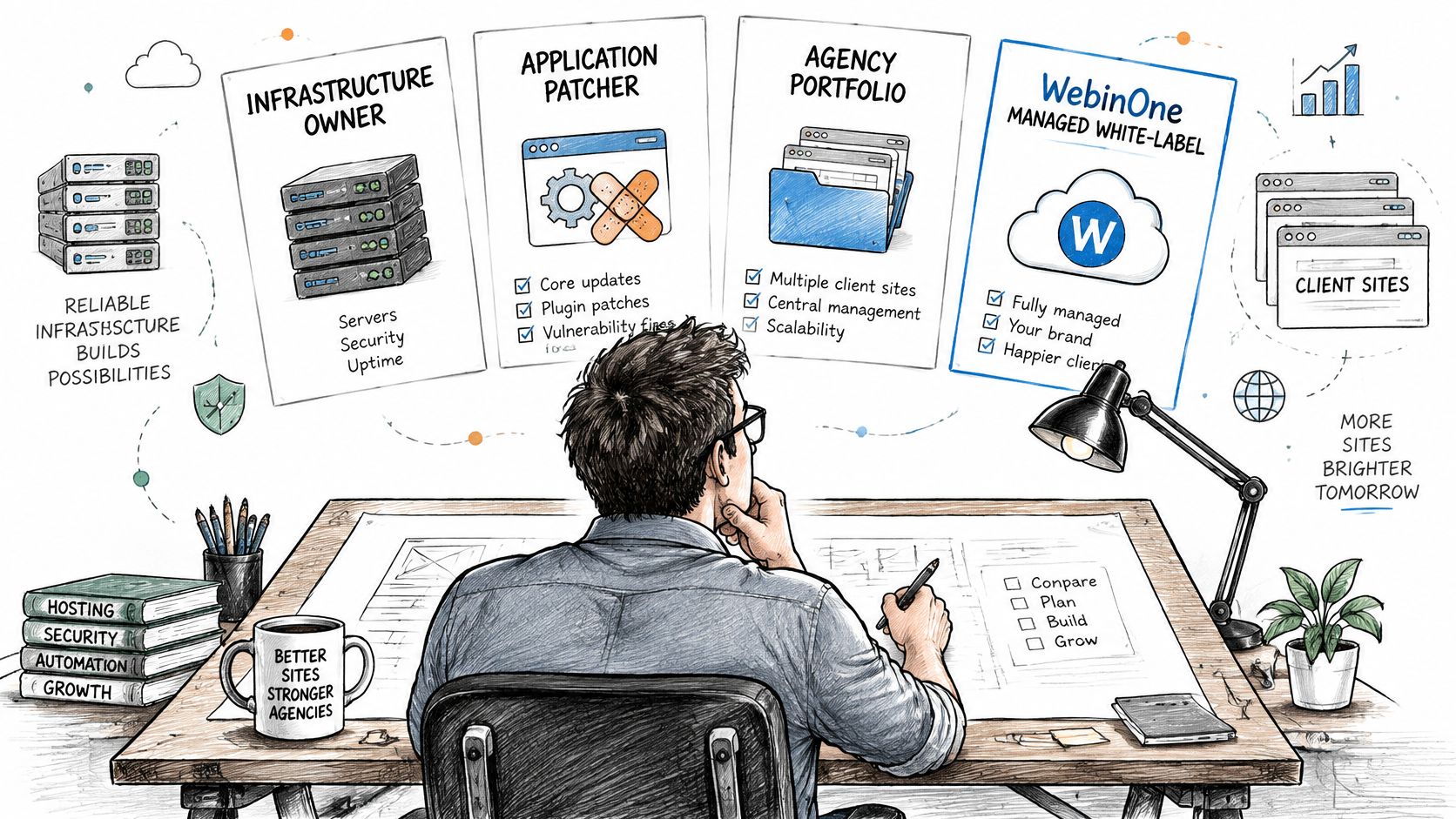
Reseller hosting models compared
| Model | Who runs infrastructure | Who patches the application | Branding depth | Best fit |
|---|---|---|---|---|
| Shared reseller account | Upstream provider runs the servers | Agency handles most client-side application updates | Limited to what the provider allows | Small brochure portfolios with low change volume |
| Reseller VPS or dedicated capacity | Upstream provider runs hardware; agency configures the stack | Agency owns the stack and its patching | Moderate, bounded by provider tooling | Agencies with custom requirements and capacity to run the stack |
| Managed white-label platform (WebinOne) | WebinOne runs the AWS-hosted platform | Platform maintains the stack; agency approves client-facing changes | Full white-label login, admin and portal at applicable tiers | Agencies scaling a portfolio and moving clients to bigger projects |
| Self-run agency hosting | Agency runs servers or containers | Agency owns everything | Full control, full cost of control | Agencies with a defined operations process and specific compliance needs |
The responsibility columns show where operational labour sits, from server administration to application updates. The branding column shows how far the client-facing identity extends, while the best-fit column identifies the portfolio and operating capacity each arrangement suits.
Control needs an operational justification
Reseller hosting has established commercial scale: Techjury's hosting industry compilation estimates its share at 13.6% of the global web-hosting services market, an industry estimate rather than an audited census. That scale doesn't make every reseller arrangement a sound agency business.
A shared account can leave a designer managing application problems across unrelated clients. Dedicated capacity changes resource ownership, but it doesn't remove deployment, patching, or recovery work. Self-run hosting adds flexibility only when the agency can maintain that flexibility through documented procedures and reliable incident coverage.
A managed platform changes the allocation of work rather than supplying a different server. Its value grows when the agency can spend more delivery time on integrations, customer journeys, portals, and ongoing improvement instead of maintaining the underlying stack.
Reading rule: The cheapest row on the invoice can leave the most expensive work with the agency. Compare the responsibilities that remain, not just the monthly charge.
How White-Labeling Changes the Client Relationship
With WebinOne white-labeling, the agency becomes the client's visible provider across the branded service experience. That changes who receives the support request, who explains the invoice, and who must answer when something stops working. It also means every response commitment the client hears is a promise the agency made, so those promises need to match what the agency can deliver and escalate.

The first surface is the login and administration area. At the Partner tier, the agency's logo and background replace the platform identity on the admin and login page, so the client signs into an environment that carries the name of the business doing the work.
The next surface is the client portal, where sites, billing, and support tickets sit under the agency's brand. The live website completes the arrangement: its forms, content, commerce, and member areas are part of the service the agency sold, not a separate product it can point a client toward when they fail.
A failed form shows who owns the problem
Say a client reports that a contact form has stopped sending enquiries. The ticket arrives through the agency's branded portal, and the agency checks whether submissions are being recorded, whether recipients changed, and whether the failure affects every submission or a particular route.
If the evidence points to a platform issue, the agency brings WebinOne support into the investigation while staying the client's single point of contact. The client shouldn't have to work out which layer failed before receiving help.
- Agency triage: Record the affected page, submission time, reproduction steps, and business impact.
- Platform escalation: Send a reproducible problem with relevant evidence, rather than forwarding an unexplained complaint.
- Client updates: Give the client a named owner and a next-update commitment, even before the cause is confirmed.
WebinOne helps agencies set up the white-label portal and migrate existing sites where needed. That removes the build work, and the agency still needs its own intake rules, escalation ownership, and communication standards around it.
Branding is not a support policy
The WebinOne reseller program gives agencies a route to delivering a branded platform rather than merely rebilling hosting. The commercial benefit depends on making that branded relationship dependable, and dependable means priced and staffed.
Support requests need classification before they need speed. A broken platform function, a client's content mistake, and a request for a new integration carry different costs and different promises; routing all three into one unlimited queue turns a white-label margin into unpaid labour.
White-labeling removes the vendor from the everyday client conversation. The agency still owns the outcome.
Who Owns Patching, Backups and Incidents
WebinOne runs and patches the managed platform stack; the agency owns client-facing change approval and the client relationship. That split needs to be written down task by task before a portfolio moves.
The operational questions go beyond whether backups exist. Who patches custom code and third-party components? Who investigates suspected malware, checks whether another tenant could be affected, and preserves the evidence needed for an incident review?
In a global survey of 446 hosting providers, 53% identified outdated or vulnerable software as a problem and 51% identified malware or ransomware infections, according to the CloudLinux Web Hosting Trends Report. Those findings concern hosting providers, but the responsibility question lands directly on agencies selling the resulting service.
Put an owner against every task
The following matrix is a working allocation for a managed reseller portfolio. Retention settings, restoration procedures, and maintenance notices must match the agreed service rather than an assumed entitlement.
Responsibility matrix for a managed reseller portfolio
| Task | Platform provider | Agency | Client |
|---|---|---|---|
| Platform stack patching | Runs and patches the managed platform | Confirms maintenance arrangements and client notice | Informed before planned work |
| Custom code and third-party components | Maintains what the platform owns | Owns custom code, testing and release | Approves the scope of risky changes |
| Backups and tested restores | Runs platform backups | Runs restore tests and sets agreed retention requirements | Informed of the recovery point |
| Monitoring and alerting | Runs platform monitoring | Handles triage and first response | Receives status updates |
| Incident containment | Isolates affected infrastructure | Leads the response for the client | Provides access and approvals |
| Access control per client site | Enforces tenant boundaries | Assigns staff permissions | Manages their own site users |
| Client communication during incidents | Supplies status information | Owns the conversation | Receives updates |
For staff accessing client systems from smaller offices, the simple patching guide for home offices from Nerds 2 You Edmonton provides a practical endpoint-maintenance reference. Endpoint patching belongs alongside platform controls, not in place of them.
Price the response, not just the prevention
An agency that offers maintenance must distinguish routine upkeep from emergency remediation. The scope should identify who can authorise a rollback, disable an integration, revoke access, or approve temporary loss of functionality to contain an incident.
The website maintenance services guidance is a useful basis for turning those responsibilities into a client-facing scope. A checklist alone isn't enough unless someone owns each action and can perform it when the usual account lead is unavailable.
A low hosting fee offers little protection when emergency support, forensic work, and a lost client arrive in the same billing period.
Before signing the next retainer, list each client's stack, custom components, credentials, and named operational owner. Unassigned work is an agency liability even when nobody has priced it.
Pricing Models and the Hours Behind Each Margin
A WebinOne reseller earns the difference between client revenue and the full cost of delivery: platform charges, agency labour, collection effort, migration work, and the exit obligations attached to the account. A markup on infrastructure becomes a margin calculation only after the agency prices its own hours.
The starting platform cost is concrete: WebinOne pricing starts from $10/month per site. Reseller pricing is then built in three steps: a required Content Plan, an optional Ecommerce add-on, and optional Native Extensions. The client price must cover the service being promised, so quote from the operating scope rather than copying a multiple of the platform fee.
Choose a package that matches the work
- Per-site hosting markup: A narrow hosting service needs tightly bounded support. Provisioning, backup checks, billing administration, failed-payment handling, and eventual offboarding still consume labour; migration should have its own scope.
- Managed website subscription: Hosting sits inside a continuing service covering agreed maintenance and improvements. This model can absorb provisioning and migration over the relationship, so cancellation terms need to state what the client owes if the account ends before that work has been recovered.
- Hosting plus a support retainer: Infrastructure and a defined support block are priced separately. Backup verification and monitoring belong in the operating scope, while content changes and troubleshooting draw against an agreed allowance.
- Hosting on a project invoice: Initial setup and migration can be recovered through the build fee. Recurring billing, restore checks, collection work, and exit assistance still need an ongoing agreement after launch.
Project invoices can create recurring obligations even when the revenue does not recur. Treat every launch as the start of an operating commitment: name the renewal owner, the support path, the billing contact, and the person who can approve work outside scope.
When comparing package structures, Veevoo, Inc.’s Veevoo Volgap pricing overview provides a concrete pricing page to examine for how an offer communicates its commercial boundaries. An agency's own proposal still needs to specify included work, exclusions, and exit charges.
Calculate contribution before break-even
The calculation needs separate fixed and variable costs:
- Net monthly margin before labour equals the client's monthly price minus the platform fee per site.
- Monthly labour cost per site equals monthly hours per site multiplied by the agency's loaded hourly rate.
- Break-even site count equals fixed monthly platform-tier and operating costs divided by net monthly margin before labour minus monthly labour cost per site.
The denominator must be positive. If servicing each additional client costs more than that client contributes, adding sites increases the loss rather than paying down overhead.
Don't count the same platform charge as both a fixed tier cost and a per-site expense. Put support coordination, payment collection, migration amortisation, and an allowance for offboarding in the category where the effort occurs. Trial sites that never expire and reusable My Templates can reduce setup labour once the agency reaches the Associate tier or above, but they do not remove client communication, approvals, or billing work.
Exit terms belong in the price. WebinOne states that reseller accounts cancelled after the 30-day period receive no refund, and it commits to open-sourcing the platform if the Service is closed or discontinued so resellers can host trial and live sites, WebinOne Portal, and SSO without WebinOne support. A proposal should convert that into client language: what is refundable, what has already been spent, who owns exports and credentials, and what continued access costs.
The managed service pricing guidance helps frame the broader service package. A white-label platform wins financially when centralised management reduces labour across the portfolio.
Uptime Targets and Support Commitments That Hold Up
WebinOne reports 99.99% uptime and publishes a 99.95% availability commitment in its SLA. Agencies should treat those as different statements and translate any target into downtime, recovery expectations, and contractual remedies before selling it onward.
Availability targets as annual downtime
The annual equivalents below come from AWS Well-Architected availability and recovery guidance.
| Availability target | Maximum unavailability per year | What it means for a client retainer |
|---|---|---|
| 99.9% | Up to 8 hours 45 minutes | Several hours of manual repair are tolerable only if the client has agreed |
| 99.95% | Up to 4 hours 22 minutes | Matches WebinOne's published availability commitment |
| 99.99% | Up to 52 minutes | Leaves little room for manual intervention during an incident |
These annual equivalents aren't permission to bundle all downtime into a convenient outage. Contractual measurement periods, exclusions, and credit rules determine how an SLA applies.
Infrastructure availability isn't application recovery
The AWS EC2 regional SLA offers 99.99% availability under its specified deployment conditions, including instances deployed concurrently across two or more Availability Zones in the same Region. That illustrates why an infrastructure percentage can't be copied directly into an agency's application-level promise.
A site can respond successfully while a checkout, form, or authenticated journey fails. Monitoring should therefore identify which client-facing functions the agency checks.
Recovery time objective describes how quickly service should return. Recovery point objective describes how much recent data the client could lose; neither is established by an uptime percentage alone.
Write the support obligation separately
WebinOne reseller support is available 12/5 through the WebinOne Portal, using integrated ticketing. Agencies need to align that coverage with client working hours and document the route for an incident that starts on a weekend.
The package should state monitoring scope, maintenance exclusions, backup responsibilities, escalation ownership, and applicable service credits. The managed services support guidance provides a basis for defining the client-facing support layer.
Contract check: A provider's response commitment, a restoration objective, and a service credit are different obligations. None should be substituted for another.
Before promising coverage, the agency should obtain answers to these questions:
- Support hours: Who receives an urgent incident outside the documented support window?
- Restore time: What restoration process is available, who authorises it, and what recovery objective has been agreed?
- Credit terms: Which failures qualify, what evidence is required, and who submits the claim?
How to Evaluate a Reseller Hosting Platform
Price belongs late in the decision. A cheaper per-site plan is a poor saving if the failure boundary is unclear, the client data cannot be recovered cleanly, or the exit terms leave the agency carrying the loss. Treat reseller hosting as an operating promise: access, isolation, support, migration, and continuity all have to hold under a real client workload.
Run the operational checks in order
Tenant isolation comes first. A compromised client site should not read neighbouring files, exhaust shared resources, alter another customer's deployment, or abuse shared messaging infrastructure. NIST's cloud access-control guidance recommends isolation mechanisms and resource quotas for multi-tenant environments. Request evidence of identity boundaries, least-privilege access, logging, and controlled support access.
Inspect the white-label surfaces. Check the applicable tier against the client experience you intend to sell: administration area, login, portal, and branded templates. Walk through notifications and support handoffs as a client would see them. Partner-tier branding covers the WebinOne admin and login page with your own logo and background, while Partner Agency adds a customizable commission on top of plan pricing for directly billed sites.
Establish hosting location and account ownership. WebinOne runs on AWS across 6 AWS regions, in WebinOne's AWS account. Standard managed sites cannot be hosted on the customer's own server because WebinOne is a closed system and sites are supported and maintained on AWS servers. For qualifying systems integrators, a licensed deployment in the SI's or customer's own AWS account is available by agreement, including AWS GovCloud.
Test a real extraction path. Choose one live client-style site and document the available exports, transferable assets, credentials, and configuration details. Check what can be reused and what would need rebuilding. If the platform cannot produce a usable handover for one representative site, the portfolio exit is theoretical.
Read the exit and continuity terms. If the service closes or is discontinued, WebinOne commits to open-source the platform so every reseller can host trial and live sites, the WebinOne Portal, and SSO service without WebinOne support. This is a continuity commitment that protects existing sites if the service closes. It should still be read alongside the practical work of migration, because continuity at platform level does not remove client acceptance work.
Resolve cancellation and refunds before migration. WebinOne reseller accounts cancelled after the 30-day period receive no refund. Confirm how the applicable terms fit the proposed engagement, and use a real client pilot before committing the portfolio.
Confirm migration assistance and acceptance criteria. WebinOne helps set up the white-label portal and migrate existing sites where needed. Agree how content, forms, redirects, integrations, and client approval will be checked before cutover. The acceptance standard should be written in terms the client can verify, not internal completion messages.
Keep platform selection separate from delivery capacity
Moving platform operations does not eliminate design and implementation work. Agencies assessing additional delivery capacity can use LatHire's cost-effective design hires for agencies as a staffing resource, while keeping access approval, quality control, and release ownership clearly assigned.
For systems integrators with account-ownership or government requirements, the appropriate next step is a WebinOne enterprise partnership or migration conversation. Those requirements belong in deployment scoping, not in assumptions made after a contract is signed.
A red flag on isolation or exit outranks any price advantage.
Start Your Reseller Account Before Your Next Client Quote
A pilot is the last cheap decision in this process. Registration through the WebinOne reseller program is open to anyone creating sites on the platform, so the only real cost is the client site you move and the hours spent measuring it.
Choose a site whose workload you already know: steady traffic, recurring change requests, a client who opens tickets. Only a live migration shows what support costs, what the client sees, and how many hours the cutover consumes.
Make the pilot a commercial test
- Model the account. Run the responsibility comparison and break-even calculation on a client whose operating costs you already track.
- Register and scope the tier. Open registration means no approval gate; the question is which tier carries the services you intend to sell.
- Inspect the client journey. Log in through the white-label portal as the client would and check what carries your branding: login, admin, billing.
- Exercise support. Raise a representative ticket through the portal's integrated ticketing. Reseller support runs 12/5, so measure the response against the commitments you plan to put in client contracts.
- Migrate and meter the hours. Move the site, record the time the migration takes, and check it against the acceptance criteria from your evaluation.
Make the commitment only after the pilot passes.
Before the next quote goes out, hold three numbers no sales deck supplies: your real reseller cost on that account, the support response you observed, and the hours the move took. The agency's own site can also run free under the program: once it is ready, a support request triggers a team review that activates the free plan.