Partner Reseller Program: Models, Margins and Onboarding
The popular advice is to chase the biggest headline discount. That's the wrong test. A partner reseller program is an operating commitment covering billing, renewals, support, migration and brand control. A smaller margin that's predictable and paid on a clear basis beats a larger advertised margin that disappears after support hours, onboarding time and renewal rules are applied.
Table of Contents
- Four Partner Reseller Models and Who Does the Work
- Benefits and Requirements to Check Before You Join
- Reseller Tiers, Pricing and White-Label Capabilities
- How Reseller Margins Are Built After Costs
- Terms, Support and Uptime to Confirm Before You Sign
- Onboarding Steps From Sign-Up to First Live Site
- Migrating Client Sites Without Downtime
- Apply to the WebinOne Reseller Program
Four Partner Reseller Models and Who Does the Work
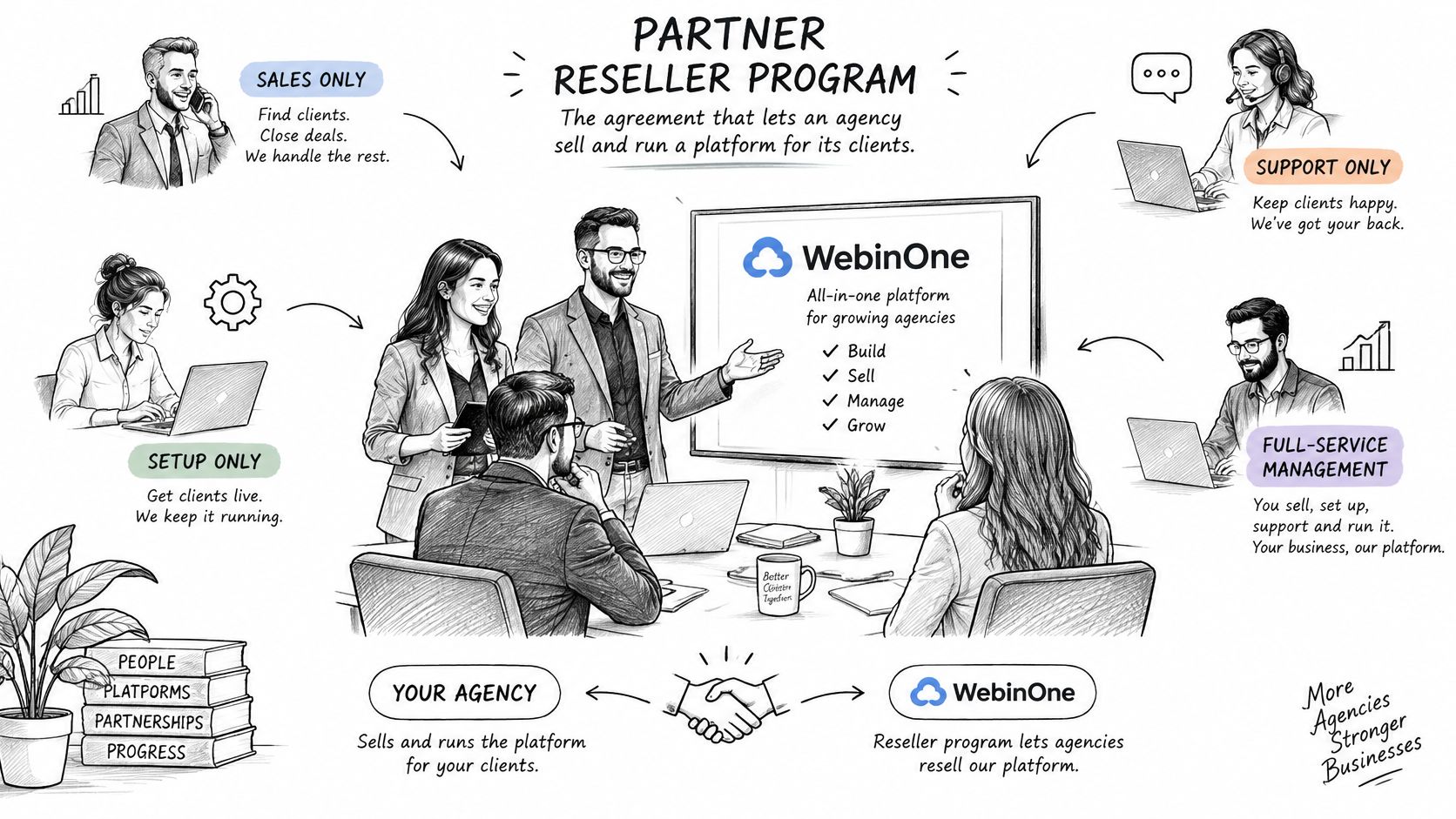
Decide the model by three jobs: who invoices the client, whose brand the client sees, and who still delivers after launch. Split those three differently and you have a different business, not a different discount.
What the table actually decides
| Model | Who bills the client | Brand the client sees | Who delivers the work |
|---|---|---|---|
| Referral | Vendor | Vendor | Vendor, after the agency passes the lead |
| Reseller | Agency | Mostly vendor | Agency handles the build and client relationship |
| White-label | Agency | Agency | Agency builds, vendor hosts and supports |
| Managed operations | Agency | Agency | Agency runs hosting, updates and support after launch |
A referral pays for the lead and leaves the client with the vendor. Reseller and white-label put the agency in the commercial relationship, so the agreement has to assign account ownership, client billing, implementation, support escalation, brand presentation and renewals. Managed operations add the post-launch load: hosting, updates and the support queue.
WebinOne's reseller program is the white-label allocation. Agencies resell the platform to their clients under the agency brand. From the Partner tier up, direct billing lets clients pay for their sites from their own site admin, so agency invoicing is not automatic. Write down who collects, who owns the renewal, and who takes the first ticket.
Labels in the market are loose. The 2026 Promethean Research agency partner program report found referral arrangements represented 49% of programs, while reseller programs represented 9% and white-label programs 8%. A program titled a partnership does not, by itself, grant resale rights or the right to show your brand.
Run this test before comparing margins
Get three answers in writing. Who bills the client? Who owns the renewal? Who answers the first support ticket? If any answer is vague, stop. Margin math can wait.
An agency that keeps those jobs also needs a way to turn agency expertise into market visibility so clients can see the delivery work behind the brand. Match the live terms on the WebinOne reseller program page to those three questions, including who runs cutover if a client site has to move.
Before you sign, name the person who still hosts the live sites, talks to the client, and gets paid on the next renewal if the relationship changes.
Benefits and Requirements to Check Before You Join
Treat this program as an operating commitment. The agency resells the platform, keeps the client relationship, and stays responsible for sites after launch. Renewals, support and cutover need named owners, and those duties should be written down before you sign.
What the agency gets
Sites the agency builds and keeps running can produce ongoing platform and service income. That income tracks retention, how fast support is handled, and whether the agency still has useful work after launch: content changes, account management, and the next site in the same account. Day-to-day communication and account decisions stay with the agency. Clients see the agency's brand. Multi-site work runs from one platform instead of a stack of disconnected tools and separate support routines.
What the agency must supply
The agency needs a person who can build and extend sites, a named owner for support after launch, and capacity to run client cutovers. Anyone can register under the reseller program and start creating sites. Fit depends on whether the agency can staff that work.
A ten-minute self-check makes the fit clear:
- Does the agency already run client sites after launch?
- Is there a developer who can extend templates or modules?
- Can support requests be answered inside a defined window?
- Are there clients ready to move off a platform that's costing them time?
The program suits agencies that will run sites after launch. Three yes answers support that fit. Two or fewer means one pilot site, not a portfolio migration. The pilot shows skill and support gaps while the commercial exposure is still small.
Reseller Tiers, Pricing and White-Label Capabilities
Treat the tier as a contract about who owns branding and billing, not as a cheaper price list. Four tiers exist. Only Associate and above replace standard pricing with reseller plans.
| Tier | Pricing basis | Key entitlements |
|---|---|---|
| Free user | Standard pricing | Create sites. No reseller plans, priority support, directory listing, or white-label admin. |
| Associate | Reseller plans: a required Content Plan, an optional Ecommerce add-on, and optional Native Extensions | Reseller pricing, priority support, trial sites that never expire, reusable My Templates |
| Partner | Same reseller plans as Associate | Associate entitlements, plus a Resellers Directory listing, the closed Partner Slack workspace, voting on upcoming features, a branded trial subdomain, template-library source files, one free live site on the highest plan for the agency website (not an ecommerce shop), white-label admin and login with your logo and background, and direct billing |
| Partner Agency | Same reseller plans, plus a customizable commission on directly-billed sites | Partner entitlements, plus that commission on top of WebinOne's plan pricing |
Associate is the first tier that changes the quote. You sell reseller plans, keep trial sites that never expire, and reuse My Templates. Login branding and client billing stay off this tier. If the proposal shows your logo on the admin or login page, you need Partner.
Partner moves both the brand and the invoice. White-label applies to the admin and the login page. Direct billing means the client pays from their own site admin. The free site is the agency's own business site on the highest plan. Do not run a shop on it. Directory listing, Slack, feature voting, the branded trial subdomain, and template source files sit in this tier. Have each one named in the agreement before you sign.
Partner Agency adds a commission you set on directly-billed sites, on top of plan pricing. Lock the rate in writing before the first direct-billed site goes live.
WebinOne is an AWS Partner, has passed the AWS Foundational Technical Review, holds the AWS Qualified Software designation, and is available on AWS Marketplace. The platform is hosted on AWS across 6 AWS regions. Choose the region for data residency. Choose the tier for who carries brand, billing, and commission.
How Reseller Margins Are Built After Costs
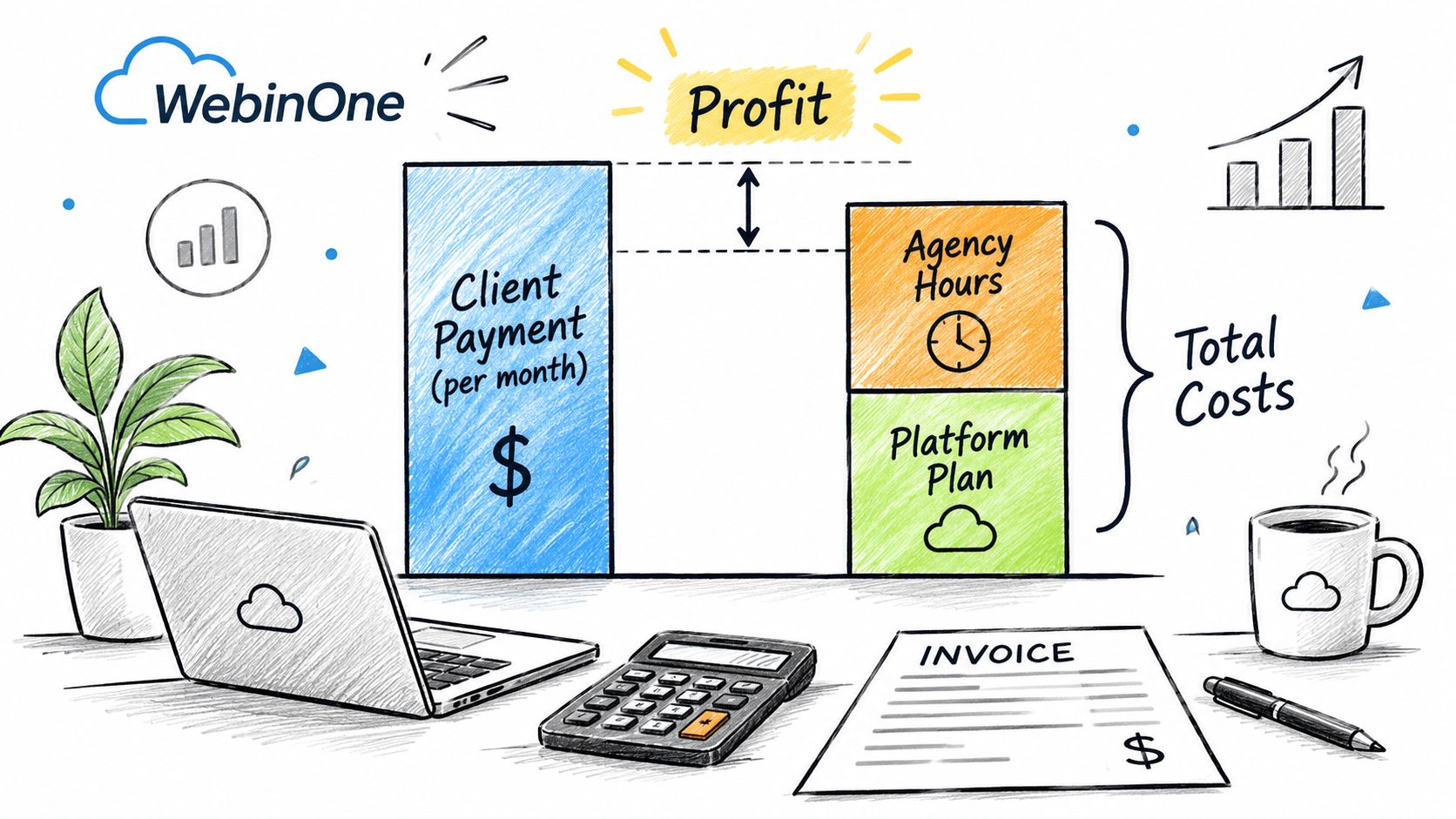
The margin is not the gap between list price and reseller cost. It is what remains after the agency pays for the work it still owns: launch, support, renewals and the hours those renewals keep generating.
Benchmarks are a check, not a quote
Independent channel benchmarks in the PulseRevOps channel program playbook place referral economics around 10–15% of first-year ARR, resellers or value-added resellers around 20–30%, and managed-service or agency partners around 20–35% when they deliver ongoing operations. These are industry ranges, not WebinOne rates.
| Partner role | Typical share of first-year ARR | Work the partner carries |
|---|---|---|
| Referral | 10–15% | Passes the lead; vendor bills and delivers |
| Reseller or value-added reseller | 20–30% | Co-sells, owns the client relationship, provides implementation or support |
| Managed-service or agency partner | 20–35% | Delivers ongoing operations after launch |
Partners who carry acquisition, deployment, support and retention need more recurring economics than a lead-only referrer. If the share does not match the work, the agency funds delivery the vendor no longer staffs.
Three scenarios, one cost stack
Published WebinOne pricing is the reseller cost. Site owners and free users should apply at least a 2× markup, and the reseller sets the client fee. Reseller pricing itself is three parts: a required Content Plan, an optional Ecommerce add-on and optional Native Extensions. Each part you turn on raises the base the markup has to cover.
From Partner upward, direct billing means the client pays for the site from their own admin. Partner Agency can add a commission on top of plan pricing for those directly billed sites. Write down who invoices, who owns the renewal and who answers the ticket before you quote. Read the guidance on managed service pricing before you lock that monthly fee.
Use your own loaded rate. The worksheet below is a sample at $80/hour, with platform cost set at half the client fee so the 2× rule holds. It is not a WebinOne price.
| Scenario | Monthly client fee | Platform cost | Support hours × $80 | Margin left |
|---|---|---|---|---|
| New sale | $400 | $200 | 4 × $80 = $320 | −$120 |
| Renewal | $400 | $200 | 1 × $80 = $80 | $120 |
| Client expansion | $560 | $280 | 1.5 × $80 = $120 | $160 |
The new sale loses $120 in month one because onboarding sits on the agency. The renewal clears $120 only after support falls to one hour for reviews, small content changes and incidents. The expansion stays positive only if the add-on is marked up the same way and the extra support is priced in. A renewal that looks fine on platform cost alone goes negative as soon as that hour is real. Price the monthly fee against fully loaded renewal work, or the account never pays back the launch.
Terms, Support and Uptime to Confirm Before You Sign
Write renewal ownership, support hours and cutover responsibility into the WebinOne reseller agreement before you sign. Those three jobs decide who gets paid, who answers the client, and who is on the hook when a site goes live.
The 2026 Promethean Research agency partner program category guide found only 2 of the 16 programs examined published a numeric percentage for their commercial economics. There isn't a standard rate an agency can safely assume.
Terms that must be explicit
- Basis of calculation: State whether economics come from partner pricing, collected revenue, net revenue or another defined base.
- Payment and attribution: Confirm payment timing, the attribution window and how existing accounts are treated.
- Refunds and cancellations: First-time Associate, Partner or Agency reseller accounts can cancel within the initial 30 days after sign-up and receive a refund under the 30-day money-back guarantee. Reseller accounts cancelled after the 30-day period receive no refund.
- Renewals and minimums: Confirm who owns the renewal, any minimum commitment and whether services revenue is included. If the agency owns the renewal, the client relationship and the invoice stay with the agency.
- Cutover: Name which party controls DNS, SSL and the go-live window before a client date is promised.
- Continuity: If the Service is closed or discontinued, WebinOne commits to open-source the platform so resellers can host trial and live sites, the WebinOne Portal and SSO service without WebinOne support.
Reading examples of clear conditions for using the platform helps reviewers separate ordinary service terms from reseller-specific economics. The commercial schedule still needs its own review.
Support and uptime
Reseller support is available 12/5 through the WebinOne Portal, which uses an integrated ticketing system. Confirm the paid partner scope, channels and escalation path, then compare that commitment with the hours you already sell to clients. The related guidance on managed services support helps define that boundary.
WebinOne reports 99.99% uptime, while its published SLA commits to 99.95% availability. Use the SLA figure in client contracts. That is the number that binds the vendor.
Onboarding Steps From Sign-Up to First Live Site
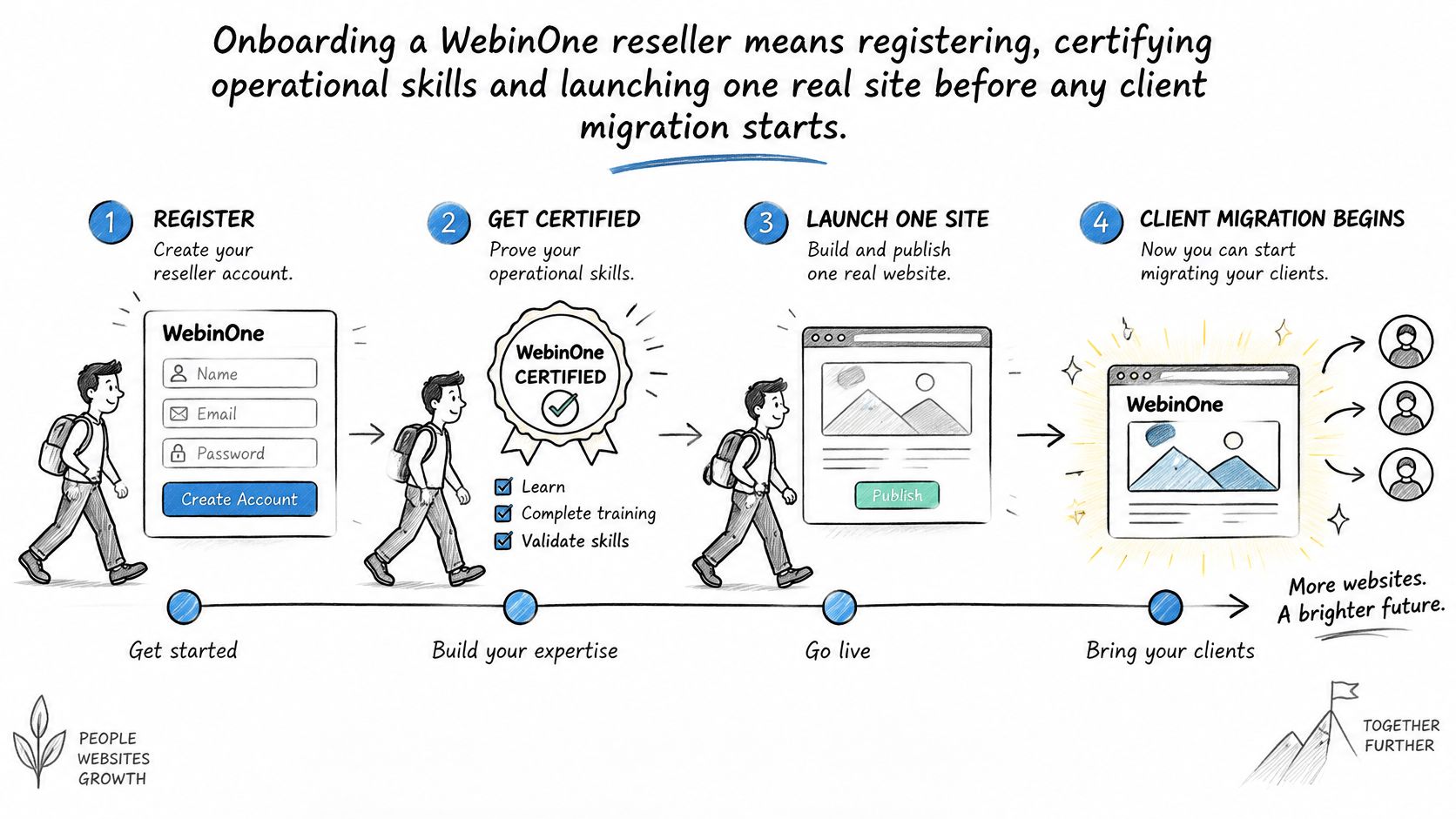
Sign-up is the cheap step. The cost shows up when the agency has to provision a site, brand the admin, launch it, and answer the first ticket under its own name. Get one internal site live before you quote a client migration.
The sequence
- Register, then stop selling. Anyone can register under the reseller program and start creating sites in WebinOne. Do not commit a client until the tier, the pricing basis, and a named delivery owner are in writing.
- Choose the tier and read the schedule. Tiers are Free user, Associate, Partner, and Partner Agency. From Associate up, reseller pricing replaces standard pricing: a required Content Plan, an optional Ecommerce add-on, and optional Native Extensions, plus priority support, trial sites that never expire, and reusable My Templates. Teams that also define terms for affiliate partners should keep referral terms in a separate schedule from resale terms. The obligations differ.
- Brand what the client will see. On the Partner tier, white-label the admin and login page with your logo and background, use the branded trial subdomain, and take the source files for the template library. Partner and Partner Agency accounts include one free website on the highest plan for the agency's own business site. That site is not for use as an Ecommerce shop.
- Build the internal site like a paid job. Start from a template, load realistic content and forms, and save the build in My Templates so the next site does not start from zero. Use a trial site that does not expire as the working copy.
- Test, and write defects down. Check redirects, forms, and integrations, then confirm DNS and SSL on a staging domain. A fix that is never logged will not exist for the next project.
- Launch and activate. Put the agency site live. When it is ready, submit a support request so the team can review it and activate the free plan. Log hours to first launch, support questions, and rework. From the Partner tier, direct billing lets a later client pay from their own site admin. Name who owns that invoice, the renewal, and the cutover before you sell the second site.
Measure the first site before you sell the next one
The Channels as a Strategy partner program assessment reports certified partners can generate roughly six times more revenue than partners that skip training, and mature programs may attribute up to 28% of company revenue to partnerships.
Treat your internal launch as the test of those habits. Compare time to first launch, implementation defects, support tickets per site, retention, and expansion. If the numbers stay messy, change the delivery process. Sell client migration only after launch, tickets, and renewal each have an owner.
Confirm before the first client site:
- Tier, reseller pricing basis, and who sets the client price.
- Who submits the free-plan activation request after the agency site is ready.
- Who owns renewals, direct billing, and cutover.
- Referral deals, if any, live in a separate agreement from resale.
Migrating Client Sites Without Downtime
Cutover is the point where a WebinOne migration either holds or breaks. Content sync, redirects, integrations, DNS changes and rollback decisions all meet live client traffic in one window. Name who owns that window, and get written approval, before you promise a client a quiet launch.
A failed switch costs orders, broken forms and a support queue the agency has to answer. Price that against the project fee. Then rehearse the switch instead of hoping the DNS change is uneventful.
Migration mechanics
Keep the existing production site running while the replacement is built. Synchronize content and data, test redirects and integrations, rehearse the cutover, monitor traffic and transactions after the switch, and keep a rollback path ready. For multi-site estates, move sites in controlled waves instead of exposing the whole portfolio to one event.
| Phase | What happens | Who must own it |
|---|---|---|
| Inventory | Map every site, form, redirect, integration and data source | Agency, with client sign-off |
| Build | Keep the live site running while the replacement is built | Delivery team |
| Content sync | Copy content and data, then re-sync shortly before cutover | Delivery team |
| Redirect and integration tests | Test every redirect, form and API call on staging | Agency and platform partner |
| Cutover | Switch DNS or routing inside a rehearsed window | Agency and platform partner, approved in writing before launch |
| Monitor and roll back | Watch traffic and transactions and keep the rollback path open | Named incident owner |
The partner agreement and the migration plan should name owners for planning, testing, DNS or routing changes, incident response and post-cutover checks before the first wave. Cutover, the hours after go-live, and later renewals are separate jobs. Assign each one. Do not leave them as an unnamed platform task.
Agencies planning a broader move should use the website replatforming guidance to structure the estate-level decision.
Turn the phase table into a runbook for this estate. List the acceptance tests, the trigger that stops the switch, and the incident owner who can roll back. Write the cutover window, the tests that must pass, and that rollback owner into the plan the client signs.
Apply to the WebinOne Reseller Program
Gather the paperwork before you price the work. A margin sheet built on assumed hours and an unsigned contract is a guess, and it gets expensive on the second client site.
Collect the three inputs in this order.
Start with the written terms. Name who owns renewals, who handles support, and who runs cutover. If those lines are blank, stop. The other two inputs cannot fill an empty responsibility.
Run the pilot only after the terms are on paper. Log time to first launch, defects, and support effort against the owners you assigned. Unlogged hours never reach the margin model, and you still pay them.
Build the margin model last. Price a new sale, a renewal, and an expansion from those fully loaded delivery costs. Renewal is the test. Support comes back every year. The setup fee does not.
Read the three results as one decision. They select Free user, Associate, Partner, or Partner Agency, and they show whether the first client move is worth staffing. From Associate upward, reseller pricing plans, priority support, trial sites that never expire, and reusable My Templates carry that model. If the logged hours do not clear your margin after plan costs, change the tier or decline the work.