Omni Channel Cms
Most organizations don't have an omnichannel problem. They have a governance problem wearing an omnichannel label. A 2024 survey found that 67% of marketers using more than one CMS do so because they need omnichannel capabilities, while 53% identified omnichannel as the single most important CMS feature. That points to operational necessity, not curiosity, as the reason buyers are consolidating content systems. The survey findings describe a market where websites, apps, and other touchpoints must draw from one controlled content layer.
The buying trigger usually isn't a new channel. It's the moment a team realizes that content is authored in one tool, translated in another, syndicated through a fourth, and governed by none. The licenses are visible. The rework, approval delays, duplicated models, and key-person risk are not.
Table of Contents
- Why Omnichannel CMS Is an Operating Model Problem
- Traditional Headless and Omnichannel CMS Compared
- Core Capabilities to Demand From an Omnichannel CMS
- Multi-Site Governance as the Real Differentiator
- The Migration Argument Escaping Plugin Sprawl and Fragmented Stacks
- Evaluating a DXP A Buyer's Checklist and Next Step
Why Omnichannel CMS Is an Operating Model Problem
An omni channel CMS should be evaluated as the control system for a content supply chain, not as a tally of supported channels. A website, mobile app, kiosk, in-store display, voice interface, and emerging endpoint are only destinations. The harder question is whether the organization can create one piece of structured content, approve it once, localize it predictably, and deliver the right representation everywhere without creating conflicting versions.
That distinction matters because traditional CMS architecture was designed around web publishing. Industry history places early CMS platforms in the 1990s and 2000s, while analyst firms broadly defined the DXP category around 2015 as digital channels expanded into mobile, social, and connected devices. The broader CMS market was estimated at USD 33.28 billion in 2026 and projected to reach USD 48.17 billion by 2031, while web content management was estimated at USD 16.57 billion in 2026 and projected to reach USD 32.18 billion by 2031. Those figures and projections are reported in this market overview.
The failure starts in the workflow
A regional editor creates a product page in WordPress. A mobile team recreates the same offer in a headless repository. A translation vendor receives a spreadsheet. A personalization platform applies a variation that the central brand team can't preview. Someone then discovers that the legal disclaimer differs between the app and the website.
That is not a channel failure. It's an operating-model failure.
For teams managing 20 or more properties, uptime becomes table stakes. Leadership starts asking different questions:
- Reuse rate: How much approved content can editors reuse instead of rebuilding?
- Localization speed: How quickly can a regional team adapt content without bypassing central controls?
- Editorial autonomy: How many people can publish safely without engineering involvement?
- Governance exposure: Can the organization identify who changed what, approved it, and published it?
A useful primer on the customer-facing side is Otter A/B's guide to omni channel retail strategies, but platform buyers should take the lesson further. Retail consistency depends on the systems and permissions behind the experience.
Practical rule: If a platform demo shows channel flexibility but not approval, inheritance, localization, and audit controls, it hasn't demonstrated omnichannel readiness.
The hidden cost of a fragmented stack is rework, not the subscription total. A portfolio can pay for several affordable tools and still spend more through duplicate modeling, manual publishing, integration maintenance, and emergency fixes. That's why vendor consolidation belongs in the business case before a procurement team compares feature counts.
Traditional Headless and Omnichannel CMS Compared
Traditional, headless, and omnichannel CMS architectures solve different problems. Buyers get into trouble when a platform is selected for its architecture diagram rather than for the operational responsibilities it owns.
A traditional CMS couples content storage, authoring, templates, and delivery. That can make a single-site launch straightforward, especially when the organization wants a tightly integrated web experience. The constraint appears when the same product information, campaign, or editorial asset must serve an app, kiosk, or another front end. The content is often shaped around the website, so every new channel introduces custom work or duplication.
A headless CMS separates content from presentation and delivers it through APIs. That separation gives developers freedom to use different front-end technologies and lets one content object reach multiple endpoints. The trade-off is the headless tax. Preview, personalization, channel orchestration, workflow, analytics, search, localization, and identity often arrive as separate services that the buyer must integrate and operate.
An omnichannel CMS builds on headless delivery while taking ownership of more of the content operating model. It should provide structured content, APIs, preview, governance, workflow, multi-site controls, and channel-aware delivery in one managed environment. That doesn't eliminate the need for integrations, but it reduces the number of places where content truth and publishing responsibility can fracture.
| Capability | Traditional CMS | Headless CMS | Omnichannel CMS |
|---|---|---|---|
| Content model | Usually organized around web pages and templates | Structured and presentation-independent | Structured, reusable, locale-aware, and governed across properties |
| Presentation | Coupled to the CMS theme or template layer | Owned by each front end | Flexible front ends with shared preview and channel rules |
| Delivery | Primarily web delivery | API delivery to selected endpoints | API-first delivery with channel orchestration and operational controls |
| Preview | Strong for the native website | Often requires separate preview services | Expected across web, app, kiosk, and other supported surfaces |
| Personalization | Commonly theme or plugin dependent | Usually supplied by another service | Managed as a platform capability or controlled integration |
| Governance | Often site-specific | Must be assembled across services | Central roles, workflows, inheritance, auditability, and localization |
| Operational burden | Lower initially, higher as complexity grows | High integration and ownership burden | Consolidated platform operations with API flexibility |
The distinction isn't academic. A headless system can be the right answer when a product team needs maximum front-end control and has the engineering capacity to own the surrounding services. It becomes a poor enterprise choice when marketers need reliable preview and publishing autonomy but the platform leaves those capabilities to custom development.
A traditional CMS breaks through rigidity. Pure headless breaks through sprawl. An omnichannel CMS earns its premium only when it absorbs the coordination work that headless architecture otherwise pushes onto the buyer. The headless architecture guide is useful for understanding the decoupling principle, but decoupling alone isn't a complete operating model.
Core Capabilities to Demand From an Omnichannel CMS
Buyers should turn every capability into a written evaluation question. A polished demo can make almost any platform look flexible. A written answer reveals whether the vendor owns the capability, integrates it, or expects the customer to build it.
Content modeling
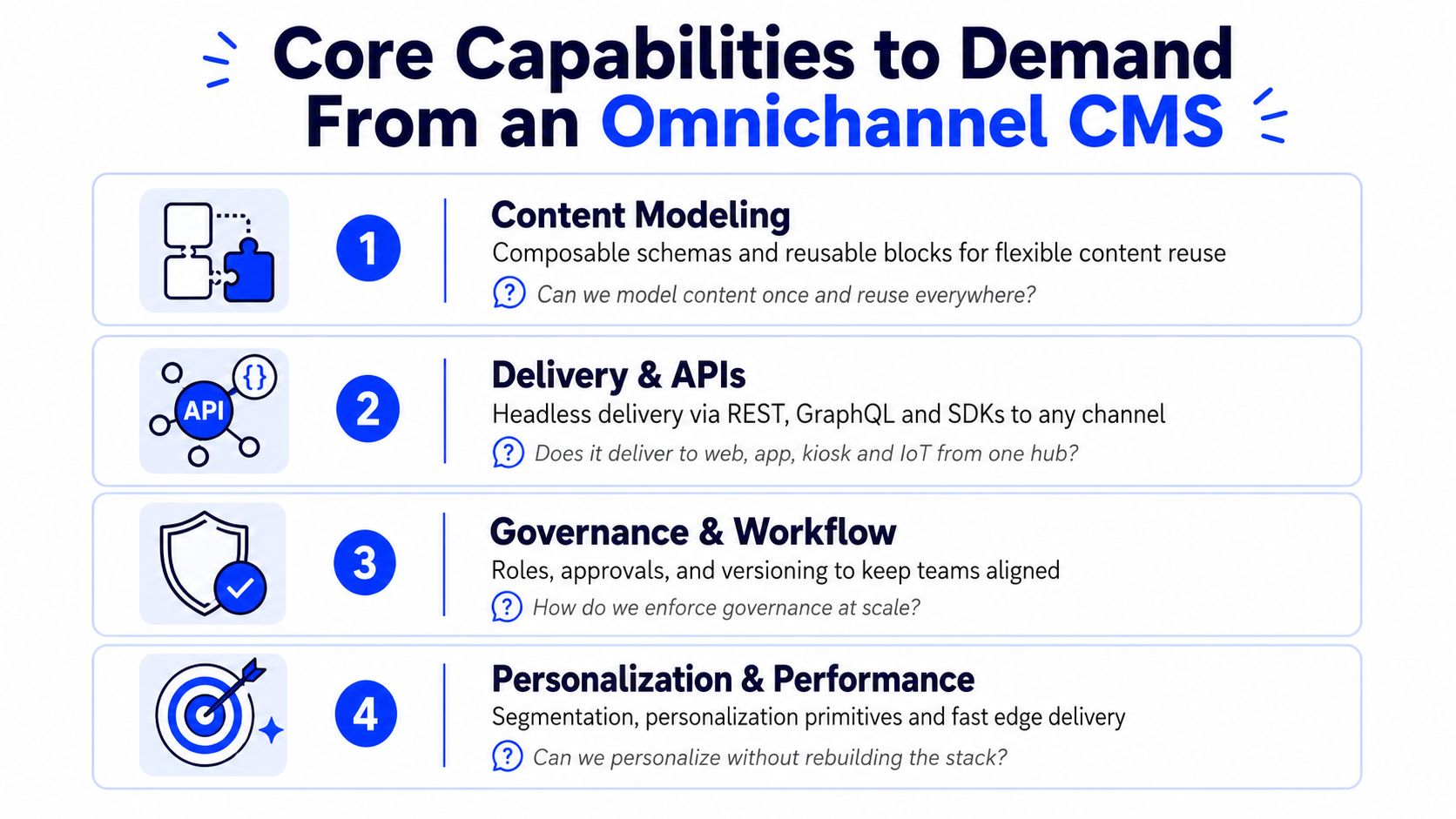
The content model is the foundation. A serious platform should support composable schemas, reusable blocks, relationships, locale inheritance, lifecycle states, and version control. The core model should remain channel-neutral, while presentation rules adapt the same content for a web page, mobile interface, kiosk, or in-store screen.
The buyer question is simple: Can the team model content once and reuse it without forcing every channel into the same layout?
That question prevents a common failure. Teams often create one page type for each channel because the CMS makes presentation the organizing principle. Editors then maintain several versions of the same product, promotion, or policy. The result is channel drift and a growing translation burden.
APIs and federation
API quality determines whether the content hub remains useful outside the native website. Buyers should require REST and GraphQL parity, documented SDKs, predictable rate limits, webhooks, and clear versioning. Legacy repositories shouldn't automatically become migration blockers. Content federation can allow older systems to remain queryable while the organization moves priority content into a governed model.
Ask vendors to demonstrate a real downstream update. The test should show a publish event, webhook delivery, cache invalidation, error handling, and endpoint monitoring. Documentation alone isn't enough.
Personalization
Personalization should not exist only in a separate CDP or marketing tool. The CMS needs audience and segment primitives, rule-based variants, and a way to manage rule-less content variations from the same approved source.
The evaluation question is: Can marketers create and preview a personalized variation without asking developers to rebuild the delivery stack?
This also exposes ownership gaps. If the CMS stores one version, the personalization service stores another, and analytics defines the audience differently, the organization can't reliably explain which content a customer saw or why.
Channel delivery and performance
A platform should support web, mobile, kiosks, in-store displays, voice, and emerging surfaces through APIs without requiring channel-specific copies of every content object. Preview must match production behavior closely enough that editors can understand how an asset will appear before approval.
Performance depends on delivery architecture, not the headless label. A practical pattern combines CDN edge caching, application caching, and webhook-driven cache invalidation. That reduces repeat database and API round trips while keeping published content fresh, as outlined in this technical guide to scaling headless content delivery.
Demand endpoint-level observability: Different channels have different throughput and freshness requirements, so API latency and cache behavior need separate monitoring rather than one blended availability number.
Multi-Site Governance as the Real Differentiator
Enterprise teams rarely fail because a CMS lacks another component type. They fail because brands, regions, and agencies create competing definitions of the same content. Taxonomies diverge, locales become orphaned, and local teams build parallel stacks after central governance becomes too slow.
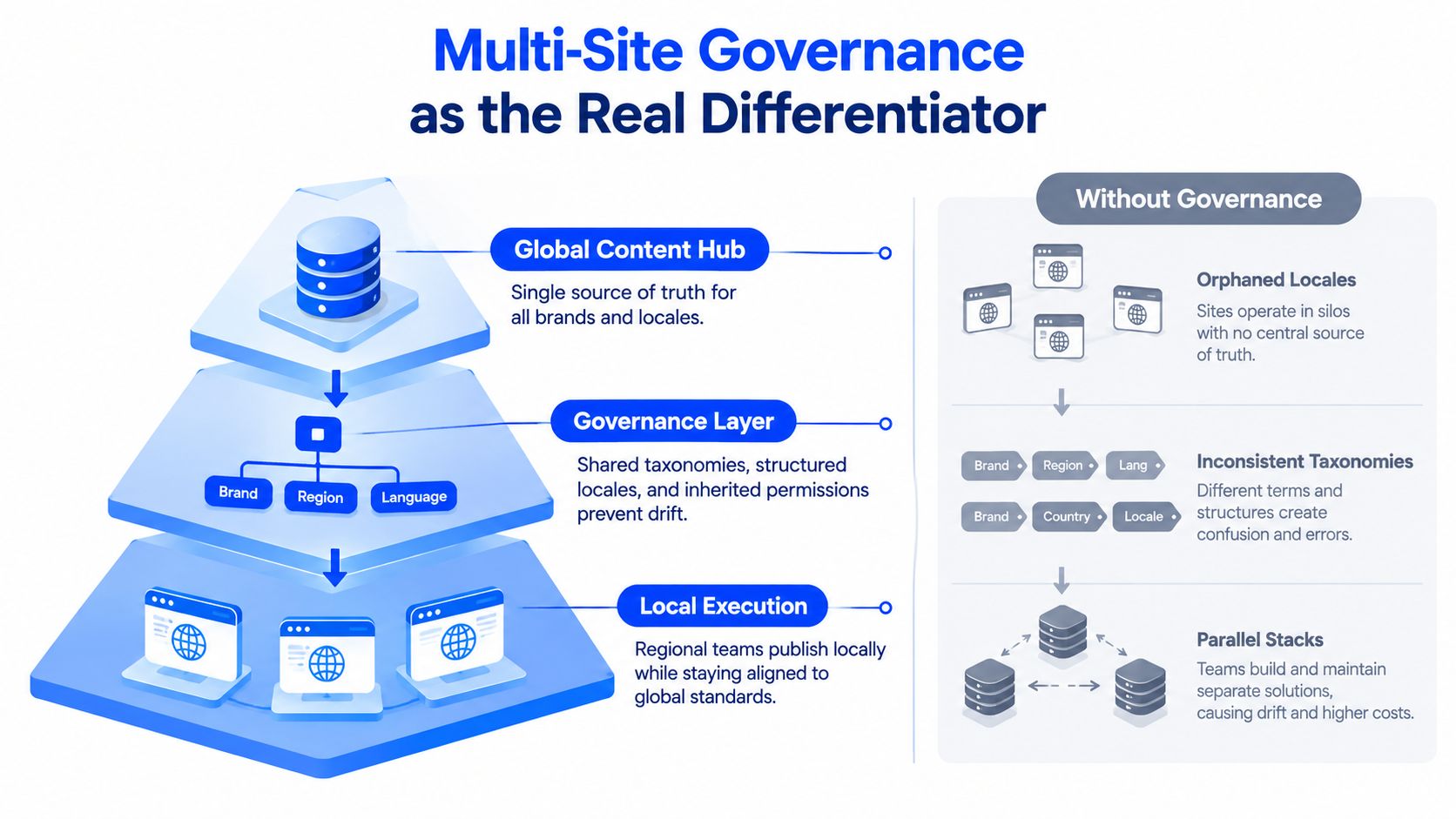
An omnichannel CMS must ship with governance primitives. Buyers shouldn't accept a roadmap promise for the controls that protect product truth, regulatory content, brand identity, and access rights.
The controls that prevent drift
A shared component library gives every brand a controlled starting point without preventing legitimate local variation. A unified taxonomy and translation model keeps products, campaigns, audiences, and locales discoverable across the estate. Locale inheritance lets a central team publish a source version while regional teams adapt approved fields rather than recreating entire entries.
Role-based permissions should scope access by brand, region, content type, and workflow stage. A regional editor may need to publish a local promotion but shouldn't be able to alter global product claims. Separation of duties matters in regulated environments, where the person who authors content shouldn't automatically be the person who approves it.
The platform should also provide:
- Inheritance and overrides: Central teams define shared content, while local teams make bounded changes.
- Audit trails: Administrators can trace edits, approvals, publication, and reversions.
- Scheduled windows: Teams can coordinate launches, expirations, and blackout periods.
- Central workflow states: Draft, review, legal approval, localization, and publication rules apply consistently.
- SSO and offboarding: Access can be granted and revoked centrally instead of site by site.
The strongest pattern for large portfolios is multi-tenant architecture with centralized governance. One platform instance can share infrastructure while logically isolating brands or sites through independent permissions, workflows, and models. This gives regional teams autonomy without forcing the organization to duplicate SSO, audit, approval, and compliance administration.
Central control without local paralysis
Centralization only works if local execution remains practical. A regional team shouldn't invent a product schema because the central team takes too long to approve a new field. The right model gives headquarters control over standards while giving local operators governed tools for publishing, localization, and market-specific content.
That balance has real operational precedent. Enterprise multi-site case material documents centralized access control with SSO and role-based permissions across 10 global sites, while regional teams retained day-to-day operating speed. The example is described in this multi-site governance case material.
Multi-site management should therefore be evaluated as a daily operating capability, not an administrative add-on. If two teams can publish conflicting product truth to the same customer, a platform's feature list is irrelevant.
The Migration Argument Escaping Plugin Sprawl and Fragmented Stacks
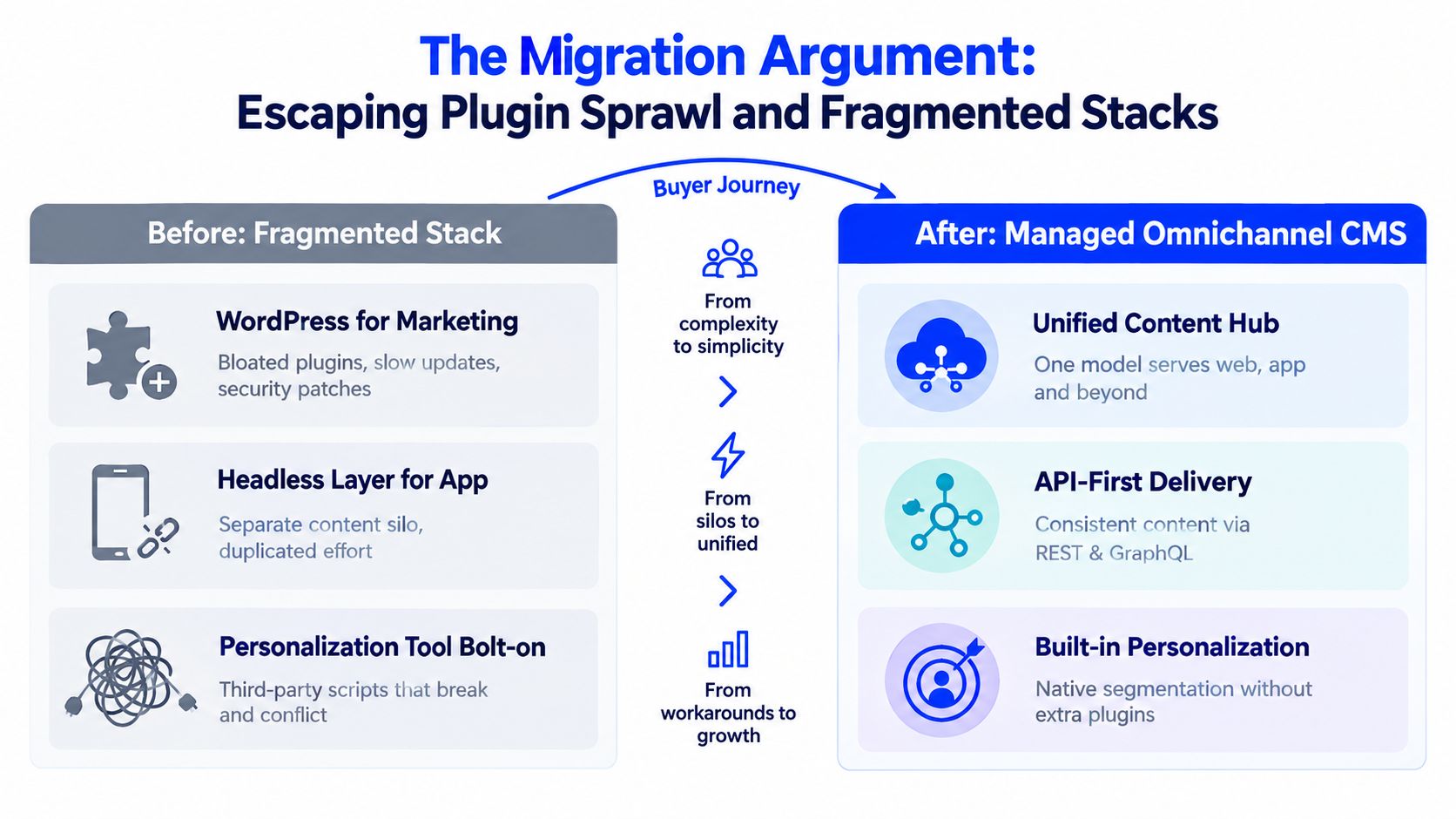
The strongest migration case starts with a familiar stack: WordPress for marketing, a separate headless repository for the app, a personalization bolt-on, a translation vendor, and an asset pipeline held together by one engineer. Each tool may look reasonable in isolation. Together, they create multiple content models, overlapping security responsibilities, separate release cycles, and a knowledge bottleneck that becomes obvious when the only person who understands deployment takes leave.
WordPress plugin sprawl makes that risk measurable. Independent security reporting found that 91% of new WordPress vulnerabilities were found in plugins and 9% in themes. The plugin-bloat analysis supports a direct conclusion: every additional extension expands the maintenance and security surface.
A separate analysis reported 7,966 WordPress vulnerabilities disclosed in 2024, roughly 21 per day, with 33% lacking a patch at disclosure. Those figures are documented in this WordPress security analysis. A managed migration isn't merely a design refresh when the existing stack requires constant patch triage and compatibility testing.
Three costs buyers miss
Operational risk rises with every independently patched dependency and integration. A consolidated managed platform can reduce the number of systems requiring coordinated updates, but buyers should verify who owns patching, incident response, backups, and rollback.
Total cost includes licenses, integration work, maintenance, specialist knowledge, security review, and the cost of delaying campaigns. A cheap CMS becomes expensive when each new experience needs an engineer to translate between tools.
Time to change is the commercial test. If a campaign page requires a developer, a personalization administrator, a translation request, and a deployment window, the stack is charging for coordination every time content changes.
The counterpoint is important. A stitched stack can be sensible for a small organization with only a few sites, limited channels, and strong internal ownership. Consolidation becomes compelling when the portfolio, compliance burden, localization needs, and integration count make manual coordination the default way work gets done.
Migration rule: Don't compare platform subscription prices until the business has priced integration ownership and the cost of preserving fragmented content truth.
Evaluating a DXP A Buyer's Checklist and Next Step
A DXP evaluation should end with evidence, not a preference formed during a polished demo. Each shortlisted vendor should be scored against architecture, operations, and commercial fit, using the hardest real use case rather than a simple brochure site.
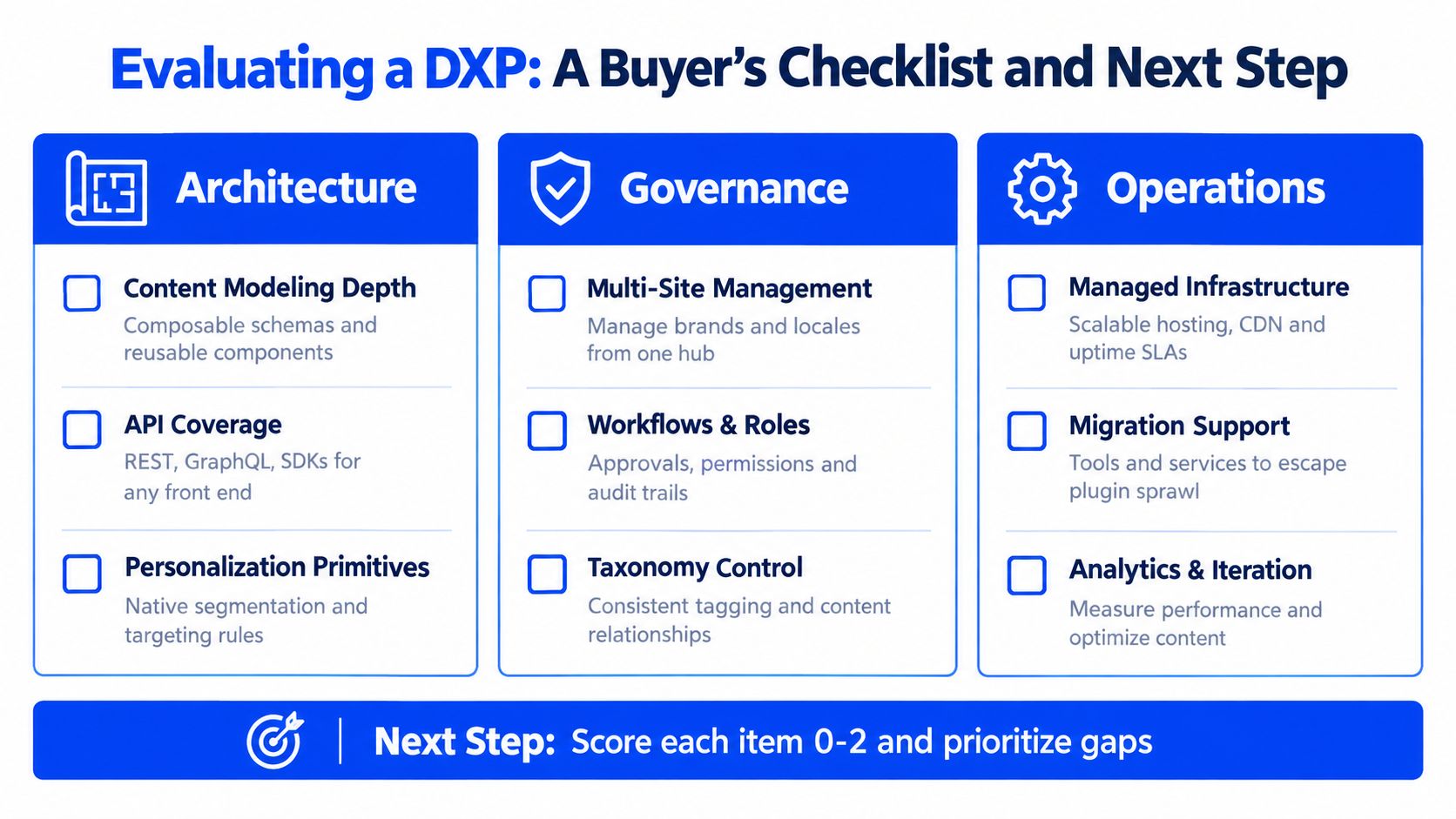
Architecture
Start with the content model. Require reusable components, relationships, localization, inheritance, version pinning, and a migration path from the current repository. Then test API coverage across REST, GraphQL, and SDKs, including webhooks, rate limits, authentication, caching, and failure behavior.
The platform should demonstrate personalization and segmentation primitives, not merely promise integration with a CDP. It should also support multi-site and multi-locale delivery while allowing each front end to preserve its own interaction model. Preview must cover the channels that matter to the organization, not just the vendor's preferred website template.
Operations
Governance belongs in the acceptance criteria:
- Roles and permissions: Confirm brand, region, content-type, and workflow scoping.
- Approvals and audit trails: Verify separation of duties, version history, scheduling, expiration, and rollback.
- Observability: Inspect API latency, cache status, publish events, errors, and channel-specific freshness.
- Infrastructure ownership: Review hosting, backups, incident response, status reporting, and service-level commitments.
- Security and compliance: Request the documented posture, including applicable controls such as SOC 2 or ISO 27001 where relevant.
- Data residency: Confirm whether deployment options meet legal, government, and internal IT requirements.
WebinOne is one platform option in this category. We combine CMS, ecommerce, CRM, email marketing, multi-site management, and a headless API in a managed system, with 300+ APIs, native extensions, and zero transaction fees for ecommerce. We host on AWS across six global data centers, report 99.99% uptime over the last 12 months, and have supported US and Australian government clients. WebinOne is an AWS Partner available on AWS Marketplace, with an AWS Foundational Technical Review approved and an AWS Well-Architected Review completed. AgentOne adds managed vibe coding inside the platform, where scoped agents can make auditable, reviewable, and reversible changes rather than abandoning generated code after deployment.
Commercial fit
Pricing needs to be tested against the whole portfolio. Ask whether costs are calculated by site, channel, users, API consumption, environments, or implementation scope. Require predictable scaling, migration tooling, professional services, support tiers, and a clear exit path.
We recommend scoring each shortlist vendor against this rubric, then running a paid proof of value against the single hardest use case. Refuse any demo that doesn't include governance, multi-site management, localization, and cross-channel preview in one session. The buyer should leave with a migration plan, an ownership matrix, and a clear answer to who operates the system after launch.
We provide a managed omnichannel CMS for agencies and enterprises migrating away from plugin-heavy WordPress builds, fragmented stacks, and oversized DXP estates. Review the migration and governance fit, then visit WebinOne to start a trial or speak with the team about a staged re-platforming assessment.