Multi Tenant CMS Explained for Agencies and Integrators
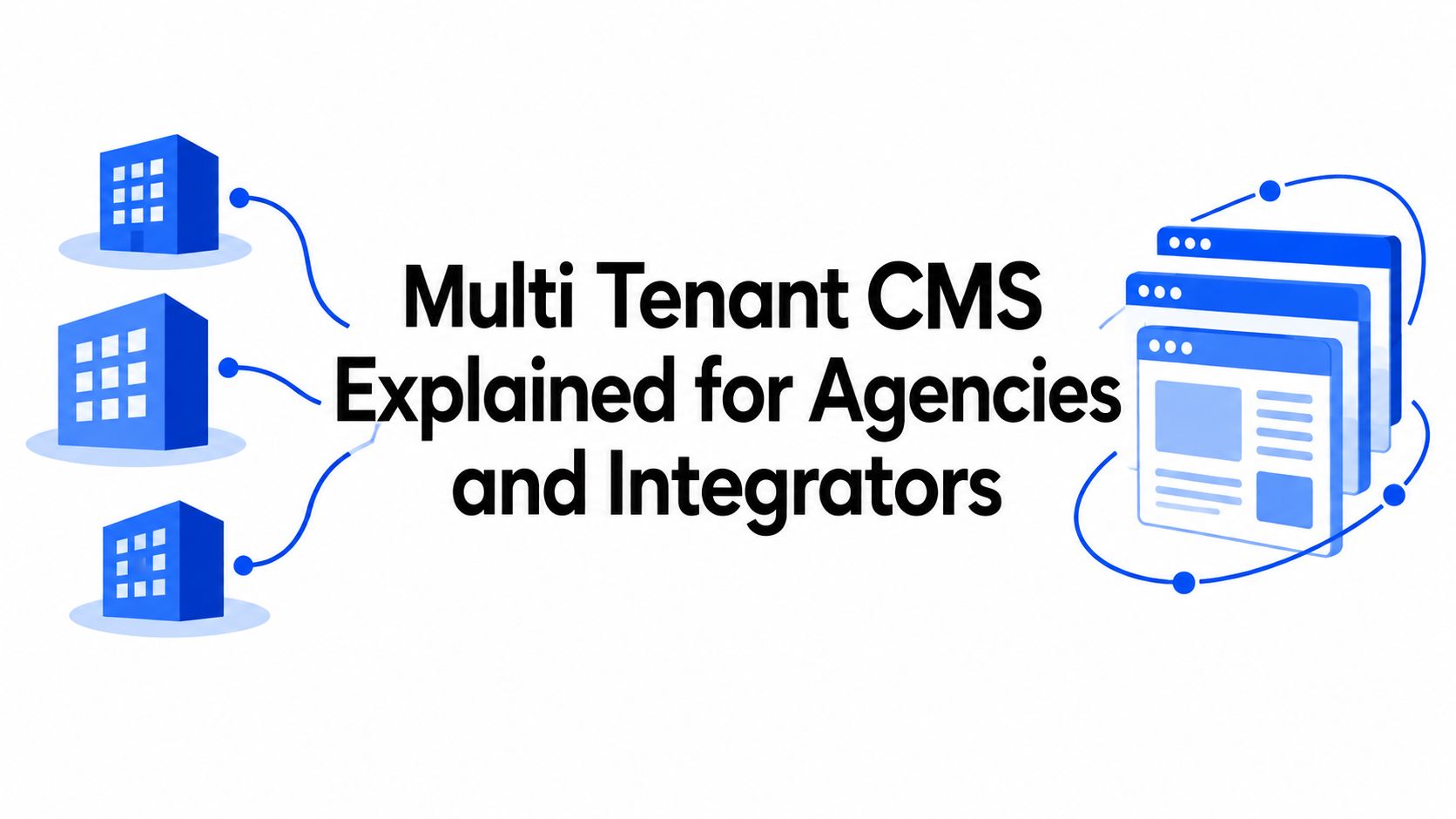
Five client sites can mean six separate CMS installations, three security incidents to manage, and one developer who leaves with the knowledge of how the whole setup fits together. The problem isn't the number of websites. It's the operational burden of running each one as a separate system.
A multi-tenant CMS can consolidate site operations, but only if its tenant boundaries are designed and enforced deliberately. For agencies, systems integrators, and enterprise teams, tenancy is a security and governance decision first, and a platform decision second.
Table of Contents
- The Problem a Multi Tenant CMS Actually Solves
- What a Multi Tenant CMS Is and Where It Came From
- Tenant Isolation Models Agencies Should Ask About
- Multi Tenant, Single Tenant, and Headless Compared
- Operating Many Sites With AI Inside the Tenant Boundary
- Selection Criteria and Migration Checklist
- Real World Use Cases Across Agency, Franchise, and SI
- The Next Step for Agencies, SIs, and Enterprises
The Problem a Multi Tenant CMS Actually Solves
WebinOne is a white-label DXP that brings CMS, ecommerce, CRM, email, and multi-site management into a managed platform, with a headless API for serving content and commerce to different front ends. For an agency or integrator, that addresses the core operational problem: too much of the work sits in separate installations, each with its own hosting, patching, permissions, and operating routines.

The inherited setup is familiar: every client has a different site, hosting arrangement, maintenance schedule, and collection of custom changes. Staff spend time applying updates, checking integrations, resolving incidents, and reconstructing decisions that were never documented. A client asking for a new site can end up adding another operational island rather than another manageable tenant.
A managed platform changes the work in practical ways:
- Consolidate operations. Manage sites and shared platform functions from a common control plane rather than repeating routine work across isolated installations.
- Keep client boundaries. Give each customer or brand its own content, users, domains, settings, and permissions.
- Standardize governance. Apply consistent operating rules without forcing every site to look or behave identically.
- Make services repeatable. Package hosting, support, maintenance, and site operations into a service clients can understand and an agency can deliver consistently.
The commercial point matters. An agency that spends its time keeping fragmented installations alive has less capacity for larger projects, deeper client relationships, and recurring managed services. The right multi-tenant CMS doesn't erase the need for skilled delivery. It gives the team a shared operating foundation so its expertise can go into client outcomes instead of repeated platform chores.
What a Multi Tenant CMS Is and Where It Came From
WebinOne operates as a managed, white-label DXP, while the basic multi-tenant CMS model is straightforward: one application serves multiple customers, with each tenant's content, users, settings, domains, and permissions kept logically separate. That differs from giving every site its own independent CMS installation and operating stack.
This model comes from the broader SaaS shift toward shared, centrally managed applications. SaaS adoption grew from roughly 12% of businesses during 2005–2010 to about 38% by the end of that period, and approximately 94% of enterprises reportedly used SaaS applications by 2024, according to the history and adoption of SaaS. Shared infrastructure, centralized upgrades, and subscription access became normal ways to consume software, not unusual architectural experiments.
The same logic applies to CMS operations. A provider can maintain a common application, then provision tenants within it. Platform updates and operational controls can be managed centrally, while each tenant retains its own editorial and administrative space. That's the operating model agencies need to evaluate when their portfolio has grown beyond a handful of independently maintained sites.
Why fragmented installations persist
Single-tenant setups often accumulate because teams inherit them one project at a time. A site launches with its own configuration, extensions, and hosting arrangement; later, another project arrives with a different set of requirements. The agency doesn't necessarily choose fragmentation as a strategy. It becomes the default because each project is delivered independently.
That approach can still make sense when a customer needs a dedicated environment. But for a portfolio, repeated installations also repeat the work of maintaining, monitoring, upgrading, and governing the platform. A multi-tenant CMS centralizes much of that work, while requiring the provider to take tenant isolation seriously.
The market context helps explain why customers now expect managed, browser-based administration and centralized operations. SaaS has moved from an emerging delivery model to a dominant way organizations consume business software. A multi-tenant CMS applies that established delivery pattern to the operational reality of managing many digital properties.
Tenant Isolation Models Agencies Should Ask About
WebinOne should be assessed on how it separates tenants, not merely on whether it can manage multiple sites. AWS describes silo, bridge, and pool as practical isolation models, and each makes a different trade-off between separation, operating cost, and shared-resource efficiency.
| Model | Infrastructure | Best fit | Main trade-off |
|---|---|---|---|
| Silo | Dedicated application stack and database or infrastructure for each tenant | Tenants with strict isolation or individual performance requirements | Strong separation, with greater cost and operational overhead |
| Bridge | Shared platform components with tenant-specific schemas or storage | Portfolios with varied risk or performance needs | Flexible, but requires clear rules for what is shared |
| Pool | Shared application and database objects, with tenant identifiers and row-level controls | Standard sites that benefit from shared capacity | Efficient operations, but every data path must preserve tenant context |
The distinctions are operational, not cosmetic. A silo gives each tenant a dedicated boundary, which can reduce cross-tenant exposure and support more specific performance controls. It also means more infrastructure to provision and maintain. A pool shares more of the underlying system, which can improve resource use and simplify fleet management, but it makes correct tenant context essential across queries, caches, background jobs, search, files, and authorization.
A bridge model combines approaches. An agency can use pooled resources for standard sites and assign stronger isolation to tenants with particular regulatory, performance, or workload needs. AWS describes this as applying silo or pool isolation where each is appropriate, rather than forcing every tenant into one pattern. Its guidance on multi-tenant architecture models is useful when evaluating that trade-off.
Questions that expose weak isolation
Ask where tenant identity is established and how it travels through the system. It should not depend solely on a URL path or a user-supplied parameter. Confirm that APIs, webhooks, backups, exports, search results, support access, logs, and analytics maintain the intended boundaries.
Then ask whether the database can enforce tenant boundaries independently of CMS application code, and whether cross-tenant read, update, and delete operations are tested. The AWS overview of multi-tenant building blocks emphasizes that tenant isolation is a security requirement. For teams formalizing ownership, publishing rules, and review responsibilities, a franchise content governance framework can help make governance concrete. WebinOne's content governance framework is another practical reference point.
Multi Tenant, Single Tenant, and Headless Compared
WebinOne combines multi-site management with a headless CMS, so teams don't have to treat operational governance and API-driven delivery as competing choices. The right decision depends on whether the main problem is isolation, repeatable operations across a portfolio, or delivering content to different front ends.
A single-tenant CMS gives a customer a dedicated installation and can support custom controls and a distinct operating environment. The trade-off is that platform work tends to repeat from one installation to the next. That may be justified for a particular customer, but it isn't an efficient default for every site in an agency portfolio.
A multi-tenant CMS focuses on shared operations across multiple sites or customers. It gives the platform operator a common system to govern and maintain, while each tenant retains its own working space. The important condition is that tenant separation must be proven throughout the platform, not assumed because sites have different domains.
Headless describes how content is delivered. A headless CMS exposes content through APIs so teams can use it across front ends and channels. It doesn't, by itself, determine whether the CMS is single-tenant or multi-tenant. WebinOne has a headless CMS and more than 300 APIs, as described in its enterprise headless CMS guidance.
Choose by the work that needs to change
If one customer needs a uniquely controlled environment, consider a siloed or dedicated deployment. If the organization operates many sites and wants centralized oversight, evaluate a multi-tenant platform and verify its isolation model. If content must reach a custom front end or multiple channels, confirm the platform's headless capabilities and API controls.
The mistake is to choose based on labels. Ask how the platform handles tenant permissions, content workflows, site-level configuration, and delivery requirements together. A useful evaluation should show how an editor works in one tenant, how an operator manages shared platform responsibilities, and how an API request stays scoped to the right customer.
Operating Many Sites With AI Inside the Tenant Boundary
WebinOne's AgentOne is designed to build and operate sites inside a managed platform, with scoped permissions and reviewable changes. AI operating across a site portfolio needs the same tenant boundaries as people and services; without them, automation can extend an operational mistake to the wrong site.
The governance gap is real. A cited 2025 industry survey reports that 99% of development teams use AI-assisted coding tools, while 29% have formal AI security controls (AI software supply-chain security analysis). Those figures point to a basic operational question for a multi-tenant CMS: what prevents an automated agent from changing the wrong tenant's content, template, integration, or configuration?

Put controls around the action, not just the prompt
An AI agent needs a defined scope, tenant-aware context, and a clear path for review. Production changes should be distinguishable from development work, and each action should leave an audit trail. Changes should also be reversible, so an operator can restore the prior state when an automated action causes an unwanted result.
AgentOne, WebinOne's native multi-agent AI for Managed Vibe Coding, is built to operate within the managed platform. Its controls include scoped permissions, audit logs, and changes that can be reviewed and reversed before they affect production. That's a different operational model from giving a disconnected assistant broad access and relying on a prompt to prevent mistakes.
The agency should ask what an agent can read, what it can change, which tenant it can act within, and who approves production changes. It should also establish how secrets are handled and how the system records responsibility. For more on AI-assisted content workflows, see WebinOne's guidance on AI-powered content generation.
Selection Criteria and Migration Checklist
A feature list will not tell you how a multi-tenant CMS behaves on day ninety. Evaluate the operating model first, then test the migration path against real content, integrations, permissions, and cutover needs. WebinOne gives agencies and integrators a managed AWS platform to check against residency, deployment, service, and migration requirements.
Selection checks
- Region and residency: WebinOne runs on AWS across six global regions, with custom data centers available by agreement. Confirm the deployment location and residency requirements for each client before you commit.
- Availability: WebinOne reports 99.99% uptime over the last 12 months and a 99.95% availability commitment in its published SLA (WebinOne platform and SLA information). Read the SLA against the service promises in your own client agreements, since a gap there becomes your problem.
- Deployment flexibility: WebinOne is available on AWS Marketplace as AWS Qualified Software and has passed the AWS Foundational Technical Review. For qualifying systems integrators, a licensed deployment in the SI's or customer's AWS account, including AWS GovCloud, is available by agreement.
- Operating model: Check how native extensions, integrations, permissions, backups, support, and tenant-level configuration work. Skip any platform that replaces one ungoverned dependency pile with another.
- Commercial fit: WebinOne pricing starts at $10 per month per site, with zero ecommerce transaction fees. Scope the work and any custom requirements up front; custom ecommerce work is scoped as a TeamOne project.
- Partner operations: Paid partner support is available. Ask what it covers, how issues are escalated, and how you can fold it into your client service offering rather than absorbing every incident yourself.
Migration checks
Start with an inventory of sites, content types, media, user roles, integrations, and custom behavior. Decide which tenants move first, map each site to its target configuration, and test representative pages and workflows before cutover. Assign owners for approval, content validation, redirects, and rollback. A migration without named owners stalls at the first hard decision.
TeamOne uses a staged migration process with testing before and after cutover, designed to avoid downtime. WebinOne reports thousands of sites migrated, and that experience includes large-scale end-of-life platform migrations and work on complex legacy builds. Decide early whether the migration is delivered in-house, through the platform's specialist team, or through a partner program, and write that decision into the migration plan.
Real World Use Cases Across Agency, Franchise, and SI
WebinOne serves three practical operating needs: agency portfolio management, governance across multiple brands, and managed delivery for integrators working on AWS. In each case, the value depends on making the platform's shared operations useful without erasing tenant-level control.
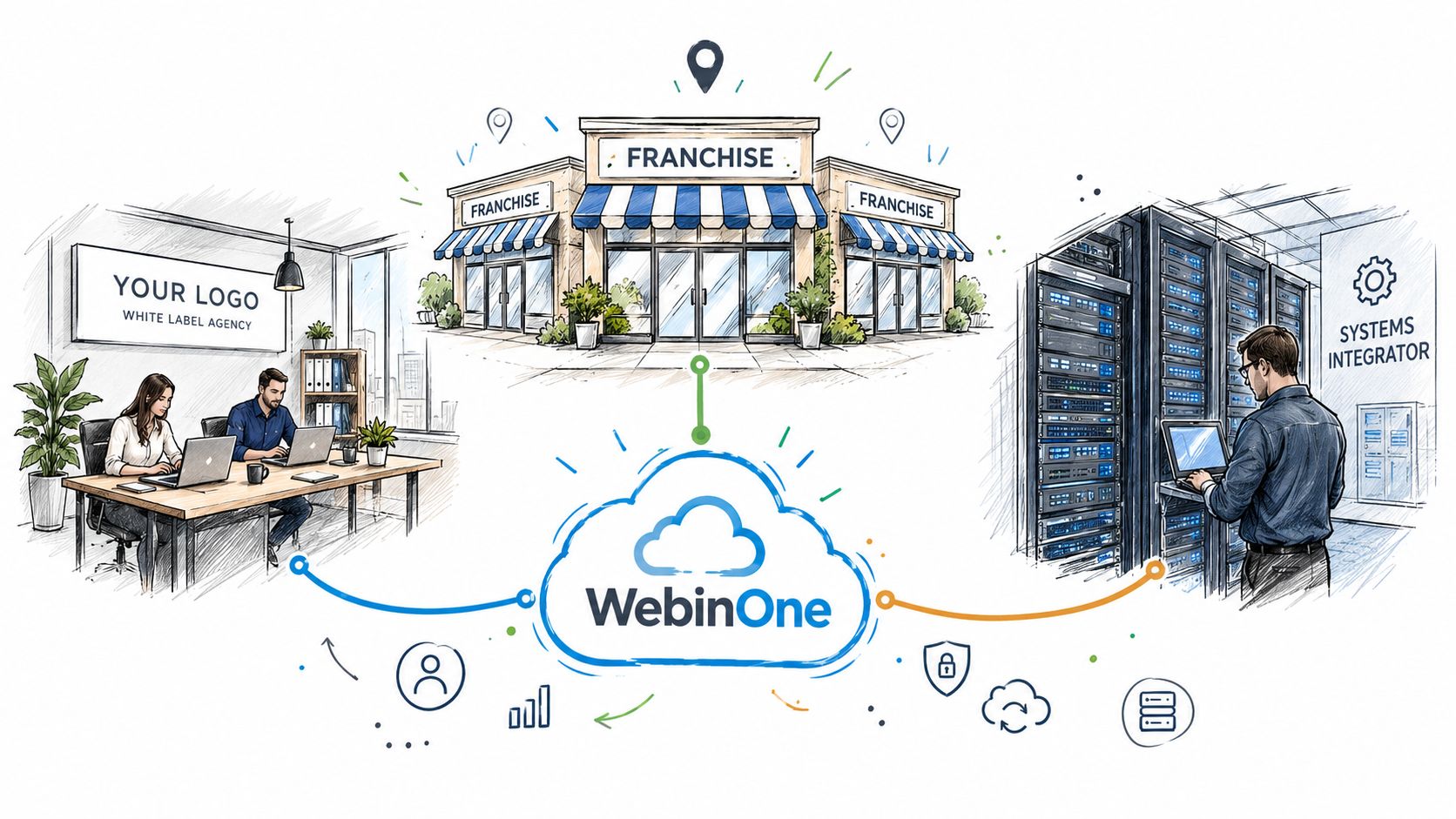
An agency with a growing portfolio can run client sites from a white-label platform rather than treating every site as a separate operating project. The agency can offer managed services under its own brand and build a repeatable delivery approach around templates, permissions, support, and billing. That creates room to move clients into larger projects instead of spending each maintenance cycle retracing the same platform work.
A franchise or multi-brand organization needs shared standards and local autonomy at the same time. A central team can define governance, while individual brands or locations manage their own content and site configuration within those rules. Where teams need to coordinate approvals and revisions, guidance on collaborative review features can help clarify the review process.
A delivery model for AWS partners
An AWS consulting partner or systems integrator can deliver client platforms using WebinOne as AWS Qualified Software. WebinOne runs as a managed platform in its AWS account; qualifying SIs can also license a version for deployment in their own or a customer's AWS account by agreement, including AWS GovCloud. WebinOne serves US and Australian government clients, and teams delivering government projects can discuss the appropriate deployment with the WebinOne team.
WebinOne is an AWS Partner, has passed the AWS Foundational Technical Review, is enrolled in the AWS Software and Services Paths, and is available on AWS Marketplace. Its partner network spans 16 countries, and WebinOne reports thousands of sites migrated. Those points establish operating experience and AWS alignment, but an SI should still validate tenant boundaries, deployment requirements, support responsibilities, and migration scope for the specific engagement.
The Next Step for Agencies, SIs, and Enterprises
Treat this as a procurement decision, not a platform upgrade. A multi-tenant CMS earns its cost when an organization runs many sites under shared governance and wants each maintenance cycle to produce reusable work. An agency running one flagship site has no portfolio problem to solve, and single-tenant tooling will serve it better.
Ask the hard questions before any demo: where tenant data physically lives, which credentials cross tenant boundaries, what happens to one tenant when another is compromised, and who carries the migration risk. Vendors that answer in generalities are telling you something.
WebinOne fits the managed white-label pattern described throughout this article: CMS, ecommerce, CRM, email, multi-site management, and a headless API on AWS, with licensed deployment options for qualifying integrators. Judge it on the same criteria as any candidate platform: tenant isolation, governance depth, migration scope, and the service model you intend to sell.
Agencies evaluating a white-label service should review the reseller program linked in the selection checklist and bring a site inventory to that conversation. Integrators and enterprise teams should open a scoping discussion with the WebinOne team through the contact path noted earlier, with deployment requirements and tenant-isolation questions in hand. The platform either fits the portfolio or it does not, and that answer comes faster when you arrive with specifics.