Multi Site Platform Guide for Agencies and Enterprises
A shared website component can spread a defect across an entire portfolio, so centralization raises operational risk unless releases and regressions are controlled. Core Web Vitals guidance identifies poor performance at loading times above 4 seconds, responsiveness above 500 milliseconds, or layout shift above 0.25. These thresholds give teams concrete boundaries for testing shared changes.
A multi site platform earns its value through controlled releases, accountable patching, local ownership and migration that preserves business dependencies. The work lies in governance and integration as much as in platform features. Without those controls, an agency or enterprise consolidates operational problems instead of reducing them.
Table of Contents
- What a Multi-Site Platform Is and How It Differs From Separate Installs
- Business and Technical Benefits for Agencies and Enterprises
- Core Features a Multi-Site Platform Must Deliver
- Evaluation Criteria and Go or No-Go Checklist
- Migrating a Multi-Site Portfolio Without Breaking It
- Real-World Use Cases Across Agencies and Enterprises
- Confirm Platform Fit Before You Move the First Site
What a Multi-Site Platform Is and How It Differs From Separate Installs
WebinOne runs multiple sites as a governed portfolio rather than a collection of unrelated installations. Shared administration provides the operating foundation, while each site retains its content, identity and accountable owner.
The useful analogy is a franchise. Head office sets the recipe, approved suppliers and operating rules; each outlet adapts its menu within those boundaries. For websites, the equivalent is a shared technical foundation with controlled differences in branding, navigation, content and integrations.
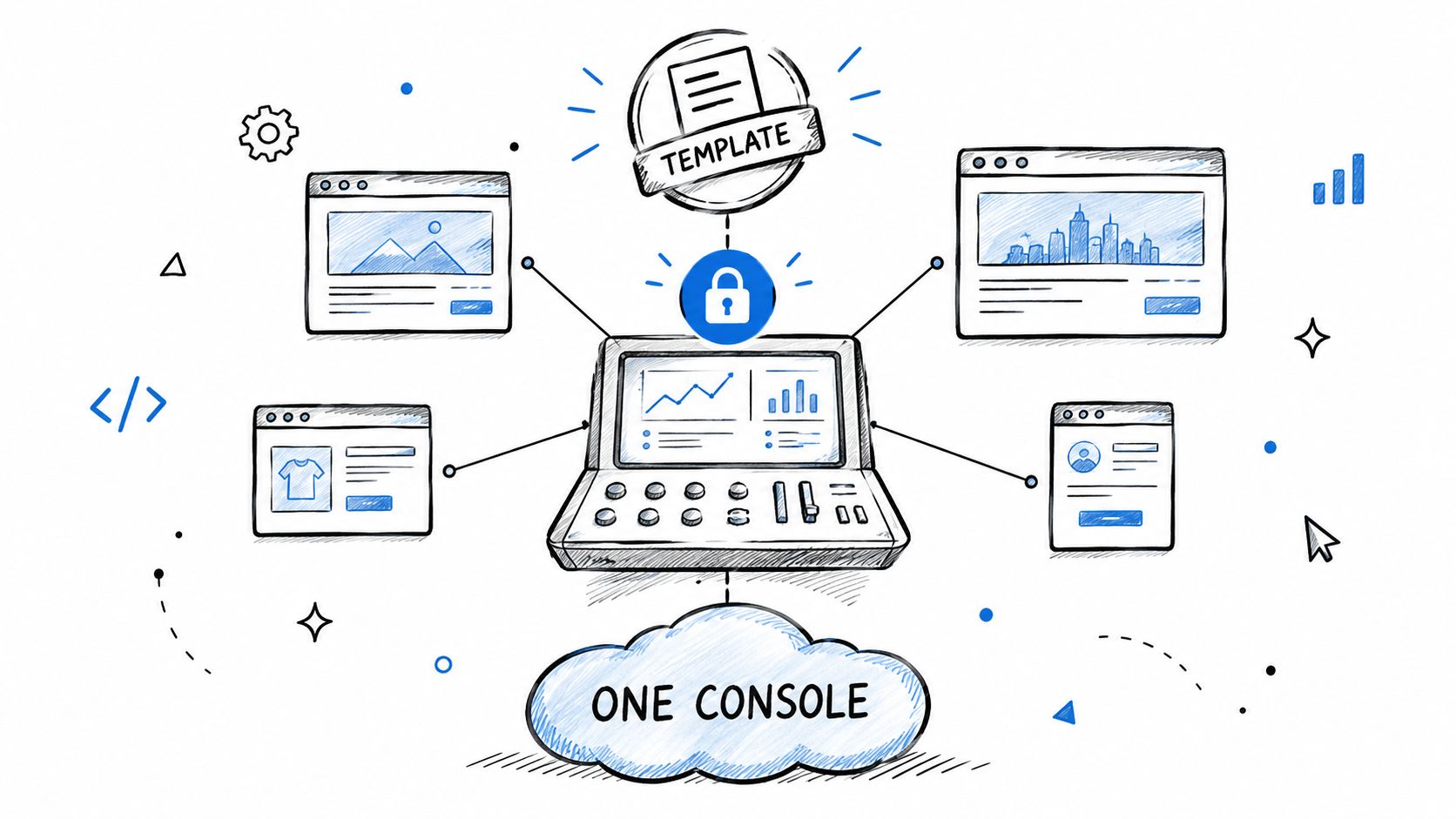
Three operating models compared
These are operating patterns, not guarantees attached to a product category. A shared codebase, for example, doesn't automatically provide safe releases or meaningful local ownership.
| Model | Updates and Patching | Templates and Components | Governance and Hosting | Adding a Site |
|---|---|---|---|---|
| Separate installations | Each site patched, tested and backed up on its own schedule | Each site builds its own templates and components | Permissions, hosting and reporting set site by site | New site means a new build and a new hosting setup |
| Shared-codebase network | One codebase with shared plugins or modules across sites | Shared templates, so a change can reach every site | Central administration, with per-site ownership dependent on implementation | New site added to an existing network |
| Managed multi-site platform | Vendor operates and patches the platform through controlled deployments | Shared component library with per-site overrides | Cross-site roles, permissions and audit records on managed hosting | New site launched from a template and priced per site |
Site counts grow because organizations add brands, countries, business units, campaigns and regulatory jurisdictions. Those properties don't necessarily share an audience or publishing schedule, even when they share infrastructure.
That distinction matters when deciding what to standardize. A campaign site may inherit a design system without inheriting a product catalog. A regional property may share page structures while requiring separate legal content and approval rules.
Working definition: A multi-site portfolio combines shared controls with per-site ownership. Adding another site should be routine configuration, not another infrastructure project.
The practical test isn't whether an administrator can see every domain in a dashboard. It's whether that administrator can delegate responsibility, identify exceptions and change the shared foundation without accidentally changing unrelated properties.
Business and Technical Benefits for Agencies and Enterprises
Agency margin erodes when every client site generates retainer hours for compatibility testing, emergency fixes and repeated configuration. Those costs can persist after launch, even when an installation appears inexpensive. A managed platform can reduce routine infrastructure work, but the agency still needs a clear division of responsibility for platform maintenance, hosting and client-specific implementation.
Government software-update guidance recommends applying updates promptly, enabling automatic updates where available and prioritizing known exploited vulnerabilities. Patching is an operational security task, not spare-time housekeeping. Agencies should confirm who monitors, tests and deploys updates, and who handles application-level issues that remain outside the platform's scope.
Remove repeated work before adding services
Consolidation pays off when it removes identifiable work across the portfolio:
- Duplicated extension upkeep: Check overlapping plugins or modules across separate installations.
- Version reconciliation: Identify each site's dependencies before testing a fix.
- Repeated security reviews: Apply an approved baseline, then focus reviews on site-specific exceptions.
- Operational administration: Coordinate backup policies, monitoring and hosting separately for each client.
- Repeated construction: Adapt approved page patterns instead of rebuilding them.
A total-cost-of-ownership analysis should compare those obligations with the costs of a managed service. Include internal delivery hours and support exposure alongside invoices. The license line alone does not show the cost of patching, governance or migration.
Less repetitive maintenance can give an agency capacity to take on larger engagements. A brochure site may grow into a multi-brand estate, commerce operation or member portal without requiring a new platform-selection exercise for every expansion. Portfolio agreements and a common SLA can clarify responsibilities, while bespoke integrations still require a defined scope.
Protect the retained margin
Reusable assets also need commercial oversight. A shared font or design asset may not be licensed for use across every client domain. Keep an asset register alongside the technical inventory, and use agency licensing advice from Font Checker Pro when establishing licensing checks.
We've migrated thousands of sites. Agencies assessing white-label delivery can use a reseller program to review how client retainers, platform responsibilities and support costs fit together. Consolidation can reduce duplicated work, but margin depends on setting those responsibilities clearly and accounting for migration and ongoing governance.
Core Features a Multi-Site Platform Must Deliver
Start the demonstration with an editor account, not an administrator account. Have the editor update a local page, then check whether that change affects a shared template or exposes another client's records. Test each capability against an operational question: who can make a change, how it reaches production and what happens when it fails.
Our website governance template can help document per-site roles, approval boundaries and ownership. Audit records should show who changed what and where. That record matters when an update causes a problem and teams need to identify its scope.
Inspect the component library under the same conditions. Shared components need visible local overrides, version control and a release process that separates a site-specific adjustment from a change affecting the portfolio.
What can the platform operate centrally?
Test the operating surface through real workflows:
- Publishing and integration: Check whether one console covers content, forms, SEO and search, and whether a headless CMS, APIs and webhooks connect other front ends.
- Deployment control: Confirm teams can target one site or a group, review changes before release and roll back if production is affected.
- Security operations: Establish who maintains native extensions, SSL, security headers and backups. Assign responsibility for custom integrations explicitly.
- Residency: Match deployment locations to market requirements. Custom data centers are available by agreement.
- Commerce: The platform charges zero transaction fees on all plans. Scope custom commerce implementation as a TeamOne project.
AgentOne adds an operating surface through Managed Vibe Coding. It builds and operates sites inside our managed platform with scoped permissions and audit logs. Its code remains transparent and auditable, and changes stay visible, reviewable and reversible before production.
Automation should inherit the organization's approval boundaries. It shouldn't receive broader authority because it can execute changes quickly.
Which availability promise applies?
Check the service commitment, not just the infrastructure label. The AWS EC2 SLA sets a 99.99% regional commitment when deployment runs concurrently across at least two Availability Zones, or two regions where a region has only one Availability Zone.
Ask how failover works, which dependencies remain shared and which contractual SLA covers the complete service. The infrastructure commitment and the application-platform commitment are separate obligations.
Evaluation Criteria and Go or No-Go Checklist
Score each criterion against evidence, and do not advance a platform until the required gates are demonstrated or contractually agreed. The figures cited for WebinOne include 99.99% uptime over the last 12 months, a 99.95% published SLA commitment, hosting across 6 AWS regions, selectable residency and pricing from $10/month per site. Use those figures as a starting point, then test the commitments against your portfolio's requirements.
Evaluation criteria for a multi-site platform
| Criterion | Question to Ask the Vendor | What Good Looks Like |
|---|---|---|
| Governance | Can a site editor change content without changing the shared template? | Per-site roles, scoped permissions and an audit log |
| Templates and components | Is there one component library with per-site overrides? | A global, versioned library tested before release |
| Deployment model | Is the platform managed, or licensed into a qualifying organization's own account? | A managed platform, or a licensed deployment by agreement |
| Security and patching | Who applies core and extension updates, and on what schedule? | A vendor-run patch cycle written into the contract |
| Data residency | Where do records for each market sit? | Selectable residency, with custom data centers by agreement |
| Availability | What is the SLA, and how is uptime measured? | A published commitment, measurement method, exclusions and escalation process |
| APIs and headless delivery | Can content and commerce serve other front ends? | APIs, webhooks and a headless CMS option |
| Migration | How are waves tested, and how is rollback handled? | Staged waves, URL maps, parallel runs and a defined rollback window |
| Pricing | What is the per-site price, and what does it exclude? | Published site pricing, explicit service exclusions and separately scoped custom commerce |
Ask vendors to show how permissions work in a live demonstration. A screen share should confirm that site editors cannot change shared templates or cross site boundaries. Put patching responsibility in the agreement, including who owns updates to the platform, native extensions and custom code.
Set hard gates before commercial negotiation
Require clear answers to these five points before a platform advances:
- Release isolation: A site can be released without forcing unrelated site changes.
- Written patching ownership: The agreement identifies responsibility for the platform, native extensions and custom code.
- Market-level residency: Required locations can be assigned through an appropriate site or market deployment, rather than assumed from an account setting.
- A usable exit: Content, URLs, users and redirect mappings can be exported in agreed formats, subject to security controls.
- Accountable support: The paid support tier defines escalation ownership, coverage and the route for urgent incidents.
If meeting a gate depends on bespoke work, record the dependency, delivery owner and cost before signing. Confirm the commitment in contract language, not only in a sales demonstration.
Buyers should weight criteria according to how the platform will be operated. An agency reselling sites should give retained margin, client-facing branding and support economics more weight. An enterprise should prioritize governance, residency, audit evidence and integration ownership. Applying identical scoring weights to both buyer types can conceal material differences in operating cost and risk.
A licensed deployment in an SI's or customer's own account may be available to qualifying systems integrators by agreement. Ask whether the option fits the intended deployment, which operational responsibilities transfer, and whether the commercial agreement covers that arrangement. Score the answer against the same evidence standard as the other gates.
Migrating a Multi-Site Portfolio Without Breaking It
Brochure sites, authenticated areas, commerce and regulated properties each need different acceptance criteria before cutover. Treating a portfolio as one launch can turn a local defect into a wider outage. Set risk-based migration waves, test each wave against its own user journeys, and define how the team will recover before production changes begin.

Migration pitfalls, what they break and the control
| Pitfall | What It Breaks | Control to Put in Place |
|---|---|---|
| Migrating every site in one cutover | Portfolio-wide availability | Risk-based waves, with commerce and member areas later |
| URLs changed without a map | Search visibility and inbound links | URL inventory, mapping file and validated server-side redirects |
| Permissions not reconciled | Editor access and authorization boundaries | A role map reconciled before cutover |
| Shared component change without a release gate | Multiple sites together | Staged rollout, release gates and tested rollback |
| Local edits to central templates | Consistent governance | An override register and named site ownership |
| Plugin or module with no equivalent | Required functionality | A feature inventory before the initial wave |
| Consent records and tags dropped | Analytics continuity and compliance reporting | Consent and tag mapping before launch |
The search-engine site-move guidance covers destination preparation and testing, URL mapping, redirects, and monitoring traffic on old and new URLs. Use server-side permanent redirects such as 301 or 308 where technically possible.
Sequence the work around recoverability
- Inventory the estate. Capture URLs, content, users, integrations, consent records and site owners. Include scheduled jobs and external systems that a page crawl will miss.
- Map destinations. Assign a destination to every retained URL and document how retired content will be handled. Test redirect mappings before launch.
- Group sites by risk. Start with representative brochure properties. Schedule transactional, authenticated and regulated workloads for later waves, with relevant specialists involved.
- Parallel-run each wave. Validate forms, search, permissions, payments, notifications and analytics. Keep production and test transactions clearly separated.
- Define cutover thresholds. Agree on DNS readiness, acceptable monitoring results, decision ownership and a rollback window. Reconcile records created during the transition.
- Verify after release. Monitor traffic across both URL sets and test real user journeys. Treat redirect and traffic checks as release controls.
Use this platform migration strategy to define acceptance criteria before migration begins. A content import alone does not confirm that authenticated journeys, payment notifications or consent workflows still work. Test each of those paths with the people responsible for them.
TeamOne handles complex site rescue, including extension bloat and custom code, and bulk portfolio migration through repeatable waves. Teams test before and after cutover, then assign exceptions to named owners instead of leaving them buried in a launch checklist.
Centralization increases the impact of a faulty shared release. Design waves around recovery, and set release gates that catch issues before they spread.
Real-World Use Cases Across Agencies and Enterprises
A multi-site platform can simplify shared operations, but it does not remove the differences between agency, enterprise, integration and public-sector projects. Each scenario below is an illustrative composite, not a customer story or a claim of results.

An agency moving into larger engagements
An agency supports a mix of open-source installations and hosted site-builder projects. A client now wants related brand sites, commerce and a member area. Separate operating processes make the delivery and ongoing support harder to scope accurately.
Walk through a representative client journey, from implementation to support, and account for the agency's obligations at each stage. Retained margin per site is the practical test: include migration, implementation and the support work that continues after launch.
An enterprise consolidating acquisitions
A multi-brand business has inherited inconsistent publishing practices, permissions and integrations. Regional teams need room to manage local content, while central teams need clear brand and security controls.
Include both a local exception and a shared change in the pilot. The evidence should show that delegated teams can act within defined boundaries, without turning central approval into a bottleneck. Governance is demonstrated in day-to-day decisions, not just in a permissions chart.
A systems integrator replacing a legacy estate
An SI may need to replace aging applications while the customer retains ownership of its AWS account. That arrangement calls for a licensed deployment by agreement and written responsibility boundaries for infrastructure, platform operations and integration support.
WebinOne's enterprise partnership information describes its AWS Partner status, AWS Foundational Technical Review, AWS Qualified Software designation and participation in AWS Software and Services Paths. The company is also available through AWS Marketplace. Deployment model and account ownership should be resolved before the SI scopes delivery.
A government team requiring hosting control
A public-sector project may require GovCloud hosting and delivery through an SI partner using a licensed deployment. FedRAMP authorization should not be assumed from those requirements; confirm the applicable evidence and authorization needs for the specific engagement.
Start with a deployment and responsibility discussion. The government team must establish residency and hosting control, then identify the evidence required for its project.
Confirm Platform Fit Before You Move the First Site
Before the first site moves, portfolio owners need a written decision pack covering the estate, migration waves, pilots and responsibilities. It should identify where the operating model or contract still needs clarification.
- Map the portfolio: Record each site's current platform, traffic profile, residency requirements and commerce status.
- Score the operating model: Apply the evaluation criteria and flag evidence gaps and contractual dependencies.
- Draft migration waves: Group straightforward publishing properties separately from transactional, authenticated and regulated workloads.
- Choose representative pilots: Include routine sites and meaningful exceptions, not only the easiest properties.
- Assign responsibilities in writing: Set ownership for patching, governance, support and acceptance before implementation begins.
A pilot should test how teams will handle exceptions, approvals and site acceptance, as well as whether the platform's features fit. Otherwise, unresolved governance and migration work can surface only after the portfolio starts moving.
Agencies can use the reseller program discussion outlined earlier to clarify white-label delivery and administration, terms, pricing and the demo process. Bring the portfolio inventory and proposed pilots to that conversation. SIs, cloud partners and enterprise teams should document account ownership, residency requirements, migration responsibilities and the proposed cutover approach before committing to a deployment.