Headless CMS Platform Buyer's Guide for Agencies and SIs
A client's campaign is ready, but publishing is blocked by an integration nobody wants to touch. Another site needs an urgent security update, while the engineer who understands the inherited estate is unavailable. The agency or systems integrator isn't short of tools. It's carrying too many operational obligations to take on the next, bigger project confidently.
Table of Contents
- The Moment the Stack Becomes the Bottleneck
- What a Headless CMS Platform Actually Means in Practice
- Comparing Headless CMS Platforms on the Criteria That Matter
- Three Buyer Scenarios and How the Criteria Resolve
- Governance, Accessibility and the Operating-Model Cost of Going Headless
- Implementation and Migration Path That Actually Works at Scale
- Why Managed Headless on AWS Changes the Unit Economics
The Moment the Stack Becomes the Bottleneck
WebinOne addresses this bottleneck by consolidating CMS, ecommerce, CRM, email and headless delivery into a managed platform. We believe a platform decision should start with the work a delivery business wants to stop carrying, not the features it wants to collect.
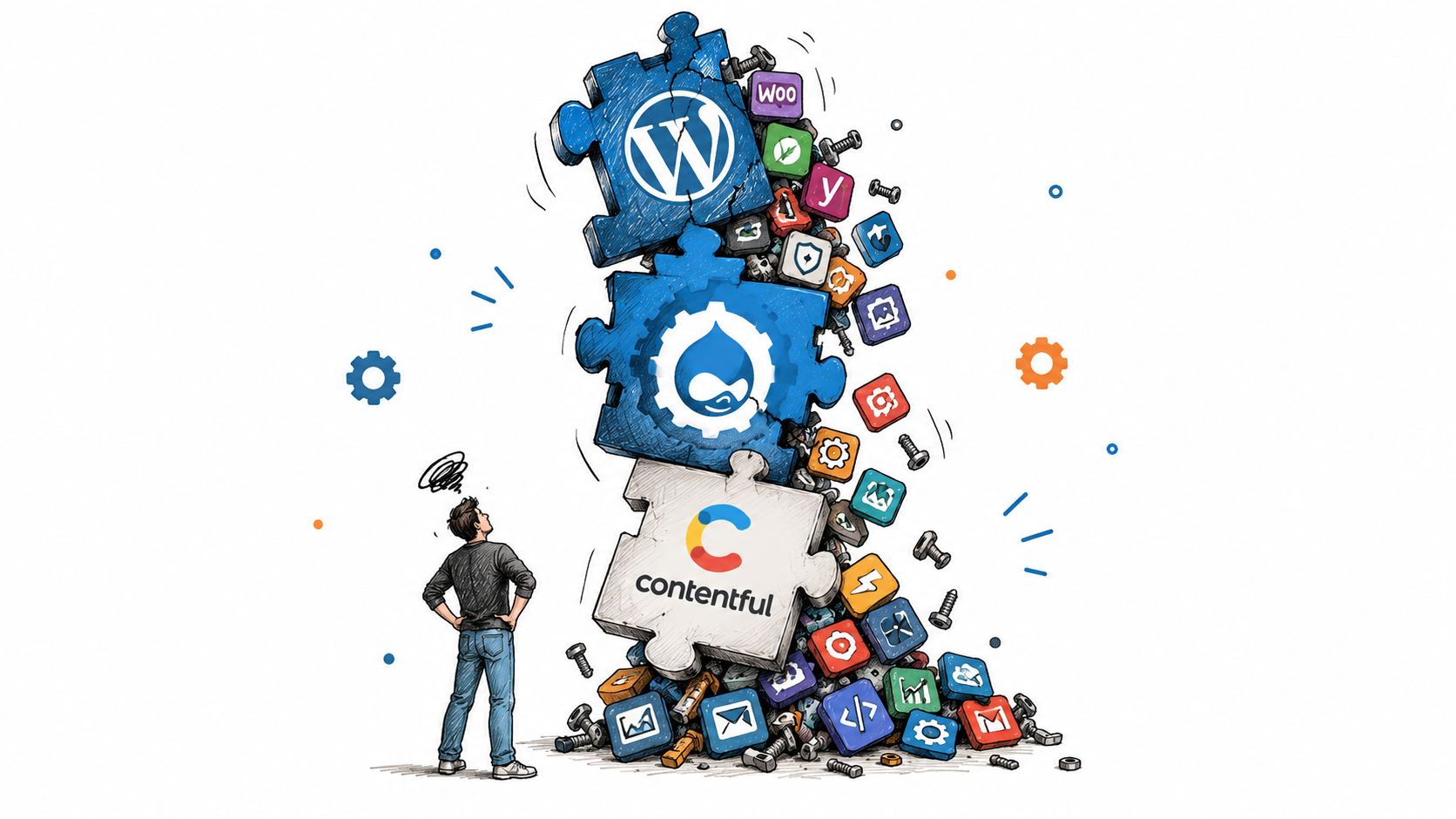
The symptoms are familiar: an inherited site with a sprawling plugin inventory, a content estate understood by a single specialist, and customer records copied between disconnected systems. Every change requires someone to trace dependencies before they can estimate the work. Routine maintenance competes with billable delivery.
Count obligations, not subscriptions
A software invoice doesn't capture the full operating cost. Agency owners also need to account for regression testing, incident coordination, infrastructure tuning and the time spent explaining which supplier owns a failure.
The AI CMO's resource on martech consolidation is useful context for examining the stack as a whole. The practical exercise is to map each business capability to its supplier, data owner and support obligation before approving another subscription.
- Maintenance load: Record the patching, compatibility checks and post-update repairs the delivery team performs.
- Incident ownership: Identify who coordinates recovery when content, payments and customer communications fail across different services.
- Knowledge concentration: Flag workflows that another qualified operator couldn't recover using the existing documentation.
- Commercial drag: Separate valuable client work from effort required merely to keep the estate running.
Buying rule: Don't replace an awkward CMS with an architecture that requires more people to operate.
For agencies, the destination should be a repeatable client product delivered under their own brand. For SIs, it should be an environment with explicit responsibility boundaries. Bigger projects become commercially attractive only when the operating model is repeatable enough to price, support and hand over.
That's the argument for managed headless, rather than headless as another subscription.
What a Headless CMS Platform Actually Means in Practice
WebinOne has a headless CMS within a broader digital experience platform. We separate the ability to deliver through APIs from the assumption that every business capability must become a separate vendor relationship.
In operating terms, headless means a governed content model feeds independently implemented experiences through an API. The distinction from a coupled CMS is the separation of content management from page rendering, described in Agility CMS's account of decoupled publishing. The useful outcome is content reuse across channels with different release cycles, not framework freedom for its own sake.
Model the business before choosing the front end
Start with the entities the organization needs to control: service descriptions, products, locations, contacts and member-facing information. Define relationships and ownership before recreating existing pages as fields in a new repository.
Then decide which channels consume those entities. A public website might need published service information; a client portal might need restricted records; a commerce experience might need content alongside transactional data. Those are different authorization and delivery requirements, even when they share a platform.
- Content model: Define reusable entities, required metadata and the rules for changing shared records.
- API contract: Specify which data each consumer can retrieve or modify, including failure behavior.
- Presentation ownership: Assign responsibility for rendering, previews, deployment and channel-specific testing.
WebinOne keeps content, commerce, contacts and transactional data within the same managed system, alongside email and multi-site management. That gives agencies and SIs a consolidation option without requiring every project to use an external front end.
Front-end independence is valuable only when editors can still preview, approve and publish without an engineering ticket.
A procurement demonstration should therefore include a real editorial task. Ask an editor to update shared content, review its channel output and publish it using the proposed workflow. If that task needs developer intervention, the implementation has moved the bottleneck rather than removed it.
Comparing Headless CMS Platforms on the Criteria That Matter
WebinOne should be evaluated against operational evidence, not awarded points because it exposes APIs. We recommend rejecting any shortlist entry whose supplier can't explain the support boundary, deployment model and recovery path.
Headless CMS Platform Evaluation Criteria
| Criterion | Diligence Question | What to Verify |
|---|---|---|
| APIs and SDKs | Can the required workflows run through supported interfaces? | Authentication, endpoint coverage, webhooks, limits, versioning and documentation. |
| Extensibility and custom modules | Who maintains extensions after launch? | Native versus custom ownership, upgrade compatibility and support exclusions. |
| Hosting and data residency | Where does the workload run, and who controls it? | Region selection, account boundaries, backups and contractual residency requirements. |
| SLA and uptime | What availability is measured and committed? | Measurement scope, exclusions, incident handling and service-credit terms. |
| Enterprise and governance features | Can the organization retain control through change? | Permission scope, approval requirements, operational evidence and handover quality. |
| Total operating cost | What must the buyer pay beyond the platform subscription? | Implementation, support, external services, infrastructure and continuing maintenance. |
The table compares buying obligations across managed platforms, CMS point products and self-managed assemblies without pretending those categories have identical responsibility boundaries. DOM Studio's feature matrix scoring criteria provides a useful reference for structuring the assessment. Weight mandatory operational requirements before scoring optional features.
How WebinOne answers the assessment
Our REST API endpoint documentation describes 300+ APIs and webhooks. The count is a starting point, not acceptance evidence. Test the actual content, commerce and contact workflows the project needs, including denied requests and unsuccessful updates.
Native extensions are developed and maintained by WebinOne. Custom modules remain a delivery decision: the statement of work should say who maintains custom behavior, what happens during upgrades and which changes need separate scoping.
Our enterprise platform offering includes AWS hosting across 6 regions, selectable data residency and pricing from $10/month per site. Buyers should establish the required region and commercial scope before comparing that starting price with a complete project budget.
Require demonstrations, not checkmarks
For reliability, request the published SLA and its measurement boundary. A content API, external front end and third-party integration can have different failure conditions; a headline availability figure doesn't explain all of them.
For governance, test whether a restricted editor can change another brand's content. Ask the supplier to demonstrate a recoverable mistake and produce the documentation a replacement implementation partner would receive.
For total cost, compare the proposed managed environment with the complete assembled environment. Include preview services, media delivery, monitoring, support and engineering time. A cheaper CMS subscription isn't necessarily a cheaper client platform.
Three Buyer Scenarios and How the Criteria Resolve
The right headless setup depends on who owns delivery after launch. Evaluate each option against a real engagement, including who controls access, handles incidents and pays for ongoing work. A vendor score alone won't settle those operating questions.
The agency building a white-label client product
An agency wants to replace one-off builds and open-ended maintenance with repeatable client services. It needs control over branding, delivery workflows and the cost of supporting each account.
WebinOne's agency portal brings templates, sites, staff, billing, branding and support tickets under the agency's brand. Test a real onboarding: launch a client site, assign access, apply the agency template and route a support request. If that workflow depends on an extra administrative workaround, account for the work before you price the service.
The WebinOne reseller program is the route for evaluating this model. Bring a representative client project and identify which costs sit with the platform, the agency and any custom delivery work.
Price the client service around accountable delivery and continuing value; treat unlimited repair promises as a cost you are absorbing.
The SI replacing an inherited platform
Which parts of the current estate must move, and who will own each one after migration? That question should lead an SI's evaluation, whether it is replacing an open-source estate, a legacy DXP or a heavily customized application. Deployment ownership and migration responsibility outweigh white-label presentation here.
WebinOne normally runs as a managed platform in its AWS account. By agreement, qualifying SIs can use a licensed deployment in their own or their customer's AWS account, including AWS GovCloud. A custom data center can also be established by agreement.
For FedRAMP and GovCloud projects, the SI and WebinOne need to allocate responsibility for control implementation, evidence collection, infrastructure operations and application support. The next step is a partnership conversation about the actual workload. An AWS hosting label does not determine who owns those duties.
The enterprise consolidating a fragmented estate
A multi-brand enterprise needs shared standards and controlled regional access. Start with a representative setup that includes shared content, local variations and restricted customer information, then test whether the proposed configuration supports the business's approval process, residency needs and regional operations.
WebinOne provides centralized multi-site management and unified data. Buyers should confirm how those capabilities fit their actual brand boundaries and editorial workflows. Consolidation should reduce duplicated administration while keeping legitimate differences between brands intact. The decision is whether the operating model can share work without granting broad access or forcing every brand into the same process.
Governance, Accessibility and the Operating-Model Cost of Going Headless
WebinOne's managed model centralizes platform patching, access control and operational monitoring, but it doesn't remove the delivery partner's responsibility for the finished experience. We treat governance as a continuity requirement, not a permissions screen shown during procurement.
The uncomfortable question is what happens after the original implementation team leaves. Can another operator understand the model, recover a bad release and distinguish a platform incident from a front-end defect? If not, the business has purchased flexibility at the cost of control.
Accessibility belongs in the rendered output
The WebAIM 2025 Million report detected 50,960,288 accessibility errors across one million home pages, with low-contrast text present on 79.1% of pages. Those results aren't evidence against a particular CMS architecture. They demonstrate why changing the repository doesn't automatically make the delivered experience accessible.
Required alternative-text fields can help editors supply information. They can't guarantee correct keyboard behavior, meaningful headings or sufficient contrast in a custom component. Acceptance testing must cover the actual website, portal or application.
Our accessibility compliance guidance is a useful starting point for defining responsibilities across content, components and rendering. The contract should identify who fixes a failed accessibility check and who verifies the correction.
Authorization must survive every delivery path
OWASP's 2021 application-security data ranked broken access control as the most serious risk, recording related weaknesses in 3.81% of tested applications and more than 318,000 occurrences. An authenticated front end isn't sufficient protection for an API.
A restricted record must remain restricted when requested directly, through a preview path or by another channel. Procurement should include negative tests, not just successful demonstrations.
- Documented models: Require field definitions, relationships and a named owner for structural changes.
- Role-scoped permissions: Test access across brands, member records, assets and preview endpoints.
- Change logs and rollback: Establish what can be restored, by whom and with what effect on connected channels.
- API versioning and exportability: Require a transition path when consumers or content models change.
- Environment separation: Keep test credentials, unpublished content and production operations appropriately isolated.
- Operational ownership: Assign previews, caching, API limits, incident response and escalation before launch.
A managed platform reduces the infrastructure and extension maintenance the partner must assemble. Custom front ends still need owners, tests and recovery procedures. Managed headless is a smaller operational burden, not an absence of operational work.
Implementation and Migration Path That Actually Works at Scale
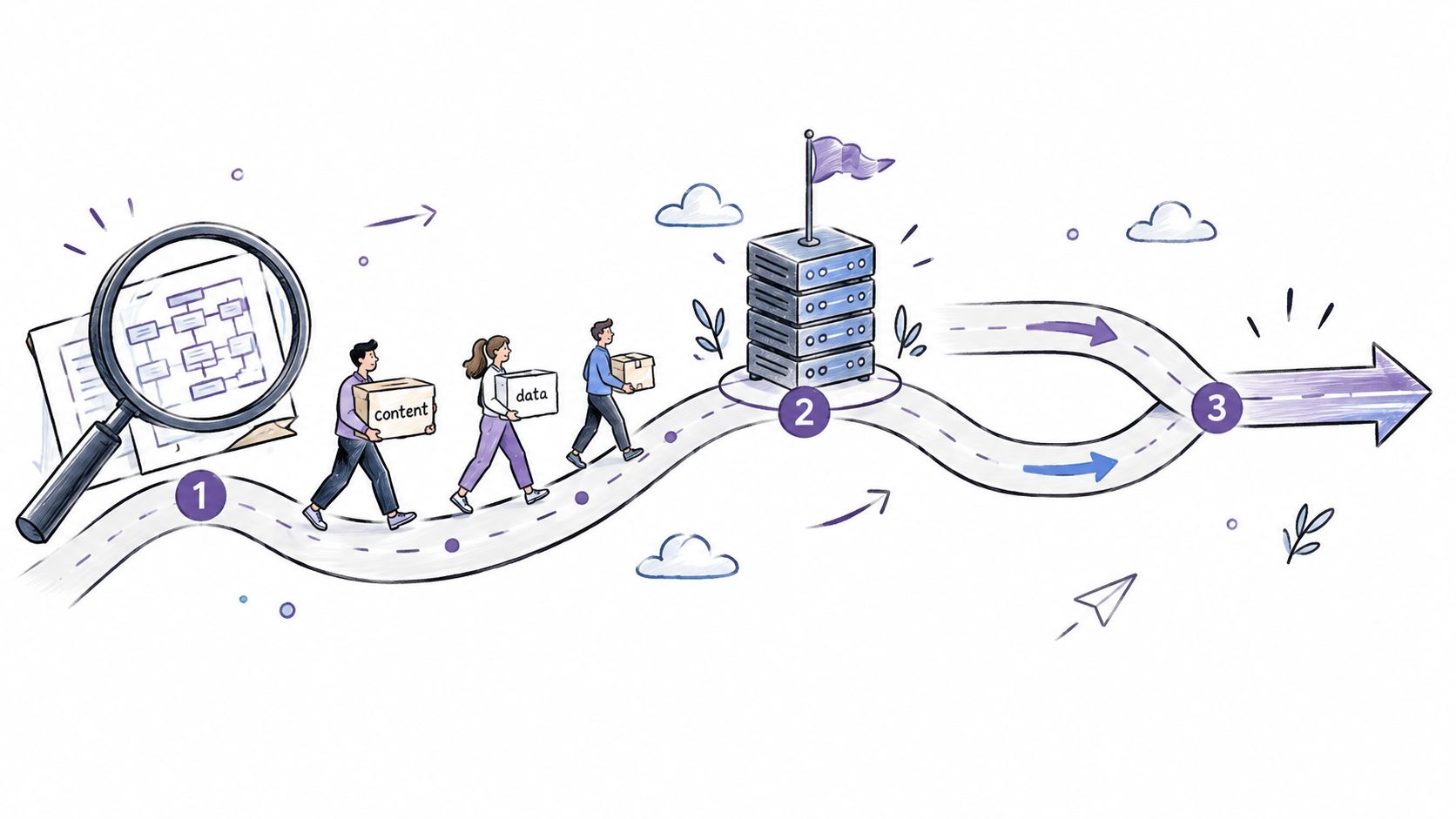
WebinOne and TeamOne use staged, tested migration with a zero-downtime cutover approach. We recommend turning that approach into explicit acceptance checkpoints, rather than treating migration as a content import followed by a launch date.
The delivery method is more important than the volume of content. A successful import can still produce broken redirects, incomplete member journeys or inconsistent customer data. The migration scope must cover behavior as well as records.
Put checkpoints into the statement of work
- Discovery and model rebuild: Inventory content, assets, URLs, integrations and restricted data. Approve the target model before bulk transfer.
- Staging acceptance: Validate imported records, redirects, forms, commerce flows and representative editorial tasks on the new platform.
- Parallel operation: Define the source of truth during transition and reconcile changes made after the initial import.
- Cutover readiness: Rehearse routing changes and rollback. Agree on who authorizes launch and which failures stop it.
- Portfolio waves: Group sites by dependencies and complexity, then reuse proven mappings without assuming every site is identical.
- Post-launch operations: Confirm monitoring, escalation, documentation and ownership of custom components.
TeamOne's migration experience includes the large end-of-life transition described in the WebinOne enterprise migration offering. Agencies should ask how that delivery experience translates into an auditable plan for their own portfolio, rather than accepting scale alone as proof of readiness.
Validate the AWS workload in scope
AWS Foundational Technical Review documentation requires the primary AWS-hosted workload to be covered by a current SOC 2 Type II report or an AWS Well-Architected Framework Review. For the review route, AWS specifies a review less than one year old, performed through its Well-Architected Tool, with no high-risk issues in Security, Operational Excellence and Reliability.
Ask which workload the evidence covers. A licensed deployment needs its own agreed operating boundary, architecture and responsibilities; it shouldn't inherit assumptions from a different deployment arrangement.
Why Managed Headless on AWS Changes the Unit Economics
WebinOne makes the strongest commercial sense when the buyer wants to deliver more client value without expanding a patching and integration-maintenance business. We see managed headless as a way to retain delivery flexibility while consolidating the underlying operating obligations.
For an agency, that means a recurring white-label service with a defined platform boundary. For an SI, it means concentrating the engagement on migration, integration and business workflows instead of continually rebuilding the hosting and maintenance arrangement.
Evidence before economics
WebinOne has passed the AWS Foundational Technical Review, holds the AWS Qualified Software designation, is enrolled in the AWS Software and Services Paths, and is available on AWS Marketplace, with 99.99% uptime over the last 12 months and a 99.95% availability commitment in its published SLA. Our headless CMS on AWS overview provides context for evaluating the managed delivery model.
Those facts support diligence; they don't replace project-specific acceptance criteria. Buyers still need to establish workload scope, custom-code responsibility and recovery procedures.
When agencies need to find local cloud hosting for client sites, UpTime Web Hosting's resource offers context for that infrastructure decision. Hosting selection should sit alongside data residency and support ownership, not become a substitute for evaluating the complete operating model.
Sell the outcome, scope the exception
A consolidated platform can reduce separate supplier coordination, duplicated administration and renewal management. The commercial benefit depends on whether the project retires those obligations. Keeping every existing service while adding a DXP won't produce the same result.
- Agency services: Package content operations, SEO/AEO, reporting and ongoing improvements as defined services, without promising rankings or visibility gains.
- SI engagements: Price migration and integration work separately from continuing platform operations.
- Custom delivery: Scope exceptional behavior as a TeamOne project rather than hiding it inside an unrestricted support promise.
Choose the platform that makes responsibility easier to explain and delivery easier to repeat. API flexibility matters, but margin and continuity depend on who operates the system afterward.
Bring a representative client site, dependency inventory and required deployment model to a platform review. Agencies can assess white-label delivery through the WebinOne reseller program. SIs, AWS partners and enterprises should arrange a partnership or migration conversation with the WebinOne team to agree on account boundaries, migration scope and ongoing operational responsibility.