Ecommerce Website Agency Guide: Services and How to Choose

A store that takes payments is not a finished project at launch. It's an operating system for catalog, orders, customers and cash, and it fails in different ways from a content site. Buyers who treat an ecommerce website agency as a design vendor usually discover the gap after go-live, when changes, patches and payment problems arrive without an owner or a price.
Table of Contents
- What an Ecommerce Website Agency Delivers Beyond the Build
- Five Services Every Ecommerce Build Needs
- What Launch, Run and Change Costs Look Like
- Criteria, Red Flags and Written Questions to Ask
- How to Migrate a Store Without Losing Sales or Rankings
- Confirm Reseller Fit Before Your Next Migration
What an Ecommerce Website Agency Delivers Beyond the Build
An ecommerce website agency designs, builds, connects and runs a store that takes payments, and WebinOne partners deliver that bundle under their own brand. The build is only the first bucket of work.
Scale explains why. The U.S. Census Bureau Q3 2025 ecommerce release put U.S. retail ecommerce sales at an estimated $310.3 billion, representing 16.4% of total U.S. retail sales. Ecommerce sales increased 5.1% year over year, while total retail sales grew 4.1%, so online commerce kept expanding faster than retail overall.

A Shop, Not a Sign
A brochure site is a sign on a wall. It can be painted, mounted and left alone for months. A store is a working shop that needs stock checks, locks and staff every day, so the agency is the operator, not the painter.
Say a merchant adds products weekly, changes prices for a promotion, and takes orders through several payment methods. Each change touches search, product display, tax, inventory, customer accounts and analytics. A broken banner is embarrassing. A broken payment flow stops revenue.
That operating load includes catalog management, payment flows, customer accounts, search, analytics, integrations, security, performance and continuous content changes. For several brands or regional storefronts, centralized administration, reliable hosting and scalable APIs become foundational, not optional extras.
Practical rule: Price a store as three separate buckets, launch, monthly run and change requests, before comparing any quote.
Those three cost buckets expose the full commitment. Launch covers design, build, integration and migration. Run covers hosting, patching, monitoring, backups and support. Change covers new templates, features, campaigns and catalog work after launch. Every later test in this guide maps back to those buckets, because an agency that prices only launch hasn't priced the store.
Five Services Every Ecommerce Build Needs
A complete ecommerce website agency delivers five services, and a quote that skips one is a partial job, which WebinOne's TeamOne team covers on the platform for web development, design, migration and accessibility. Buyers should require one named owner for every row.
| Service | What it covers | Cost bucket |
|---|---|---|
| Design | Product, category and checkout layouts, brand system | Launch and change requests |
| Development | Templates, custom modules, forms, accounts, search | Launch and change requests |
| Commerce integration | Payments, tax, shipping, catalog sync, marketplaces | Launch and monthly run |
| Migration | URLs, products, customers, orders and content from the old CMS | Launch |
| Operations | Hosting, patching, backups, monitoring, support, content updates | Monthly run |
Design and Development
Design covers product pages, category templates and checkout layout. Merchants should judge those templates by how clearly they present price, variants, delivery and trust information, not by brand look alone. A beautiful product page that hides shipping costs until checkout creates avoidable friction.
Development turns templates into working templates, custom modules, forms, member accounts and search. TeamOne developers specialize in Liquid templating, custom modules, API integrations, and Ecommerce, including marketplace integrations. Acceptance should cover account creation, password reset, search results with no matches, and form errors, not just the happy path.
Integration, Migration and Operations
Commerce integration is where most launch delays happen. Payments, tax, shipping, catalog sync and marketplaces depend on credentials, test accounts, product data quality and third-party rules. Detailed planning for ecommerce integration services should name each connection, its data direction, its failure behavior and its test evidence.
Search visibility belongs in that plan from the start. Agencies that pair build work with SEO tactics that drive revenue protect category and product pages as commercial assets, rather than treating findability as post-launch marketing.
Migration moves products, customers, orders, content and URLs from the old system. Operations then keeps the store patched, backed up, monitored and supported. Ask each agency to name one owner for every row, with a handover point between rows. Unowned rows become change requests later, usually at the worst possible time.
What Launch, Run and Change Costs Look Like
Store costs continue after launch. Compare the platform's recurring fees with agency charges for ongoing operations and later changes, so the budget reflects the store as an always-on operation.
The run bucket covers recurring work: patch cycles, backups and restore testing, monitoring, payment and tax updates, catalog and content maintenance, and accessibility checks when products or banners change. For each patch cycle, agree who reviews the update, tests checkout and other affected journeys, and records the result. A smooth launch does not remove this workload.
The Maintenance Load Buyers Miss
Plugin-heavy stores add coordination to each cycle. Agencies need an extension inventory, advisory tracking, tested updates, restricted admin access and a process for removing abandoned components. Different extension combinations and hosting settings mean a patch that works on one store may break checkout on another. The quote should make clear whether this testing is included in ongoing support or billed as a change.
Name the owner for critical issues and set a response commitment. For broader context on separating initial development from ongoing costs, Wistec's Australian ecommerce cost guide is a useful reference. Local quotes still need to itemize the work.
| Item | Price | Best for |
|---|---|---|
| Content site plans | From $10 per month per site | Brochure and content sites |
| Ecommerce Basic | $20 per month, added to a selected content plan | Small online stores |
| Ecommerce site migration with products and payments | $3,000 | Moving an existing store with products and payments |
| Ecommerce transaction fees | 0% | Merchants avoiding platform transaction fees |
These platform prices help separate subscription costs from agency work. Launch can include design, custom modules, data cleanup and integrations. Run can include support, monitoring and recurring content help, as outlined in managed service pricing guidance. Change covers new features and other work outside the agreed recurring service. Specify what triggers a change request and who must approve it before work begins.
Use the table to compare recurring platform costs, then read the service quote to see what the agency will deliver. Record the inclusions, exclusions and approval process for each bucket. That makes it easier to compare proposals on the work covered, not just the initial figure.
Criteria, Red Flags and Written Questions to Ask
A vendor's answers should be specific enough to become acceptance tests. Put each requirement in writing before signature, including how it will be tested and what evidence will count as a pass. General assurances leave gaps when a real catalog, payment failure or checkout change puts the store under pressure.
| Criterion | Strong answer | Red flag |
|---|---|---|
| Commerce delivery | Names payment, tax and shipping integrations, with tests using a representative catalog | “We will add a plugin,” with no test plan |
| Checkout quality | Defines acceptance tests for checkout steps, guest checkout and payment-error recovery | Judges checkout only by visual design |
| Performance | Measures Core Web Vitals by template and uses real-user monitoring | Offers one homepage score as proof |
| Migration SEO | Provides a redirect map, sitemap and crawl comparison before cutover | Plans redirects only after launch |
| Operations | Specifies how ownership, response times, restores and outage communication are documented | Offers support by email without a stated response time |
| Accessibility | Uses reusable accessible components, regression tests and retained evidence | Relies on a one-time launch audit |
| Pricing | Publishes per-site plan prices and states transaction fees | Discloses pricing only after a call or leaves sales fees unclear |
Commerce Delivery and Checkout Quality
For commerce delivery, ask for the exact payment, tax and shipping integrations proposed for the store, then require a test plan using representative products and rules. The plan should cover successful and declined payments, refunds, partial stock, tax by destination and shipping edge cases. A test that checks only whether a payment completes does not show how the store behaves when orders fail or inventory changes.
Checkout usability deserves its own acceptance criteria. The Baymard checkout usability benchmark examined 344 leading US and European ecommerce sites and found that 65% of checkout experiences were mediocre or worse, while only 2% were rated good. Baymard also reported that 17% of US online shoppers abandoned an order because checkout was too long or complicated.
Translate those findings into observable checks: field count, guest checkout, early display of shipping and tax costs, clear validation, keyboard accessibility, completion time and recovery from payment failure. Instrument funnel events by device so the team can identify which checkout step loses buyers after launch.
A realistic scenario is more useful than a polished demo. Ask the agency to show how a customer chooses a product, enters an address that triggers different tax or shipping rules, receives a payment error, corrects it and completes the order. Confirm that each step can be tested against the acceptance criteria and that the resulting events can be reviewed. Agencies can also discuss synthetic user testing to explore behavior before committing scarce participants. Synthetic results do not replace payment testing with real catalog data.
Performance, Migration and Evidence
Performance should be measured for each page template using real-user data, not inferred from a homepage score. Product listings, product details, carts and checkout pages load different images, scripts and widgets. Require a performance budget for each template, broken down by device, and a plan to assess third-party tags that slow interaction.
For migration SEO, ask for a redirect map and crawl comparison before cutover. The evidence should include checks of canonicals, sitemaps, internal links and structured data, alongside product and order counts. A redirect plan that exists only after launch cannot prevent customers and search engines from encountering missing pages during the move.
Ask the agency to attach evidence to each acceptance test: the test conditions, expected result, observed result and any unresolved failure. For example, a checkout test should state the address, shipping rule and payment condition used, then record whether the order and its customer-facing messages match expectations. That makes “tested” a verifiable delivery requirement rather than a loose description.
Accessibility, Pricing and Written Questions
Accessibility needs repeatable checks because new products, banners, forms and checkout changes can introduce defects after launch. Ask for reusable accessible components, publishing controls, regression testing and retained evidence. Specify how a defect is reported and escalated so accessibility work remains part of ongoing releases.
Pricing should show per-site plan costs and state fees on sales. Transaction fees affect the margin on every order, so compare them alongside monthly plan costs rather than treating them as a footnote. WebinOne charges zero transaction fees on ecommerce, a specific claim buyers can confirm against the written proposal.
Send written questions before signature and score the answers against the proposal:
- Data ownership: Who owns the content, customer data and order history if the relationship ends?
- Change control: How are changes reviewed, approved, reversed and logged?
- Reference check: Can the agency connect you with a client in the same sector that has been live for at least a year?
Answers should address the actual scope, not defer decisions until a later phase. If an answer is vague, ask for the missing detail in writing and make it part of the acceptance criteria before approving the work.
How to Migrate a Store Without Losing Sales or Rankings
The Solo Media Group replatforming statistics review of 892 domain migrations reported that affected sites took an average of 523 days to regain their previous organic traffic, while 17% had still not recovered after 1,000 days. Organic search carries revenue risk, so SEO acceptance criteria belong in the same sign-off as payments. A checkout that works on day one can still sit in front of a traffic recovery measured in years.
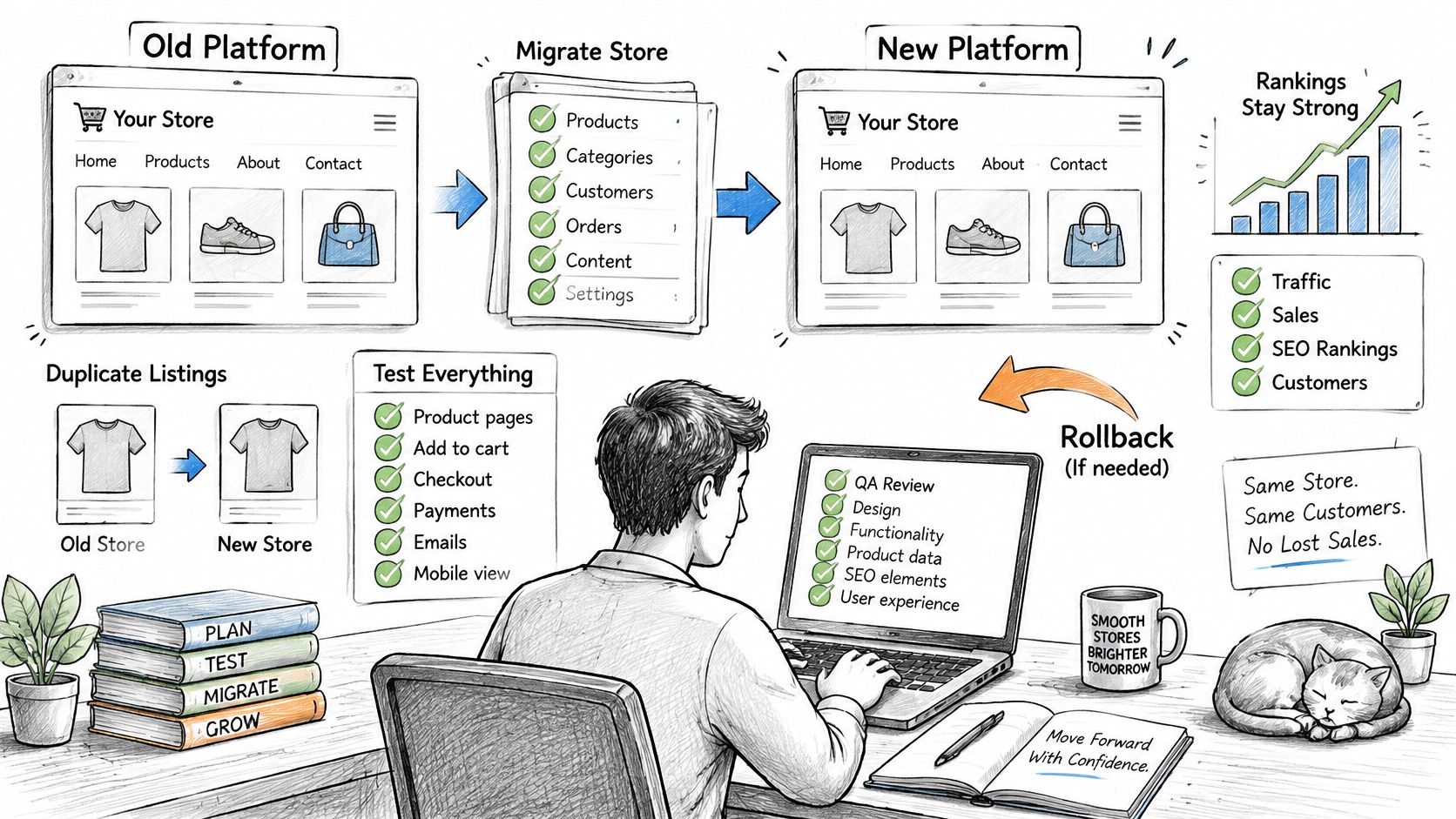
Treat the store as an always-on operation until the merchant has agreed a pause. Orders, open carts, inventory and indexed URLs keep moving while the new site is built. WebinOne migration should be staged and tested before and after cutover, with a named rollback trigger and owner. TeamOne migrates sites from hosted site builders and self-built CMS installs. The procedure matters more than the source system.
Staged Migration Procedure
- Inventory everything: Record products, customers, orders, open carts, redirects and integrations, and agree the longest interruption the merchant will accept. Unknown integrations surface during cutover unless they are found first.
- Map every URL: Match each product, category, content and checkout URL to its new address and confirm redirect coverage. Preserve the existing domain structure where possible.
- Build staging: Run real test payments and tax calculations through checkout using representative products, discounts, shipping rules and customer accounts.
- Compare crawls: Check old and new sites for indexability, canonicals, sitemaps, internal links and structured data. A detailed site migration SEO checklist turns that comparison into sign-off criteria.
- Freeze and sync: Freeze catalog and content, then run a final delta sync of orders, customers, inventory and open carts. Count records before and after, and reconcile totals.
- Validate release controls: Confirm payments, tax and DNS preparation. Name who can authorize rollback and what evidence triggers it.
- Cut over under observation: Watch orders, payment errors, server errors and 404s live. Test refunds, order status changes, fulfillment exports and customer account access, not only purchase.
- Monitor for weeks: Track organic sessions, rankings, crawl errors and conversion by template after launch. Early stability does not prove search recovery.
Worked Example With Live Carts
A merchant with several thousand products and customers holding live carts during a promotion faces a data decision that is harder than the design decision. If both systems accept orders without reconciliation, staff must merge customers, stock and order numbers by hand, and customers may see missing orders.
A brief checkout pause can be safer than running two systems. The pause gives the delta sync a clean endpoint, so final orders, inventory and carts land once. That choice depends on order volume, promotional timing and sync reliability. The merchant must approve it before anyone books a cutover date.
Decision point: Define the maximum tolerable interruption, the rollback trigger and the checkout pause rule before a cutover date is booked.
Put redirect coverage, indexability, structured data parity and post-launch traffic monitoring in the same sign-off as data counts and payment tests. Ranking recovery then has the same owner, the same evidence and the same go or no-go call as sales protection.
Confirm Reseller Fit Before Your Next Migration
A reseller arrangement fits when the agency can manage the client relationship, delivery work and ongoing site operations under its own brand. WebinOne is a white-label digital experience platform, and its Reseller Program gives agencies a way to build, host and manage client sites in one system. The Partner Agency tier includes a customizable commission on top of plan pricing for directly billed sites.
Partner and Partner Agency members also get one free website on the highest plan for their agency's own business website. That website is not intended for use as an ecommerce shop. Treat this benefit separately from the plans and services needed to deliver client stores.
AI, Limits and Brand Control
AgentOne is WebinOne's managed AI for designing, building and managing sites inside the platform. Agencies should define which tasks it may handle and what staff must review before changes reach production.
Scope unusual catalog rules, marketplace requirements and custom integrations before quoting a merchant. Ecommerce plans have no transaction fees and unlimited sales volume, but that does not make custom implementation work disappear. Put the required behavior, ownership and acceptance criteria in writing.
The WebinOne team helps set up the white-label portal and migrate existing sites when needed. Agencies can then provide design, migration, merchandising and ongoing improvement under their own brand. Confirm how the portal will be branded and which migration tasks are included before setting the client's delivery scope.
Five-Step Fit Check
- Count upcoming work: List the sites the agency expects to build or migrate, then estimate the hours needed to operate each one.
- Price the operating model: Compare those hours with the relevant content and ecommerce plans. Ecommerce plans are added to a selected content plan, and are required to accept payments.
- Set brand treatment: Decide which clients will be served under the agency's brand and which will remain direct.
- Plan setup: Confirm portal configuration and any required site migration with the WebinOne team.
- Set the decision criteria: Compare the first migration candidates with the agency's delivery capacity, client responsibilities and ongoing service model.
A good fit is measurable: the agency knows which sites will move, who owns each operational task, and how the branded portal supports the client relationship. Use those criteria to decide whether to begin a migration wave and what must be agreed before any store is scheduled. The WebinOne reseller program is the program for agencies considering that operating model.