Ecommerce Web Development: The Agency Migration Playbook
Most agencies don't need more features. They need fewer dependencies, because complexity is where margin goes to die. When a store breaks after a plugin update or a payment flow slips on a device you didn't test, the agency is the one on the hook, and that support time rarely bills cleanly.
That's why ecommerce web development should be judged as an operating model, not a build project. Global retail online sales reached about $5.9 trillion in 2023, equal to 22.5% of total retail sales worldwide, up from 14.3% in 2020 (global ecommerce statistics). With 5.3 billion internet users in 2023 and 66% penetration, stores have to serve far more devices, markets, and connection conditions than they used to (global ecommerce statistics). That pressure changes the job: the platform has to reduce risk, not create new kinds of work.
Table of Contents
- The Hidden Cost of Ecommerce Complexity
- Headless Architecture versus Traditional Stacks
- The Essential Integration Stack
- Performance and Security Requirements
- Why Agencies Migrate Away from Open Source
- Choosing the Right Platform Partner
The Hidden Cost of Ecommerce Complexity
A store with five integrations doesn't feel expensive on the proposal. It feels expensive when a checkout field stops validating, a script update breaks product pages, or a client asks why a staff member spent half a day rechecking forms after a minor release. Most agencies don't lose margin on strategy, they lose it on the accumulated cleanup around every dependency.
Fewer dependencies, fewer fires
The hidden cost isn't the license line item. It's the patching, the emergency fixes, the compatibility checks, and the people hours that vanish into “just one more change” before launch. If a platform needs constant intervention to stay stable, it's not supporting delivery, it's consuming delivery time.
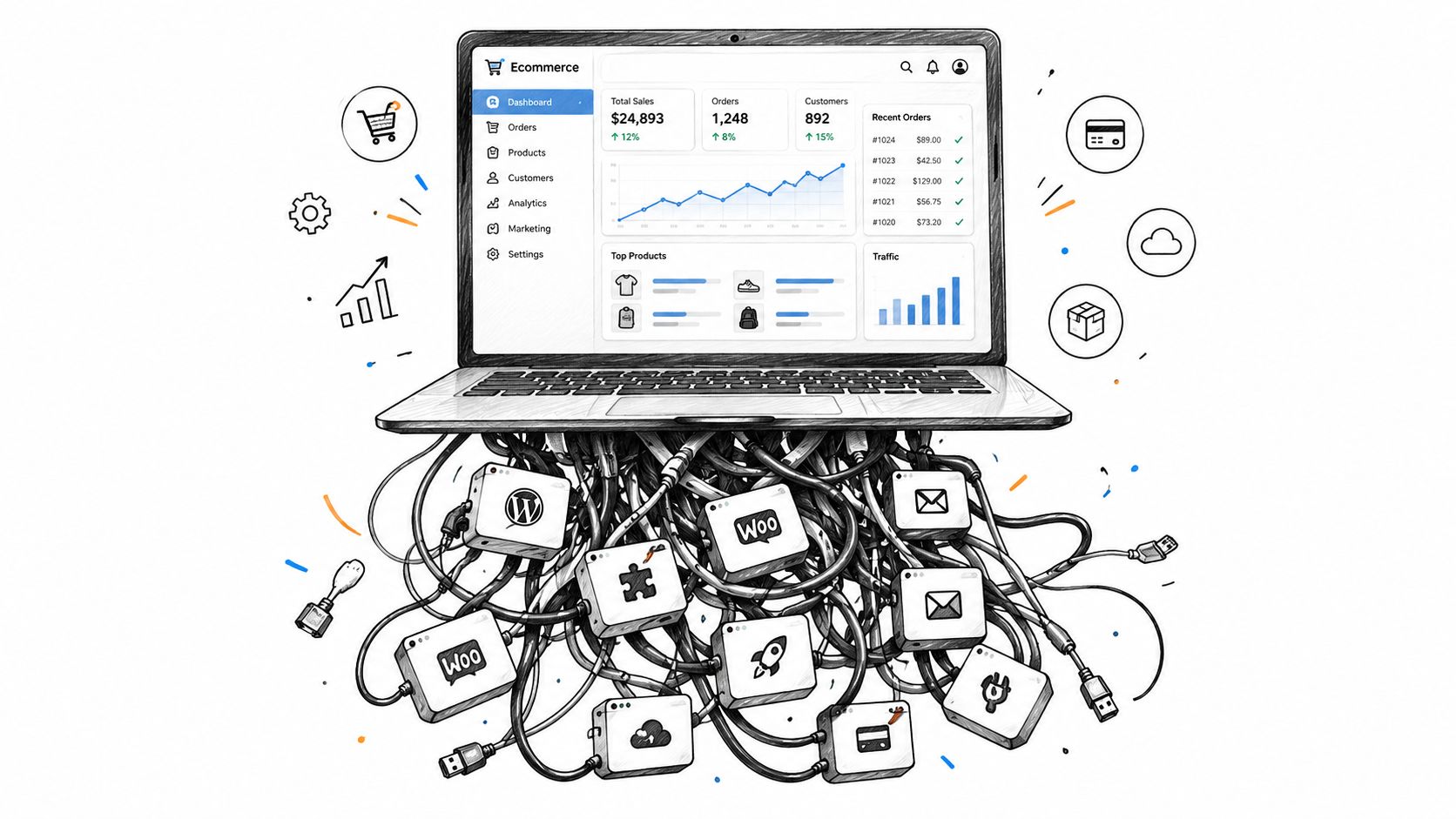
The operator's test is simple. If a team can't explain who owns each dependency, who checks it, and what happens when it fails, the project is already drifting toward unpaid maintenance. That's why agencies outgrow fragmented stacks so often, the work shifts from building revenue-generating capability to defending a brittle setup.
Practical rule: if a client store can only survive because one developer remembers how every part fits together, that store is already fragile.
A better platform shrinks the blast radius of change. It gives an agency a path to launch, maintain, and extend stores without turning every release into a risk event. That's the core benchmark, not how many add-ons a site can tolerate before something snaps.
Headless Architecture versus Traditional Stacks
Architecture is a business decision disguised as a technical one. Headless commerce separates the customer-facing frontend from backend systems such as checkout, inventory, payments, and security, and those layers communicate through APIs so teams can change one side without forcing changes to the other. That separation matters because it changes how fast a team can adapt without rebuilding the whole store.
For agencies, the central question is margin. A traditional stack can be faster to launch for a simple catalog, but it often ties presentation, business logic, and platform limits together in ways that make later changes expensive. Headless architecture gives you more control over what gets rebuilt and what stays in place, which matters when you are managing client growth instead of one-off builds. For a clearer breakdown of that split, see our guide to headless architecture.
The market direction is hard to ignore. One industry summary says 73% of businesses use headless architecture and 98% of non-users plan to evaluate it within 12 months, and it projects the market will grow from $1.74 billion in 2025 to $7.16 billion by 2032, at a 22.4% CAGR (headless commerce architecture summary). That does not mean every store needs it, but it does show where operational expectations are heading.
Where headless earns its keep
Headless makes sense when the agency is handling multi-brand estates, omnichannel delivery, or a roadmap that will outgrow a single front end quickly. In those cases, the value is avoiding a second migration before the first project has settled. Traditional stacks can work for simpler stores, but they tend to become the point where future change slows down.
The question is whether the client needs composability, governance, and API-driven extensibility now, or whether the complexity of integration would just replace one maintenance burden with another. Agencies that answer that question protect margin, because they stop selling migrations as temporary fixes.
A stack should let a client add channels, brands, or workflows without forcing a rebuild every time the business gets more serious.
That is why architecture should be judged by replatforming avoidance. If a choice today only buys 18 months before the next upheaval, it has not solved anything, it has only postponed the pain.
The Essential Integration Stack
The essential ecommerce stack usually comes down to four things, payments, catalogs, CRM, and analytics. The mistake is treating them as separate “features” instead of one operating surface. When every function lives in a different dashboard, the agency spends its time reconciling data, hunting mismatches, and explaining why one report doesn't agree with another.
A managed system changes that. Data flows more cleanly, support has fewer handoffs, and the team spends less time stitching together vendor behavior. That matters even more when the store has multiple markets or multiple editors, because each extra integration is another place where permissions, scripts, or sync jobs can fail.
What a unified stack changes
A unified approach doesn't just reduce setup work. It reduces the maintenance burden that comes from keeping multiple systems aligned after launch. Orders, customer records, and product updates stay easier to govern when they're part of one managed environment instead of a chain of loosely connected services.
For teams that need a practical reference point on API security, defending APIs with DevArmor is worth a look, because ecommerce integrations are only as reliable as the controls around them. That's especially relevant when custom endpoints handle customer or checkout data, since a weak integration layer becomes an operational problem fast.
The integration test agencies should use
Before approving an integration plan, ask whether the system can answer these questions without manual cleanup:
- Does the payment flow stay consistent: If payment states don't match order states, the store creates support tickets instead of revenue.
- Does catalog data stay synchronized: If product content drifts across systems, merchandising and SEO both take a hit.
- Does CRM data land where the team works: If contacts and cases are scattered, follow-up becomes guesswork.
- Do analytics reflect the true funnel: If reports need spreadsheet repair, decision-making slows down.
Explore ecommerce integration services if the current stack keeps forcing manual reconciliation. The point isn't to add more software, it's to keep the store coherent enough that support and marketing can trust the same data.
Performance and Security Requirements
Ecommerce performance needs hard thresholds, not loose intentions. Core Web Vitals give agencies a baseline that is easy to brief and hard to dispute, Largest Contentful Paint at 2.5 seconds or less, Interaction to Next Paint at 200 ms or less, and Cumulative Layout Shift at 0.10 or less. Those targets force teams to plan around latency budgets, not feature wish lists.
Pre-launch verification checklist
A launch is ready when the load path, script behavior, and checkout flow hold up under real traffic patterns. Teams should verify what is loaded, when it loads, and whether anything on the page shifts or blocks interaction.
| Metric | Target Threshold | Verification Method |
|---|---|---|
| Largest Contentful Paint | 2.5 seconds or less | Real-user monitoring plus browser-based testing |
| Interaction to Next Paint | 200 ms or less | Interaction testing on product and checkout pages |
| Cumulative Layout Shift | 0.10 or less | Visual stability checks during load |
| Total page weight | Near 750 KB, agency budget target | Asset audit before release |
| First-party JavaScript | Around 170 KB gzipped, agency budget target | Bundle review and pruning |
| Third-party scripts | Three or fewer per page, agency budget target | Script inventory and dependency review |
The practical steps are blunt. Compress and defer noncritical assets, remove unused JavaScript, load payment and review widgets only when needed, and test on real devices instead of trusting one clean lab run. For agencies that need a working reference point, review performance optimization practices before launch. Performance problems usually show up at checkout first, where small delays become support tickets and abandoned carts.
PCI has its own mandatory standards. PCI DSS version 4.0.1 introduced 64 new requirements, with 51 future-dated requirements that became effective on 31 March 2025. For ecommerce environments, requirements 6.4.3 and 11.6.1 target e-skimming risk by requiring payment page scripts to be authorized, integrity-checked, and monitored for tampering (PCI Security Standards Council guidance).
Agencies that treat performance and PCI as acceptance criteria protect conversion and reputation at the same time. The alternative is familiar, a client blames slow pages, payment friction, or checkout tampering, and the agency owns the cleanup.
Why Agencies Migrate Away from Open Source
The migration story usually starts the same way. A site grows, plugins multiply, one developer becomes the keeper of the setup, and then a routine update turns into a weekend of damage control. The platform didn't fail all at once. It became expensive by inches.
The point where maintenance becomes strategy
At some stage, agencies stop talking about “site improvements” and start talking about who owns the maintenance burden. That shift usually happens after too many patch cycles, too many break-fix tickets, or too many late-night rescues on a live store. It's not just a technical annoyance, it's key-person risk, because the knowledge of how the stack works sits with one or two people.
The relief comes from migration, but the reason behind the migration is operational. Thousands of sites have already been migrated, including complex live sites and sprawling builds that had accumulated years of plugin bloat and custom code. That scale matters because it proves the work isn't limited to clean-room projects. It can rescue real production systems without treating the client's business as a test case.
What agencies are really escaping
They're escaping the unpaid chore of carrying infrastructure maintenance inside a services business. They're also escaping the sales ceiling that comes from spending senior time on patching instead of strategy, content, SEO, analytics, or new revenue work. The more a team is stuck keeping the old stack alive, the less room it has to upsell meaningful work.
Migration, at its best, is a reset of operating discipline. It moves the client onto a platform where hosting, upgrades, and native extensions aren't constantly pulling the agency back into firefighter mode. That changes the economics of the account.
Operational rule: if a client portfolio keeps producing surprise maintenance work, the platform is already taxing margin more than it is supporting growth.
That's why the best migration conversations aren't framed as a rebuild. They're framed as a way to stop carrying a brittle setup and start selling work that actually grows the account.
Choosing the Right Platform Partner
The wrong choice here isn't always a bad build. Sometimes it's a build that can't scale economically, can't be governed cleanly, or needs another migration before the business case has matured. The platform partner has to solve for launch, but also for what happens when the store portfolio gets bigger, the support load increases, and the agency needs to preserve margin.
A fragmented stack gives control at the cost of coordination. A custom in-house system gives flexibility at the cost of ownership. A managed DXP gives the agency a shared operating layer, but only if it's built to stay stable as the client grows. That trade-off is where most buying decisions should be made.
What to compare
- Fragmented open-source stacks: These often start cheap on paper, then become expensive in maintenance, upgrades, and support handoffs.
- Custom in-house builds: These give a team full control, but the agency inherits everything, including hosting, security, and long-term upkeep.
- Managed DXP platforms: These reduce coordination work by centralizing the things agencies usually have to stitch together themselves.
The strongest option is the one that removes forced migrations and keeps the agency from rebuilding the same account every few years. Predictable pricing matters too, and WebinOne publishes pricing from $10/month per site, includes zero transaction fees on ecommerce, and runs on AWS across six global regions with a 99.99% uptime record and a 99.95% availability commitment in its published SLA. It is also an AWS Partner, has passed the AWS Foundational Technical Review, holds the AWS Qualified Software designation, and is enrolled in the AWS Software and Services Paths.
That makes the next step straightforward for agencies and systems integrators that are tired of upgrades, security patching, and scaling limits. The right move is a conversation about partnership or migration, not another short-term fix.
If the current stack is draining margin, the fix isn't another patch cycle, it's a platform that reduces operational drag and gives the agency room to grow accounts properly. WebinOne brings ecommerce, multi-site management, CRM, and managed operations into one system built for agencies and delivery teams that need fewer moving parts. Visit WebinOne to start a conversation about partnership or migration.