Digital Experience Platform: A Buyer's Guide

The week before launch, the only developer who understands the legacy stack gives notice, taking the migration script and the admin passwords with them. A feature grid cannot score that risk. Documentation, testing, patching, billing and support either live inside the platform and the contract, or they leave with the person. Judge a digital experience platform by who still owns the estate after that resignation. WebinOne is built for that test.
Table of Contents
- What a Digital Experience Platform Is For
- Capabilities One Platform Has to Hold
- Coupled Sites and a Headless API Together
- Site Builders and Enterprise DXPs Compared
- White-Label Delivery and Agency Margin
- Migration That Ends Key-Person Risk
- AI That Stays Inside Platform Controls
- Start a Reseller or Enterprise Conversation
What a Digital Experience Platform Is For
One publishing stack serving many clients changes what a buyer has to verify: who holds the documentation, who tests each release, and who owns the outage when the original builders have moved on. WebinOne, developed and supported by Upgrade Parade, is built for that handover.
Feature grids measure what a vendor ships. They stay silent on the work that decides whether an estate survives its builders: documenting custom code, rehearsing a cutover, reconciling customer records, answering a support call at midnight. A shared-infrastructure buyer checks those four items before comparing price.
Market context without false precision
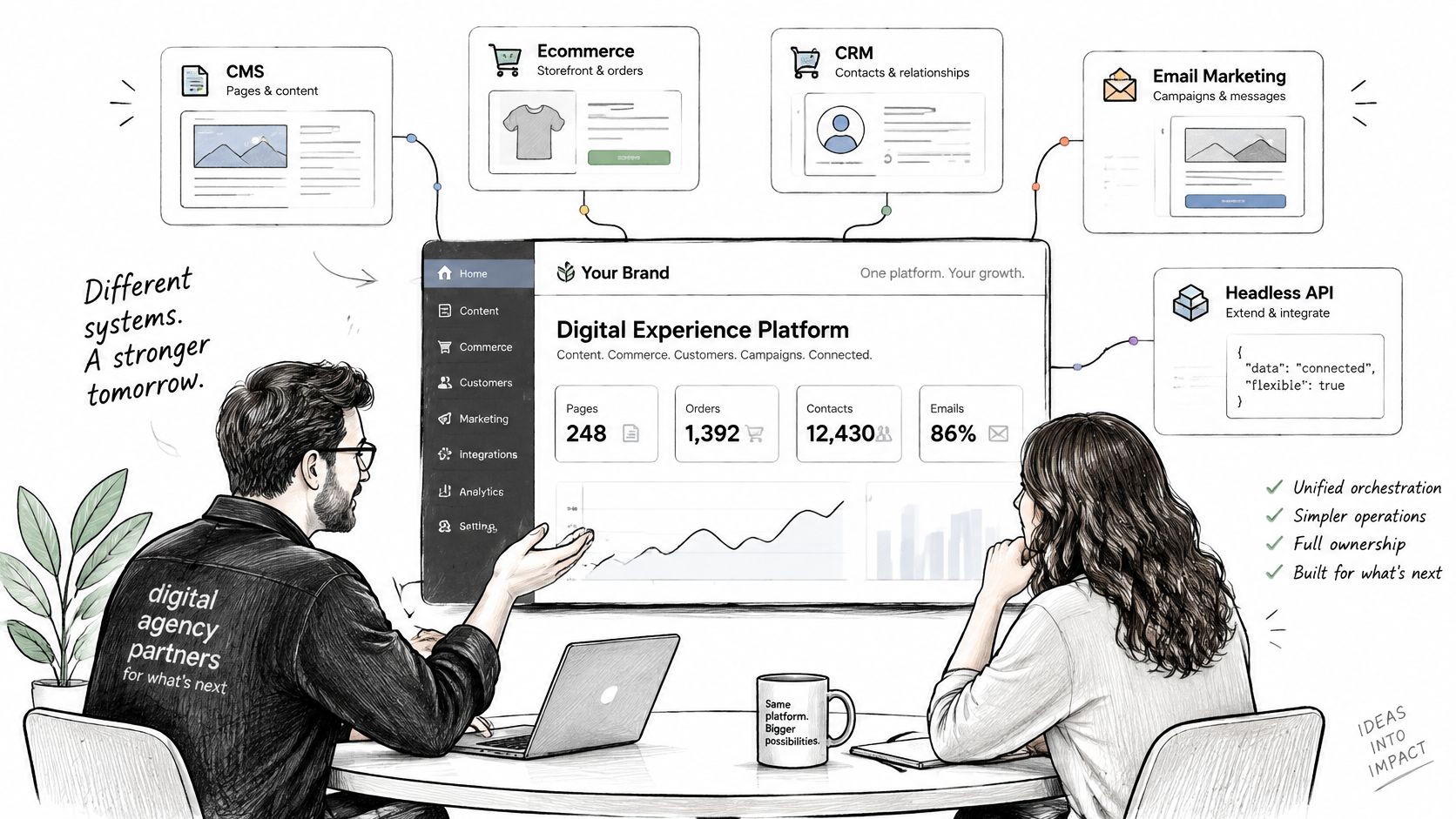
Grand View Research estimated global digital experience platform revenue at USD 12.39 billion in 2023 and projected USD 30.41 billion by 2030, a compound annual growth rate of approximately 13.7% from 2024 through 2030. Other firms publish different totals because category boundaries run into content management, customer experience, marketing automation and commerce. Those differences don't cancel the signal: organizations keep consolidating isolated publishing tools into systems that hold content, customer records, transactions and several channels together. For an agency, the operating decision that follows is to consolidate client sites onto one platform while the portfolio is still small enough to migrate deliberately, since every site added to a fragmented stack raises the eventual cost of leaving it.
Two buyers face that shift directly. Agency owners want larger projects at better margins while maintenance hours stay flat as the portfolio grows. Systems integrators and enterprise web teams want to stop carrying upgrades, security patching and hosting for every estate they touch. A scorecard that tests ownership serves both. When the platform documents the build, tests the releases and takes the midnight call, the partner's hours go to the next project. When it does the opposite, the agency ends up brokering between vendors and paying for that coordination itself.
Capabilities One Platform Has to Hold
A digital experience platform earns the name only where one system answers the requirement directly. Five vendors and five contracts around a single client relationship leaves the partner coordinating between all of them. WebinOne holds content, commerce, customer records, email and delivery APIs in one managed platform, and each row below is something the platform itself owns.
Scoring rule: A capability counts only when the platform owns the data, the interface and the maintenance burden for that capability.
| Buying requirement | What has to be true | How WebinOne answers |
|---|---|---|
| Content and channels | CMS plus a headless API, not headless-only | Liquid CMS, modules, forms, blog, search, member areas, APIs and webhooks |
| Commerce | Catalog, orders and payments without a percent skim | Zero transaction fees; custom commerce scoped as a TeamOne project |
| Customer records | CRM in the same system as the site | Cases, contacts, custom fields and member activity |
| Portfolio control | Many sites, staff and brands in one console | Agency portal for templates, sites, staff, branding, billing and tickets |
| Extensions | No third-party plugin chain to patch | Native extensions developed and maintained by WebinOne |
| Run and residency | Managed hosting with a stated availability commitment | AWS across 6 AWS regions, 99.99% uptime, 99.95% availability commitment in the published SLA |
Content, commerce and customer operations
Content means more than page editing. WebinOne provides a CMS with Liquid templates, custom modules, forms, blog, search, member areas and SEO tooling, plus a headless API. Editors can run rendered sites while developers expose the same content elsewhere, so a scorecard can mark the rendering row and the API row against one product rather than two.
Commerce has to connect catalog, orders and payments to the same customer record that receives email and support. Any no-limits commerce claim carries a clear condition. Custom commerce work is scoped as a TeamOne project, which protects margin because unusual checkout, pricing or integration work gets estimated as a project instead of hiding inside support.
Customer operations belong beside the site, not in a disconnected list. The built-in CRM holds cases, contacts, custom fields and member activity. Email marketing sits in the same operating picture, and deliverability still needs discipline before campaigns scale. Teams that test email deliverability before a major send catch authentication and inbox problems while correction is cheap.
Portfolio control and the run layer
Portfolio control separates a digital experience platform from a single-site tool. The agency portal manages templates, sites, staff, branding, billing and support tickets in one dashboard, so staff access, client branding and site creation follow one operating model across the whole portfolio. Native extensions developed and maintained by WebinOne remove the third-party plugin chain that otherwise needs inventory, compatibility checks and patching on every site.
The run row needs evidence, not adjectives. Hosting is managed on AWS with selectable data residency, and a custom data center can be set up by agreement. WebinOne is an AWS Partner, has passed the AWS Foundational Technical Review, holds the AWS Qualified Software designation, is enrolled in the AWS Software and Services Paths and is available on AWS Marketplace. Architecture debates should start after those operating facts are on the table.
Coupled Sites and a Headless API Together
WebinOne renders complete sites while exposing the same content and commerce through APIs and webhooks, so coupled and headless delivery run on one platform. Client need picks the pattern. Most estates want rendered pages for discoverability and editing speed, plus API delivery for an app, portal, kiosk or partner-built front end.
Take a retailer running a public site and an in-store kiosk app. The public site earns its traffic through search, so it ships as Liquid templates that editors update in the On-Site Editor, with forms, search and redirects handled by the platform. The kiosk shows the same catalog and promotions inside a custom interface, so it pulls them through the platform's 300+ APIs. Both channels run on one content model and one staff permission model, and a price change or a new landing page reaches each channel without a second publishing step.
Splitting those jobs across two products creates duplicated models, duplicated staff rules and templates that drift apart. A detailed explanation of what a headless API does helps separate delivery method from content ownership before you scope a build like this.
Deployment comes second. The managed platform runs in WebinOne's AWS account. For qualifying systems integrators, a licensed version running in the integrator's or customer's own AWS account is available by agreement, including AWS GovCloud for government projects. The delivery pattern stays identical either way, which keeps the question of who owns the estate after launch separate from the question of where it runs.
Site Builders and Enterprise DXPs Compared
An agency running forty client sites on a hosted site builder pays for each one separately. Separate subscriptions, separate logins, separate renewals, and no shared template when the same change has to reach all forty. That is the comparison that matters: what each category asks the buyer to own after launch.
| Category | Typical fit | Who carries day-to-day operations |
|---|---|---|
| Hosted site builder | One site with visual editing and a small page set | The agency, site by site: separate accounts, renewals and updates per client |
| Enterprise DXP suite | Large organizations with platform teams and multi-year programs | The customer's platform team runs the suite |
| WebinOne | Agencies and integrators running many client sites under their own brand | Managed platform: WebinOne maintains extensions, forms and hosting |
A hosted site builder suits one marketing site where resale, many brands and deep customer operations aren't part of the job. An enterprise suite suits a large organization with a dedicated platform team and a long implementation program. Neither is wrong on its own terms. The difference is who absorbs the work after go-live.
We built WebinOne for the case those two categories skip: agencies and integrators running many client sites that need CMS, Ecommerce, CRM, forms and hosting held in one place, with no plugins to maintain. Evaluate any category the same way. Count the contracts, upgrade paths and maintenance queues that remain after launch, then name the team that carries each one.
White-Label Delivery and Agency Margin
WebinOne is built to be resold under the agency's brand, so clients see the agency's platform relationship rather than a third-party login. That structure changes the commercial offer. A reseller can sell the build, the platform the site runs on and care after launch as one monthly relationship instead of a project followed by scattered invoices.
Margin is the gap between monthly client revenue and the cost of keeping the site running. That cost has two parts, the platform fee and agency hours. Platform fees are visible. Hours often slip away through patching, retesting after updates, fixing extension conflicts, and handling security incidents across self-hosted or managed open-source portfolios.
Count the hours before pricing the retainer
- Patching load: Count monthly hours spent applying updates and checking affected sites.
- Retesting load: Count forms, checkout, search and member flows checked after each change.
- Incident load: Count investigation, cleanup, client calls and evidence after security events.
- Coordination load: Count vendor tickets, hosting questions and license renewals handled by agency staff.
That total is the workload a managed digital experience platform has to remove. WebinOne's native extensions are maintained by WebinOne, and templates, staff, branding, billing and tickets sit in one agency portal. A plain overview of the benefits of white label software clarifies why brand control matters, but the financial case still depends on hours removed. Practical reseller mechanics are covered in the guide to becoming a white-label website reseller.
Pricing starts at $10/month per site. Partners work with WebinOne from 16 countries, and paid partner support forms part of the arrangement rather than leaving agencies to a community forum. Current wholesale terms sit in the WebinOne reseller program. The commercial test isn't the starting price alone. It's whether recurring platform revenue survives after the agency stops donating maintenance hours to every client site.
Migration That Ends Key-Person Risk
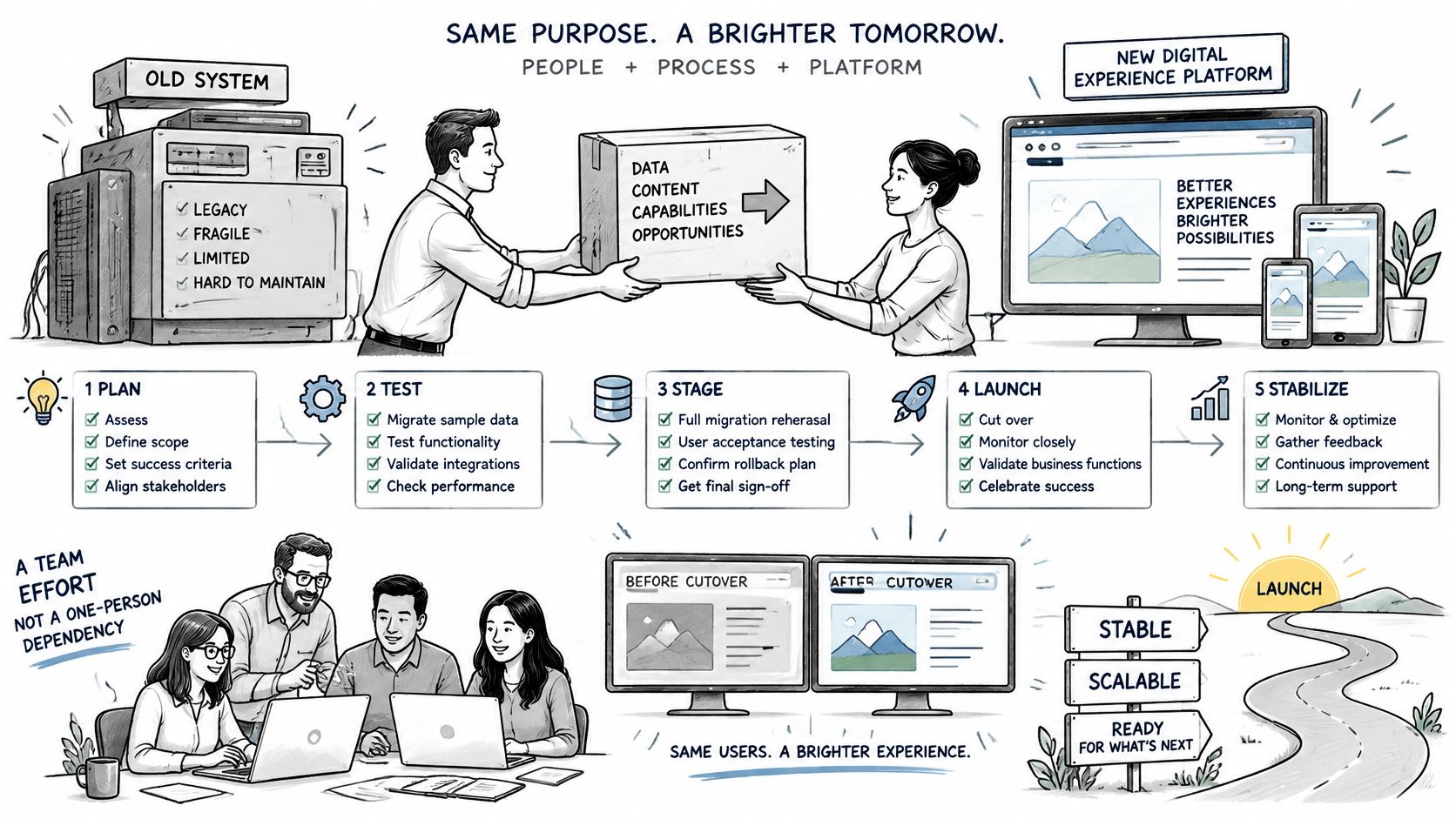
WebinOne migrations are handled as a TeamOne job, staged and tested before and after cutover with downtime kept to a minimum. That ownership matters because many estates depend on one person who remembers why a form posts to an old endpoint, which custom code block prices an order or where member data was patched. A successful launch that preserves that dependency hasn't modernized anything.
The 2025 Ensono survey of 500 IT and business leaders in the United States and United Kingdom found that 9 in 10 organizations had at least one talent gap obstructing modernization. Cloud architecture and migration expertise was the most common gap, reported by 27% of respondents, and 49% said the cost of maintaining legacy systems had been higher than expected during the previous year. Those findings explain why migration capability deserves more weight than feature parity. Scarcity sits in operational knowledge, not page templates.
A migration sequence that transfers control
- Inventory everything: List every page, module, custom code block, form, integration and data set.
- Document purpose and owner: Record what each item does, who relies on it and what breaks if it disappears.
- Map and reconcile: Move content and data into the target model, then reconcile record counts and critical field values.
- Build and test before cutover: Test templates, forms, checkout, search, member access and redirects on the new site.
- Cut over in stages: Use a defined rollback path and verify production behavior after each stage.
- Hand over operations: Deliver documentation and confirm who owns support, changes and escalation after launch.
That sequence follows the discipline in a sound platform migration strategy, with one addition. Documentation isn't a closing artifact. It starts during inventory, while the people who know the estate can still correct the record.
Time to launch is a weak buying metric when the new estate still depends on the same undocumented knowledge as the old one.
WebinOne has migrated thousands of sites. US and Australian government clients use the platform for secure, compliant web presence, and systems integrators use WebinOne as the platform layer in enterprise and government projects. One case study records David's assessment: "The solution solid and stable under heavy spikes from national ads, but they also went beyond that to create an easily manageable interface with the admin". Stability matters, but manageable administration is the point. Control has moved from memory into a documented platform and a named delivery process.
AI That Stays Inside Platform Controls
AgentOne is WebinOne's managed AI. It designs, builds and manages sites inside the platform, and it accelerates TeamOne delivery. A typical task runs inside the same controls as any other platform change: a content update is drafted, held for review, and published only after approval. Changes stay visible, reviewable and reversible before they reach production.
That boundary protects accountability. The KPMG 2025 U.S. board survey identified data inaccuracy as the leading generative-AI concern at 48%, followed by reputational risk at 39% and cybersecurity at 35%. Generated output can be fast and still be wrong, off brand or impossible to reconstruct after publication. The review path matters more than the generation speed.
Judge the change path, not the demo
- Draft first: Does the change wait for human review before production?
- Version held: Does a restorable version exist before publication?
- Reversal clear: Can a published change be reversed?
- Boundary visible: Did the agency set the limits for the work?
- Activity recorded: Can a reviewer see what changed?
Every WebinOne project is tested on every browser and platform before delivery, and that discipline carries more weight as AI increases the volume of changes awaiting review. Responsibility stays with the operator. The Platform User remains solely responsible for Custom Agents, their configurations and any output they generate, including results delivered to Clients and End Users. For regulated enterprises and government teams, that allocation should be settled in writing before AI touches content, commerce or customer records. When the people who understood the old stack leave, the platform and its change record are what remain. Review and reversal are the buying test.
Start a Reseller or Enterprise Conversation
The next step splits by who owns the estate after launch. Agencies that resell take one path; systems integrators, AWS partners, enterprises and government teams take another. Wholesale resale, portfolio migration and licensed AWS delivery carry different commercial and operating commitments, so the conversation starts differently for each.
Agencies ready to offer clients a fully branded platform should apply through the WebinOne reseller program, where wholesale terms are set out. As a Platform User, your agency resells the Services to third parties under its own login and admin branding, and our team helps set up the white-label portal and migrate existing sites if needed. The Agency Portal then keeps templates, sites, development, staff, branding and billing in one dashboard, so the question of who runs the estate day to day has a concrete answer.
Systems integrators, AWS consulting and ISV partners, and enterprise or government web teams should start at WebinOne Enterprise. That conversation covers multi-site governance, movement off an open-source estate, and licensed deployment in an integrator's or client's AWS account by agreement, including AWS GovCloud for government projects. TeamOne can supply web development, design, migration and accessibility capacity, or take complete white-label delivery where the partner wants the build work off its books.
Careful vendor assessment also means reading independent product scrutiny in adjacent buying decisions, such as Suby's take on Deal Soldier, then returning to the operating scorecard. Agencies ready to own a branded platform file the reseller application. Integrators and enterprises ready to retire a fragile estate open the enterprise conversation.