Agency Management Platform: What It Is and How to Choose One
A client's site needs a small change before morning. The agency's owner is still checking updates across several systems, chasing an unanswered support ticket, and trying to work out whether the latest site change is safe to publish. The work is familiar. The problem is that too much of it happens outside the work the client is paying for.
That's when an agency management platform becomes a serious buying decision. The right platform isn't another dashboard to check. It's the operating layer that connects site delivery, client access, billing, support, and portfolio governance, and earns its place by reducing the cost of running each site.
Table of Contents
- The Night the Stack Finally Broke
- What an Agency Management Platform Actually Is
- The Core Capabilities That Actually Matter
- Why Profitability, Not Features, Should Drive the Decision
- Selection Criteria and Questions to Put to Any Vendor
- How WebinOne Fits the Agency Operating Layer
- Next Step for Agencies Looking to Make the Move
The Night the Stack Finally Broke
WebinOne gives agencies an operating layer for client delivery, not another place to manage tasks. When site operations, billing, support, and access are scattered, the cost shows up in staff time and missed client work.

A familiar agency scene: a portfolio spread across multiple platforms, a hand-built client portal, and a late-night maintenance task that can't wait until morning. One person is checking a site update, another is chasing a ticket, and the client still needs a clear answer. The failure isn't dramatic. It's operational: skilled people are spending paid working hours coordinating systems instead of moving client work forward.
That's the signal to examine the operating model, not just shop for a new content editor. A platform decision should answer whether the agency can bring more of the recurring work under one controlled system, with clear ownership and fewer handoffs. If a proposed solution adds a new console without removing an existing task or cost, it hasn't solved the problem.
The digital-agency sector is large and fragmented. Promethean Research counted more than 179,000 digital agencies worldwide, with more than 50,000 in the United States and Canada, and reported that the average agency employed fewer than 10 full-time people. The same report found 88% had fewer than 50 employees, while agencies averaged 12% annual growth over the preceding five years (Promethean Research's 2025 industry report). A small team may still be responsible for client sites, hosting, support, content changes, and recurring revenue. Its headcount is small, but the operational surface area isn't.
Operator's test: Don't ask whether a platform has more features. Ask which recurring tasks disappear after the move.
That's the purpose of an agency management platform: coordinate the delivery operation rather than merely document it. Agencies assessing consolidation can also use this guide to vendor consolidation to clarify which systems overlap and which responsibilities still need an owner.
What an Agency Management Platform Actually Is
WebinOne sits in the agency operating layer: the system that connects client sites, staff access, billing, support, and delivery under a console the agency controls. It goes beyond managing tasks or publishing content because it also addresses how the agency runs its portfolio.
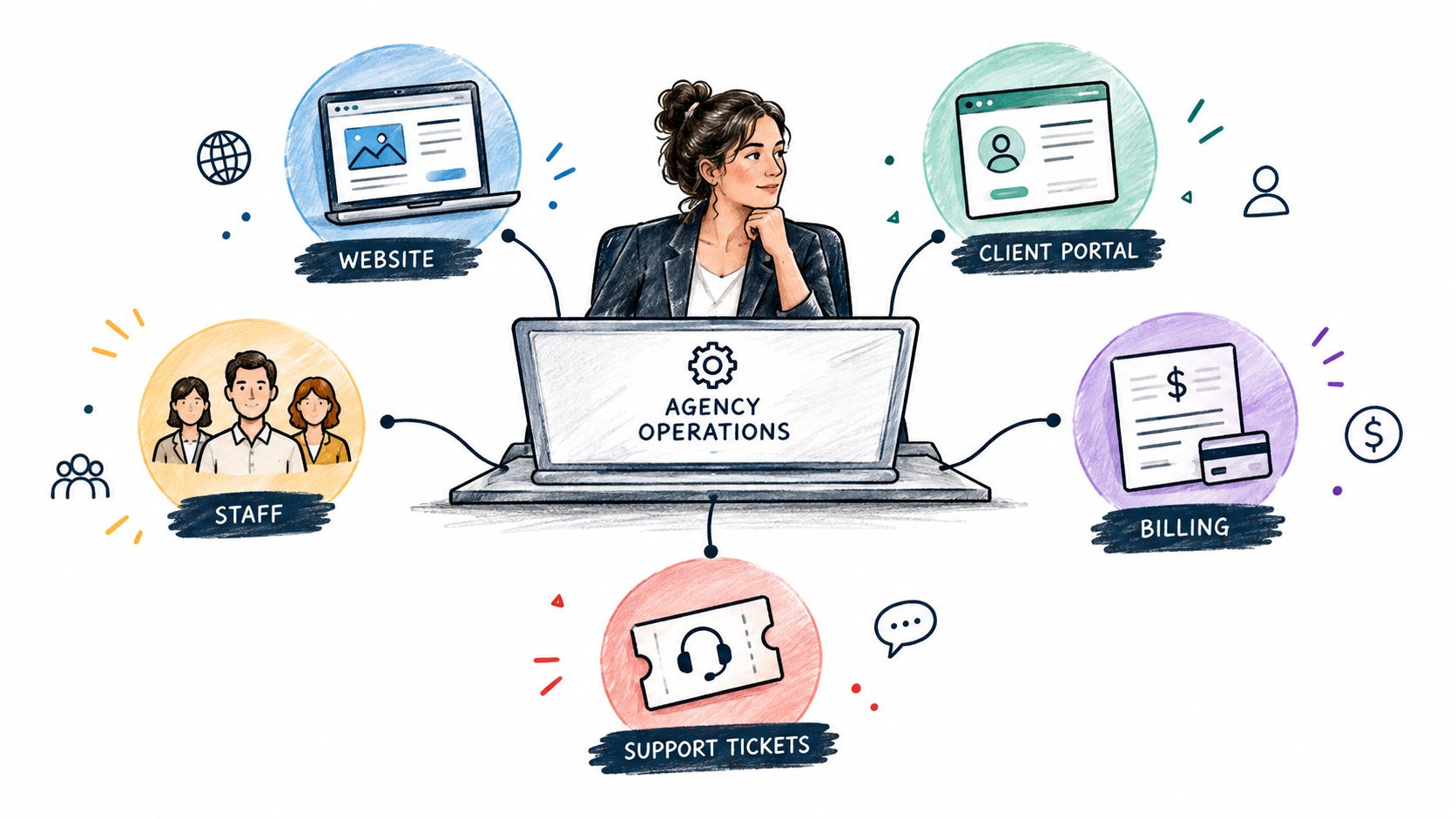
A CMS handles content and the publishing workflow, but it doesn't necessarily manage client billing, partner branding, or portfolio-wide access. A project tool tracks tasks and deadlines, but it doesn't host the client's site or govern changes to production. A generic enterprise DXP can consolidate digital capabilities, yet the agency still needs a way to package delivery, manage client relationships, and run sites under its own service model.
An agency management platform crosses those boundaries. It's an operating layer that ties the work and the client relationship together, while allowing the agency to decide what to standardize and what to keep specific to each account.
The operating layer, not another subscription
The category isn't just a site builder that the agency subscribes to on a client's behalf. Nor is it only a white-label label applied to a standalone product. The important distinction is operational ownership: can the agency provision and govern sites, manage team and client access, coordinate support, and handle billing from a system that fits how it sells and delivers?
An agency should also be wary of treating “all-in-one” as a result in itself. Consolidation is useful only when it removes duplicated work, clarifies accountability, or makes delivery easier to repeat. If billing remains separate, clients still send requests through scattered channels, and every update still needs manual coordination, the agency has moved the fragmentation.
A useful review starts by drawing the delivery path from client request to approved production change. Mark where someone hands work to another person, where staff switch systems, and where the agency must re-enter information. That map makes it easier to judge whether a platform owns a real part of the operating layer or only gives an old task a new interface.
The Core Capabilities That Actually Matter
WebinOne brings agency operations into one managed system, but a platform earns its place only when each capability replaces work that currently costs time. Judge the six capabilities below by what they remove from the workflow, not by the feature name on a sales slide.
White-labeling and billing
White-labeling puts the agency's identity on the client-facing admin and login experience. The business case is straightforward: the agency can own the relationship and present a consistent service rather than making clients use a vendor's separate interface.
Billing should let the agency define its service and pricing model, manage site-level charges, and understand its markup against platform costs. Ask for a live walkthrough of the billing flow, including what a client sees, what the agency controls, and what happens when a site or service changes.
Multi-site governance and reusable assets
Multi-site governance means shared assets can be managed centrally while site-specific work remains scoped to the right client. The agency needs to know which changes apply across the portfolio, which require approval, and how it can reverse a deployment if something goes wrong. Read more about multi-site management when mapping central control against local client requirements.
Reusable templates, modules, design systems, and content models help teams make consistent delivery repeatable. They only create value if they're versioned and governed, rather than copied between sites and gradually diverging. Agencies also need to decide which assets are safe to standardize and which are part of a client's distinct requirements.
Client access and integration
A client portal gives clients an appropriate view of their sites, tickets, and reports without requiring agency staff to act as couriers. Access needs to be role-based: a client should see what they need to review without receiving permissions that belong to the agency's delivery team.
A headless API and integrations let the agency connect content and commerce to other experiences and systems. That flexibility matters when a client needs a custom front end, but it shouldn't require rebuilding routine delivery workflows just to connect data.
Site delivery also needs a clear incident process. Agencies looking to make incident response and operational coordination more consistent can review how to streamline SRE workflows as a practical complement to platform selection.
Before signing, ask the vendor to demonstrate each capability using a realistic agency workflow. A polished feature list isn't evidence that the platform will remove work.
Why Profitability, Not Features, Should Drive the Decision
An agency running a large client portfolio loses margin in small increments: a plugin conflict here, a manual report there, a support ticket that pulls a senior developer off billable work. WebinOne should be judged on the delivery costs it removes per site. The number of tools it puts under one login is irrelevant if the administrative work stays the same.
The constraint shows up in agency economics. The 2024 Digital Agency Industry Report put average revenue per employee at approximately USD 172,000 in 2023 and described a typical 38-hour working week, including 25 hours of expected billable work and 13 hours of non-billable tasks (agency growth benchmarks). Those non-billable hours go to coordination, support, reporting, technical maintenance, and tool-switching. Repeated across a portfolio, small tasks consume the capacity that should fund client delivery.

The comparison is measurable delivery cost per site against another system to administer. Before committing, build a simple model from the costs the agency bears, and pressure-test the managed service pricing structure against expected site volume:
- Migration: discovery, content cleanup, rebuild work, and cutover planning.
- Hosting and licensing: recurring platform expense, then the agency's resale margin.
- Support labor: routine client requests, troubleshooting, and platform maintenance.
- Rework: duplicated work caused by unclear approvals, inconsistent templates, or failed changes.
- Plugin maintenance: where applicable, the agency's time to review, update, and resolve dependencies.
Consolidation only pays when work disappears
Scale alone doesn't produce better margins. Promethean Research reports that smaller studios under 10 employees averaged 19% net margins, while agencies with 50 or more employees averaged 8%; agencies that reduced their service mix grew 13% on average and reached 30% net margins (Promethean Research's agency industry analysis). Adding complexity doesn't improve profitability by itself.
Consolidation is the wrong move when recurring site volume can't justify migration, workflows are heavily customized, or delivery can't be standardized. In those cases the platform creates a new layer of administration instead of removing an old one. Agencies building a clearer view of their financial operations can see how MyOfficeOps helps agencies organize the numbers behind a platform decision.
Selection Criteria and Questions to Put to Any Vendor
WebinOne should answer the same hard questions as any platform under consideration. A vendor that can't explain data ownership, change control, support, and exit planning hasn't demonstrated a fit for agency operations.
Use these questions in the vendor conversation:
- Commercial terms and ownership: Who owns client data and assets? What can the agency export on exit, in what form, and what charges apply? How does pricing change as the portfolio grows?
- Operations and governance: Can the agency scope changes to a site, brand, or shared asset? Are audit logs available for approvals and production changes? If AI can modify a site, can the agency restrict its permissions, review its work, and reverse changes?
- Security and service commitments: What availability commitment appears in the published SLA? Who handles platform patching? Which hosting regions and data-residency options are available, and where is the public security information?
- Support and partnership: What support is included, what is paid, and how does escalation work? Who owns partner questions, and what does the vendor do when a production issue affects several clients?
- Migration: Has the vendor migrated portfolios and complex live sites? How are staging, cutover, validation, and rollback handled? Can the vendor provide references relevant to the agency's scale and delivery model?
Make software delivery measurable
A serious operating platform should expose delivery telemetry at the portfolio, site, and deployment levels, not just a general availability view. For example, teams should be able to record which site and client a change affects, which environment and version it uses, who approved it, when it was deployed, and whether an incident or rollback followed.
DORA defines deployment frequency, change lead time, failed-deployment recovery time, change-failure rate, and deployment rework rate as complementary indicators, and recommends reporting shared assets separately from local changes so a failed global template release doesn't distort every client's apparent reliability (DORA's metrics guidance). Ask any vendor to show how it records and reports those events, rather than accepting a generic dashboard as proof of governance.
For a broader view of how to find the right agency workflow tools, compare the agency's actual handoffs with the responsibilities the platform will take on. The deal-breaker isn't a missing minor feature. It's an unclear answer about ownership, support, recovery, or the ability to leave.
How WebinOne Fits the Agency Operating Layer
WebinOne combines agency-facing site operations in a managed system, with the agency controlling its branding and client delivery. The practical question is whether those capabilities match the agency's cost model and the level of governance its clients require.
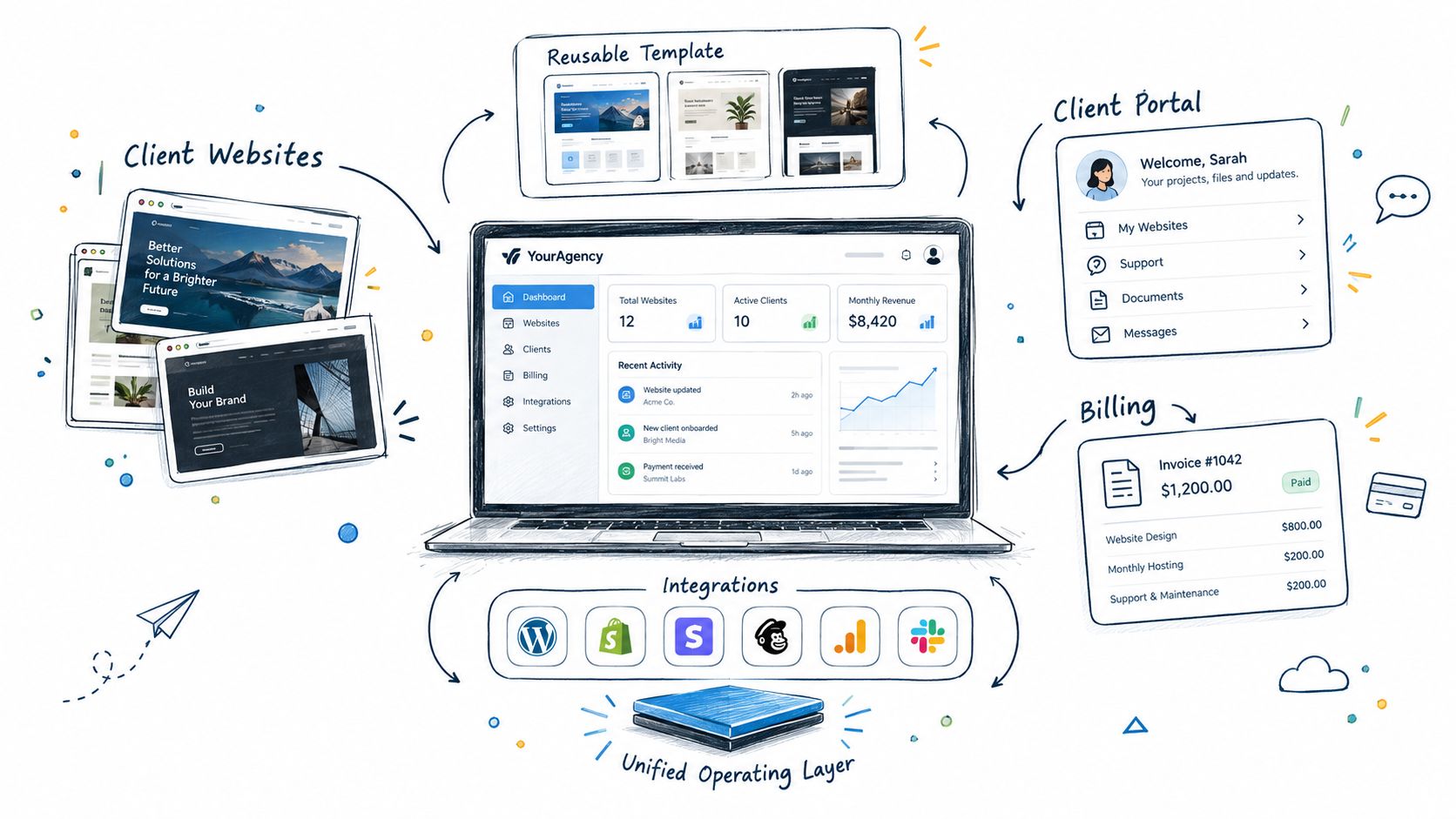
The platform brings CMS, ecommerce, CRM, email marketing, multi-site management, and a headless API together. Agencies can manage client sites through a white-label admin and login, organize reusable templates and modules, and handle portfolio operations through a centralized console. WebinOne starts at $10 per month per site, has zero transaction fees on ecommerce, and is hosted on AWS across six regions. It reports 99.99% uptime over the last 12 months and makes a 99.95% availability commitment in its published SLA.
Managed delivery, with room for AI
WebinOne's native extensions are maintained as part of the managed platform, reducing the agency's reliance on third-party plugin upkeep. For agencies adding AI to site operations, AgentOne builds and operates sites inside that managed platform. Its changes use scoped permissions and audit logs, and can be reviewed and reversed before affecting production. AI-assisted creation is not a substitute for governance. A vendor should show exactly who approves a change and how the agency can recover from one that doesn't meet the brief.
TeamOne supports migrations and delivery, including staged cutover and rollback planning. WebinOne has migrated thousands of sites and has partners in 16 countries. It has passed the AWS Foundational Technical Review, holds the AWS Qualified Software designation, is enrolled in the AWS Software and Services Paths, and is available on AWS Marketplace (WebinOne's platform and partner information). The platform also serves US and Australian government clients, and paid partner support is available.
For an agency, those claims matter only when they connect to the operating model: what work moves off the team, what the agency still owns, how client access is controlled, and how the migration is managed. The commercial test remains per-site economics, with the platform helping only if the managed system removes enough recurring effort to justify its cost.
Next Step for Agencies Looking to Make the Move
An agency management platform is the operating layer beneath client delivery. The right choice reduces measurable cost per site; the wrong one adds another system to administer.
Agencies ready to assess the fit can apply to the WebinOne reseller program or book a demo with an existing WebinOne partner. The next conversation should cover partner pricing, the agency's portfolio, and a practical migration plan, not a generic trial. Put the current workload and recurring costs on the table, then decide whether one managed system under the agency's brand can replace enough operational effort to improve the margin.