WP Engine Alternative: Best Managed Hosts for 2026
By Alex Yag
For agencies and systems integrators, the strongest WP Engine alternative is a white-label digital experience platform such as WebinOne, because it removes much of the patching and migration risk while preserving client branding. The practical decision isn't only about hosting price, but about who owns the operational burden, the client relationship, and the multisite workflow.
An agency can start with a managed WordPress account because the arrangement feels simple. Over time, each client adds a form extension, ecommerce integration, analytics script, custom theme change, or security exception. The agency still sells the project under its own name, but the underlying work becomes a chain of third-party dependencies that the agency has to explain, test, maintain, and sometimes repair.
Table of Contents
- Why Agencies Are Moving Off WP Engine
- The Hidden Cost of Managed WordPress Hosting
- Types of WP Engine Alternatives Available
- Comparison Between WP Engine, Headless Platforms, and WebinOne
- How to Evaluate Migration from WP Engine
- The Case for a White-Label DXP for Agencies
- When to Consider an Enterprise DXP Instead
Why Agencies Are Moving Off WP Engine
WebinOne gives agencies a route away from hosting management and toward platform ownership. It combines a white-label DXP with CMS, ecommerce, CRM, email marketing, multisite management, and a headless API, so the agency can offer a broader client platform instead of reselling a branded hosting layer.
The margin squeeze usually appears gradually. A project that looked profitable at launch starts consuming support time when an update changes a layout, a plugin conflicts with another extension, or a client wants a new brand site that doesn't fit the original plan. The agency may still invoice for some of that work, but unplanned maintenance erodes delivery capacity and makes fixed-fee work harder to protect.
A useful technical background resource is this developing for WordPress guide, particularly for teams documenting the maintenance decisions that accumulate around a WordPress estate. The important question for an agency isn't whether the CMS can produce a good site. It can. The question is whether the agency wants to keep owning every layer around that site.
The commercial problem is operational
An alternative should change the agency's operating model, not merely move the same maintenance work to another dashboard. WebinOne provides agency-branded login and administration, templates, sites, staff access, billing, support tickets, and client-facing branding under the agency's own identity. That lets the agency package a managed digital experience as its own service.
The distinction matters when an agency moves clients into larger engagements. A single website can become a multi-brand rollout, an ecommerce programme, a member area, an integrated CRM, or an API-connected front end. A platform that keeps those capabilities in one managed system gives the agency more room to define scope and recurring services without rebuilding the stack for every client.
Practical rule: If the agency still has to explain another vendor's limitations to the client, the agency hasn't fully taken control of the platform relationship.
WebinOne's published information describes pricing from $10 per month per site, with zero transaction fees on ecommerce, while custom ecommerce work is scoped as a TeamOne project. Agencies should still model support, migration, content transfer, and account management separately. The relevant comparison is total delivery effort, not the hosting line alone. The total cost of ownership guidance provides a useful framework for making that calculation.
The Hidden Cost of Managed WordPress Hosting
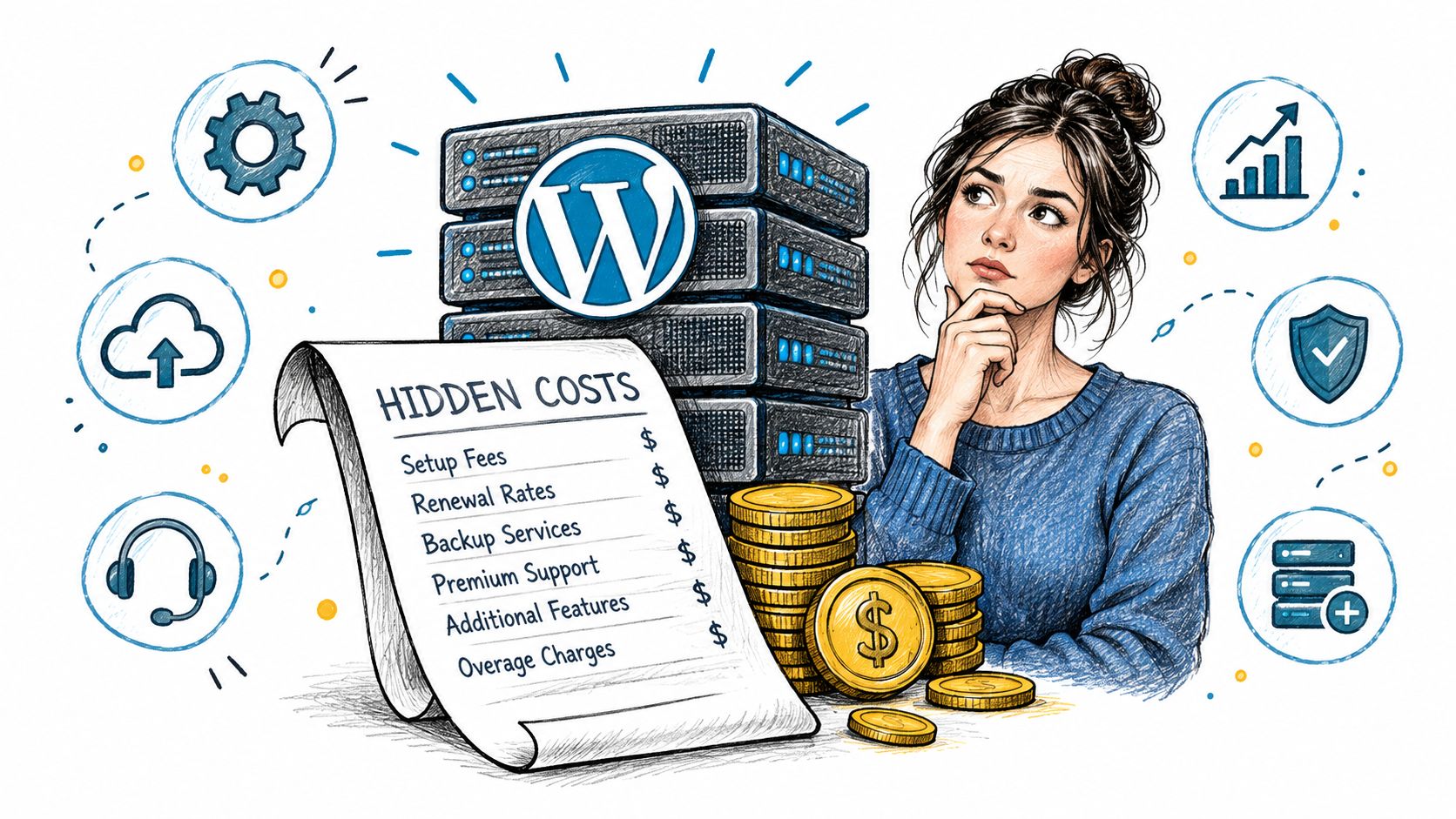
WebinOne addresses platform debt, not only server administration. A managed host may handle infrastructure while the agency still pays for plugin review, compatibility testing, content workflows, custom code, and recovery when an update disrupts the live site. The hosting invoice rarely shows those hours.
WordPress remains the largest CMS in the world. W3Techs shows it used by 48.6% of all websites whose content management system is known and ranked in the top 1,000,000 as of August 2026. That scale helps explain migration demand, but it also leaves agencies managing a broad mix of themes, extensions, integrations, and inherited operating habits. W3Techs tracks the platform's historical share, making the installed base visible without treating market share as a reason to ignore maintenance cost.
The maintenance invoice is rarely the full invoice
The direct hosting bill is easy to locate. The less visible cost appears in work such as:
- Patch assessment: Someone checks whether an update affects templates, forms, checkout, search, tracking, or custom integrations.
- Conflict investigation: When extensions or theme changes interact badly, the agency reproduces the issue and chooses between rollback and repair.
- Security response: Teams need a process for disclosure review, patching, validation, and rollback, rather than a one-time checklist.
- Scale planning: A campaign, product launch, or content release can create infrastructure work outside the original scope.
- Client communication: The agency explains the cause and impact even when another vendor supplied the failing component.
For a broader view of modernization economics, see the Software Modernization Intelligence guide, which frames platform debt as a modernization problem rather than only a hosting problem.
Patchstack's 2026 state report records 11,334 new WordPress vulnerabilities disclosed in 2025, with 91% found in plugins, and says 46% did not receive a fix from the developer in time for public disclosure. Those figures make plugin governance a concrete operating concern for agencies managing large estates. The report is available in the State of WordPress Security in 2026.
Native capability changes the work
WebinOne uses native extensions maintained by the platform instead of requiring an agency to assemble every business function from separate plugins. Where a WordPress estate needs a plugin for each function, a WebinOne site can provide forms, member areas, and redirects through the same managed release. The agency tests one upgrade path instead of coordinating several vendors and their conflicting release schedules.
That does not remove design, testing, content governance, or integration planning. It changes where those hours go. The team can spend less time resolving extension-level breakage and more time on information architecture, conversion paths, SEO and AEO content operations, brand systems, and measurable client outcomes.
Agencies should also compare the platform's support model with their delivery model. Paid partner support is available, and WebinOne describes partners in 16 countries. Pricing and support tiers still need to be mapped against the portfolio, because a lower operational burden does not mean every client has identical requirements. The managed service pricing guidance helps separate platform cost from the agency's service margin.
Types of WP Engine Alternatives Available
WebinOne represents the white-label DXP route for agencies that have outgrown a hosting-only model. The other broad paths are managed WordPress hosting, headless CMS delivery, and self-managed open-source infrastructure, each of which solves a different problem and leaves a different burden with the buyer.
Managed WordPress hosting
This path keeps the existing CMS model while outsourcing more of the server and core platform work. It can suit a team that wants continuity and has a relatively stable site portfolio. It doesn't automatically solve plugin selection, theme governance, multisite permissions, fragmented client reporting, or the agency's need to sell a branded platform service.
The migration may look smaller because the publishing model remains familiar. The operational question remains largely the same: who owns the dependencies that sit above the server?
Headless delivery
A headless CMS can separate content management from the presentation layer and support custom channels through APIs. That can be appropriate for an enterprise with a capable product and engineering function, especially where web, application, and other digital experiences share structured content.
The trade-off is integration ownership. Teams must define content models, preview workflows, authentication, deployment processes, search, forms, commerce connections, and editorial governance across more components. A headless CMS is not automatically a lower-maintenance option for a smaller agency. It can move maintenance into API design and front-end operations.
White-label DXP
A white-label DXP brings site management, client administration, commerce, CRM, marketing functions, and multisite governance into a coordinated operating environment. WebinOne offers a white-label portal, templates, custom modules, 300+ APIs and webhooks, ecommerce without transaction fees, and a headless CMS that can deliver content to different front ends.
This route is most relevant when the buyer wants to move clients into bigger projects and recurring managed services. It also supports agencies that need to keep their brand visible while delegating platform operations to a specialist partner.
The selection test should be simple: choose managed hosting when continuity is the main need, headless delivery when the organization can own integration complexity, and a white-label DXP when agency governance, multisite scale, and service margin are the priorities.
Comparison Between WP Engine, Headless Platforms, and WebinOne
WebinOne is the option in this matrix that combines white-label control, multisite operations, and managed platform delivery. The comparison should focus on who carries the work after launch, not on which category has the longest feature list.
| Platform Type | White-Label Control | Multisite Governance | Migration Support | Security Model |
|---|---|---|---|---|
| Managed WordPress hosting | Usually centered on the hosting provider's account experience; agency branding may remain separate | Depends on plan structure, site permissions, and the existing WordPress estate | Often migration-focused, but agencies must verify the scope, number of transfers, manual steps, and rollback process | Managed infrastructure with continued responsibility for themes, plugins, custom code, and ecosystem review |
| Headless CMS platform | Can support branded delivery, but front-end and integration layers remain part of the agency's operating model | Central content governance is possible, while site, channel, and deployment governance requires integration work | Requires content modelling, API mapping, front-end rebuilding, testing, and editorial validation | Managed CMS layer combined with security responsibilities across APIs, front ends, identity, and connected services |
| White-label DXP | WebinOne supports agency-branded login, administration, templates, billing, support tickets, and client-facing operations | WebinOne provides multisite management from a single console, with governance for sites, staff, branding, and support workflows | TeamOne uses staged, tested, zero-downtime migration processes, with thousands of sites migrated | Managed AWS platform with native extensions, platform controls, backups, security headers, and selectable deployment arrangements |
White-label governance is a business capability
A hosting account can keep sites online without giving the agency a complete service layer. Agencies selling strategy, design, content, SEO, AEO, ecommerce, and ongoing optimization need a client experience that reflects their own brand. WebinOne's reseller model is designed for that operating pattern, including agency-branded administration and support workflows.
Multisite governance also needs more than a site counter. Technical leads should verify permission boundaries, shared templates, brand-specific content, billing ownership, support escalation, and the process for applying changes safely across a portfolio. A central console is useful only when it reduces duplicated administration without creating unsafe shared dependencies.
Migration complexity is a portfolio question
A single-site move and a portfolio re-platform are different projects. The second requires a repeatable intake process, data mapping, redirect review, content QA, accessibility checks, analytics validation, stakeholder sign-off, and a cutover plan that can be reused without treating every site as an isolated emergency.
WebinOne's AWS-based platform runs across six AWS regions, and dedicated or custom deployment arrangements can be discussed for qualifying requirements. Its published platform information also states 99.99% uptime over the last 12 months, with a 99.95% availability commitment in the published SLA. Those figures matter only when the buyer also confirms support responsibilities, recovery procedures, data residency, and the exact service boundary.
The right alternative reduces the number of systems the agency must explain, test, secure, and invoice.
For enterprise and public-sector work, WebinOne is an AWS Partner, has passed the AWS Foundational Technical Review, holds the AWS Qualified Software designation, is enrolled in the AWS Software and Services Paths, and is available on AWS Marketplace. AWS states that an FTR can be satisfied through a SOC 2 Type II report or an AWS Well-Architected Framework Review covering the primary AWS-hosted workload, and that the validation applies to eligible software products rather than professional services alone. Buyers can review the AWS FTR requirements before assessing a partner.
How to Evaluate Migration from WP Engine
WebinOne treats migration as a staged delivery project, not a file transfer. TeamOne has migrated thousands of sites, with testing before and after cutover and a zero-downtime process designed to protect content, SEO signals, integrations, and business continuity.
Start with an inventory that is detailed enough to expose hidden scope. Record templates, content types, forms, search behaviour, redirects, media, user roles, ecommerce data, CRM relationships, analytics, consent requirements, scheduled jobs, and every integration that touches the site. A migration plan that only counts URLs will miss the workflows that keep the business running.
Set acceptance criteria before the build
The technical lead should define what “ready” means before migration begins:
- Content parity: Confirm that required pages, media, metadata, structured content, and editorial relationships have transferred correctly.
- SEO continuity: Test redirects, canonicals, indexation controls, internal links, XML sitemaps, page titles, descriptions, and structured data.
- Functional validation: Exercise forms, search, login, checkout, CRM handoffs, notifications, and integrations in a staging environment.
- Governance review: Check staff permissions, brand separation, approval paths, support ownership, and multisite administration.
- Rollback readiness: Agree on the cutover window, monitoring signals, decision rights, and the procedure for reversing a change if acceptance criteria fail.
Data migration deserves its own workstream. Teams handling large or relational datasets can use this AI ready data migration with NanoPIM as a reference point for thinking about mapping, validation, and repeatability rather than treating migration as a one-off export.
Ask questions that expose the real risk
A provider should explain which migration tasks are included, which require manual work, how many sites can be transferred under the proposed engagement, and who owns post-cutover defects. Agencies should also confirm whether the new platform supports staging, redirects, backups, audit trails, data residency, and a defined escalation path.
WebinOne's TeamOne service handles complex site rescue, portfolio migration, multisite governance, headless delivery, and managed operations. The useful proof isn't a promise of effortless migration. It's a documented process that lets the agency see what will happen to data, integrations, editorial work, and client approvals before the first production cutover.
The Case for a White-Label DXP for Agencies
WebinOne is the more suitable WP Engine alternative when the agency wants to become the platform provider rather than remain the maintenance intermediary. A white-label DXP gives the agency a way to package hosting, governance, ecommerce, CRM, content operations, and support as one branded service.
The commercial advantage comes from changing the unit of delivery. Instead of selling a site and then absorbing unpredictable maintenance, the agency can define a managed relationship around a platform that supports multiple brands, shared templates, structured content, APIs, email marketing, and ongoing optimization.
WebinOne runs on AWS and offers dedicated server options, selectable data residency, and the operational controls of a managed platform. The platform reports 99.99% uptime over the last 12 months, while its published SLA carries a 99.95% availability commitment. Agencies should present those terms accurately, alongside their own support hours, response commitments, content responsibilities, and escalation rules.

The platform becomes part of the agency offer
A reseller program works when the agency has control over the client experience. WebinOne supports agency branding, templates, site administration, staff management, billing, support tickets, and partner support. The agency can then attach strategy, design, content, SEO, AEO, conversion work, and operations to a consistent platform foundation.
AgentOne, WebinOne's Managed Vibe Coding capability, operates inside the managed platform after deployment. It can support development, content updates, optimizations, and automations within scoped permissions, with auditable and reversible changes. That is materially different from generating a site and leaving the agency to own every later change.
The agency still needs a delivery method, QA standards, and commercial discipline. A white-label platform doesn't replace those practices. It gives them a more coherent base, which is why the white-label agency platform overview is relevant to agencies reviewing their next operating model.
When to Consider an Enterprise DXP Instead
WebinOne gives systems integrators and enterprise teams an enterprise deployment path beyond managed hosting. Qualifying partners can discuss a licensed version running in their own AWS account or a customer's account, including AWS GovCloud by agreement, while WebinOne's standard managed platform runs in its AWS account.
That model suits SIs replacing open-source maintenance, fragmented legacy stacks, or in-house builds where key-person risk and patching effort have become governance issues. WebinOne delivers FedRAMP and GovCloud projects with SI partners and licensed deployments, with authorization and project requirements handled in the partnership conversation.
The next step for an enterprise buyer is a working session with the WebinOne team about migration scope, AWS account ownership, data residency, support boundaries, multisite governance, and compliance requirements. The enterprise partnership and migration team can assess whether a managed or licensed deployment fits the estate.
WebinOne provides agencies and systems integrators with a white-label DXP for consolidating CMS, ecommerce, CRM, APIs, and multisite operations while reducing the maintenance burden behind client sites. Agencies should review the WebinOne platform, then arrange a conversation about a reseller deployment, a staged portfolio migration, or an AWS partnership matched to their client estate.