Sitecore Alternative for Agencies and Enterprises
A Sitecore renewal rarely arrives as a simple procurement decision. The platform may still support complex content operations, but the people who understand its customizations, integrations, deployment model, and release process may be harder to retain. Agencies face the same pressure from a different angle: every client estate becomes another specialist environment to maintain instead of another repeatable source of margin.
The practical Sitecore alternative question is therefore not “Which platform has the longest feature list?” It's “Which operating model can support the required experience without preserving unnecessary platform dependency?” WebinOne approaches that decision as a migration, governance, and delivery problem rather than a suite comparison.
Table of Contents
- The Real Question Behind the Sitecore Alternative Search
- Who Actually Runs Sitecore and Why It Matters
- Decision Criteria That Separate Marketing From Substance
- Migration Paths Most Comparisons Skip
- Timelines and Cutover Models That Hold Up in Practice
- Matching the Platform to the Operating Model
- Why WebinOne Fits as a Sitecore Alternative
The Real Question Behind the Sitecore Alternative Search
WebinOne is a sensible Sitecore alternative when the main problem is operating weight, not the absence of enterprise features. The decision should start with the cost of keeping specialist knowledge alive and the cost of moving it somewhere more manageable.
Consider an agency with several enterprise contracts approaching renewal. Its senior developers spend more time maintaining inherited implementations than creating new client value. The agency can continue funding specialist skills, accept slow delivery, and pass the operating cost to clients. Or it can standardize delivery on a managed DXP, create repeatable environments, and reserve engineering effort for work clients can see.
An enterprise faces a similar choice. Its content teams may depend on a legacy implementation that still works, while platform teams carry infrastructure, release, integration, and upgrade responsibilities. A renewal can preserve continuity, but it also preserves the knowledge concentration that makes every departure or reorganization risky.
The search query is only a symptom
The phrase Sitecore alternative usually signals one of four problems:
- Renewal pressure: Licensing and implementation costs require a clearer justification. An independent enterprise CMS comparison places proprietary licensing at approximately $40,000 to $100,000 or more per year before implementation. The comparison of enterprise CMS costs and deployment timelines shows why the commercial decision can't be separated from delivery capacity.
- Specialist dependency: A small group of developers understands the custom modules, personalization logic, content model, and deployment process.
- Agency margin erosion: Each client requires too much bespoke platform knowledge, so growth adds operational burden instead of improving delivery economics.
- Migration uncertainty: Teams aren't sure whether to replace the presentation layer, replace the CMS, or run both systems during transition.
Sitecore has real enterprise credibility. It was founded in 2001 in Denmark, expanded internationally, and received a $1.1 billion acquisition by EQT in 2016, followed by a $1.2 billion investment in 2021. Sitecore's company history explains why the platform became an enterprise benchmark. That history doesn't answer whether its operating model still fits a particular agency or enterprise.
Practical rule: A platform decision is mature only when the buyer can state what will be removed, who will operate the replacement, and how the migration will reduce dependency.
The rest of the decision comes down to three questions. When does staying make sense? When does moving make sense? What will the move require in time, governance, and licensing exposure? WebinOne is relevant when the answer requires a managed, multi-site platform with headless delivery and AWS deployment options rather than another heavily customized estate.
Who Actually Runs Sitecore and Why It Matters
WebinOne should be evaluated against the actual Sitecore footprint, not an imagined universal enterprise market. Independent usage data shows a platform with meaningful concentration in larger properties but limited share across the full web, which makes migration context more important than generic feature parity.
WhatCMS reports Sitecore at 0.126% across all sites, while a separate technology tracker places it at 0.09% of the CMS and website builder category and 40th among 50 tracked technologies. The same WhatCMS data shows higher representation among major site cohorts, including 2.9% among the top 1K sites, 1.54% among the top 10K, 1.345% among the top 100K, and 0.485% among the top 1M.
That distribution matters. Sitecore isn't a typical long-tail publishing choice. It appears more often where organizations have complex governance, high content expectations, multiple markets, or substantial investment in an existing implementation. The buyer therefore needs to assess the estate's accumulated dependencies, not just compare editor screens.
Sitecore installed base snapshot
| Segment | Share | Implication for migration |
|---|---|---|
| All sites | 0.126% | A specialized platform footprint requires a deliberate transition plan |
| CMS and website builder category | 0.09% | Broad market comparisons can misrepresent the platform's actual buyer profile |
| Top 1K sites | 2.9% | Large properties may carry deeper integration and governance dependencies |
| Top 10K sites | 1.54% | Migration planning must account for established content operations |
| Top 100K sites | 1.345% | The platform can sit inside complex, business-critical estates |
| Top 1M sites | 0.485% | Sitecore remains concentrated relative to the wider web |
Enlyft reports 27,456 companies using Sitecore, with usage spread across organizations of different sizes. Its data also identifies companies with 1 to 10 employees and $1 million to $10 million in revenue as a frequent segment, which is a useful warning against treating every installation as a global enterprise deployment. The independent Sitecore usage overview supports a more precise conclusion: the platform serves both smaller organizations and larger properties, but its web footprint is disproportionately concentrated in higher-traffic cohorts.
The migration constraint is institutional memory
A platform's practical cost includes undocumented decisions. Custom components, integrations, analytics mappings, publishing rules, and editorial workarounds often live in tickets, code repositories, or individual knowledge.
The DXP platform directory's independent scoring framework describes Sitecore XP as capable but aging, and evaluates platforms across 187 criteria. That kind of feature analysis is useful, but it doesn't replace an inventory of the current estate. A buyer needs to know which capabilities are actively used, which are merely installed, and which can be retired.
WebinOne's role as a Sitecore alternative starts with that inventory. The replacement should absorb unnecessary operational responsibility without forcing the business to rediscover every requirement during the build.
Decision Criteria That Separate Marketing From Substance
WebinOne belongs on the shortlist when the evaluation weights operating cost, tenant governance, and AWS posture alongside content capability. A feature matrix that ignores ownership burden will reward the platform that creates the most expensive long-term dependency.
The right matrix has five criteria:
- Three-year total cost of ownership, including licensing, implementation, specialist support, infrastructure, and upgrade work.
- Time to first publish on a new site or tenant, not merely the time to complete an initial implementation.
- Multi-tenant governance, including permissions, branding, templates, support, billing, and portfolio oversight.
- Headless and API surface, including the ability to serve content and commerce to multiple front ends.
- AWS deployment posture, including managed hosting, regional options, and qualified deployment models.
Sitecore vs alternatives decision matrix
| Platform | TCO | Time-to-launch | Agency tenancy | Headless/API | AWS posture |
|---|---|---|---|---|---|
| Sitecore | High implementation and ownership weight | Long for full enterprise deployments | Requires careful estate-by-estate governance | Deep enterprise capability | Must be assessed against the existing hosting model |
| WebinOne | Predictable site-level pricing from $10 per month WebinOne enterprise information | Managed migration and reusable delivery model | White-label workspace and multi-site management | Headless CMS and 300+ APIs | Runs on AWS across 6 AWS regions |
| Managed DXP | Depends on license, support, and tenancy model | Usually faster when templates and governance are reusable | Strong fit when tenancy is native | Varies by API depth | Depends on vendor and account model |
| SaaS-native headless DXP | Often shifts cost toward implementation and integration | Fast for focused content models, slower when enterprise workflow is rebuilt | Depends on workspace and permission design | Usually central to the architecture | Depends on hosting and deployment agreements |
Sitecore can remain the correct choice for a single global property with deep personalization logic, a dedicated platform team, and a budget that supports its ownership model. That is a narrow recommendation, but it is a valid one.
The agency case is different. A client portfolio benefits from reusable templates, centralized governance, consistent support, and a way for account teams to operate sites without escalating every action to engineering. The platform must make the next tenant easier than the previous tenant.
A Sitecore alternative should reduce the number of decisions the delivery team has to make for every new client. If it merely moves those decisions into a different set of services, the migration has changed vendors without changing the operating model.
The same distinction applies to enterprises. A platform can provide a modern API while still leaving the buyer responsible for hosting, patching, observability, integrations, and release coordination. The matrix should score the work that remains after launch, not just the capabilities demonstrated in a sales environment.
The platform strategy guidance for digital transformation is useful for keeping the assessment focused on consolidation, governance, and delivery outcomes rather than a checklist of isolated features.
Migration Paths Most Comparisons Skip
WebinOne supports a migration decision that begins with the failing layer. A Sitecore move doesn't automatically require a full rebuild, and treating it as one can create unnecessary risk.

Frontend replacement
This path keeps the existing content backbone while replacing the delivery layer. It fits teams that trust their editorial workflows and personalization setup but need a faster, more flexible presentation architecture.
The risk is hidden API complexity. Personalization rules, preview behavior, analytics events, search, and localization may depend on more than the visible page templates. A frontend project fails when the team estimates component conversion but not the behavior that surrounds each component.
Backend replacement
This path replaces the CMS while preserving selected routing, integration, or frontend patterns. It fits organizations where authoring, governance, licensing, or backend operations create the largest burden.
The risk is dependency discovery. Existing content models may encode business rules that aren't documented. Analytics, personalization, workflow, and integration assumptions can surface late unless the migration begins with a dependency inventory and content model audit.
Parallel run
A parallel run deploys the replacement beside the existing platform and moves content and traffic in controlled slices. It provides rollback and allows teams to validate production behavior before retiring the old estate.
The trade-off is direct. Two systems must be supported during the overlap, and editorial teams need explicit rules about where content changes happen. The approach is strongest when the business can't accept a single cutover or when multiple brands, locales, and integrations need staged validation.
A documented enterprise migration moved 15 monolithic sites into a centralized headless architecture with parallel environments and DNS-level cutover while maintaining zero downtime and avoiding content freezes. The migration case study demonstrates the value of running old and new systems side by side when continuity matters.
The cross-platform migration guide reinforces the operational point: naming the path is the first serious migration decision. Teams that skip it usually discover their architecture halfway through the project.
Timelines and Cutover Models That Hold Up in Practice
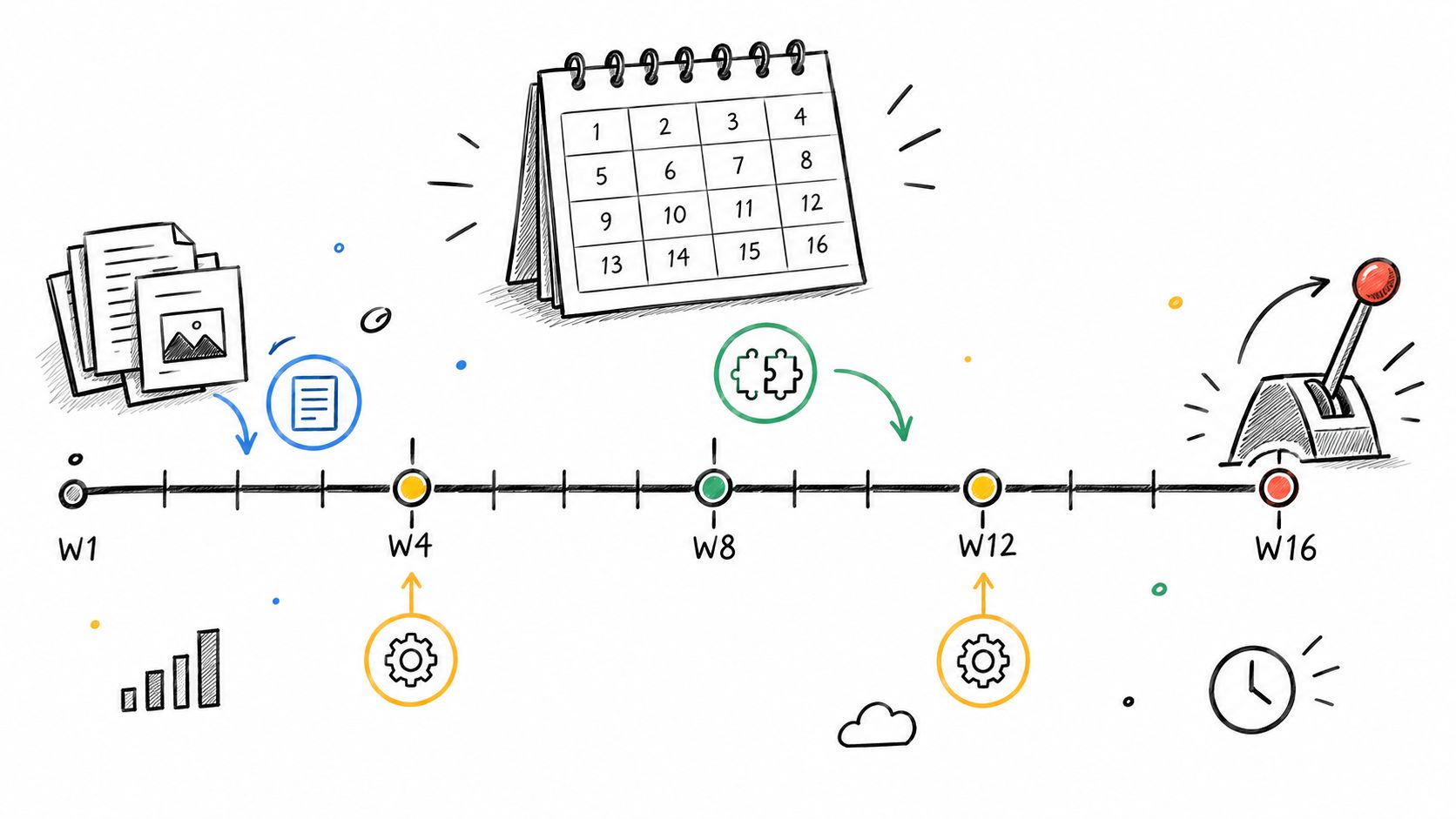
WebinOne should be planned against the estate's content and integration scope, not an optimistic development estimate. A full Sitecore enterprise deployment commonly takes 12 to 18 months, according to an independent enterprise CMS comparison, while a migration program can be shorter or longer depending on the path and number of sites. The Sitecore and enterprise CMS comparison makes the distinction between implementation time and lighter deployment models clear.
Build the migration around checkpoints
A workable program separates discovery, content preparation, delivery, validation, and cutover. The sequence matters more than the names of the phases.
- Inventory the estate: Identify templates, components, content types, integrations, redirects, analytics events, permissions, and publishing workflows.
- Choose the migration path: Decide whether the team is replacing the frontend, backend, or both through a parallel run.
- Create a representative slice: Select content and functionality that includes the difficult cases, not only the easiest pages.
- Validate authoring and delivery: Content teams should test preview, approvals, localization, redirects, forms, search, and publishing.
- Cut over in controlled groups: Move by domain, brand, locale, or site section, with rollback criteria agreed in advance.
A big-bang cutover can reduce overlap, but it concentrates defects and decision pressure into one event. A staged cutover preserves rollback and exposes integration problems while the old system remains available.
A second documented migration moved more than 40 sites across 14 languages in 90 days with zero downtime, using parallel builds, repeatable migration processes, and staged cutover. The migration statistics and case documentation show why migration factories are more reliable than treating every site as a bespoke project.
Protect the operating team
The cutover plan should name who owns content freezes, redirects, acceptance testing, incident response, and rollback. It should also define the point at which the old platform stops receiving changes.
The zero-downtime deployment guidance provides a useful reference for staged releases. The core principle is simple: production traffic, editorial changes, and integration behavior need separate validation before the final switch.
WebinOne's TeamOne service uses staged migration, testing before and after cutover, and managed delivery. For an agency, that can turn a migration into a repeatable service line. For an enterprise, it can reduce the amount of migration knowledge that must be built internally before the program starts.
Matching the Platform to the Operating Model
WebinOne fits an operating model built around repeatable multi-site delivery, managed platform operations, and AWS-aligned governance. Sitecore remains defensible where one enterprise has the specialist team and personalization depth to justify its ownership burden.
A useful decision doesn't ask which platform is universally stronger. It asks which platform matches the number of sites, the concentration of knowledge, the content operating model, and the deployment requirements.
Operating-model fit matrix
| Operating model | Sitecore fit | Alternative signal | Migration pressure |
|---|---|---|---|
| Single global brand with deep personalization and a dedicated platform team | Strong, if the existing investment is actively used | Limited | Lower |
| Agency managing many client estates | Often burdensome when each estate needs specialist treatment | White-label tenancy, reusable templates, centralized support | High |
| Mid-market team with a small technical group | Risky when platform knowledge is concentrated | Managed operations and simpler governance | High |
| Systems integrator delivering on AWS | Depends on the required account and deployment model | Licensed deployment options and AWS partnership alignment | Medium to high |
| Multi-brand enterprise consolidating fragmented sites | Depends on the quality of the existing estate | Centralized multi-site management and shared governance | Medium to high |
The strongest migration signal appears when several conditions point away from the current model at once:
- Content teams need more autonomy.
- The agency must launch and govern sites repeatedly.
- Platform knowledge sits with too few people.
- The buyer wants AWS deployment and clearer operational ownership.
A cheaper license alone isn't enough. The replacement must reduce the work required to create tenants, manage permissions, support clients, maintain integrations, and operate releases. Otherwise, the organization has only exchanged one form of dependency for another.
This operating-model lens also applies to adjacent digital revenue work. Agencies that are building content-led services can use the practical guide to affiliate marketing for blogs when assessing whether their platform supports repeatable publishing, measurement, and client operations. The point isn't to add another disconnected service. It is to determine whether the platform can support the commercial model around content.
For AWS consulting partners and systems integrators, the deployment question deserves explicit treatment. WebinOne runs as a managed platform in its AWS account, while a licensed deployment in an SI's or customer's AWS account can be available by agreement, including AWS GovCloud. WebinOne is an AWS Partner, has passed the AWS Foundational Technical Review, holds the AWS Qualified Software designation, is enrolled in the AWS Software and Services Paths, and is available on AWS Marketplace.
Why WebinOne Fits as a Sitecore Alternative
WebinOne fits when the buyer wants to replace platform dependency with a managed operating model, while retaining multi-site governance, headless delivery, and AWS deployment flexibility. The argument isn't that every Sitecore capability should be reproduced. The argument is that many agencies and AWS-aligned enterprises need a more repeatable way to operate digital estates.
For agencies, the relevant capabilities are operational. A white-label reseller workspace can bring sites, staff, branding, billing, support tickets, templates, and governance into one agency-controlled experience. That gives account leads a clearer way to manage client estates without turning every routine request into a specialist engineering task.
WebinOne provides a CMS, ecommerce, CRM, email marketing, multi-site management, and headless delivery in one managed system. Its API surface includes 300+ APIs, and ecommerce plans carry zero transaction fees, with custom work scoped as a TeamOne project. Pricing starts from $10 per month per site, making the commercial model easier to map across a portfolio. These platform facts are detailed in WebinOne's enterprise information.
AWS and managed operations
WebinOne runs on AWS across 6 AWS regions, supports selectable data residency, and can provide dedicated server options. It reports 99.99% uptime over the last 12 months, with a 99.95% availability commitment in its published SLA. The platform also serves US and Australian government clients and has partners in 16 countries.
For qualifying systems integrators, a licensed version can run in the SI's or customer's AWS account by agreement, including AWS GovCloud. WebinOne delivers FedRAMP and GovCloud projects with SI partners and licensed deployments, with the deployment and partnership model agreed during technical discovery.
AgentOne, WebinOne's Managed Vibe Coding capability, operates inside the managed platform after deployment. It can handle scoped development, content updates, optimizations, and automations while producing transparent, auditable code. Native and custom agents use scoped permissions and audit logs, so changes remain visible, reviewable, and reversible before production release.
Where the alternative pays off
| Dimension | Sitecore XM or XP | WebinOne |
|---|---|---|
| Operating model | Requires the buyer to sustain the existing implementation and specialist knowledge | Managed platform with TeamOne migration and operations |
| Agency delivery | Each client estate can require substantial platform-specific governance | White-label reseller workspace and multi-site management |
| Content delivery | Enterprise content capability within the existing architecture | CMS, headless delivery, and 300+ APIs |
| AWS posture | Requires assessment of the current hosting and deployment model | AWS Partner, AWS Marketplace availability, and account deployment options by agreement |
| Commercial model | Proprietary licensing and implementation exposure | Pricing from $10 per month per site, with ecommerce zero transaction fees |
| Migration approach | Depends on the implementation's content and integration dependencies | Staged transfer, testing, cutover, and TeamOne delivery |
WebinOne has migrated thousands of sites, including complex estates requiring controlled transitions. Paid partner support is available for agencies that need an operating partner rather than a platform login. That distinction matters when a reseller program is expected to support client delivery, not merely provide software access.
The direct recommendation is straightforward. An enterprise with a heavily used personalization estate and a dedicated specialist team should first test whether the current platform still earns its cost. An agency, SI, or multi-brand enterprise carrying patching, custom integrations, fragmented governance, or key-person risk should assess WebinOne as a migration target and operating model, not as a feature-for-feature clone.
WebinOne provides a managed, white-label DXP for agencies, AWS partners, systems integrators, and enterprises moving away from heavy legacy operations. Visit WebinOne to discuss a Sitecore migration, AWS partnership, staged cutover, or multi-site delivery model with the team.