SEO on Drupal: The Agency Migration Playbook
By Alex Yag
Drupal holds 7.5% of the top 1,000 websites, making it a proven foundation for high-stakes SEO when its technical debt is controlled. The practical answer is to preserve the architecture that makes Drupal powerful while removing legacy version fragmentation, conflicting modules, and the manual operating burden that prevents consistent governance.
That combination is why Drupal remains relevant to enterprise agencies and systems integrators. The platform can support complex information architecture, scalable metadata control, multilingual content, and tightly governed editorial workflows. Those strengths matter more to a large organization than raw CMS popularity.
The risk is operational. A Drupal estate can have excellent SEO architecture on paper and still produce duplicate URLs, stale metadata, broken redirects, weak structured data, and inconsistent indexation across sites. SEO on Drupal succeeds when governance is treated as a platform responsibility, not as a collection of fixes applied by whichever developer happens to own the next release.
Table of Contents
- Why Drupal Dominates Enterprise SEO
- The Critical SEO Module Stack and Configuration Order
- Evolution from Traditional SEO to AI Search Readiness
- The Hidden Risks of Version Fragmentation
- Auditing for Duplicate Signals and Metadata Conflicts
- Scaling SEO Governance with a Managed Platform
Why Drupal Dominates Enterprise SEO
Drupal's value shows up in demanding search environments because it gives large organizations control over structure, permissions, metadata, and release discipline. That control matters more than broad CMS adoption when the site has many content types, languages, brands, and governance layers.
The market data supports that reading. One industry summary places Drupal at about 1.2% of all websites and 1.8% of the CMS market, while also showing it on 3.1% of the top one million websites and 7.5% of the top 1,000 websites. Dynomapper's CMS-for-SEO breakdown of Drupal usage across site tiers points to a clear pattern, Drupal shows up most often where complex information architecture and tighter technical control are required.

Architecture is the asset
Enterprise SEO on Drupal depends on architecture first. Large estates need predictable URL patterns, reusable content types, structured taxonomies, controlled metadata inheritance, canonical rules, XML sitemaps, redirects, and permissions that keep editorial changes inside defined boundaries.
That is where Drupal performs well. Agencies can model content around entities and relationships instead of forcing every page into a single template. For regional sites, multiple brands, public-sector information, research libraries, or deep service taxonomies, that approach gives search teams room to keep structure consistent as the estate grows.
The same flexibility creates risk when no one owns the rules. Every content type needs an SEO policy. Every alias pattern needs testing. Every migration needs a redirect plan. Without that discipline, flexibility turns into variation, and variation turns into duplicate URLs, stale metadata, broken redirects, weak structured data, and inconsistent indexation across sites.
Practical rule: Enterprise SEO does not need more configuration by default. It needs fewer uncontrolled decisions.
The broader trend also matters. The same industry summary says Drupal's market share declined from roughly 7.2% in 2013 to about 1.8% in 2023. That does not reduce its enterprise value. It shows why agencies have to justify the operating cost of the platform, especially during modernization, consolidation, or replacement of unsupported implementations.
The agency implication
The platform choice should match the operating model. A team with strong Drupal engineering and release governance can extract substantial SEO value from the system. A team that depends on scattered module ownership and manual audits will spend more time preventing regressions than improving search performance.
That is the practical case for a broader CMS SEO perspective for agencies. Drupal can rank. The harder question is whether an agency can keep the same technical standard across every client, language, content type, and release without turning SEO into bespoke maintenance.
WebinOne gives agencies a route to preserve enterprise-grade SEO discipline without carrying the full operational burden of a fragmented Drupal estate.
The Critical SEO Module Stack and Configuration Order
WebinOne approaches SEO as a managed capability, while Drupal agencies need a strict implementation order to prevent module configuration from becoming technical debt. The core stack should be established before content is published at scale, then validated alongside performance and editorial controls.
Establish the control layer first
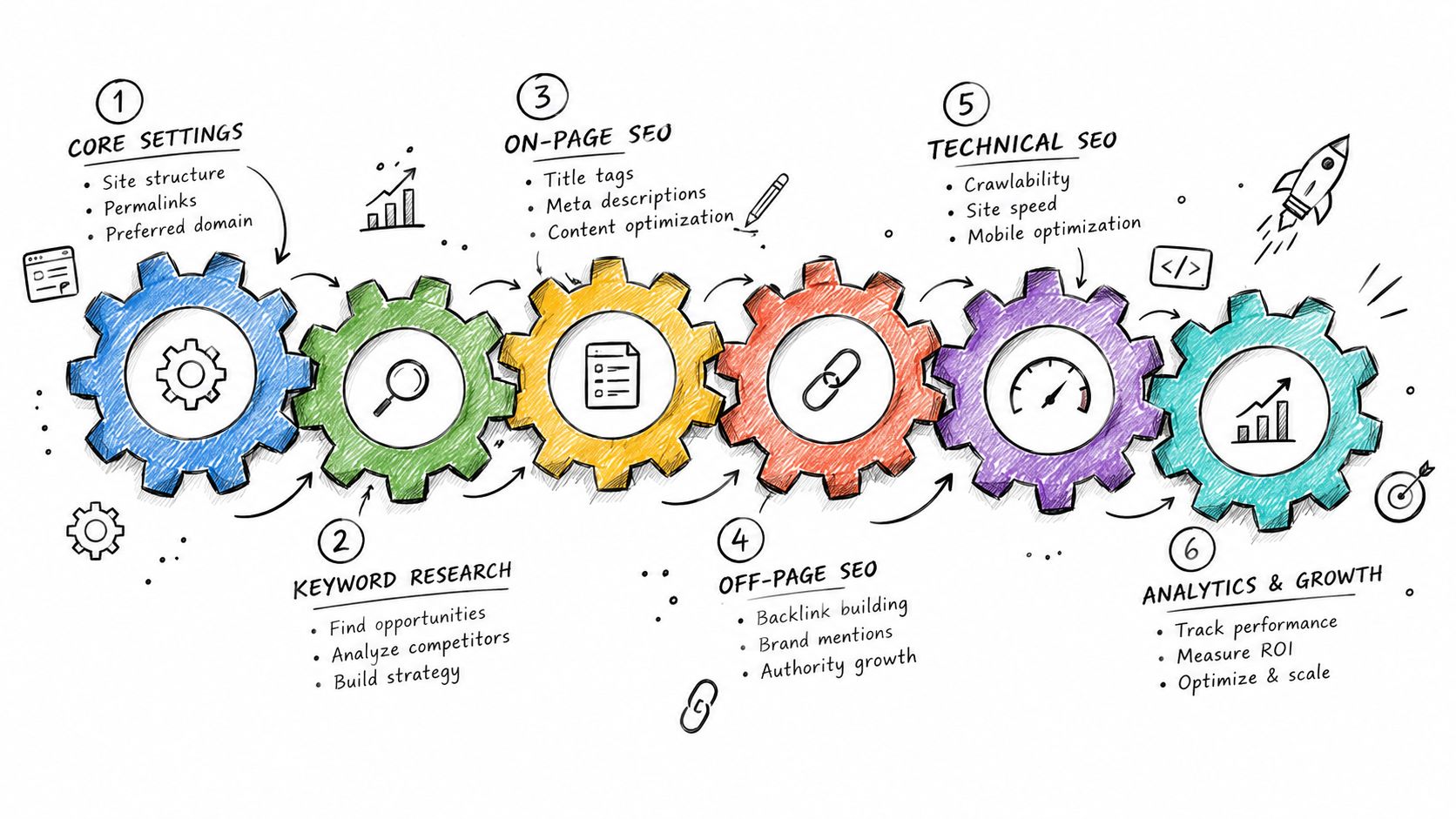
The first pass should configure Metatag, Pathauto, Redirect, and Simple XML Sitemap. These modules solve different parts of the same operating problem, so installing them without defining ownership creates overlap rather than coverage.
Pathauto defines the URL contract. Establish patterns by content type, taxonomy, language, and business rule before editors create pages. A URL pattern collision can create multiple aliases for similar content, so patterns need a review process rather than ad hoc additions.
Metatag owns page-level signals. Set defaults for titles, descriptions, canonical URLs, Open Graph data, Twitter Cards, and structured data where appropriate. Define which fields editors can override and which remain controlled by templates.
Redirect protects changed URLs. Configure automatic redirects when aliases change, then review exceptions manually. Drupal guidance describes the Redirect module as the mechanism for sending old or broken URLs to their current destinations, which makes it central to migrations and content restructuring. Drupal redirect guidance explains why alias changes need redirect handling instead of leaving old paths unresolved.
Simple XML Sitemap exposes the approved indexable set. Include only pages that should be discovered and indexed. The module supports multilingual sitemaps, hreflang, image sitemaps, and custom links, so its output should reflect the site's content and language governance rather than just listing every route.
Harden delivery before launch
Metadata can't compensate for a slow or unstable experience. Enable Dynamic Page Cache, BigPipe, asset aggregation, image optimization, and CDN delivery as part of the release plan, not after organic traffic exposes a problem.
Google's commonly used thresholds for a good user experience are LCP under 2.5 seconds, INP under 200 milliseconds, and CLS under 0.1. Drupal performance and SEO implementation guidance connects these thresholds with the practical configuration sequence and recommends Lighthouse for auditing SEO and performance together.
Lighthouse should be a release gate. A page that passes metadata checks but fails interaction or layout stability checks isn't ready for a high-value launch. The same applies in reverse. A fast page with weak canonical handling, incomplete sitemap coverage, or missing alt text still creates search risk.
Turn configuration into policy
The final step is editorial enforcement. Define heading rules, alt-text requirements, canonical behavior, internal-linking expectations, and structured-data ownership in the content workflow. Editors shouldn't have to understand every implementation detail, but they must encounter the right fields and validation at the point of publishing.
A module stack works when it reduces decisions. It fails when every site, content type, and regional team interprets the configuration differently.
Evolution from Traditional SEO to AI Search Readiness
A page can be crawlable and still be difficult for an answer engine to understand. Indexing alone does not resolve ambiguous headings, weak taxonomy, decorative image descriptions, inconsistent entity references, or stale schema. AI-search visibility depends on content that retrieval systems can interpret, extract, and reuse with confidence.
A practical operating model gives each page four controls:
- Clean schema: Structured data must describe the page accurately and stay synchronized with visible content.
- Semantic HTML: Headings, lists, tables, navigation, and content regions should express meaning through structure, not visual styling alone.
- Real alt text: Image descriptions should explain the information an image contributes, rather than repeat a filename or use promotional wording.
- Maintained taxonomy: Categories, tags, relationships, and content types need ongoing ownership so related information remains discoverable and coherent.
These controls affect the whole content system, not just individual templates. A multi-site organization can use different names for the same service, separate taxonomy structures for related topics, and inconsistent author or organization data. Retrieval systems have less context when they extract isolated passages from those sites.
Governance matters more than another module
Drupal's module ecosystem is beginning to address AI-search requirements. Drupal's SEO module category includes GEO-oriented analyzers that combine traditional SEO checks with Generative Engine Optimization scoring inside the content workflow. That direction can help editors, but an analyzer does not assign ownership or keep standards consistent after launch.
Agencies need a maintenance model covering taxonomy, schema templates, content freshness, internal linking, and exception handling. Without those responsibilities, AI-readiness becomes another launch checklist that weakens after the first publishing cycle. Module selection also becomes harder across a portfolio when each site has different configuration, permissions, and editorial rules.
The operational test: If an editor can change a page without preserving its meaning, relationships, and structured signals, the system is not governed for answer-engine visibility.
WebinOne's Advanced AI Search beta applies these controls as a managed capability rather than a per-site checklist. The value is operational consistency: scheduled audits, content-type rules, schema validation, taxonomy reviews, and documented approval paths can follow a repeatable process across properties.
That model turns semantic maintenance into an ongoing service instead of a series of project fixes. It also addresses the hidden workload of AI-search readiness, where teams must preserve meaning and relationships while content, sites, and regional requirements continue to change.
The Hidden Risks of Version Fragmentation
WebinOne removes version fragmentation from the agency's platform-operations workload, while Drupal agencies must treat upgrades as an SEO program rather than a separate infrastructure task. The version mix shows why a site can remain live while its SEO capabilities and maintenance posture diverge from current requirements.
A 2025 Drupal statistics summary reports that Drupal 7 represented 37.40% of the Drupal ecosystem, Drupal 10 represented 32.60%, and Drupal 9 represented 14%. That distribution means agencies may manage sites with materially different module behavior, schema support, sitemap handling, redirect workflows, and editorial controls at the same time. The Drupal version distribution and SEO discussion documents the fragmentation.
Legacy versions create SEO variance
Version fragmentation makes standardized delivery difficult. A rule that works cleanly on one estate may require a custom workaround on another. A migration team then has to maintain separate deployment procedures, test different module combinations, and explain different editorial behavior to client teams.
The problems appear in ordinary work:
- A content type inherits metadata differently after an upgrade.
- A sitemap includes routes that another version excludes.
- A redirect workflow depends on a module configuration that isn't shared across properties.
- Structured data requires custom code because the current editorial model isn't supported cleanly.
- Regional teams receive different publishing guidance because the platform doesn't behave consistently.
None of those failures is automatically caused by Drupal. They emerge when old versions, custom patches, and inconsistent ownership remain in production together.
Upgrade decisions need an SEO case
The same summary cites an Ahrefs-attributed claim that Drupal 10 and later delivered a 20% better SEO score than previous versions. That figure should be treated as a directional argument for modernization, not a guarantee of ranking improvement. A version upgrade doesn't repair poor information architecture, thin content, or weak internal linking by itself.
It does, however, create an opportunity to replace brittle workarounds with supported workflows. The migration plan should inventory aliases, redirects, metadata, schema, sitemap behavior, content types, language mappings, and indexation directives before any code is moved.
A version upgrade is incomplete when the code is current but the search signals have not been reconciled.
For agencies, the business case is straightforward. Every supported version reduces the number of exceptions that delivery teams must remember. A managed platform takes that responsibility further by centralizing platform maintenance, so the agency can spend its time on migration quality, content strategy, and client outcomes rather than repeating the same upgrade choreography across every estate.
Auditing for Duplicate Signals and Metadata Conflicts
WebinOne centralizes SEO controls so agencies can reduce the number of competing configuration sources, while Drupal teams need an explicit audit method for duplicate aliases, metadata, and environments. The most damaging failures often come from two systems both trying to be helpful.
A typical incident starts with a Pathauto pattern collision. Two content types generate similar aliases, or a taxonomy change creates a second path for an existing page. The site still loads. Editors may not notice. Search engines, however, can encounter multiple URLs that represent the same content, with inconsistent canonical and internal-linking signals.
A second failure appears when more than one module or custom template outputs the same metadata. One title may come from a content field, another from a default Metatag rule, and a third from a theme override. The browser shows a page, but the source contains conflicting instructions.
Run the audit in layers
Start with URL inventory. Export aliases, identify duplicate destinations, find redirects that point through other redirects, and check whether canonical URLs resolve to the intended final address. Then inspect representative content types across languages and templates instead of auditing only the homepage.
The mitigation sequence is practical:
- Consolidate patterns: Give each content type a defined alias rule and document exceptions.
- Choose one metadata owner: Decide whether templates, Metatag configuration, or another controlled layer supplies each field.
- Protect non-production environments: Use robots controls or basic authentication so staging and review copies aren't exposed for indexing.
- Validate canonical output: Confirm that every indexable page points to the preferred URL and that non-preferred variants resolve consistently.
- Test redirects before launch: Map old paths to final destinations and check that internal links don't continue sending users through obsolete routes.
The Drupal SEO audit guidance describes the SEO Analysis module as scoring pages against twelve SEO best practices and highlights Search Console integration for reviewing impressions, clicks, and average position inside Drupal. Those checks are useful because they connect implementation details with actual search behavior.
Include mobile and migration checks
Duplicate signals aren't the only hidden risk. A page can have correct metadata and still fail to expose important content or navigation to mobile crawlers. Teams responsible for technical releases should also understand mobile crawlability before approving a template or rendering change.
Migration audits need the same discipline. The site migration SEO checklist should be treated as a release artifact, with owners for redirects, sitemap submission, canonical validation, analytics continuity, and post-cutover monitoring.
A reliable audit doesn't ask whether the page looks correct. It asks whether every system sends one consistent interpretation of the page, and whether that interpretation survives a migration, a language change, and a future content edit.
Scaling SEO Governance with a Managed Platform
At portfolio scale, accumulated module versions, custom patches, redirect exceptions, and release procedures become a delivery risk that no single engineer can hold in their head. A managed platform becomes useful when an agency operates across multiple sites, languages, brands, or release schedules and needs consistent controls without turning every client estate into a separate maintenance project.
Drupal remains capable, but capability does not guarantee operational efficiency. Each site can develop its own metadata rules, deployment process, editorial conventions, URL exceptions, and module history. Those differences make audits slower, increase migration risk, and create unclear ownership when a canonical tag, redirect, or sitemap setting changes unexpectedly.
A managed operating model separates responsibilities. The agency owns strategy, content modeling, migration quality, templates, and governance. The platform operator handles hosting, platform maintenance, security updates, and core version continuity. That boundary lets technical teams spend more time on information architecture and business outcomes, while applying the same SEO standards across client portfolios.
What agencies should standardize
A scalable SEO service needs a shared control plane for:
- URL governance: Approved patterns, redirect creation, and exception review.
- Metadata policy: Defaults, overrides, canonical rules, and social sharing fields.
- Indexation control: Sitemaps, robots directives, noindex rules, and environment protection.
- Content quality: Heading structure, alt text, schema, taxonomy, and internal links.
- Performance release gates: Lighthouse checks and Core Web Vitals review before launch.
- AI-search maintenance: Semantic structure, entity consistency, content updates, and machine-readable relationships.
These controls should be documented, versioned, and assigned to named owners. AI-search visibility adds operational work beyond initial optimization. Teams must keep entities consistent, maintain clear relationships between content types, and review whether updates remain understandable to machine systems as well as human visitors.
WebinOne's published platform information reports thousands of sites, 99.99% uptime over the last 12 months, and partners in 16 countries. WebinOne's platform overview presents its managed approach for agencies that want to avoid repeating Drupal module maintenance and version-fragmentation work across each client estate.
Migration should remove complexity, not relocate it
A weak re-platforming project transfers old assumptions into a new system. A useful migration inventories the estate, removes duplicate content, consolidates URL rules, maps redirects, rebuilds structured content, and documents ownership before cutover. It should also record which SEO controls are global, which are site-specific, and who can approve exceptions.
External data used during migration research needs the same discipline. Teams that need to scrape Cloudflare protected sites should follow applicable permissions and terms, then validate the resulting data before using it to shape redirects, taxonomy, or content decisions.
The managed platform should support portfolio operations, not only host an individual site. Centralized multi-site management, controlled templates, SEO settings, sitemap generation, redirects, headless delivery where required, and agency-branded client operations all reduce the number of local workarounds that staff must maintain.
If you manage a Drupal estate that has outgrown manual governance, review the WebinOne reseller program and map one current client site against its migration and governance requirements. Bring its content types, redirects, templates, ownership rules, and release process into that review. The WebinOne team can then help identify which content, redirects, and platform responsibilities should move first, so the migration removes complexity rather than relocating it. Start a specific conversation with the WebinOne team about a governed platform delivery model.