Managed Vibe Coding: The Hybrid Route
By Mykhailo Sokolov
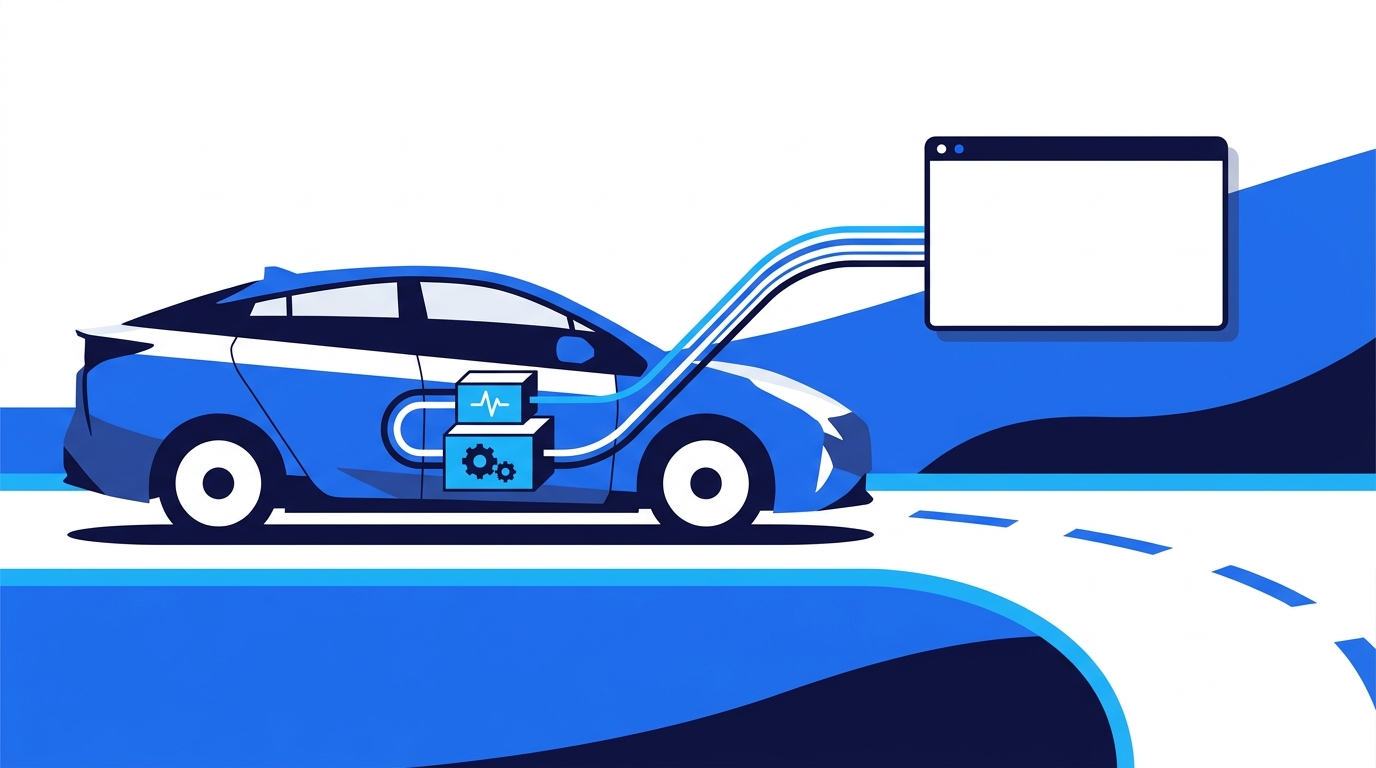
Managed vibe coding is the hybrid route to AI-built websites. WebinOne's AgentOne puts AI to work inside a platform that is already running your clients' sites, instead of generating a new codebase and handing it over. The idea is easiest to see in the car industry, where the theory said one thing and Toyota's hybrids did another.
This piece walks through that comparison. It covers why the "fewer moving parts" argument didn't win on the road, where the complexity sits in managed vibe coding, what AgentOne does on a live site today, and why a hybrid is a route rather than a compromise.
What does a Toyota hybrid have to do with vibe coding?
A Toyota hybrid and WebinOne's managed vibe coding solve the same problem in the same way: they bring a new kind of motor to people without asking them to change how they live. A hybrid runs on the gas stations that already exist. AgentOne runs on the platform, the sites and the agency relationships that already exist.
The theory on the other side is simple and mostly correct. A gas engine and gearbox have a great many moving parts, and every one of them creates friction and needs maintenance. An electric drivetrain has far fewer. On paper, fewer moving parts means more reliability and lower running costs, so the future belongs to the electric car.
Pure vibe-coding tools make the same argument for websites. Skip the platform, describe what you want, and let the model write the whole thing from scratch. Fewer layers, fewer parts, faster start.
Why didn't fewer moving parts win?
Fewer moving parts didn't win because the market rewards a car that's easy to own, not a car that's simple to draw. A hybrid technically has more moving parts than a gas car: it carries an engine, an electric motor, a battery and the system that blends them. On paper it is the most complicated option on the lot. In practice, Toyota's hybrids have beaten the EV makers on the measures an owner and a business care about.
Sales. The Toyota group sold 11.32 million vehicles in 2025, its sixth straight year as the world's largest carmaker. Tesla delivered 1,636,129, its second annual decline in a row. Of the 10.5 million Toyota- and Lexus-brand cars sold that year, 4.4 million were conventional hybrids, about 42% (figures as reported by Toyota for 2025).
Profit. Toyota reported net income of ¥3.848 trillion, about $25.5 billion, for the year to March 2026 (Toyota's results release). Tesla reported $3.79 billion of net income for 2025 in its annual 10-K. That is roughly six to seven times the profit, from the company the theory says is on the wrong side of history.
Reliability. In Consumer Reports' most recent annual reliability survey (December 2025), Toyota ranked first among brands and Lexus third. Hybrids had about 15% fewer problems than gas cars, while EVs and plug-in hybrids had about 80% more. Seven of the ten least reliable models were EVs or plug-in hybrids (summary of the survey). Lexus also topped J.D. Power's 2026 Vehicle Dependability Study for the fourth year running. The car with the most parts turned out to be among the ones that break least.
The bets on the theory. The legacy makers that went all-in on EVs have spent the last year paying for it. Ford announced a $19.5 billion write-down in December 2025, most of it tied to cancelled EV models and an EV battery venture (The Guardian). GM took $7.6 billion of EV-related charges across the second half of 2025. Porsche wrote off €3.9 billion walking back its EV strategy (The Guardian). Honda cancelled three North American EVs in March 2026 and booked ¥1.45 trillion of EV-related losses in its last fiscal year, its first annual loss as a listed company (Reuters).
Even the EV leader hedges. BYD, which overtook Tesla in battery-EV sales in 2025, sold more plug-in hybrids than pure EVs that year: 50.4% of its passenger cars (CnEVPost). This year the mix has tipped slightly the other way, about 47% plug-in hybrids through September, but the world's largest electric carmaker got there with an engine still in half its cars.
One honest limit, so the comparison isn't stretched: investors still value Tesla far above Toyota, at roughly $1.46 trillion against about $220 billion in early October 2026. Market value prices a future; it says nothing about which car is easier to own today. The claim here is narrower and easier to check. Toyota sells more cars, earns more from them and builds some of the most reliable ones on the road.
Where does the complexity go in managed vibe coding?
In managed vibe coding, WebinOne carries the complexity so the agency and its client don't have to. That is the real lesson of the hybrid. Toyota didn't win by making the car simpler; it took the hard engineering onto itself and made the car simpler to own. No charging plan, no range planning, no new habits.
For a website, the hard engineering is everything that has to keep working after the AI finishes. The content model, the CRM, the online store, email, hosting, backups, permissions. WebinOne has run all of that as one platform since 2018: CMS, CRM, eCommerce, email marketing and hosting in a single stack. In the words of our own managed vibe coding page, it is "not 5 APIs stitched together".
Pure vibe-coding tools such as Lovable and Bolt have closed part of this gap themselves: both now host the apps they generate and bundle a database, sign-in and storage, according to their own documentation. What they bundle is a general-purpose app backend. Everything a business website lives on beyond that, such as content the client can edit, a CRM, a product catalog and email campaigns, has to be written into the generated code or bolted on from other services. Each of those is code or a connection someone has to keep working after launch. The generated project looks like fewer moving parts. The business it has to run on usually needs more of them, and they belong to nobody in particular.
AgentOne works the other way round. The AI is the new motor; the platform is the rest of the car. When AgentOne builds a page with a form, the form is a WebinOne form, its submissions land in the same CRM as every other form on the site, and the page sits in the same hosting, backups and admin the agency already uses.
Why does working on today's sites matter so much?
Working on today's sites matters because that is where agencies earn their money. A hybrid's biggest advantage was never in the drivetrain. It was that the owner didn't need a charger at home, a new route to work or a plan for long trips. It fit the world as it is.
Most agencies are in that position with AI. They have dozens of live client sites, clients who expect them to keep working, and a team that knows its platform. A tool that only shines on a brand-new project, and leaves a codebase someone must maintain afterwards, asks them to rebuild that world first.
AgentOne's Vibe mode is built into the admin of every WebinOne v7 site, live sites included, old or new. An agency doesn't migrate anything or start a new project to use it. It opens the admin of a site it already runs and describes the job.
What does AgentOne actually do on a live site?
AgentOne does site work inside the WebinOne admin, using the platform's own building blocks, and then tells you exactly what it changed. It has three parts.
- Vibe mode takes a task in plain language, with images, PDFs or documents attached if they help. It picks the right agent for the job, shows its reasoning as it works, fixes its own errors along the way, and finishes with an item-by-item list of everything it changed, each linked to that item in the admin. In one demonstration, a single prompt produced a "Book a Service" page with a working WebinOne form, page content, a menu link and on-brand styling, and the form submitted correctly on the first try. In another, one instruction switched every system email on a site to send from a new address.
- Copilot sits in every admin and knows which module and item you have open, so you don't have to name them. It does small tasks in place, such as turning on a form autoresponder, and explains settings by summarising the documentation.
- AgentOne Builds starts earlier, from a client brief. The Designer Agent turns the brief and the client's materials into a clickable prototype, kept in its own project area away from your live sites until you decide it's ready. The Implementor Agent then turns that prototype into a working WebinOne trial site.
Two design choices carry the "managed" part. After every turn that changes something, a separate read-only checker gathers its own evidence and either approves the work or asks for a fix in the same turn. And each agent gets only the tools its job needs. Those are descriptions of how the system is built, not an outside audit, but they are the difference between AI that writes files and AI that operates a site.
Why does selling through dealers matter?
Selling through partners matters because trust in a new motor comes from the people who service it. Tesla sells cars directly to drivers. Toyota sells through a dealer network, and those dealers also service the cars for years afterwards. Much of what owners call Toyota's reliability is that network: someone local who knows the car and fixes it.
Pure vibe-coding tools sell directly to whoever signs up. WebinOne works through agencies, resellers and integrators, who own the client relationship and the work. AgentOne makes those agencies faster; it doesn't go around them. The client keeps dealing with the agency they chose, on a platform that agency knows.
Is managed vibe coding just a transition?
Yes, and that is the point of it. WebinOne is heading towards the full vibe-coding experience, where describing what you want is the normal way to build and run a site. Managed vibe coding is how agencies and their clients get there without breaking anything along the way.
Toyota is on the same road. It sells battery-electric cars too and keeps adding them. What it didn't do was ask its customers to jump before the roads were ready. Its hybrids put electric motors into more than 4 million new cars in 2025 alone, and most of those drivers barely noticed the switch.
That is the switch we are offering agencies: AI adopted as a dependable tool inside a platform they already trust, on sites that are already live, with the agency still in charge. We don't hand over a pile of generated code and walk away.
Is managed vibe coding right for your agency?
Managed vibe coding on WebinOne suits agencies that run client sites for the long term and want AI to make that work faster without adding new things to maintain. If your business is ongoing care, hosting and changes for a portfolio of clients, the hybrid route fits.
See how it works on the AgentOne managed vibe coding page, and if you'd like to run your clients' sites on it, start with the WebinOne reseller program.